

Device
Siri AI Developer Preview Opens iOS 27.3 and macOS 27.3 to Third-Party App Intents—With EU and Usage Limits
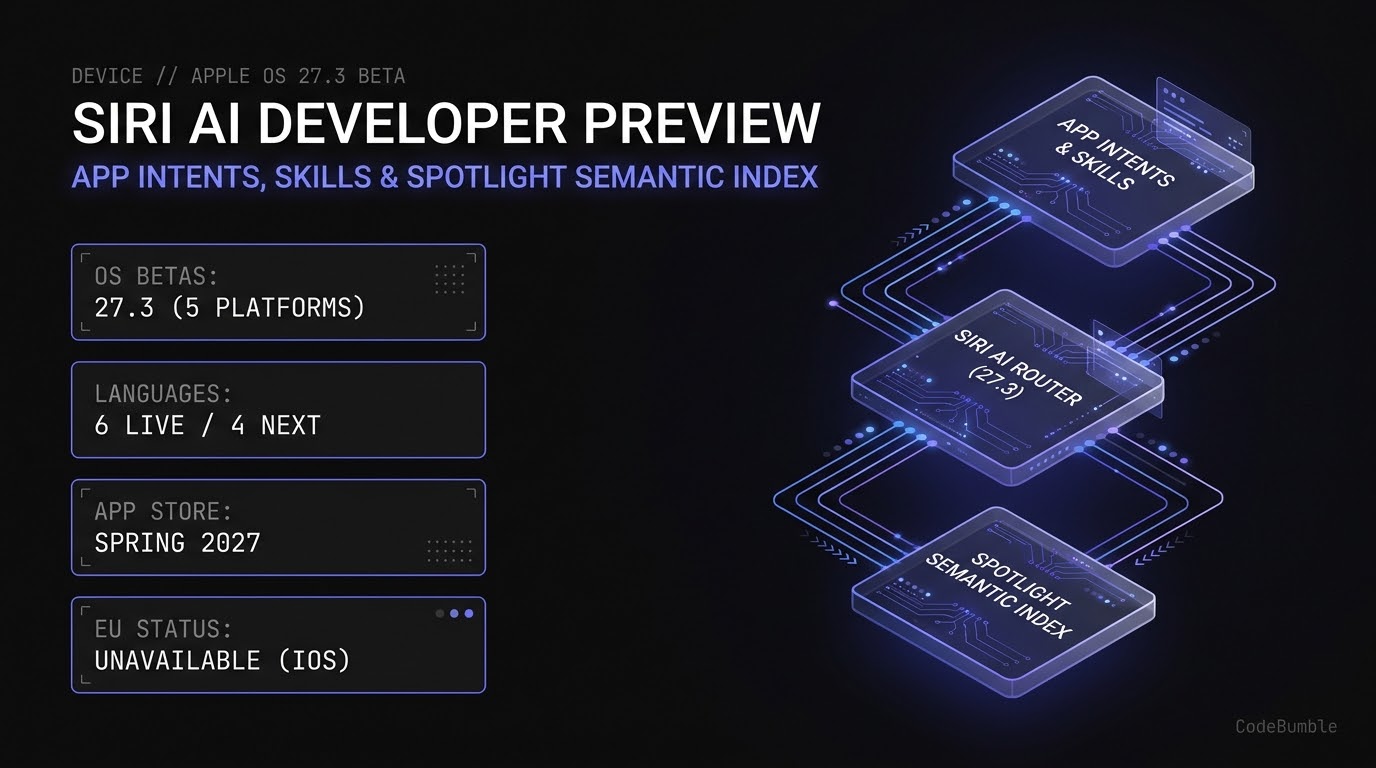
Apple opened the Siri AI Developer Preview across iOS 27.3, iPadOS 27.3, macOS 27.3, watchOS 27.3, and visionOS 27.3, enabling any app to expose custom actions, multi-step Skills, and Spotlight semantic entities to Siri AI via App Intents. Here is how foreground and Live Activity routing works, what Swift code to test now before Spring 2027 App Store submissions, and which EU and enterprise MDM caveats remain.
9 min read
Siri AI Developer Preview Opens iOS 27.3 and macOS 27.3 to Third-Party App Intents—With EU and Usage Limits
Executive Summary
Apple has opened its Siri AI Developer Preview across the 27.3 beta releases of iOS 27.3, iPadOS 27.3, macOS 27.3, watchOS 27.3, and visionOS 27.3 (bundled with Xcode 27.3), allowing third-party developers to integrate custom app actions and content directly with Siri AI (Apple Developer News, November 3, 2026; InfoQ, November 13, 2026). During the preview, third-party Siri AI integrations are restricted to developer builds and internal TestFlight testers, with public App Store submissions scheduled to open in spring 2027 (Apple Developer News; InfoQ).
Rather than introducing a separate agent SDK, Apple built the integration directly on App Intents and the Spotlight semantic index—allowing Siri AI to leverage personal context understanding, onscreen awareness, natural language, and multi-step Skills that combine multiple actions into a single experience (Apple Developer News). Across Apple's own first-party apps (including Calendar, Files, Finder, Mail, Maps, Messages, Notes, Photos, Preview, Reminders, Safari, Shortcuts, and Weather), the system already exposes expanded examples.
Before committing product roadmaps, mobile and enterprise teams must account for three platform boundaries:
- Regional & age exclusions: Siri AI is currently unavailable in the European Union on iOS, iPadOS, and watchOS, and is disabled for users under age 13 (Apple Developer News).
- Server-side daily usage limits: Apple notes that server-side Apple Intelligence features—including Siri AI and AFM 3 Cloud models in Shortcuts—are subject to daily usage limits, with paid expanded access planned for the future (Apple Developer News).
- Enterprise MDM text-exfiltration concerns: Developers on the Apple Developer Forums report that on iOS 27.2, a Siri AI entry can still appear in
WKWebViewandUITextViewselection menus even whenwritingToolsBehavior = .noneis set (Apple Developer Forums).
Technical Mechanics and Architecture
1. App Intents Routing, Live Activities, and Spotlight Semantic Indexing
In OS 27.3, Siri AI acts as an OS-level intent router across foreground context, background state, and indexed entities (InfoQ, November 13, 2026):
+-----------------------------------------------------------------------------+
|                    NATURAL LANGUAGE REQUEST -> SIRI AI (27.3)               |
|  (Personal Context + Onscreen Awareness + Multi-App Action Chaining)        |
+--------------------------------------+--------------------------------------+
                                       |
          +----------------------------+----------------------------+
          | (No App Named in Prompt)                                | (App Named)
          v                                                         v
+--------------------------------------+        +-----------------------------+
| Contextual Target Resolution         |        | Explicit App Invocation     |
| 1. Foreground App                    |        | - Routes to Background App  |
| 2. Active Live Activity App          |        | - Chains Cross-App Intents  |
| 3. Prior App in Conversation         |        | - Executes Multi-Step Skill |
+------------------+-------------------+        +--------------+--------------+
                   |                                           |
                   +---------------------+---------------------+
                                         |
                                         v
+-----------------------------------------------------------------------------+
|                APP INTENTS & SPOTLIGHT SEMANTIC INDEX                       |
|  - @AppEntity (conforms to AppSchema, e.g., .video.contentCreator)          |
|  - Surfaces any Spotlight semantic entity (beyond fixed schemas)            |
|  - Requires Apple Intelligence-enabled device + supported OS language       |
+-----------------------------------------------------------------------------+
Two routing behaviors govern how third-party apps receive requests (InfoQ):
- Implicit routing: If the user does not name an app, Siri AI automatically routes the request to the foreground app, an app with an active Live Activity, or the app referenced earlier in the conversation.
- Background restriction: When an app is running in the background without an active Live Activity, it receives requests only if the user explicitly names the app.
2. Safe Swift Implementation Pattern (AppIntent & AppEntity)
Instead of inventing custom prompt wrappers, developers expose structured Swift types via AppIntents. Using explicit ParameterSummary, @AppEntity schema conformance, and non-destructive read/write separation ensures Siri AI resolves parameters accurately without unintended mutations.
import AppIntents
import Foundation

/// Example AppEntity indexed into Spotlight semantic search for Siri AI discovery.
struct DeliveryPackageEntity: AppEntity, IndexedEntity {
    static var typeDisplayRepresentation: TypeDisplayRepresentation = "Delivery Package"
    static var defaultQuery = DeliveryPackageQuery()

    let id: String

    @Property(title: "Tracking Number")
    var trackingNumber: String

    @Property(title: "Delivery Status")
    var status: String

    var displayRepresentation: DisplayRepresentation {
        DisplayRepresentation(
            title: "\(trackingNumber)",
            subtitle: "\(status)"
        )
    }
}

struct DeliveryPackageQuery: EntityQuery {
    func entities(for identifiers: [String]) async throws -> [DeliveryPackageEntity] {
        // Fetch read-only status records from local cache or authenticated API
        return []
    }

    func suggestedEntities() async throws -> [DeliveryPackageEntity] {
        return []
    }
}

/// Read-only AppIntent safe for Siri AI invocation without destructive side effects.
struct CheckDeliveryStatusIntent: AppIntent {
    static var title: LocalizedStringResource = "Check Delivery Status"
    static var description = IntentDescription(
        "Fetches the latest shipment status for a tracked package without modifying order state."
    )

    @Parameter(title: "Package")
    var package: DeliveryPackageEntity

    static var parameterSummary: some ParameterSummary {
        Summary("Check status for \(\.$package)")
    }

    func perform() async throws -> some IntentResult & ReturnsValue<String> {
        let summary = "Package \(package.trackingNumber) is currently: \(package.status)."
        return .result(value: summary)
    }
}
3. Security & Privacy Hardening in iOS 27.3 (NEURLFilter)
Alongside App Intents, the iOS & iPadOS 27.3 Beta Release Notes enforce stricter static configuration rules for NEURLFilter (Private Information Retrieval URL filtering):
- Static
Info.plistdeclaration:PIRServerURLandPrivacyPassIssuerURLmust now be declared statically inside anNSPIRConfigurationdictionary in the host app'sInfo.plist(not the extension's); runtime-only configuration is deprecated. - Power-of-two shard limit:
NEURLFiltercaps PIR configurations at 65,536 shards and requires the shard count to be a power of two (e.g.,256,512,1024,2048), rejecting non-compliant configurations. - User tier removal:
NEURLFilterno longer calls/token-key-for-user-tokenand instead uses the first valid public key in the Privacy Pass issuer directory.
Evidence: Platform Support, Language Matrix, and Undisclosed Limits
Supported Platforms and Language Rollout
Cross-referencing Apple Developer News (November 3, 2026) and InfoQ (November 13, 2026) establishes the exact availability matrix for the 27.3 Developer Preview:
| Dimension | Confirmed Status in 27.3 Beta | Notes & Caveats |
|---|---|---|
| Operating Systems | iOS 27.3, iPadOS 27.3, macOS 27.3, watchOS 27.3, visionOS 27.3 | Requires an Apple Intelligence-enabled device and Xcode 27.3 SDK. |
| Live Languages (6) | English, French, Japanese, Korean, Portuguese, Spanish | Device must be set to a supported language. |
| Upcoming Languages (4) | Traditional Chinese, Norwegian, Turkish, Vietnamese | Announced as "coming soon"; no exact ship date published. |
| European Union | Unavailable on iOS, iPadOS, and watchOS | Apple states it is working with the EU; no timeline disclosed. |
| Distribution Scope | Developer builds & internal TestFlight only | App Store submissions open in spring 2027. |
Benchmark & Policy Gaps
Confidence & Benchmark Note: Apple has not published quantitative benchmarks for Siri AI intent-resolution latency, parameter-extraction accuracy, or token/request ceilings in the 27.3 Developer Preview. Specifically, Apple's November 3 announcement confirms that server-side Apple Intelligence features are subject to daily usage limits based on request complexity and system demand, but does not disclose exact daily quotas or pricing for future paid tiers (Apple Developer News; Data Studios).
Early Developer Reception vs. Android AppFunctions
Early practitioner feedback highlighted by InfoQ (November 13, 2026) points to Apple's decision to reuse App Intents rather than shipping a brand-new agent SDK as a major ergonomic advantage:
- Intent & parameter clarity: Developers testing iOS 27.3 beta builds noted that supplying clear descriptions on intents and parameters allows Siri AI to resolve user requests reliably without brittle keyword matching.
- Ecosystem contrast: Commenters contrasted Apple's App Intents approach with Google's Android agent skills SDK, noting that teams who already invested in App Intents for Shortcuts and Spotlight can extend existing definitions rather than maintaining a parallel integration layer.
- First-party reference surface: Apple has already shipped updated Siri AI actions across 15 built-in apps—Calendar, Files, Finder, Journal, Mail, Maps, Messages, Music, Notes, Photos, Preview, Reminders, Safari, Shortcuts, and Weather—giving developers concrete patterns to inspect before spring 2027 App Store submissions (Apple Developer News).
Hardening Playbook: Preparing iOS & macOS Apps for Siri AI 27.3
Follow these numbered engineering steps to test Siri AI safely during the TestFlight preview window without introducing data-leakage or routing regressions:
- Gate sensitive enterprise text views on MDM devices: Before rolling out OS 27.x to managed corporate fleets, audit
WKWebViewandUITextViewsurfaces for the reported iOS 27.2 selection-menu Siri AI entry behavior wherewritingToolsBehavior = .nonedid not suppress the menu item (Apple Developer Forums). Test against iOS 27.3 beta builds before approving OS upgrades. - Separate read-only intents from state-mutating actions: Annotate destructive intents (payments, deletions, account transfers) with explicit confirmation prompts in
AppIntentand test multi-step Skills to verify that implicit foreground or Live Activity routing never triggers unintended mutations. - Write concise, unambiguous
IntentDescriptionand parameter labels: Early developer testing highlights that Siri AI parameter resolution depends heavily on clear intent and parameter descriptions (InfoQ). - Migrate
NEURLFilterto staticNSPIRConfiguration: If your security or enterprise app usesNEURLFilter, movePIRServerURLandPrivacyPassIssuerURLinto the app'sInfo.plistand verify your PIR shard count is a power of two<= 65,536(iOS 27.3 Beta Release Notes). - Plan regional feature flags for EU and under-13 accounts: Do not make Siri AI intents the sole entry point for core workflows; EU users on iOS, iPadOS, and watchOS, as well as users under 13 and devices without Apple Intelligence hardware, cannot invoke Siri AI.
- Rollback & TestFlight isolation: Keep all new 27.3 Siri AI
Skillsand@AppEntityschemas behind compile-time SDK checks (#if canImport(AppIntents)) and internal TestFlight tracks until Apple publishes final Siri AI terms, usage policies, and spring 2027 App Store review guidelines.
Frequently Asked Questions (FAQ)
When can developers submit Siri AI-enabled apps to the App Store?
Apple states that the 27.3 Developer Preview is restricted to developer builds and internal TestFlight testing now, with App Store submissions opening in spring 2027 and customer availability beginning in a few months (Apple Developer News; InfoQ).
Do developers need to learn a new SDK to integrate with Siri AI?
No. Siri AI builds on Apple's existing App Intents framework and the Spotlight semantic index, adding multi-step Skills and expanded entity indexing rather than requiring a separate third-party agent SDK (InfoQ).
Which operating systems and devices support the Siri AI Developer Preview?
Siri AI is in beta across iOS 27.3, iPadOS 27.3, macOS 27.3, watchOS 27.3, and visionOS 27.3, and requires an Apple Intelligence-enabled device set to one of the six currently supported languages: English, French, Japanese, Korean, Portuguese, or Spanish (Apple Developer News).
Is Siri AI available in the European Union?
No. Apple confirms that Siri AI is currently unavailable in the EU on iOS, iPadOS, and watchOS, and has not announced a timeline for EU availability (Apple Developer News).
Are there usage limits on Siri AI?
Yes. Apple's November 3, 2026 announcement notes that server-side Apple Intelligence features—including Siri AI—are subject to daily usage limits that vary by request complexity and system demand, with paid expanded access planned for the future (Apple Developer News).
Sources
- Apple Developer News — Siri AI is now open to all developers (Published November 3, 2026)
- Apple Developer Documentation — iOS & iPadOS 27.3 Beta Release Notes (November 2026)
- Apple Developer Documentation & Forums —
contentCreatorAppSchema & Apple Intelligence / App Intents Forums (November 2026) - InfoQ — Siri AI Developer Preview Lets iOS, iPadOS, and macOS Apps Integrate with Siri (Published November 13, 2026)
- 9to5Mac — iOS 27.3: New features, release date, more (Published November 6, 2026)