

SEO
ChatGPT Citation Drops vs Google Core Updates: Diagnosing OAI-SearchBot Logs and AI Retrieval Shifts
ChatGPT citation drops now mimic unannounced Google core updates—cutting major newsroom citations by 50% to 90% even when Google rankings hold flat. Learn how to audit OAI-SearchBot and ChatGPT-User server logs against OpenAI's published IP prefixes, decouple GPTBot in robots.txt, and separate AI selection shifts from Google core updates.
10 min read
ChatGPT Citation Drops vs Google Core Updates: Diagnosing OAI-SearchBot Logs and AI Retrieval Shifts
Executive Summary
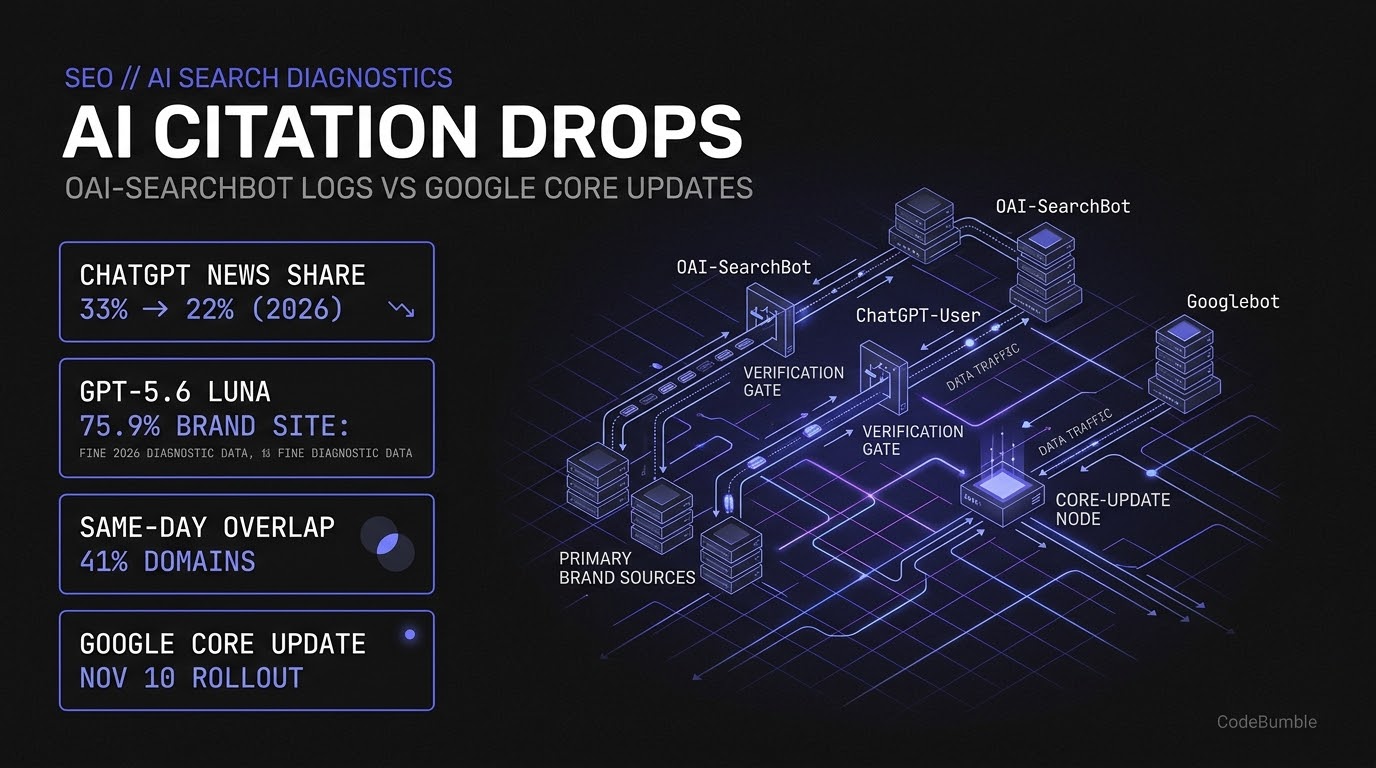
On November 16, 2026, Search Engine Land published an investigation into ChatGPT citation drops that behave like unannounced Google core updates. Drawing on Generative Pulse's October 2026 dataset of more than 40 million AI responses alongside Semrush ranking comparisons, the analysis documents a sharp decoupling between traditional Google Search visibility and AI answer citations. Specifically, when OpenAI rolled out the GPT-5.6 model family on July 9, 2026, ChatGPT citations to major newsrooms—including the Associated Press, TIME, TechCrunch, the Los Angeles Times, and The Atlantic—dropped by 50% to 90% within a week, even though those outlets' top-three Google keyword counts remained flat or positive between June 15 and July 15.
For technical SEO engineers and infrastructure teams, this divergence creates a diagnostic trap—especially during active Google algorithm rollouts such as the Google November 2026 core update, which began on November 10, 2026 and runs up to two weeks. When AI referral traffic or brand citations fall suddenly, teams frequently blame content decay, robots.txt regressions, or Google Search ranking shifts. In reality, OpenAI's crawler architecture (OAI-SearchBot, ChatGPT-User, and GPTBot) separates fetch eligibility from model-side retrieval selection. If server logs confirm OAI-SearchBot and ChatGPT-User are still fetching 200 OK responses from verified OpenAI IP prefixes, the drop reflects an upstream retrieval-fanout change rather than a crawl block.
Confidence level: High for OpenAI crawler mechanics, Google's November 2026 core update schedule, and the November 16 Search Engine Land / Semrush findings. Moderate for the exact internal weighting inside ChatGPT's retrieval pipeline, as OpenAI does not publish changelogs or algorithm notes for search selection updates; Generative Pulse's longitudinal figures also rely on API-level prompting rather than consumer app UI sessions, as noted in the source report.
Technical Mechanics and Architecture
How OpenAI's Crawler Stack Separates Discovery, Training, and Live Fetches
Unlike Google Search—where Googlebot handles primary indexing and Google-Extended acts as a separate Gemini training/grounding control—OpenAI documents distinct user-agent tokens with independent robots.txt controls and published IP prefix lists on its OpenAI Crawlers specification:
OAI-SearchBot: Indexes and surfaces websites in ChatGPT's search features. Sites that opt out viarobots.txtare excluded from ChatGPT search answers (though navigational links may still appear). OpenAI notes thatrobots.txtupdates can take roughly 24 hours to propagate into ChatGPT search systems.GPTBot: Crawls public web content that may be used to train OpenAI's generative AI foundation models. Publishers can allowOAI-SearchBotwhile disallowingGPTBotindependently; if both are allowed, OpenAI may reuse a single crawl for both purposes.ChatGPT-User: Executes user-triggered web fetches when a person asks ChatGPT or a Custom GPT a question or invokes GPT Actions. Because these fetches are initiated by an end user rather than automated web crawling, OpenAI explicitly states thatrobots.txtrules may not apply, andChatGPT-Userdoes not govern ChatGPT Search inclusion.
+-------------------------------------------------------------------------+
|              AI SEARCH VS TRADITIONAL SEARCH DIAGNOSTIC PATH            |
+-------------------------------------------------------------------------+
|                                                                         |
|  [User Prompt in ChatGPT]                                               |
|   |-- Model Fan-Out (e.g., GPT-5.6 Luna: 76% site: queries)             |
|   v                                                                     |
|  [OpenAI Retrieval Layer]                                               |
|   |-- OAI-SearchBot (Index crawl; honors robots.txt in ~24h)            |
|   |-- ChatGPT-User  (Live user-triggered fetch; robots.txt optional)    |
|   v                                                                     |
|  [Origin / Edge WAF & Logs]                                             |
|   |-- Verify IP against openai.com/searchbot.json (39 IPv4 prefixes)    |
|   |-- Verify IP against openai.com/chatgpt-user.json                    |
|   |-- Status 200 OK + flat Google Search Console?                       |
|       --> SELECTION SHIFT (Model / fan-out), NOT crawl/ranking failure  |
|   |-- Status 403 / 429 / Disallow?                                      |
|       --> INFRASTRUCTURE BLOCK (WAF, CDN, or robots.txt regression)     |
|                                                                         |
+-------------------------------------------------------------------------+
Why Model Launches Trigger Citation Cliffs
Evidence from the November 16 Search Engine Land analysis shows that ChatGPT citation cliffs repeatedly cluster around OpenAI model deployments:
- March 5, 2026 (
GPT-5.4 Thinking): By March 9, The Financial Times had vanished from ChatGPT's cited wave. - Week of May 5, 2026 (
GPT-5.5 Instant): Six days before a broad May drop hitting The Verge, Business Insider, The Wall Street Journal, Investopedia, People, Barron's, and Politico. - July 9, 2026 (
GPT-5.6family): Within a week, citations to AP, TIME, TechCrunch, the Los Angeles Times, and The Atlantic fell 50% to 90%.
Two retrieval behaviors observed in GPT-5.6 Luna explain the shift away from secondary newsrooms toward primary sources:
- Aggressive
site:fan-out: Seer Interactive found thatGPT-5.6 Lunaissuedsite:queries in 76% of its fan-out searches and retrieved 43% fewer sources thanGPT-5.5. - Direct brand targeting: Ahrefs observed that 75.9% of
Luna'ssite:queries in logged-out ChatGPT targeted brand websites directly rather than third-party summaries. When ChatGPT cites a press release, it now links to the company's own domain roughly 85% of the time and to a wire service only 14%.
Defensive Log Verification: Catching Impersonators and Silent Blocks
Because OpenAI documents no reverse DNS (rDNS) hostnames for its crawlers, relying solely on the User-Agent string in Nginx or Apache access logs is unreliable. An independent 36-day log audit published on November 12, 2026 by Podrez.pl found that 61 of 914 requests (6.7%) claiming to be OAI-SearchBot originated outside OpenAI's official IP list (openai.com/searchbot.json, which lists 39 IPv4 prefixes—six of which overlap with GPTBot). Fifty-six of those spoofed requests came from Google Cloud IPs.
Below is a safe, read-only Python diagnostic script that cross-references your local Nginx/CDN access logs against OpenAI's official published CIDR prefix JSON files (searchbot.json and chatgpt-user.json) to distinguish verified OpenAI fetches, spoofed bots, and accidental 403/429 blocks:
#!/usr/bin/env python3
"""
Safe, read-only log verifier for OAI-SearchBot and ChatGPT-User.
Checks whether requests claiming OpenAI User-Agents match published CIDR prefixes
and summarizes HTTP status codes to isolate crawl blocks from selection drops.
"""
import ipaddress
import json
import re
from collections import Counter
from pathlib import Path

LOG_PATTERN = re.compile(
    r'^(?P<ip>\S+)\s+\S+\s+\S+\s+\[.*?\]\s+"[^"]*"\s+(?P<status>\d{3})\s+\S+\s+"[^"]*"\s+"(?P<ua>[^"]*)"'
)

def load_prefixes(json_path: str) -> list[ipaddress.IPv4Network | ipaddress.IPv6Network]:
    data = json.loads(Path(json_path).read_text(encoding="utf-8"))
    return [ipaddress.ip_network(entry["ipv4Prefix"]) for entry in data.get("prefixes", []) if "ipv4Prefix" in entry]

def ip_in_prefixes(ip_str: str, networks: list) -> bool:
    try:
        addr = ipaddress.ip_address(ip_str)
        return any(addr in net for net in networks)
    except ValueError:
        return False

def audit_access_log(log_path: str, searchbot_json: str, chatgpt_user_json: str) -> dict:
    searchbot_nets = load_prefixes(searchbot_json)
    user_nets = load_prefixes(chatgpt_user_json)

    stats = {"verified_statuses": Counter(), "spoofed_count": 0, "total_matched_ua": 0}

    with Path(log_path).open("r", encoding="utf-8", errors="replace") as fh:
        for line in fh:
            match = LOG_PATTERN.match(line)
            if not match:
                continue
            ip, status, ua = match.group("ip"), match.group("status"), match.group("ua")
            if "OAI-SearchBot" in ua:
                stats["total_matched_ua"] += 1
                if ip_in_prefixes(ip, searchbot_nets):
                    stats["verified_statuses"][f"OAI-SearchBot:{status}"] += 1
                else:
                    stats["spoofed_count"] += 1
            elif "ChatGPT-User" in ua:
                stats["total_matched_ua"] += 1
                if ip_in_prefixes(ip, user_nets):
                    stats["verified_statuses"][f"ChatGPT-User:{status}"] += 1
                else:
                    stats["spoofed_count"] += 1
    return stats
Evidence and Production Impact
The divergence between traditional search rankings and AI answer citations is quantifiable across three dimensions: citation share shifts, ranking-vs-citation decoupling, and cross-model volatility.
| Dimension / Metric | Measured Finding | Source / Window | Operational Implication |
|---|---|---|---|
| ChatGPT Journalism Share | Fell from ~33% (Jan) to 22% (Sep 2026) | Generative Pulse (40M+ AI responses) | Earned news mentions no longer guarantee AI visibility |
| July 9 Newsroom Drop | 50% to 90% citation loss in 1 week | AP, TIME, TechCrunch, LA Times, The Atlantic | Licensing deals do not insulate against model shifts |
| Google Top-3 Overlap | AP +17%, TIME +1%, TechCrunch +3% | Semrush (Jun 15 – Jul 15, 2026) | Flat/rising Google rankings do not prevent AI drops |
| 102-Prompt Source Mix | Gov/NGO: 10% -> 35%; Brand sites: 14% -> 20% | Generative Pulse (Apr vs Sep 2026) | Primary institutional and brand docs gained share |
| Same-Day Domain Overlap | Only 41% overlap on identical prompts | Generative Pulse / Search Engine Land | Single-day prompt checks are noisy; track rolling trends |
| Accidental Crawler Block | 98% Gemini citation drop after Google-Extended block |
Medscape (late May – early Jun 2026) | CDN/WAF and robots.txt mistakes cause immediate loss |
Two additional findings from the November 16 Search Engine Land report underscore why single-score "AI visibility" dashboards mislead engineering and SEO teams:
- Minimal cross-model consensus: Out of more than 20,000 domains cited across four tracked AI models, only 200 to 250 appeared in all four. Averaging visibility across ChatGPT, Gemini, Claude, and Perplexity masks model-specific retrieval cliffs.
- Listicle and forum contraction: Reddit's share of ChatGPT Search citations fell 86% over four days in mid-August 2026 (provisional data, cause unconfirmed), and listicles' share of retrieved pages nearly halved following
GPT-5.6. Relying on a single earned-media channel exposes brand visibility to sudden model-level rewrites.
Meanwhile, on the traditional search side, Google's November 2026 core update (launched November 10, 2026 at 10:06 US/Pacific) remains in its two-week global rollout window. Comparing Google Search Console impressions against model-specific citation exports is essential before attributing any November traffic change to either system.
Hardening and Diagnostic Playbook
Follow these six steps to isolate crawl failures from AI retrieval shifts and protect primary-source visibility.
1. Segment AI Citations by Model and Date Window
Export citation counts separately for ChatGPT, Gemini, and Perplexity rather than tracking a blended average. Overlay OpenAI model release dates (such as July 9) and Google Search Status incidents (such as November 10). If citations drop in ChatGPT while Gemini and Google Search Console remain stable, treat the event as an OpenAI retrieval shift.
2. Audit Server Logs for OAI-SearchBot and ChatGPT-User
Run read-only log queries across your CDN or origin access logs to confirm whether verified OpenAI IP prefixes are still receiving 200 OK responses on key documentation, pricing, and press-release URLs.
# Safe read-only grep on Nginx access logs for OpenAI crawler status codes
grep -E 'OAI-SearchBot|ChatGPT-User' /var/log/nginx/access.log | awk '{print $9}' | sort | uniq -c | sort -nr
If verified OAI-SearchBot requests return 403, 429, or 5xx, inspect your WAF rate limits (e.g., Cloudflare Bot Fight Mode) rather than rewriting page copy.
3. Decouple OAI-SearchBot from GPTBot in robots.txt
Verify that robots.txt does not accidentally block search indexing when opting out of model training. Keep OAI-SearchBot explicitly allowed if ChatGPT Search discovery is desired:
User-agent: OAI-SearchBot
Allow: /

User-agent: GPTBot
Disallow: /
Allow at least 24 hours for OpenAI's systems to pick up robots.txt updates.
4. Publish Primary Data and Press Releases on Your Own Domain First
Because GPT-5.6 Luna targets brand domains in 75.9% of site: fan-out queries and cites company sites 85% of the time for press releases, publish original benchmarks, changelogs, and official announcements in clean, server-rendered HTML on your canonical domain—not exclusively on wire services or PDFs.
5. Coordinate robots.txt and CDN Rules Across SEO and Infra Teams
Before deploying WAF rules or robots.txt edits (such as blocking Google-Extended or AI user-agents), require joint sign-off between infrastructure and SEO. As Medscape's 98% Gemini citation drop demonstrated, a single crawler-control change can sever AI referral traffic overnight.
6. Rollback and Change-Control Note
If a drop coincides with a CDN/WAF deployment or robots.txt commit, revert the specific rule change immediately and monitor OAI-SearchBot and Googlebot 200 OK rates over the next 24–48 hours. Do not roll back content or canonical tags during an active Google core update rollout (such as the November 10–24, 2026 window) without first confirming a technical crawl or indexing regression in Search Console.
Frequently Asked Questions (FAQ)
1. Why did my ChatGPT citations drop while Google Search rankings stayed flat?
ChatGPT's retrieval pipeline and Google Search operate independently. According to Search Engine Land's November 16 analysis, OpenAI model launches (such as GPT-5.6 on July 9) frequently shift which sources the model fans out to—favoring direct brand and .gov sites over secondary newsrooms—without any change in Google Search rankings.
2. How can I tell if OAI-SearchBot is blocked or just not citing my site?
Check your origin or CDN server logs for OAI-SearchBot and ChatGPT-User requests originating from OpenAI's published IP prefixes (openai.com/searchbot.json and openai.com/chatgpt-user.json). If they are still fetching 200 OK responses, the issue is upstream selection rather than a crawl block.
3. Does blocking GPTBot in robots.txt remove my site from ChatGPT Search?
No. Per OpenAI's crawler documentation, GPTBot (training) and OAI-SearchBot (ChatGPT Search) are controlled independently in robots.txt. Blocking GPTBot while allowing OAI-SearchBot keeps your site eligible for ChatGPT Search citations.
4. Can I verify OAI-SearchBot in my logs using reverse DNS?
No. OpenAI does not document reverse DNS hostnames for its crawlers. Because User-Agent strings can be spoofed—Podrez.pl observed 6.7% impersonation in October–November 2026 logs—you must validate source IPs against OpenAI's published JSON prefix lists.
5. Should I change my content during the Google November 2026 core update?
Wait until the rollout completes (up to two weeks from November 10, 2026) before evaluating ranking changes in Search Console, and separate any Google organic shifts from model-specific AI citation movements.
Sources
- Search Engine Land — ChatGPT citation drops look like unannounced Google core updates (Published November 16, 2026)
- OpenAI Developers — Overview of OpenAI Crawlers (
OAI-SearchBot,GPTBot,ChatGPT-User) (Official Documentation, accessed November 17, 2026) - Google Search Status Dashboard — November 2026 core update (Incident began November 10, 2026)
- Podrez.pl — OAI-SearchBot: ChatGPT Search Crawler, User-Agent and IPs (Published November 12, 2026)