

SEO
Gemini 4 Hydrogen Becomes Google AI Mode's Default Model—Expanding Query Fan-Out Mid-Core Update
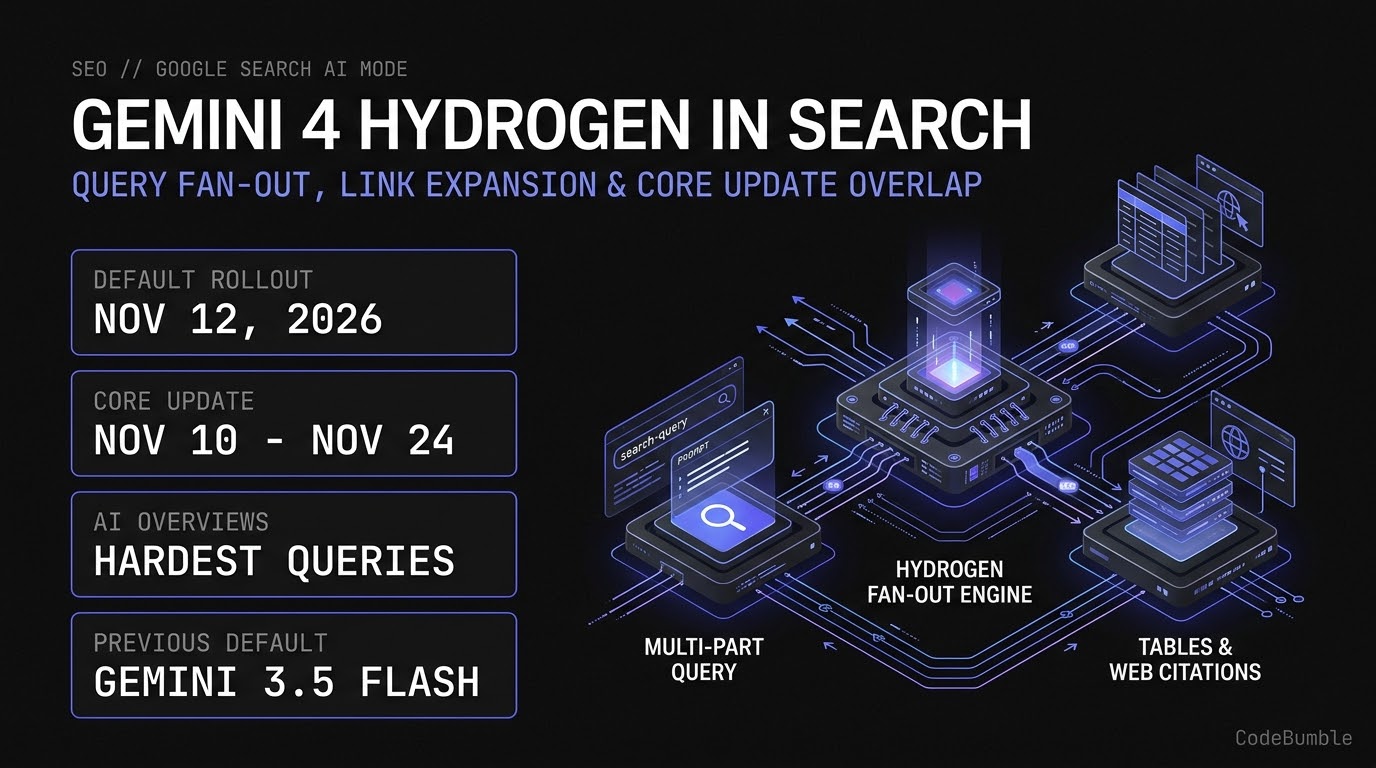
On November 12, 2026, Google made Gemini 4 Hydrogen the global default model in Search AI Mode and routed the hardest AI Overview questions to it—just 48 hours after launching the November 2026 Core Update. Here is how Hydrogen's query fan-out and structured outputs work, why Google published no link-count benchmarks, and how SEO engineers can isolate AI Mode shifts from core ranking volatility.
10 min read
Gemini 4 Hydrogen Becomes Google AI Mode's Default Model—Expanding Query Fan-Out Mid-Core Update
Executive Summary
On November 12, 2026, Google rolled out Gemini 4 Hydrogen globally as the new default model powering AI Mode in Google Search for all users without requiring a paid subscription (Google Blog; Search Engine Journal). According to Robby Stein, Vice President of Product for Google Search, Hydrogen is also being used for the "hardest questions in AI Overviews" (Search Engine Roundtable, November 12, 2026).
The timing creates an immediate attribution problem for technical SEO and analytics teams. Google launched the November 2026 Core Update on November 10, 2026—just two days before swapping AI Mode's underlying default model from its previous Gemini 3.5 Flash baseline (Search Engine Journal). In addition, Google had rolled out Gemini 4 Carbon for Google AI Ultra subscribers in AI Mode on November 10 (Google Blog).
For publishers and search engineers, the practical shift is architectural rather than cosmetic. Google states that Hydrogen improves query fan-out—running simultaneous sub-queries across topic facets to surface "a broader range of helpful links than before"—while generating more visual comparison tables and custom tools (Search Engine Roundtable). However, Google has not published numeric link counts, click-through benchmarks, or the threshold defining what counts as a "hardest" AI Overview query (Search Engine Journal SEO Pulse, November 14, 2026). Teams must log both November 10 and November 12 in their telemetry annotations and audit sub-question coverage rather than reacting to short-term noise.
Technical Mechanics and Architecture
1. Where Gemini 4 Hydrogen Sits in Google's Search Stack
Google's Gemini 4 family splits workloads across speed-optimized and deep-reasoning tiers (Google Blog):
- Gemini 4 Hydrogen: Fast, cost-efficient model (API pricing
$1.50/ 1M input tokens,$7.50/ 1M output tokens across a 1M-token context window, with four thinking levels:low,medium,high, andxhigh). Because of its latency and cost profile, Google deployed it globally for all Search users in AI Mode and for the hardest AI Overview queries. - Gemini 4 Carbon: Frontier reasoning model rolled out on November 10, 2026, as an optional daily-limited choice in AI Mode for Google AI Ultra subscribers aged 18+ (Google Blog; Search Engine Journal).
- Gemini 4 Argon: Earlier frontier model made optional in AI Mode for Google AI Pro and Ultra subscribers starting October 13, 2026 (Search Engine Journal).
2. Query Fan-Out & Multi-Part Synthesis Pipeline
Unlike traditional single-query lexical retrieval, AI Mode with Gemini 4 Hydrogen decomposes complex, typo-ridden, or multi-constraint prompts into parallel sub-queries before synthesizing visual comparison tables and citation links:
+-----------------------------------------------------------------------------+
|                    USER PROMPT (Multi-Part / Typos / Constraints)           |
+--------------------------------------+--------------------------------------+
                                       |
                                       v
+-----------------------------------------------------------------------------+
|               GEMINI 4 HYDROGEN INTENT & ROUTING LAYER                      |
|  - Normalizes typos & preserves multi-part constraints                      |
|  - Routes standard AI Mode -> Hydrogen (Global Default)                     |
|  - Routes "Hardest" AI Overviews -> Hydrogen (vs Gemini 3 baseline)         |
+--------------------------------------+--------------------------------------+
                                       |
          +----------------------------+----------------------------+
          |                            |                            |
          v                            v                            v
+-------------------+        +-------------------+        +-------------------+
| Sub-Query Branch A|        | Sub-Query Branch B|        | Sub-Query Branch C|
| (Specs / Limits)  |        | (Compatibility)   |        | (Regional Price)  |
+---------+---------+        +---------+---------+        +---------+---------+
          |                            |                            |
          +----------------------------+----------------------------+
                                       |
                                       v  (Parallel Web Index Retrieval)
+-----------------------------------------------------------------------------+
|               SYNTHESIS & CITATION ASSEMBLY                                 |
|  - Renders HTML-style comparison tables, images, and custom tools           |
|  - Attaches expanded web citations across niche sub-topic pages             |
|  - Logs impressions in Search Console GenAI Report (Clicks due Dec 3, 2026) |
+-----------------------------------------------------------------------------+
Two retrieval implications stand out for technical SEO (Geosnap, November 15, 2026; Dev.to, November 15, 2026):
- Sub-question specificity over domain-level generality: Because fan-out spawns narrower parallel queries (e.g., specifications, compatibility, maintenance, regional availability), a focused section that directly answers a specific sub-question in its opening sentence is easier for the retriever to match than a broad overview page.
- Structured comparison extraction: Hydrogen explicitly generates comparison tables and visual aids; clean semantic HTML
<table>elements and structuredJSON-LD(Product,FAQPage,TechArticle) reduce parsing ambiguity.
3. Defensive Telemetry & Content Audit Script
Because Google Search Console's Generative AI report currently logs impressions without separate AI click attribution, and GA4 lumps AI Mode referrals under google.com, teams should run a two-part defensive Python script: (a) verify that key landing pages expose clean semantic HTML tables and self-contained answer sections, and (b) annotate Search Console / analytics time-series around the Nov 10 (Core Update) and Nov 12 (Hydrogen rollout) boundaries.
#!/usr/bin/env python3
"""
Defensive technical SEO auditor for AI Mode query fan-out readiness
and Core Update (Nov 10) vs. Gemini 4 Hydrogen (Nov 12) cohort segmentation.
Uses Python standard library only.
"""
import csv
import datetime as dt
import re
from html.parser import HTMLParser
from typing import Dict, List


class FanOutStructureParser(HTMLParser):
    """Inspects headings, tables, and JSON-LD blocks for sub-question clarity."""

    def __init__(self) -> None:
        super().__init__()
        self.headings: List[str] = []
        self.table_count: int = 0
        self.jsonld_count: int = 0
        self._in_heading = False
        self._buf: List[str] = []

    def handle_starttag(self, tag: str, attrs: list) -> None:
        if tag in {"h1", "h2", "h3"}:
            self._in_heading = True
            self._buf = []
        elif tag == "table":
            self.table_count += 1
        elif tag == "script":
            attr_map = dict(attrs)
            if attr_map.get("type") == "application/ld+json":
                self.jsonld_count += 1

    def handle_endtag(self, tag: str) -> None:
        if tag in {"h1", "h2", "h3"} and self._in_heading:
            text = " ".join("".join(self._buf).split())
            if text:
                self.headings.append(f"{tag.upper()}: {text}")
            self._in_heading = False

    def handle_data(self, data: str) -> None:
        if self._in_heading:
            self._buf.append(data)


def audit_html_for_fanout(html_text: str) -> Dict[str, object]:
    """Return structural readiness metrics for a page."""
    parser = FanOutStructureParser()
    parser.feed(html_text)
    question_headings = [
        h for h in parser.headings if re.search(r"\b(how|what|why|when|vs|compare)\b|\?", h, re.I)
    ]
    return {
        "total_headings": len(parser.headings),
        "question_or_compare_headings": len(question_headings),
        "semantic_tables": parser.table_count,
        "jsonld_blocks": parser.jsonld_count,
    }


def segment_rollout_windows(csv_path: str) -> Dict[str, Dict[str, int]]:
    """
    Aggregate daily GSC/analytics CSV (columns: date,clicks,impressions) into:
      - pre_baseline: before 2026-11-10
      - core_only:    2026-11-10 to 2026-11-11
      - core_plus_hydrogen: 2026-11-12 onwards
    """
    buckets = {
        "pre_baseline": {"days": 0, "clicks": 0, "impressions": 0},
        "core_only": {"days": 0, "clicks": 0, "impressions": 0},
        "core_plus_hydrogen": {"days": 0, "clicks": 0, "impressions": 0},
    }
    d_core = dt.date(2026, 11, 10)
    d_hydro = dt.date(2026, 11, 12)

    with open(csv_path, "r", encoding="utf-8") as fh:
        for row in csv.DictReader(fh):
            day = dt.date.fromisoformat(row["date"])
            if day < d_core:
                key = "pre_baseline"
            elif day < d_hydro:
                key = "core_only"
            else:
                key = "core_plus_hydrogen"
            buckets[key]["days"] += 1
            buckets[key]["clicks"] += int(row["clicks"])
            buckets[key]["impressions"] += int(row["impressions"])
    return buckets
Evidence: Timeline, Model Capabilities, and Measurement Limits
November 2026 Search Rollout Timeline
Cross-referencing Google's official announcements with Search Engine Journal and Search Engine Roundtable confirms four distinct search changes within a two-week window:
| Date (2026) | Change | Scope & Availability | Source |
|---|---|---|---|
| Oct 13 | Gemini 4 Argon added to AI Mode | Optional for AI Pro & Ultra subscribers | SEJ |
| Nov 10 | November 2026 Core Update begins | Global, all languages; up to 2-week rollout (~Nov 24) | SEJ |
| Nov 10 | Gemini 4 Carbon added to AI Mode | Optional for AI Ultra subscribers (18+, daily limits) | Google Blog |
| Nov 12 | Gemini 4 Hydrogen becomes AI Mode default | Global, all users (free); also hardest AI Overviews | Google Blog |
Published Benchmarks vs. Search Telemetry Gaps
Google's model announcement published strong general-purpose and agentic benchmarks for Gemini 4 Hydrogen—including scoring 51 on the Artificial Analysis Intelligence Index at its default high thinking level (surpassing Argon's 50 and reaching 54 at xhigh), alongside 67% success on a toxicology evaluation vs. 37% for the top non-Gemini baseline (Google Blog).
Search Benchmark Availability Note: By contrast, Google published zero quantitative benchmarks for Search AI Mode or AI Overviews under Hydrogen. Specifically, neither Google's blog post nor Robby Stein's X thread discloses:
- How many additional web links Hydrogen's improved query fan-out displays per answer;
- Any change in AI Mode or AI Overview click-through rate (CTR); or
- What criteria classify an AI Overview query as "hardest" (Search Engine Journal).
Furthermore, Search Engine Roundtable reported a Google Search Console Generative AI Performance Report data bug affecting November 9–11, 2026 (Search Engine Roundtable, November 13, 2026), reinforcing that any immediate post-November 12 citation spike or dip should be treated as low confidence until the November 2026 Core Update finishes rolling out.
Hardening Playbook: Isolating Hydrogen Impact & Optimizing for Fan-Out
Follow this numbered operational playbook to measure and adapt to Gemini 4 Hydrogen without conflating model changes with core ranking updates:
- Annotate November 10 and November 12 separately: Log
2026-11-10(November Core Update start) and2026-11-12(Gemini 4 Hydrogen AI Mode default + hardest AI Overviews) in GA4, Looker Studio, and your internal Search Console tracking sheets. - Do not evaluate core-update recovery until December: Google advises waiting at least a full week after a core update completes before comparing Search Console data against a pre-update baseline (Search Engine Journal). Because a full two-week rollout ends around November 24—immediately before U.S. Thanksgiving, Black Friday, and Cyber Monday—retail sites must compare against prior-year seasonal baselines rather than early-November weeks.
- Exclude the November 9–11 GSC GenAI data anomaly: Flag November 9–11 data points in your Generative AI Performance Report exports so reporting artifacts do not distort week-over-week comparisons (Search Engine Roundtable).
- Restructure long guides for sub-question retrieval: Audit high-value commercial and technical pages with
audit_html_for_fanout(). Ensure each major subtopic uses a clear heading, opens with a direct one-sentence answer, and places specs, compatibility matrices, and pricing tiers inside semantic HTML<table>tags (Geosnap). - Lock a fixed prompt-monitoring cohort: If you track AI Mode citations via third-party tools or manual QA, keep your prompt set, region, and language fixed across November and December so model-level fan-out changes remain observable.
- Rollback & stability check: Avoid major URL migrations, canonical rewrites, or aggressive content pruning while both the Core Update and Hydrogen rollout are settling. Stage structural HTML table and FAQ additions on a 10–20 page test cohort first and monitor crawl stats and indexation before site-wide deployment.
Frequently Asked Questions (FAQ)
What did Gemini 4 Hydrogen replace in Google Search AI Mode?
Prior to November 12, 2026, Google's global default model for AI Mode was Gemini 3.5 Flash (introduced at Google I/O in May 2026), while Gemini 3 served as the default for AI Overviews (Search Engine Journal).
Do users need a paid subscription to get Gemini 4 Hydrogen in Search?
No. Google confirmed that Gemini 4 Hydrogen is the new default model in AI Mode for all Search users globally at no cost, whereas Gemini 4 Carbon remains an optional model for paying Google AI Ultra subscribers (Google Blog; Search Engine Journal).
Does Gemini 4 Hydrogen also change Google AI Overviews?
Yes, partially. Google Search VP of Product Robby Stein stated that Hydrogen is "being used for your hardest questions in AI Overviews," though Google has not defined which queries qualify as hardest or what model handles simpler AI Overview questions (Search Engine Journal).
Will Gemini 4 Hydrogen increase organic clicks to websites?
There is no published proof of higher clicks yet. While Google states that improved query fan-out connects users to "a broader range of helpful links than before," it has not released numeric link counts or CTR figures, and AI Mode traffic currently blends into standard google.com referrals in analytics (Search Engine Journal; Geosnap).
How does the November 2026 Core Update affect measuring Hydrogen?
Because the Core Update started on November 10 and Hydrogen rolled out on November 12, ranking shifts and AI citation changes overlap in the same window. SEO teams must log both dates and wait until after the core update finishes (estimated around November 24) before drawing conclusions (Dev.to).
Sources
- Google Blog — Introducing Gemini 4 Hydrogen for Agentic Workflows (Published November 13, 2026)
- Google Blog — Gemini 4 Carbon is now available (Published November 10, 2026)
- Search Engine Journal — Google Makes Gemini 4 Hydrogen The Default Model In AI Mode (Published November 12, 2026)
- Search Engine Journal — Core Update, ChatGPT Business Hub & AI Mode's New Model – SEO Pulse (Published November 14, 2026)
- Search Engine Roundtable — Google Search Gets Major Upgrade With Gemini 4 Hydrogen (Published November 12, 2026) & Google Search Console Generative AI Performance Report Data Bug (Published November 13, 2026)
- Geosnap — Gemini 4 Hydrogen in Google AI Mode: what changes if you want to be cited (Published November 15, 2026)
- Dev.to — Google Makes Gemini 4 Hydrogen the Default Model in AI Mode (Published November 15, 2026)