

Vulnerability
CISA Confirms Check Point CVE-2026-123039 Exploited: Gaia DynamicCLI Root Escalation, TSGA Backdoor, and Remediation
CISA added Check Point CVE-2026-123039 to KEV on November 13 with a November 16 deadline after attackers chained PHP2Shell with DynamicCLI root escalation to deploy TSGA backdoors and ESXi wipers. Get fixed Jumbo Hotfixes, dbset mitigations, and /var/log/dynamicCli.log checks.
8 min read
CISA Confirms Check Point CVE-2026-123039 Exploited: Gaia DynamicCLI Root Escalation, TSGA Backdoor, and Remediation
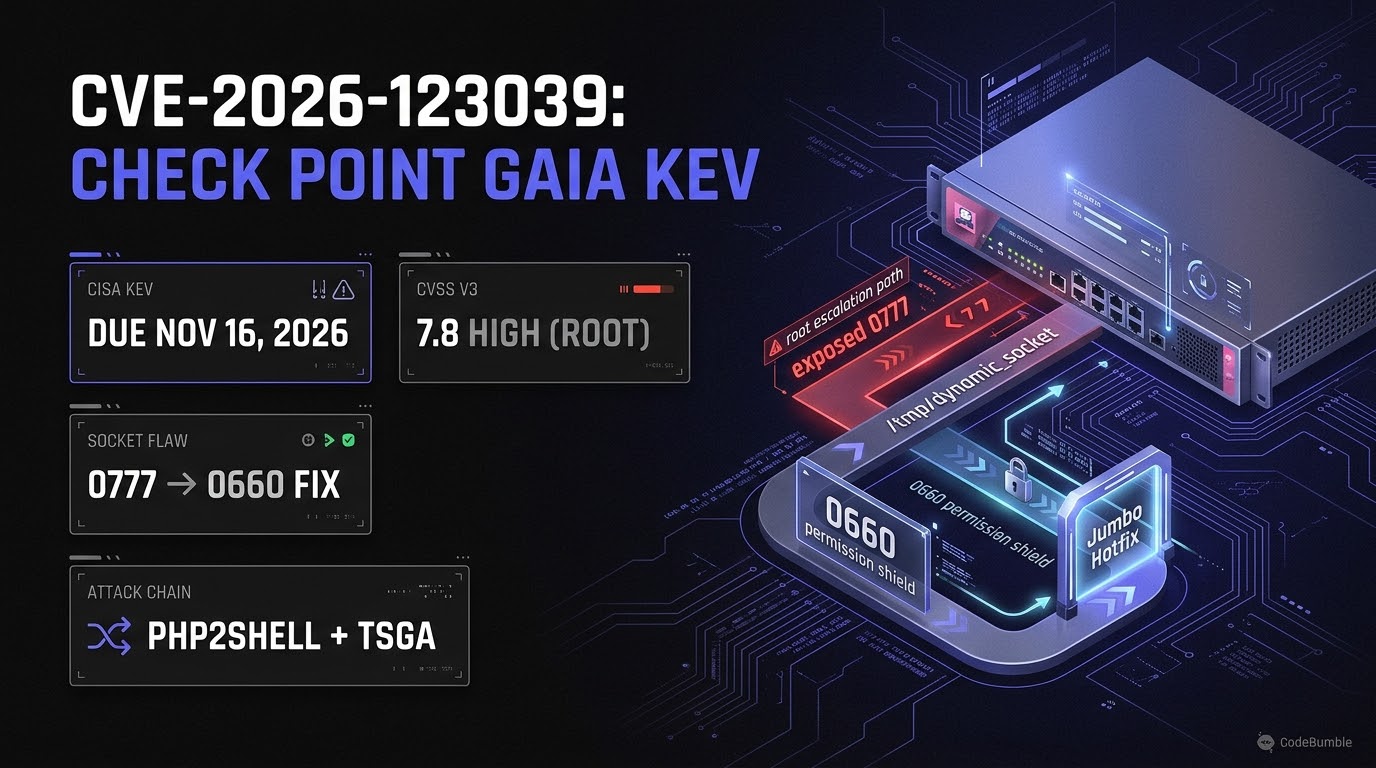
Executive Summary
On November 13, 2026, the U.S. Cybersecurity and Infrastructure Security Agency (CISA) added CVE-2026-123039—a local privilege escalation vulnerability in Check Point Gaia OS dynamic_server (DynamicCLI)—to its Known Exploited Vulnerabilities (KEV) Catalog, setting an aggressive November 16, 2026 remediation deadline for federal agencies under Binding Operational Directive (BOD) 26-04 and requiring forensic triage.
Rated CVSS v3.1 7.8 (High) by Check Point (sk1000362), CVE-2026-123039 stems from an unauthenticated, world-writable (0777) local Unix IPC socket (/tmp/dynamic_socket) listened on by the dynamic_server daemon running as root. While CVE-2026-123039 requires an attacker to already hold local code execution on the appliance, Check Point Research confirmed on November 12, 2026 that threat actors actively chained PHP2Shell (CVE-2026-109618 and CVE-2026-109619) against internet-facing Mobile Access portals with CVE-2026-123039 to gain root access across roughly two dozen customer environments.
Once elevated to root, operators deployed custom PHP webshells (zz*.tpl), the TSGA persistent backdoor (slot_CPconfigdaemon), the TSProxy shared library (/lib/libcpfwcommon.so), the gogo internal scanner, and pivoted via SSH to VMware ESXi hosts to execute the destroy_v6 wiper. Administrators running Check Point Force Firewalls, Security Gateways, Security Management/Log Servers, Multi-Domain Servers, or Maestro Orchestrators on R81 through R82.20 must apply the November Jumbo Hotfix Accumulator immediately and audit /var/log/dynamicCli.log for unauthenticated socket commands.
Affected Products and Jumbo Hotfix Matrix
Per Check Point sk1000362 (last modified November 12, 2026), Spark Firewalls and Smart-1 Cloud are not affected. All other listed Gaia OS appliances on R81 through R82.20 are exposed:
| Gaia OS Release | Support Status | Fixed Jumbo Hotfix Accumulator | Post-Patch Socket Permission |
|---|---|---|---|
R82.20 |
Supported | Take 14 or higher | srw-rw---- root config (0660) |
R82.10 |
Supported | Take 52 or higher | srw-rw---- root config (0660) |
R82 |
Supported | Take 132 or higher | srw-rw---- root config (0660) |
R81.20 |
Supported | Take 174 or higher | srw-rw---- root config (0660) |
R81.10 / R81 |
End of Support (EOS) | Upgrade to supported release + Hotfix | N/A (Mitigate via dbset) |
Technical Mechanics and Architecture
How the PHP2Shell → CVE-2026-123039 → ESXi Wiper Chain Operates
In Check Point Gaia OS, DynamicCLI extends the clish shell with dynamic commands executed by /usr/bin/dynamic_server running as root. On unpatched appliances, dynamic_server binds /tmp/dynamic_socket with 0777 (srwxrwxrwx) permissions and does not verify the UID or credentials of the connecting local process. Any local service account—such as the low-privileged nobody / web portal worker compromised via PHP2Shell—can write a command string to /tmp/dynamic_socket and have dynamic_server execute it as root:
+-----------------------------------------------------------------------------+
|        CHECK POINT GATEWAY INTRUSION CHAIN & CVE-2026-123039 HARDENING      |
+-----------------------------------------------------------------------------+
|                                                                             |
|  [ STAGE 1: INITIAL ACCESS (Oct 30 & Nov 2 Waves) ]                         |
|   Internet Attacker (130.94.19[.]204) ---> Mobile Access Portal             |
|     +---> Exploits PHP2Shell (CVE-2026-109618 / CVE-2026-109619)            |
|     +---> Gains local execution as portal service account (e.g., uid 99)    |
|                                                                             |
|  [ STAGE 2: ROOT ESCALATION (CVE-2026-123039) ]                             |
|   Low-priv process writes command to /tmp/dynamic_socket (0777, no auth)    |
|     +---> /usr/bin/dynamic_server (root) executes command -> FULL ROOT!     |
|                                                                             |
|  [ STAGE 3: PERSISTENCE & LATERAL WIPE ]                                    |
|   PHP Webshells (zz*.tpl) -> TSGA (/tmp/CPconfigdaemon -> slot_CPconfigdaemon)
|     +---> TSProxy (/lib/libcpfwcommon.so) + gogo scanner                    |
|     +---> SSH (vpxuser) -> VMware ESXi -> destroy_v6 wiper                  |
|                                                                             |
|  [ REMEDIATION & HARDENING (Jumbo Hotfix / sk1000362) ]                     |
|   1. /tmp/dynamic_socket locked to 0660 (root:config) + UID auth enforced   |
|   2. Unauthorized UID calls blocked & logged to /var/log/dynamicCli.log     |
+-----------------------------------------------------------------------------+
Per Check Point Research, post-exploitation unfolds across three distinct stages after dynamic_server grants root:
- Portal Webshells: Operators write
zz*.tplfiles into the Mobile Access<templates>directory, upgrading an initial command-execution stub to a full PHP shell gated by the hardcoded keyzz2026(supporting plain-text and Base64/XOR commands, plus file uploads to/tmp/.up.tplcopied tochallenge_render.tpl). - TSGA & TSProxy Passive Backdoors: Operators launch
/tmp/CPconfigdaemonin the background (nohup /tmp/CPconfigdaemon >/tmp/.bd.log 2>&1 &). Running asroot, the implant relocates to the boot persistence directory asslot_CPconfigdaemon, listens on TCP port11072across all IPv4 interfaces and/tmp/.p_sock, and drops TSProxy (/lib/libcpfwcommon.so) into appliance processes to intercept networking functions for encrypted SOCKS-style proxying and binary firewall-log tampering. - ESXi Lateral Pivot &
destroy_v6Wiper: Using thegogointernal scanner, operators locate reachable VMware ESXi hosts, authenticate over SSH using thevpxuserservice account, stagedestroy_v6to/tmp/des, and recursively overwrite/delete files (-ffor fast deletion without zero-overwriting;-wfor pipe-separated exclusion directories), leavingDREAM_ANNEXATION.txtnotes.
Defensive Engineering Pattern: Automated Audit of /var/log/dynamicCli.log
Every command processed by dynamic_server is recorded in /var/log/dynamicCli.log. Per Check Point sk1000362, legitimate Gaia Clish commands always wrap execution with . /opt/CPshared/5.0/tmp/.CPprofile.sh >> /dev/null; export SP_DISTRIBUTE=0; set -o noglob; <Gaia binary> 2>&1. Any Received = line lacking that wrapper—or invoking Received = #return_value# (system() sink)—is a high-confidence indicator of socket abuse.
Below is a safe, read-only Python triage script for offline log analysis (run against exported /var/log/dynamicCli.log files in your SIEM or forensic workstation):
import re
from pathlib import Path

EXPECTED_WRAPPER = "CPprofile.sh >> /dev/null; export SP_DISTRIBUTE=0; set -o noglob;"
SUSPICIOUS_PATTERNS = re.compile(
    r"(id;|whoami|/etc/shadow|ncat|\bnc\s-|/dev/tcp|curl\s|wget\s|base64|useradd|authorized_keys)",
    re.IGNORECASE,
)

def audit_dynamic_cli_log(log_path: str) -> list[dict[str, str]]:
    """Parses exported Check Point dynamicCli.log for anomalous root socket commands."""
    findings = []
    for idx, line in enumerate(Path(log_path).read_text(errors="replace").splitlines(), start=1):
        if "Received =" in line and EXPECTED_WRAPPER not in line:
            findings.append({"line": str(idx), "reason": "missing_clish_wrapper", "entry": line})
        elif "Received = #return_value#" in line:
            findings.append({"line": str(idx), "reason": "system_sink_invocation", "entry": line})
        elif "Received =" in line and SUSPICIOUS_PATTERNS.search(line):
            findings.append({"line": str(idx), "reason": "suspicious_shell_payload", "entry": line})
        elif "Rejected connection from unauthorized uid" in line:
            findings.append({"line": str(idx), "reason": "blocked_lpe_attempt", "entry": line})
    return findings
Evidence: Campaign Waves, IOCs, and Attribution Caveats
- Timeline & Victim Scope: Check Point Research documented an initial exploitation wave on October 30, 2026 targeting Israeli organizations (including destructive wiper activity), followed by a broader global scanning wave on November 2, 2026 across multiple countries and sectors. Security fixes had been released roughly one week prior (October 23), and Check Point reported active compromise of a couple of dozen unpatched systems in a single region.
- CISA KEV Mandate: Added November 13, 2026 with a November 16, 2026 federal remediation deadline and mandatory BOD 26-04 forensic triage.
- Verified Malware & Network Indicators (Check Point Research):
- Source IPs:
130.94.19[.]204,130.94.19[.]168(LightNode VPS). - Portal Artifacts: PHP session files under
/opt/CPcvpn-R81.20/tmp/containingupload_progress_pwn, Apache/PHP worker segmentation faults, and webshells<templates>/zz*.tpl,/tmp/.up.tpl,challenge_render.tpl. - Key SHA-256 Hashes:
slot_CPconfigdaemon(4171b521fa6441382aa2fa014a08e18ff9a6e0ab6096c9144072bf46b37a2ec8),CPconfigdaemon(d7549671c7189979f0624ec52dad9ea6a707d23146e3585ab8f8c4720eca0c63),tpl webshell(edb3e92eb7bda7413a09edcc4b1ba3cbed4bcdf42808a8abce63b6e4c3fda2b3),gogo(3b51080a909023f7d484e2443740b572307ce0054eb9e32d98f0a06bfcd2db90), anddestroy_v6wiper (c7d9477309fac6c638a1128442056a242de086996add8cb49cd6496c36003237).
- Source IPs:
- Confidence Level: High on technical root cause, Jumbo Hotfix versions, and observed malware artifacts (
sk1000362and Check Point Research). Attribution Caveat: WhileTSGAandTSProxyshare code and cryptographic material with thePhiliKitframework (previously linked by ESET to China-nexusUNC5221), Check Point Research notes that the destructive wiper and Hebrew-referencedDREAM_ANNEXATION.txtnotes do not align cleanly with typicalUNC5221operations—leaving open whether the intrusion reflects an initial-access broker handoff, false-flagging, or retaliation.
Hardening & Remediation Playbook
Step 1: Apply the November Jumbo Hotfix (Both PHP2Shell and DynamicCLI)
Install the appropriate Jumbo Hotfix Accumulator via CPUSE on all Management Servers, Security Gateways, and Maestro Orchestrators:
R82.20: Take 14 or laterR82.10: Take 52 or laterR82: Take 132 or laterR81.20: Take 174 or later
Confirm the patch is active in Expert mode by checking /tmp/dynamic_socket permissions:
# Expected post-patch output: srw-rw---- root config (0660), NOT srwxrwxrwx (0777)
ls -l /tmp/dynamic_socket

# Verify blocked escalation attempts post-patch
grep "Rejected connection from unauthorized uid" /var/log/dynamicCli.log
Step 2: Apply Emergency dbset Mitigation If You Cannot Reboot/Patch Immediately
For appliances awaiting a maintenance window (or R81 / R81.10 EOS systems prior to upgrade), stop dynamic_server and prevent automatic restarts:
# Run in Gaia Clish or Expert mode (per sk1000362)
dbset process:dynamic_server
dbset :save

# Verify dynamic_server is no longer running in Expert mode
ps auxw | grep -v grep | grep 'dynamic_server'
Step 3: Perform Mandatory BOD 26-04 Forensic Triage
Before trusting any internet-facing Mobile Access gateway, check for historical exploitation:
# 1. Check /var/log/dynamicCli.log for un-wrapped commands or system() sinks
grep "Received =" /var/log/dynamicCli.log | grep -vF "CPprofile.sh >> /dev/null; export SP_DISTRIBUTE=0; set -o noglob;"
grep -F "Received = #return_value#" /var/log/dynamicCli.log

# 2. Check Mobile Access tmp & template directories for PHP2Shell / webshell artifacts
ls -la /opt/CPcvpn-*/tmp/ 2>/dev/null
find /opt/CPcvpn-* -name "zz*.tpl" -o -name "challenge_render.tpl" 2>/dev/null
ls -la /tmp/.up.tpl /tmp/CPconfigdaemon /lib/libcpfwcommon.so 2>/dev/null
Step 4: Isolate Gateway-to-Hypervisor Management Planes
Because attackers pivoted from compromised gateways over SSH using vpxuser to VMware ESXi hosts, enforce strict management-plane network segmentation so perimeter firewalls cannot reach hypervisor SSH (TCP/22) or vSphere management interfaces, and rotate gateway and hypervisor credentials if any IOC is found.
Step 5: Rollback Notes
Stopping dynamic_server via dbset process:dynamic_server disables Dynamic CLI extended commands listed in sk144112. Once the Jumbo Hotfix Accumulator (Take 14/52/132/174+) is installed and ls -l /tmp/dynamic_socket confirms 0660 permissions, re-enable dynamic_server cleanly with:
dbset process:dynamic_server t
dbset :save
Frequently Asked Questions
1. Can CVE-2026-123039 be exploited remotely without authentication?
Not by itself. CVE-2026-123039 is a local privilege escalation (LPE) vulnerability requiring prior local code execution on the Gaia OS appliance. In real-world attacks, adversaries achieved that initial foothold remotely by exploiting PHP2Shell (CVE-2026-109618 / CVE-2026-109619) on exposed Mobile Access portals, then immediately used CVE-2026-123039 to become root.
2. Why did CISA set a 3-day deadline (November 16, 2026) for CVE-2026-123039?
CISA added CVE-2026-123039 to the KEV Catalog on November 13, 2026 under BOD 26-04 because active in-the-wild exploitation was confirmed against perimeter security appliances, leading to persistent backdoors (TSGA/TSProxy) and destructive ESXi wiper deployment.
3. Are Check Point Spark Firewalls or Smart-1 Cloud affected?
No. According to Check Point's official advisory (sk1000362), Spark Firewalls and Smart-1 Cloud are not affected.
4. How do I verify my Check Point gateway is actually patched?
Run ls -l /tmp/dynamic_socket in Expert mode. A patched system displays srw-rw---- owned by root:config (0660), whereas a vulnerable system displays srwxrwxrwx (0777).
5. What happens if I apply the dbset process:dynamic_server mitigation?
It stops the dynamic_server daemon and prevents restarts, closing /tmp/dynamic_socket immediately without a full Jumbo Hotfix reboot. The only operational side effect is that Dynamic CLI extended commands (sk144112) will fail until you install the hotfix and re-enable the process.
Sources
- CISA Alert: CISA Adds Two Known Exploited Vulnerabilities to Catalog (
CVE-2026-123039) — Published November 13, 2026. - Check Point SecureKnowledge
sk1000362:CVE-2026-123039- Local privilege escalation to root in the DynamicCLI process — Last modified November 12, 2026. - Check Point Research: PHP2Shell Exploitation on Check Point Gateway — Published November 12, 2026.
- NIST NVD:
CVE-2026-123039Detail — Published November 12, 2026.