

Vulnerability
Plex2Shell (CVE-2026-96652) Hits QNAP NAS Devices: Why Updating Alone Isn't Enough
Plex2Shell chains four CISA KEV vulnerabilities (CVE-2026-96652 through CVE-2026-96656) into unauthenticated RCE on Plex Media Server builds before 1.43.3.10861, actively compromising QNAP NAS devices. Learn how the 4-stage chain works, why patching alone isn't enough, and how to hunt for IoCs.
8 min read
Plex2Shell (CVE-2026-96652) Hits QNAP NAS Devices: Why Updating Alone Isn't Enough
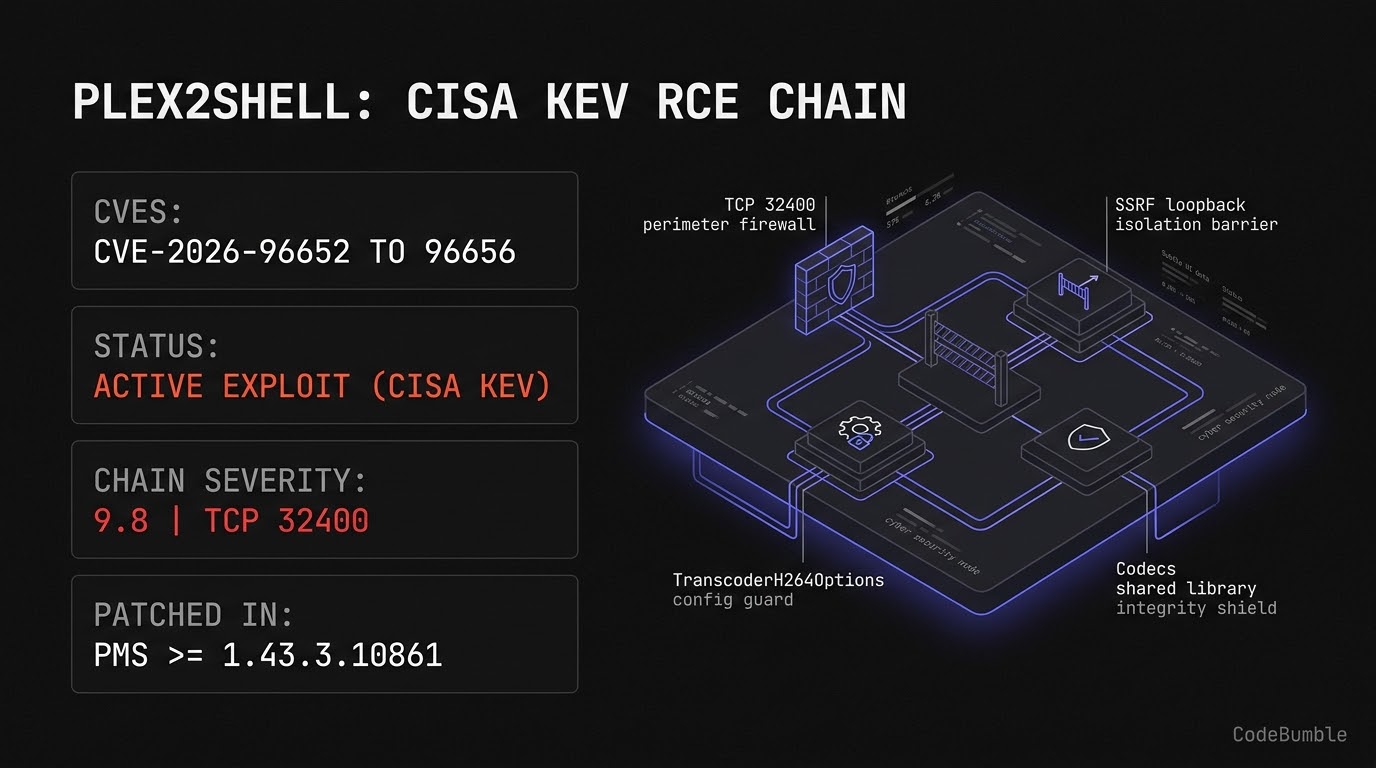
Executive Summary
Plex2Shell—a four-vulnerability exploit chain spanning CVE-2026-96652, CVE-2026-96654, CVE-2026-96655, and CVE-2026-96656—is actively exploited in the wild against internet-facing Plex Media Server instances running builds prior to 1.43.3.10861 (CISA KEV Alert, ThreatDefence). While each individual CVE carries a Medium or High CVSS v4.0 score (ranging from 5.3 to 8.6), the researcher who discovered the chain rates the combined unauthenticated remote code execution (RCE) chain at 9.8 Critical, and CISA added all four CVEs to its Known Exploited Vulnerabilities (KEV) catalog on October 20, 2026 (CISA, ThreatDefence).
On November 6, 2026, NAS vendor QNAP issued a formal security notice after receiving user reports of compromised Plex Media Server installations on QNAP NAS devices, deploying cryptocurrency miners and residential proxy software (QNAP Security Notice). Crucially, both Plex and QNAP emphasize that updating an exposed server after October 16, 2026 is not enough: any instance reachable from the internet on port 32400 while running 1.43.2 or earlier (or unpatched 1.43.3 builds before 1.43.3.10861) must be treated as potentially compromised, cleanly reinstalled, and rotated across all local and cloud credentials (QNAP Remediation FAQ, ThreatDefence).
Confidence Level: High for affected/fixed versions, CISA KEV status, CVE mechanics, and QNAP compromise guidance (verified across CISA, NVD, QNAP, and ThreatDefence's November 15, 2026 update). Note that published network indicators come from limited honeypot telemetry, so an absence of matching IP hits does not rule out compromise.
Threat Context & Exposure Surface
Plex Media Server rarely runs in isolation. In small-office, home-lab, and enterprise edge deployments, it typically executes on a NAS appliance (QNAP, Synology, TerraMaster, WD, Netgear), a Docker container, or a Windows/Linux host with read access to shared network folders, backup targets, and cloud storage keys (ThreatDefence).
QNAP confirmed that its operating systems (QTS and QuTS hero) are not vulnerable themselves; rather, exposure occurs when users install the third-party Plex Media Server app from App Center and expose TCP port 32400 via Plex Remote Access, manual router port forwarding, UPnP, or myQNAPcloud auto-router configuration (QNAP Remediation FAQ).
Disclosure & Exploitation Timeline
- August 4, 2026: Plex releases fixed build 1.43.3.10861 (following Beta on August 3).
- September 1, 2026: Plex urges owners to update prior to public CVE details.
- September 23, 2026: CISA CNA publishes CVE records (
CVE-2026-96652,96654,96655,96656) (NVD CVE-2026-96652, NVD CVE-2026-96656). - October 16–17, 2026: Technical details and a public proof-of-concept (PoC) are released; honeypots observe exploitation attempts the next morning.
- October 20, 2026: CISA adds all four CVEs to the KEV catalog (CISA Alert).
- November 6, 2026: QNAP reports in-the-wild NAS compromises and issues its clean-reinstall advisory (QNAP Security Notice).
Technical Mechanics & Architecture
Plex2Shell chains four distinct bugs to escalate from an unauthenticated external request on TCP 32400 to arbitrary shared-library execution as the Plex Media Server service account:
Plex2Shell 4-Stage Exploitation Chain (TCP 32400):
  [1. Unauthenticated SSRF (CVE-2026-96652)]
     GET/POST /player/timeline?protocol=http://... (any X-Plex-Token)
        │  Forces server POST to attacker-controlled destination
        ▼
  [2. Loopback Plugin Invocation (CVE-2026-96654)]
     searchOne() fails to neutralize URLs -> bounces via 127.0.0.1.<ip>.sslip.io
        │  Calls internal plugin functions -> obtains Admin Token
        ▼
  [3. Authenticated SSRF (CVE-2026-96655)]
     /video/:/transcode/universal (path parameter) -> internal/external fetch
        │
        ▼
  [4. Arbitrary File Write & Code Load (CVE-2026-96656)]
     TranscoderH264Options appended verbatim to x264 options -> writes .so/.dll to Codecs/
        │  Plex loads all .so/.dll in Codecs/ without signature or execute-bit checks
        ▼
  [Code Execution as Plex Service Account] -> Miners (xmrig) / Residential Proxies
- Stage 1 — Unauthenticated SSRF (
CVE-2026-96652): The/player/timelineendpoint accepts any arbitrary value in theX-Plex-Tokenheader and allows a full URL in theprotocolparameter, forcing the Plex server to issue an outbound POST request (NVD CVE-2026-96652). - Stage 2 — Improper Neutralization (
CVE-2026-96654): URLs passed tosearchOneare not neutralized, allowing requests bounced back over loopback (often via wildcard DNS names like127.0.0.1.<attacker-ip>.sslip.io) to invoke other plugins' functions and retrieve the server owner's admin token (ThreatDefence). - Stage 3 — Authenticated SSRF (
CVE-2026-96655): Using the captured token, thepathparameter of/video/:/transcode/universallets the attacker fetch arbitrary internal or external addresses (CISA KEV). - Stage 4 — Arbitrary File Write & Shared Library Load (
CVE-2026-96656): TheTranscoderH264Optionspreference is appended verbatim to thex264encoder's option string on every transcode, enabling an admin-level write into theCodecs/directory. Because Plex loads every.soor.dllfile inCodecs/without signature, execute-bit, or symbol checks, the planted library executes on load (NVD CVE-2026-96656).
(Note: CISA advisory VA-26-266-01 also lists CVE-2026-96651, a path traversal in /system/agents/media/get for authenticated users that can expose PlexOnlineToken. It is not part of the KEV-listed Plex2Shell chain, and 1.43.3.10861 fixes it as well.)
Evidence, Vulnerability Metrics & Affected Platforms
The table below consolidates CVSS v4.0 scores, EPSS probabilities, CISA KEV status, and fixed builds verified as of November 15, 2026 (ThreatDefence, NVD):
| CVE ID | Component / Weakness | CVSS v4.0 | EPSS | CISA KEV | Fixed In |
|---|---|---|---|---|---|
CVE-2026-96652 |
/player/timeline Unauthenticated SSRF (CWE-918) |
5.3 (Medium) | 11.9% | Yes (Oct 20, 2026) | 1.43.3.10861 |
CVE-2026-96654 |
searchOne Improper URI Neutralization |
6.9 (Medium) | 12.7% | Yes (Oct 20, 2026) | 1.43.3.10861 |
CVE-2026-96655 |
/video/:/transcode/universal Authenticated SSRF |
5.3 (Medium) | 10.7% | Yes (Oct 20, 2026) | 1.43.3.10861 |
CVE-2026-96656 |
TranscoderH264Options File Write / Load |
8.6 (High) | 19.8% | Yes (Oct 20, 2026) | 1.43.3.10861 |
Affected Scope: All Plex Media Server builds prior to 1.43.3.10861—including 1.43.2 and earlier, plus early 1.43.3 builds such as 1.43.3.10828—across Windows, macOS, Linux, Docker, NVIDIA Shield, and NAS packages (QNAP, Synology, TerraMaster, WD, Netgear). The current release as of November 15, 2026 is 1.43.5.11079 (ThreatDefence).
Benchmark Availability Note: Neither Plex nor QNAP publishes runtime transcoding performance benchmarks for 1.43.3.10861 or 1.43.5.11079; no performance degradation from the security fixes is documented in the advisories.
Hardening, Detection & Incident Response Playbook
Step 1: Audit Local Version & Check for Compromise Artifacts (Read-Only)
Before patching—especially if your server was internet-exposed after October 16, 2026—preserve a copy of your Plex Logs/ folder, Preferences.xml (or Windows Registry key HKCU\Software\Plex, Inc.\Plex Media Server), and Codecs/ directory, then inspect for exploitation artifacts (ThreatDefence):
# 1. Verify running Plex Media Server version locally
curl -s http://127.0.0.1:32400/identity | grep -o 'version="[^"]*"'

# 2. Inspect Preferences.xml for injected TranscoderH264Options (dump-yuv / stats=)
PMS_DIR="/var/lib/plexmediaserver/Library/Application Support/Plex Media Server"
grep -o 'TranscoderH264Options="[^"]*"' "$PMS_DIR/Preferences.xml"

# 3. Audit Codecs/ for unexpected .so or .dll files written outside update windows
find "$PMS_DIR/Codecs" -type f \( -name '*.so' -o -name '*.dll' \) -printf '%TY-%Tm-%Td %TH:%TM %s %p\n' | sort

# 4. Search Plex logs for SSRF protocol schemes, searchOne plugin calls, and sslip.io callbacks
grep -aiE '/player/timeline/subscribe\?([^ ]*&)?protocol=[a-z0-9+.-]{1,16}(%3a|%253a|:)' "$PMS_DIR/Logs/"Plex\ Media\ Server*.log
grep -aiE '(sslip|nip)\.io|TranscoderH264Options(=|%3d)[^& ]*(dump(-|%2d)yuv|stats(=|%3d))' "$PMS_DIR/Logs/"Plex\ Media\ Server*.log
Step 2: Threat Hunting in Microsoft Sentinel & Defender XDR (KQL)
Because NAS and home-lab Plex logs rarely reach central SIEMs, hunt for internet exposure, wildcard loopback DNS lookups, and unexpected child processes spawned by Plex binaries:
// Hunt 1: Unexpected non-Plex child processes spawned by Plex services
DeviceProcessEvents
| where Timestamp > ago(30d)
| where InitiatingProcessFileName startswith "Plex"
| where not(FileName startswith "Plex")
   or FileName in~ ("sh", "bash", "dash", "busybox", "curl", "wget", "python3", "perl", "nc", "cmd.exe", "powershell.exe", "myawesomeproxy", "mylovelyminer", "xmrig")
| project Timestamp, DeviceName, InitiatingProcessFileName, FileName, ProcessCommandLine, AccountName, SHA256
| order by Timestamp desc
// Hunt 2: Wildcard loopback DNS callbacks (sslip.io / nip.io) and new Codecs libraries
union
(
    DeviceNetworkEvents
    | where Timestamp > ago(30d)
    | where RemoteUrl has_any ("sslip.io", "nip.io")
    | project Timestamp, DeviceName, Signal = RemoteUrl, InitiatingProcessFileName
),
(
    DeviceFileEvents
    | where Timestamp > ago(30d)
    | where FolderPath has "Plex Media Server" and FolderPath has "Codecs"
    | where FileName endswith ".so" or FileName endswith ".dll"
    | where ActionType in ("FileCreated", "FileModified", "FileRenamed")
    | project Timestamp, DeviceName, Signal = FileName, InitiatingProcessFileName
)
| order by Timestamp desc
Step 3: Patch, Isolate & Cleanly Rebuild Exposed Hosts
- Upgrade Immediately: Update to Plex Media Server
1.43.5.11079(or at minimum1.43.3.10861) via QNAP App Center, your Linux package manager, Docker image pull, or Plex's Downloads page. - Eliminate Direct Port
32400Exposure: Disable Plex Remote Access if unneeded, remove router port forwards for32400, disable UPnP, and remove myQNAPcloud auto-router rules for Plex. Route remote streaming over a VPN or an authenticated reverse proxy (QNAP Remediation FAQ, ThreatDefence). - Clean Reinstall & Credential Rotation (If Exposed After Oct 16): Do not reuse the old Plex data folder. Reinstall Plex cleanly, run QNAP Malware Remover (detecting
MR2104), sign out of all devices in Plex account settings first (to invalidate stolen admin tokens), reset Plex and NAS passwords, enable 2FA, and rotate any backup or cloud storage keys accessible to the NAS (QNAP Remediation FAQ). - Rollback Note: Do not roll back below
1.43.3.10861. If an upgrade causes media-library or codec issues, clear theCodecs/directory on a patched build so Plex re-downloads verified codecs rather than downgrading.
Frequently Asked Questions (FAQs)
1. Are QNAP QTS or QuTS hero operating systems themselves vulnerable to Plex2Shell?
No. QNAP confirmed that QTS and QuTS hero are not vulnerable; the vulnerability resides solely in the third-party Plex Media Server application prior to 1.43.3.10861 (QNAP Security Notice).
2. If I updated Plex to 1.43.5.11079 today, is my server automatically safe?
Not if it was reachable from the internet while running 1.43.2 or earlier after October 16, 2026. Updating closes the vulnerability for future attacks, but it does not remove miners, proxy binaries, or stolen tokens already planted on the host (QNAP Remediation FAQ).
3. Why does the public exploit use sslip.io or nip.io domains?
In Stage 2 (CVE-2026-96654), attackers use wildcard DNS names like 127.0.0.1.<attacker-ip>.sslip.io that appear loopback-like while resolving to attacker infrastructure, bouncing requests between the Plex server and the attacker (ThreatDefence).
4. Is a Plex server that is only reachable on a local LAN still vulnerable?
Yes, to any attacker or compromised device already inside the LAN that can reach TCP port 32400, because Stage 1 (CVE-2026-96652) requires no valid authentication token (ThreatDefence).
5. What payloads have been observed in QNAP Plex2Shell compromises?
QNAP and ThreatDefence report that compromised servers have been used to run cryptocurrency miners (such as xmrig / mylovelyminer) and residential proxy software (such as myawesomeproxy), alongside potential exposure of any mounted shares or backup credentials readable by the Plex account (QNAP Security Notice, ThreatDefence).
Sources
- CISA Known Exploited Vulnerabilities Alert — CISA Adds Six Known Exploited Vulnerabilities to Catalog (Oct 20, 2026): https://www.cisa.gov/news-events/alerts/2026/10/20/cisa-adds-six-known-exploited-vulnerabilities-catalog
- NVD CVE-2026-96652 — Plex Media Server SSRF Vulnerability (Sep 23, 2026): https://nvd.nist.gov/vuln/detail/cve-2026-96652
- NVD CVE-2026-96656 — Plex Media Server Arbitrary File Write Vulnerability (Sep 23, 2026): https://nvd.nist.gov/vuln/detail/CVE-2026-96656
- QNAP Security Notice — Plex Media Server Vulnerabilities (Plex2Shell): Update to 1.43.3.10861 or Later Immediately (Nov 6, 2026): https://www.qnap.com/en/security-news/2026/qnap-security-notice-plex-media-server-vulnerabilities-plex2shell-update-to-1-43-3-10861-or-later-immediately-no-data-loss-reported
- QNAP Check & Remediation FAQ — Plex2Shell: Check and Remediation FAQ for QNAP NAS Users (Nov 6, 2026): https://www.qnap.com/en/how-to/faq/article/plex2shell-check-and-remediation-faq-for-qnap-nas-users
- ThreatDefence — Plex2Shell CVE-2026-96652: Detection, Hunting and Patching (Updated Nov 15, 2026): https://threatdefence.com/article/plex2shell-plex-media-server-cve-2026-96652-hunting