

Vulnerability
CISA Confirms Active Exploitation of CVE-2026-114713: How the UnrealIRCd Delimiter Bug Gives Users Server Authority
CISA added UnrealIRCd CVE-2026-114713 to its KEV Catalog on November 13 amid active exploitation. Learn how the IRCv3 label delimiter bug grants server authority and how to deploy the zero-downtime hot-patch.
9 min read
CISA Confirms Active Exploitation of CVE-2026-114713: How the UnrealIRCd Delimiter Bug Gives Users Server Authority
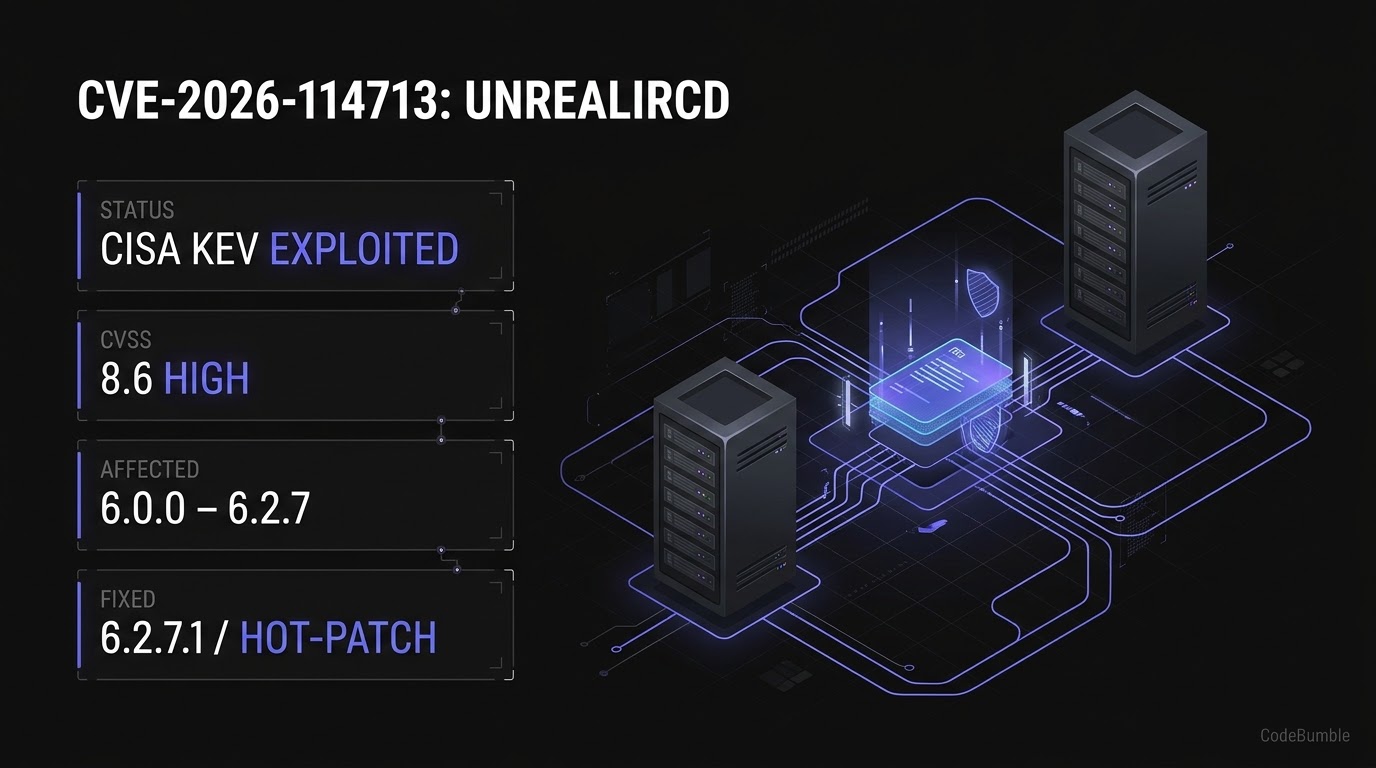
Executive Summary
On November 13, 2026, the U.S. Cybersecurity and Infrastructure Security Agency (CISA) added CVE-2026-114713—an improper neutralization of delimiters vulnerability (CWE-140, CVSS v3.1 8.6 HIGH) in UnrealIRCd—to its Known Exploited Vulnerabilities (KEV) Catalog based on evidence of active exploitation in the wild. Under Binding Operational Directive (BOD) 26-04, Federal Civilian Executive Branch (FCEB) agencies face an urgent remediation deadline of November 16, 2026, and CISA urges all private and community infrastructure operators to patch or mitigate immediately.
Tracked in the NIST National Vulnerability Database (NVD) and detailed in UnrealIRCd maintainer Bram Matthys's (Syzop) oss-security advisory (released November 7–8, 2026), the flaw resides in the labeled-response module across UnrealIRCd 6.0.0 through 6.2.7 (as well as end-of-life UnrealIRCd 5). Because the module fails to escape the IRCv3 label message tag when echoing it into replies, any unprivileged user on an IRC network with two or more linked servers can inject newline delimiters (\n) and arbitrary server-to-server commands that execute with server or IRCOp authority.
Matthys—who discovered the flaw alongside eight other security issues during an AI-assisted internal code audit—described CVE-2026-114713 as "the most critical issue found in UnrealIRCd in the past 15 years" and confirmed on November 14 that attackers are actively probing and exploiting unpatched servers on the internet. Fortunately, UnrealIRCd 6.0.0–6.2.7 supports both a zero-downtime hot-patch (bundle-20261107) and an immediate network-wide SPAMFILTER workaround on 6.0.4+ networks, alongside a full release in UnrealIRCd 6.2.7.1.
Technical Mechanics and Architecture
How the IRCv3 label Delimiter Injection Works
Internet Relay Chat (IRC) is a line-delimited, text-based protocol where carriage returns and newlines (\r\n) separate individual protocol commands. Modern IRCv3 extensions allow clients to prepend message tags (such as @label=<token>) to commands so servers can correlate asynchronous replies back to the originating client.
In affected versions of UnrealIRCd (6.0.0 before 6.2.7.1, plus EOL UnrealIRCd 5), the labeled-response module echoes the client-supplied label tag value into server replies without neutralizing embedded newline or delimiter characters. On a standalone single-server deployment, this boundary is contained; however, on a multi-server linked IRC network (two or more linked servers), the echoed reply traverses the trusted server-to-server (S2S) link. When a receiving linked server parses the S2S stream, an unescaped newline splits the message into a new, trusted server-to-server command—granting an ordinary unauthenticated or standard user server/IRCOp authority to issue privileged operations such as KILL (disconnecting users) or GLINE (network-wide bans):
+-----------------------------------------------------------------------------+
|     CVE-2026-114713: UNREALIRCD MULTI-SERVER DELIMITER INJECTION FLOW       |
+-----------------------------------------------------------------------------+
|                                                                             |
|  [ UNPRIVILEGED IRC CLIENT ]                                                |
|   Sends command with unescaped IRCv3 @label= tag containing delimiter (\n)  |
|             |                                                               |
|             v                                                               |
|  [ LINKED SERVER A: labeled-response module (UnrealIRCd 6.0.0 - 6.2.7) ]    |
|   |-- Vulnerable: Echoes @label= into reply without escaping delimiters     |
|   +-- Mitigated:  SPAMFILTER regex blocks invalid @label= OR hot-patched    |
|             |                                                               |
|             v  (Trusted Server-to-Server Link)                              |
|  [ LINKED SERVER B: S2S Command Parser ]                                    |
|   Parses injected newline as a new S2S frame -> executes with SERVER/IRCOp  |
|   authority (e.g., unauthorized KILL, GLINE, network disruption)            |
+-----------------------------------------------------------------------------+
Affected & Fixed Versions Matrix
Per the NIST NVD record and UnrealIRCd's oss-security advisory:
| UnrealIRCd Branch / Version | Status | Impact & Remediation Path |
|---|---|---|
| UnrealIRCd 6.0.0 – 6.2.7 | Affected | Apply zero-downtime hot-patch bundle-20261107 or upgrade to 6.2.7.1; networks on 6.0.4+ can deploy the SPAMFILTER rule immediately |
| UnrealIRCd 6.2.7.1 | Fixed | Official patched release addressing CVE-2026-114713 plus 8 additional security bugs |
| UnrealIRCd 5 (EOL since 2023-07-01) | Affected | End-of-life; temporary workaround is blacklist-module "labeled-response"; + full restart, then migrate to UnrealIRCd 6 |
| UnrealIRCd 3.2.x / 4 (EOL) | Unverified / High Risk | Maintainer warns EOL releases are unsupported and likely share multiple unpatched bugs; upgrade to UnrealIRCd 6 |
Defensive Code: Auditing Logs for Anomalous label= Tags and S2S Spikes
While UnrealIRCd's SPAMFILTER handles real-time blocking at the protocol edge, security and SRE teams should also inspect historical server logs for malformed label= tags or unexpected KILL/GLINE bursts issued since November 7, 2026. The following read-only Python script scans UnrealIRCd log files for non-conforming label= tag characters (control characters, semicolons, or whitespace outside [A-Za-z0-9_-]) and flags sudden KILL/GLINE events for manual triage:
import re
from pathlib import Path

# Matches IRCv3 label= tags containing disallowed control/delimiter bytes
VALID_LABEL_RE = re.compile(r"^label=[^\r\n;\x20]+$")
LABEL_EXTRACT_RE = re.compile(r"(?:^|[;\s])(label=[^\s]+)")
PRIV_CMD_RE = re.compile(r"\b(KILL|GLINE|SHUN|ZLINE)\b", re.IGNORECASE)

def audit_unrealircd_log(log_path: str) -> dict[str, list[str]]:
    """
    Read-only defensive audit for suspicious IRCv3 label tags or unexpected
    server-level moderation commands in UnrealIRCd text logs.
    """
    findings: dict[str, list[str]] = {"invalid_labels": [], "privileged_cmds": []}
    path = Path(log_path)

    if not path.is_file():
        raise FileNotFoundError(f"Log file not found: {log_path}")

    with path.open("r", encoding="utf-8", errors="replace") as handle:
        for line_no, line in enumerate(handle, start=1):
            for match in LABEL_EXTRACT_RE.finditer(line):
                tag = match.group(1)
                if not VALID_LABEL_RE.match(tag):
                    findings["invalid_labels"].append(f"Line {line_no}: {tag!r}")

            if PRIV_CMD_RE.search(line):
                findings["privileged_cmds"].append(f"Line {line_no}: {line.strip()[:160]}")

    return findings
Evidence: Active Exploitation, Timeline, and the AI-Audit Disclosure Context
Multiple primary and security-press sources confirm both the severity and the compressed exploitation timeline of CVE-2026-114713:
- Timeline from Patch to CISA KEV:
- November 7, 2026: UnrealIRCd releases version
6.2.7.1and hot-patchbundle-20261107, fixingCVE-2026-114713and eight other security issues (including two user-decloaking IP leaks, a blacklist recheck hang, aCHGIDENTcrash, a"This server is full"counting bug, Services ban limits, a TLS renegotiation flood issue, and awhowasdbcrash). - November 8, 2026: Maintainer Bram Matthys posts the full advisory to oss-security, noting that exploitation attempts began within a day of the November 7 fix.
- November 13, 2026: CISA adds
CVE-2026-114713(alongside Check PointCVE-2026-123039) to the KEV Catalog under BOD 26-04. - November 14, 2026: The Hacker News and Security Affairs report Matthys's confirmation ("We are seeing bad guys exploiting this issue on the internet right now") and highlight the November 16, 2026 federal remediation deadline.
- November 7, 2026: UnrealIRCd releases version
- CVSS & Attack Vector: MITRE scores the vulnerability at 8.6 HIGH (
CVSS:3.1/AV:N/AC:L/PR:N/UI:N/S:C/C:N/I:H/A:N), reflecting network reachability, low attack complexity, zero privileges required, and a Changed Scope (S:C) with High Integrity impact (I:H) across linked servers. - AI-Assisted Discovery Warning: In his oss-security post, Matthys disclosed that he spent roughly 100 hours since February 2026 auditing UnrealIRCd with AI tools—and warned operators of any network daemon that has not shipped major security fixes recently that adversaries are likely probing legacy codebases with similar AI tooling.
- Confidence & Benchmark Caveat: Confidence Level: High on affected versions, CISA KEV status, BOD 26-04 deadline, and remediation commands (verified across CISA, NVD, oss-security, The Hacker News, and Security Affairs). Attribution & Telemetry Caveat: As of November 14, 2026, neither CISA nor the UnrealIRCd project has published attacker attribution, specific campaign IOCs/IPs, or a global count of compromised IRC networks; operators must treat any unpatched multi-server UnrealIRCd instance exposed since November 7 as potentially probed.
Hardening Playbook: Immediate Workaround, Hot-Patch, and Verification
Follow the exact remediation sequence published by the UnrealIRCd maintainer, prioritizing multi-server linked networks first:
Step 1: Apply the Immediate SPAMFILTER Workaround (Networks on 6.0.4+)
If all linked servers on your IRC network run UnrealIRCd 6.0.4 or newer, an IRCOp can immediately block malformed label tags network-wide while preparing the hot-patch or upgrade:
SPAMFILTER add -regex T block - Invalid_label ^label=(?![^\r\n;\x20]*\z)
(Note: This protects against CVE-2026-114713 across linked 6.0.4+ servers, but does not fix the other eight security issues in 6.2.7.1, so proceed immediately to Step 2 or Step 3.)
Step 2: Deploy the Zero-Downtime Hot-Patch (*NIX, 6.0.0 – 6.2.7)
On Unix/Linux servers running UnrealIRCd 6.0.0 through 6.2.7, apply the official hot-patch bundle without restarting the daemon or disconnecting users:
./unrealircd hot-patch bundle-20261107
Look for "Patch installed and server rehashed correctly. All should be good now!" (or "Done! All should be good now" on older 6.x builds).
Step 3: Verify Patch Status Across Every Local and Remote Server
On UnrealIRCd 6.0.2+, verify the running labeled-response module from the shell:
./unrealircd module-status | grep labeled-response
- Safe (hot-patched):
labeled-response 5.0-hot-patch-bundle-20261107 - Safe (upgraded):
6.2.7.1 - Vulnerable:
5.0without the patch-bundle suffix
You can also verify remote linked servers as an IRCOp over IRC using MODULE -all and MODULE -all remote.server.name.
Step 4: Upgrade to 6.2.7.1 (Windows or Hot-Patch Fallback)
If you run UnrealIRCd on Windows, or if hot-patching fails (for example, after a host OS distribution upgrade), run the standard upgrade and restart the server:
./unrealircd upgrade
Step 5: Mitigate End-of-Life UnrealIRCd 5 (and Migrate Off EOL)
For legacy UnrealIRCd 5 deployments (EOL since July 1, 2023), add the following directive to the configuration on every server and perform a full restart (a rehash is insufficient), then schedule migration to UnrealIRCd 6:
blacklist-module "labeled-response";
Step 6: Rollback Notes & Post-Patch Forensics
- Workaround Rollback: Once every linked server is verified on
6.2.7.1orbundle-20261107, you may remove theInvalid_labelspamfilter rule if needed, though keeping strictlabel=character validation poses minimal operational risk to compliant IRCv3 clients. - Forensics Triage (BOD 26-04): Per CISA's BOD 26-04 guidance, check server logs (
KILL,GLINE,OPescalations, andlabeled-responseerrors) between November 7 and your patch timestamp for signs of unauthorized server-authority commands before assuming the host is clean.
Frequently Asked Questions
1. Is a single standalone UnrealIRCd server vulnerable to CVE-2026-114713?
Per the NIST NVD and UnrealIRCd advisory, server-to-server command injection requires a network with two or more linked servers. However, standalone servers on 6.0.0–6.2.7 are still affected by the other eight security bugs fixed in 6.2.7.1 (including two IP-decloaking flaws and multiple crashes), so you should still hot-patch or upgrade.
2. Does CVE-2026-114713 give attackers OS-level shell access?
No. The vulnerability grants IRC server / IRCOp authority within the IRC network—allowing attackers to issue privileged IRC commands such as KILL and GLINE across linked servers—rather than direct operating-system shell execution.
3. Can I patch CVE-2026-114713 without disconnecting my IRC users?
Yes, on Unix/Linux systems running UnrealIRCd 6.0.0–6.2.7. Running ./unrealircd hot-patch bundle-20261107 patches the labeled-response module and other eight bugs in place without restarting the IRC daemon.
4. Why did CISA add CVE-2026-114713 to the KEV Catalog?
CISA added CVE-2026-114713 on November 13, 2026, because of confirmed active exploitation in the wild—corroborated by the UnrealIRCd maintainer's warning that attackers began targeting unpatched servers within a day of the November 7 fix.
5. Is UnrealIRCd 5 affected, and does a config rehash protect it?
Yes, UnrealIRCd 5 is affected. You must add blacklist-module "labeled-response"; to your configuration on every server and restart the server (a REHASH will not unload the module), then upgrade to UnrealIRCd 6 as soon as possible.
Sources
- CISA Alert: CISA Adds Two Known Exploited Vulnerabilities to Catalog — Released November 13, 2026.
- NIST NVD: CVE-2026-114713 Detail — Published November 7, 2026; Last Modified November 8, 2026.
- oss-security: UnrealIRCd 6.2.7.1 released & hot-patch (CVE-2026-114713) — Posted November 8, 2026 (mirroring official advisory at
https://forums.unrealircd.org/viewtopic.php?t=9487). - The Hacker News: Attackers Exploit UnrealIRCd Flaw That Enables Server-Level Command Injection — Published November 14, 2026.
- Security Affairs: U.S. CISA adds Check Point and UnrealIRCd flaws to its Known Exploited Vulnerabilities catalog — Published November 14, 2026.