

Web performance
Chrome 159 Beta Arrives With 8 WebTransport Overhauls, Cross-Origin Iframe Prerendering, and ServiceWorker Race Diagnostics
Chrome 159 Beta (Nov 12, 2026) ships 8 WebTransport latency and telemetry upgrades, cross-origin iframe prerendering via Supports-Loading-Mode, and distinct ServiceWorker race diagnostics.
8 min read
Chrome 159 Beta Arrives With 8 WebTransport Overhauls, Cross-Origin Iframe Prerendering, and ServiceWorker Race Diagnostics
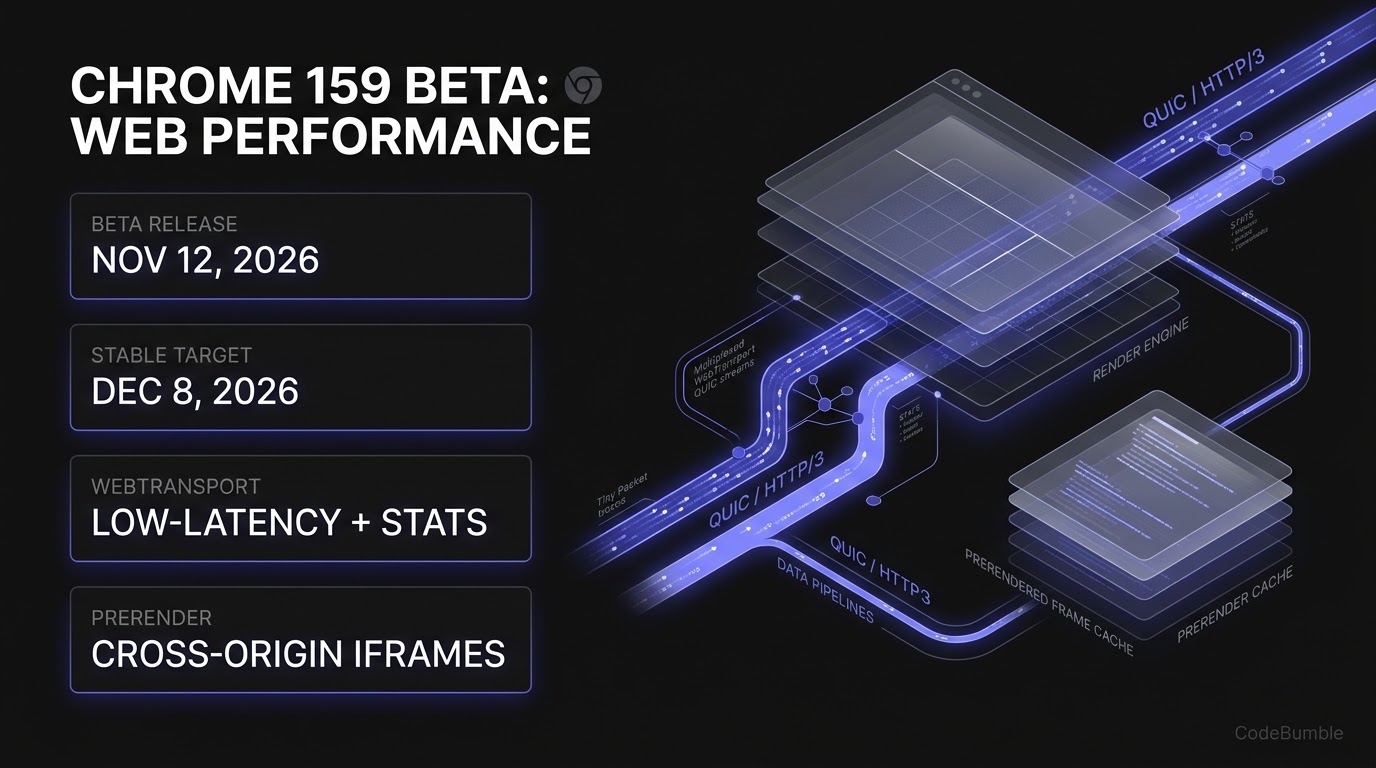
Executive Summary
On November 12, 2026, Google promoted Chrome 159 (159.0.8154.6 on Windows, Mac, and Linux; 159.0.8154.4 on Android; 159.0.8154.5 on iOS) to the Beta channel, with Stable release scheduled for December 8, 2026, according to Chrome for Developers, Chrome Releases, and the Chrome 159 Release Notes on Chrome Platform Status.
While Chrome 159 includes CSS Color Module Level 4 alignments (AccentColor / AccentColorText), single-axis scroll snap fixes, and TC39 regular expression buffer boundaries (\A, \z, \Z), the release's heaviest engineering investments target web performance, transport latency, and navigation telemetry:
- 8 WebTransport Transport & Observability Upgrades: Chrome 159 introduces session-level
congestionControl("default","throughput","low-latency"),WebTransport.getStats()connection telemetry (RTT, estimated sending rate, and expired/lost/dropped datagrams),WebTransportReceiveStreambyte counters (bytesReceivedvs.bytesRead),sendGroup/sendOrderstream and datagram prioritization,datagramsReadableType: "bytes"(BYOB reading),WebTransport.exportKeyingMaterial(), and structured-clonableWebTransportErrorserialization. - Prerendering Cross-Origin Iframes: Sites can now opt into prerendering all cross-origin
<iframe>embeds when the top-level HTTP response includesSupports-Loading-Mode: prerender-cross-origin-frames. - ServiceWorker Static Routing Race Diagnostics: When a Service Worker
race-network-and-fetch-handlerrule cancels a deduplicatedfetch(event.request)before headers arrive, Chromium now rejects with a distinctTypeErrormessage rather than a generic"Failed to fetch", allowing RUM scripts to separate expected race cancellations from real network outages.
This technical briefing details the architecture of Chrome 159 Beta's networking and prerendering changes, provides production-ready JavaScript and HTTP header configurations, and outlines a verification playbook ahead of the December 8 Stable rollout.
Technical Mechanics and Architecture
How Chrome 159's Transport & Prerender Pipelines Work
Modern web applications face two orthogonal performance bottlenecks: navigation startup latency (waiting for third-party or embedded cross-origin iframes during speculative prerenders) and real-time transport head-of-line blocking (inability to prioritize streams, tune congestion control, or inspect QUIC/HTTP/3 datagram loss). Chrome 159 Beta addresses both layers directly in Blink and the Chromium network stack:
+-----------------------------------------------------------------------------+
|        CHROME 159 BETA: PRERENDER & WEBTRANSPORT PERFORMANCE PIPELINE       |
+-----------------------------------------------------------------------------+
|                                                                             |
|  [ NAVIGATION & SERVICE WORKER LAYER ]                                      |
|   |-- Top-level HTTP Response:                                              |
|   |    Supports-Loading-Mode: prerender-cross-origin-frames                 |
|   |      -> Prerenders cross-origin iframes ahead of activation             |
|   +-- ServiceWorker Static Routing (race-network-and-fetch-handler):        |
|        -> Cancelled race fetch rejects with distinct TypeError message      |
|           (separates expected race aborts from real net::ERR_* failures)    |
|             |                                                               |
|             v                                                               |
|  [ WEBTRANSPORT OVER HTTP/3 LAYER (8 New Capabilities) ]                    |
|   |-- Constructor: congestionControl ("default"|"throughput"|"low-latency") |
|   |-- Datagrams:   datagramsReadableType: "bytes" (BYOB) + sendGroup/Order  |
|   |-- Streams:     WritableStream sendGroup/sendOrder + ReceiveStream stats |
|   +-- Telemetry:   WebTransport.getStats() -> RTT, sendRate, datagram loss  |
+-----------------------------------------------------------------------------+
The 8 WebTransport Upgrades in Chrome 159 Beta
Per Chrome Platform Status, Chrome 159 ships all eight of the following WebTransport capabilities simultaneously:
| Feature | API Surface | Performance / Engineering Impact |
|---|---|---|
| 1. Congestion Control | new WebTransport(url, { congestionControl }) |
Lets apps request "default", "throughput", or "low-latency" congestion control per session |
| 2. Connection Statistics | await transport.getStats() |
Exposes RTT, estimated sending rate, and expired/lost/dropped datagram counts—even after close |
| 3. Send Groups & Prioritization | sendGroup / sendOrder on WritableStream |
Prioritizes critical control/media streams ahead of bulk background transfers within a group |
| 4. Datagram Writable Prioritization | datagrams.createWritable() |
Adds sendGroup/sendOrder on datagram writables and enforces negotiated max payload size |
| 5. Datagram BYOB Byte Streams | datagramsReadableType: "bytes" |
Enables zero-copy Bring-Your-Own-Buffer (ReadableStreamBYOBReader) reading for incoming datagrams |
| 6. Receive Stream Byte Counters | WebTransportReceiveStream.getStats() |
Separates bytesReceived (from network) vs. bytesRead (delivered to JS) for backpressure tuning |
| 7. Keying Material Export | transport.exportKeyingMaterial(label, ctx, len) |
Derives 1–4096 bytes bound to the HTTP/3 CONNECT stream ID (labels/contexts up to 255 bytes) |
8. WebTransportError Serialization |
structuredClone(err) / (msg, options) |
Preserves message, source, and full unsigned-long error code across postMessage / Workers |
Defensive & Performance Code 1: Low-Latency WebTransport Session With Telemetry
The following production-safe JavaScript snippet initializes a WebTransport session requesting "low-latency" congestion control and "bytes" datagram reading, and safely polls getStats() while guarding against unsupported browsers:
async function connectLowLatencyTransport(endpointUrl) {
  if (!("WebTransport" in globalThis)) {
    throw new Error("WebTransport is not supported in this browser.");
  }

  const transport = new WebTransport(endpointUrl, {
    congestionControl: "low-latency",
    datagramsReadableType: "bytes",
  });

  await transport.ready;

  // Poll connection-level RTT and datagram loss telemetry
  const stats = await transport.getStats();
  const datagrams = stats.datagrams ?? {};
  console.info("WebTransport connected", {
    congestionControl: transport.congestionControl,
    rttMs: stats.rtt ?? null,
    estimatedSendRateBps: stats.estimatedSendRate ?? null,
    droppedDatagrams: datagrams.droppedIncoming ?? 0,
    lostDatagrams: datagrams.lostOutgoing ?? 0,
  });

  return transport;
}
Defensive & Performance Code 2: Distinguishing ServiceWorker Race Cancellations in RUM
When using ServiceWorker Static Routing with race-network-and-fetch-handler, Chrome 159 rejects cancelled raced fetch(event.request) calls with:
"The service worker race-network-and-fetch-handler request was cancelled before 'fetch()' settled."
Your Service Worker fetch handler can inspect err.message so expected race cancellations do not pollute your Real User Monitoring (RUM) error alerts:
const RACE_CANCEL_MSG =
  "The service worker race-network-and-fetch-handler request was cancelled before 'fetch()' settled.";

self.addEventListener("fetch", (event) => {
  event.respondWith(
    (async () => {
      try {
        return await fetch(event.request);
      } catch (err) {
        if (err instanceof TypeError && err.message === RACE_CANCEL_MSG) {
          // Expected pre-settlement race cancellation (not a network outage)
          return Response.error();
        }
        // Real network failure: report to telemetry or serve offline fallback
        throw err;
      }
    })()
  );
});
Evidence: Scope, Rollout Dates, and Telemetry Caveats
All dates, version numbers, and API behaviors in this briefing are sourced directly from Chromium's primary release channels:
- Beta & Stable Schedule: Chrome for Developers and Chrome Releases confirm Chrome 159 entered Beta on November 12, 2026 (
159.0.8154.6Desktop;159.0.8154.4Android;159.0.8154.5iOS). Chrome Platform Status lists the scheduled Stable release as December 8, 2026 (note:chromestatus.comroadmap summary widgets also reflect Chromium's two-week release cadence shifts, so teams should track therelease-notes/159target date of December 8 while verifying Chrome 158 Stable rollout starting November 17). - WebTransport Telemetry Boundaries: Per Chrome Platform Status,
WebTransport.getStats()exposes RTT, estimated sending rate, and expired/lost/dropped datagram counts (and remains readable after connection close), but Chromium does not currently expose connection-level total byte or packet counters onWebTransport.getStats(). To measure per-stream bytes, useWebTransportReceiveStream.getStats()(bytesReceivedvs.bytesRead). - Additional Web Platform & Performance Items in Chrome 159:
- Scroll Snap for Single-Axis Scroll Containers: Containers with
overflow: auto clipnow handle scroll snap alignment strictly on the scrollable axis and propagate the non-scrollable axis to the nearest scrollable ancestor. CSSImportRule.styleSheet: Returnsnullwhen an@importrule has no associated stylesheet (for example, when itssupports()condition evaluates to false).- Sanitizer API
javascriptURLsOption: Aligns with WHATWG HTML PR#12898sojavascript:URL sanitization is an explicit developer-selectable option onSanitizerConfig/Sanitizer. - Origin Trial — Web Authentication Conditional UI Passive Mode ("Ambient"): Allows
navigator.credentials.get()to surface non-modal passkey/password sign-in suggestions without requiring a login<form>on the page.
- Scroll Snap for Single-Axis Scroll Containers: Containers with
- Confidence & Benchmark Caveat: Confidence Level: High on all Chrome 159 Beta APIs, error strings, and release dates (verified across Chrome Platform Status, Chrome for Developers, and Chrome Releases). Benchmark Caveat: Chromium's Chrome 159 Beta release notes do not publish synthetic throughput, CPU, or LCP millisecond benchmarks for
congestionControl: "low-latency"orprerender-cross-origin-frames. Teams should measure real-user LCP, INP, andWebTransport.getStats()RTT in Beta/Canary before shipping production header changes.
Performance & Deployment Playbook
Step 1: Enable Cross-Origin Iframe Prerendering Selectively at the Edge
Add the Supports-Loading-Mode: prerender-cross-origin-frames response header only on top-level HTML documents whose embedded cross-origin iframes are safe to execute speculatively (for example, embedded documentation widgets or media players, rather than stateful payment or one-time-token frames):
# Enable cross-origin iframe prerendering on eligible top-level HTML routes
location /docs/ {
    add_header Supports-Loading-Mode "prerender-cross-origin-frames" always;
}
Step 2: Update ServiceWorker Error Classification Before December 8, 2026
Audit any Service Worker using Static Routing's race-network-and-fetch-handler and update catch blocks to recognize "The service worker race-network-and-fetch-handler request was cancelled before 'fetch()' settled." so Chrome 159 users do not trigger false-positive network outage alerts.
Step 3: Feature-Detect New WebTransport Options Gracefully
When adopting congestionControl: "low-latency" or datagramsReadableType: "bytes", wrap getStats() and WebTransportReceiveStream.getStats() in defensive property checks (typeof transport.getStats === "function"), because older Chromium builds (<= 158) and non-Chromium browsers may omit these methods.
Step 4: Verify Single-Axis Scroll Containers With overflow: auto clip
If your layout uses single-axis scroll containers with scroll-snap-type, test scrolling behavior in Chrome 159 Beta (159.0.8154.6) to confirm that cross-axis snap areas now propagate cleanly to ancestor scrollers as intended.
Step 5: Rollback Notes
- Prerender Header Rollback: If
Supports-Loading-Mode: prerender-cross-origin-framescauses unexpected third-party analytics impressions or backend load on embedded origins during speculative prerenders, remove the header at your CDN/Nginx layer—no client-side code deploy is required. - WebTransport Serialization Kill Switch: Chrome 159 enables
WebTransportErrorstructured-clone serialization by default behind a Chromium runtime kill switch; if your Worker messaging layer relies on legacy error-swallowing behavior, testpostMessageerror handlers in Beta prior to December 8.
Frequently Asked Questions
1. When does Chrome 159 reach the Stable channel?
Chrome 159 entered Beta on November 12, 2026, and Chrome Platform Status lists its scheduled Stable release date as December 8, 2026.
2. How do I opt into prerendering cross-origin iframes in Chrome 159?
Include the HTTP response header Supports-Loading-Mode: prerender-cross-origin-frames on the top-level document's HTTP response. Browsers supporting the header will prerender eligible cross-origin frames during speculation-rules prerenders.
3. Does WebTransport.getStats() expose total connection bytes sent and received?
No. In Chrome 159, WebTransport.getStats() provides RTT, estimated sending rate, and expired/lost/dropped datagram counts, but does not expose connection-level byte or packet totals. Use WebTransportReceiveStream.getStats() (bytesReceived and bytesRead) for per-stream byte counters.
4. Why did my ServiceWorker Static Routing TypeError message change in Chrome 159?
When a race-network-and-fetch-handler raced fetch(event.request) is cancelled before response headers arrive, Chrome 159 rejects with "The service worker race-network-and-fetch-handler request was cancelled before 'fetch()' settled." instead of "Failed to fetch", matching Navigation Preload so apps can distinguish expected race cancellations from real network errors.
5. What is WebTransport.exportKeyingMaterial() used for?
It derives cryptographic keying material (1 to 4,096 bytes) bound to an established WebTransport session using application-supplied label and context values (up to 255 bytes each). Over HTTP/3, Chromium includes the CONNECT stream ID in the TLS exporter context so multiplexed WebTransport sessions on the same HTTP/3 connection derive distinct keys.
Sources
- Chrome Platform Status: Chrome 159 Release Notes — Beta channel feature & schedule documentation (Verified November 14, 2026).
- Chrome for Developers: Chrome 159 beta — Published November 12, 2026.
- Chrome Releases: November 2026 (Chrome Beta for Desktop Update) — Published November 12, 2026.