

Web performance
Intel Quietly Seeds Linux Kernel and GCC 17 for 2028 Razor Lake and Coral Rapids CPUs
Intel engineers posted the first Linux kernel family/model IDs and GCC 17 compiler patches for 2028 Razor Lake client and Coral Rapids Xeon server CPUs on November 13, 2026. Learn what Family 18 (0x12) and Family 19 (0x13) reveal about AVX10.2, APX_F, AMX-FP8, and post-quantum ML-DSA acceleration.
8 min read
Intel Quietly Seeds Linux Kernel and GCC 17 for 2028 Razor Lake and Coral Rapids CPUs
Executive Summary
On November 13, 2026, Intel engineers initiated upstream open-source toolchain and operating system enablement for two processor families not expected to ship until 2028: Razor Lake (mainstream desktop and mobile successor to Nova Lake) and Coral Rapids (next-generation Xeon server successor to Diamond Rapids). Intel engineer Tony Luck submitted the initial Linux kernel patch establishing CPU family and model identifiers, while Intel compiler engineer Haochen Jiang (on behalf of Qin Sun) posted the corresponding GCC 17 enablement patches on the GCC mailing list (Phoronix, GCC Patches). Simultaneously, Intel published Revision 063 of its Architecture Instruction Set Extensions Programming Reference, documenting CPUID signatures and new architectural features for both silicon families (TechPowerUp).
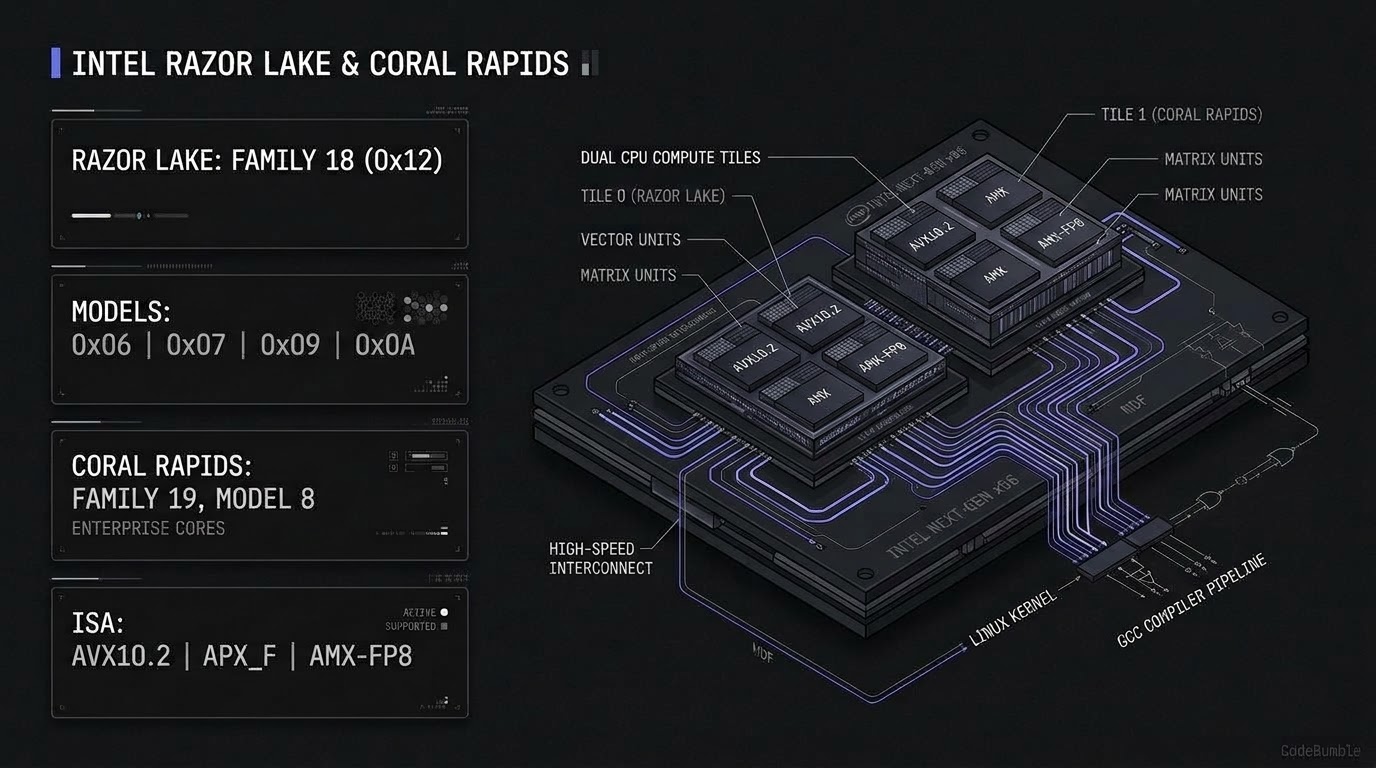
While the initial kernel submission intentionally omits clock speeds, core counts, cache capacities, and power envelopes, the combined kernel, GCC, and ISA documentation provides concrete architectural signals for Linux performance engineers and compiler maintainers. Razor Lake is assigned four model IDs under Family 18 (0x12)—matching Nova Lake's instruction set (AVX10.2, APX_F, MOVRS, SHA512, SM3, SM4)—while Coral Rapids lands under Family 19 (0x13), Model 8, adding server matrix extensions (AMX-FP8, AMX-AVX512, AMX-TF32) and a dedicated post-quantum cryptography intrinsic (AVX10_VPMLDSABFLYDQ for ML-DSA) while staying on AVX10.2 rather than AVX10.3 (BigGo Finance, TechPowerUp).
Confidence Level: High for CPUID family/model identifiers, GCC -march=razorlake alias behavior, and documented ISA flags (verified directly against gcc-patches [PATCH 2/3] and Intel ISA Reference Revision 063 reporting). Low/Unconfirmed for retail launch dates, LGA 1954 socket reuse on Razor Lake-S, and performance benchmarks—Intel has not confirmed launch quarters, socket compatibility, or performance figures, and any 2028 or socket-reuse timeline remains an industry expectation rather than an official commitment (Shattered.io).
Why Early Kernel & Compiler Enablement Matters for Performance
Upstreaming CPU identifiers roughly 18 to 24 months ahead of hardware availability is a deliberate engineering strategy for Linux and enterprise server ecosystems. A Linux kernel patch submitted to the Linux Kernel Mailing List (LKML) must pass subsystem maintainer review, land in a merge window, reach mainline releases, and then filter down into long-term support (LTS) enterprise distributions. Similarly, GCC 17.1 (expected in early 2027) and downstream enterprise toolchains take months to propagate into CI/CD build farms and container base images (BigGo Finance).
Without early Family/Model ID definitions in arch/x86/include/asm/intel-family.h and gcc/common/config/i386/cpuinfo.h, downstream performance subsystems have nothing to key off:
- Linux Performance Monitoring Units (PMU) &
perf: Hardware event tables, uncore counters, and top-down microarchitecture analysis (TMA) cannot bind to silicon without registered model IDs. - Scheduler & Power Management (
intel_pstate,intel_idle): Hybrid core topology, thread-director hints, and C-state/P-state residency tables depend on explicit family/model dispatch. - Compiler Auto-Vectorization &
-march=native: Runtime CPU feature detection (__builtin_cpu_isand__builtin_cpu_supports) in GCC and glibc relies oncpuinfo.hmapping CPUID signatures to the correct Processor Target Architecture (PTA_*) bitmasks.
Technical Mechanics & Architecture
1. Linux Kernel Family & Model ID Taxonomy
In Linux kernel notation and Intel's ISA Reference Revision 063, Intel's post-Family-6 numbering continues with Family 18 (0x12) for client platforms (Nova Lake and Razor Lake) and Family 19 (0x13) for server Xeon platforms (Diamond Rapids at 0x01 and Coral Rapids at 0x08).
Intel x86-64 Enablement Pipeline (Nov 2026 -> 2028 Hardware):
  [CPUID Hardware Signature]
     ├── Family 18 (0x12): Client (Nova Lake -> Razor Lake)
     │      ├── Model 0x06 (CPUID 300F6x) -> Razor Lake (Desktop)
     │      ├── Model 0x07 (CPUID 300F7x) -> Razor Lake L (Mobile/Laptop)
     │      ├── Model 0x09 (CPUID 300F9x) -> Razor Lake U (Mobile/Laptop)
     │      └── Model 0x0A (CPUID 300FAx) -> Razor Lake S (Desktop)
     └── Family 19 (0x13): Xeon Server (Diamond Rapids -> Coral Rapids)
            └── Model 0x08 (13_08H)       -> Coral Rapids (AVX10.2 + AMX-FP8 + ML-DSA)
                    │
                    ▼
  [Linux Kernel] (intel-family.h) ──> [GCC 17] (cpuinfo.h / i386-common.cc)
Notice the deliberate gap at Model 0x08 within Family 18: the November 13 patch defines Models 6, 7, 9, and 10 (0x06, 0x07, 0x09, 0x0a), and available reporting explicitly cautions against speculating about the unallocated 0x08 slot (Shattered.io).
2. GCC 17 Compiler Implementation ([PATCH 2/3] & [PATCH 3/3])
In [PATCH 2/3] Initial Razor Lake support (gcc-patches), Intel maps all four Razor Lake model IDs (0x06, 0x07, 0x09, 0x0a) directly to the novalake CPU detection path in gcc/common/config/i386/cpuinfo.h, and adds a "razorlake" entry in gcc/common/config/i386/i386-common.cc using PROCESSOR_NOVALAKE, PTA_NOVALAKE, and P_PROC_AVX10_2.
This confirms that, from a compiler code-generation perspective, Razor Lake shares Nova Lake's full ISA feature set:
- Vector & General-Purpose Extensions:
AVX10.1,AVX10.2,APX_F(Advanced Performance Extensions),MOVRS(Move with Read-Shared hint),PREFETCHI,CMPCCXADD,SERIALIZE,UINTR. - AI & Crypto Extensions:
AVX-VNNI,AVXVNNIINT8,AVXVNNIINT16,AVXIFMA,AVXNECONVERT,SHA512,SM3,SM4,VAES,VPCLMULQDQ.
By contrast, Coral Rapids ([PATCH 3/3] Initial Coral Rapids Support) diverges on server-class compute and cryptography:
- Matrix & AI Acceleration: Adds
AMX-FP8,AMX-AVX512, andAMX-TF32alongsideAMX-FP16andAMX-COMPLEX. - Post-Quantum Cryptography: Introduces
AVX10_VPMLDSABFLYDQ, a packed butterfly instruction intrinsic designed to accelerate ML-DSA (Module-Lattice-Based Digital Signature Algorithm) operations (TechPowerUp, BigGo Finance). - Speculative & Virtualization Controls: Intel's ISA Reference Revision 063 documents
SSBD_PSFD_U_Sfor Razor Lake (enabling separate user-mode and supervisor-mode Speculative Store Bypass Disable / Predictive Store Forwarding Disable controls) and APIC-Timer Virtualization across both families (TechPowerUp).
Evidence, Feature Matrix & Benchmark Availability
The table below summarizes the verified identifiers and architectural attributes across the November 13–15, 2026 disclosures:
| Platform | Segment | Linux Kernel ID | ISA Ref Rev 063 / CPUID | Key Confirmed ISA & Security Features |
|---|---|---|---|---|
| Razor Lake | Client (Base) | Family 18, Model 6 (0x06) |
12_06H / 300F6x (Desktop) |
Nova Lake ISA alias (AVX10.2, APX_F, MOVRS), SSBD_PSFD_U_S, APIC-Timer Virt |
| Razor Lake L | Client (Mobile) | Family 18, Model 7 (0x07) |
12_07H / 300F7x (Laptop) |
Same GCC PTA_NOVALAKE feature set as Nova Lake |
| Razor Lake U | Client (Mobile) | Family 18, Model 9 (0x09) |
12_09H / 300F9x (Laptop) |
Same GCC PTA_NOVALAKE feature set as Nova Lake |
| Razor Lake S | Client (Desktop) | Family 18, Model 10 (0x0a) |
12_0AH / 300FAx (Desktop) |
Same GCC PTA_NOVALAKE feature set; LGA 1954 reuse expected, unconfirmed |
| Coral Rapids | Xeon Server | Family 19, Model 8 (0x08) |
13_08H |
AVX10.2 (no AVX10.3), APX_F, AMX-FP8, AMX-AVX512, AMX-TF32, AVX10_VPMLDSABFLYDQ |
Benchmark Availability Note: No performance benchmarks, IPC deltas, clock frequencies, core counts, or memory bandwidth numbers exist for Razor Lake or Coral Rapids as of November 15, 2026. The initial kernel and GCC patches strictly define CPUID matching and ISA flag bitmasks; any performance claims circulating prior to silicon sampling are unverified speculation (Shattered.io).
Engineering & Toolchain Readiness Playbook
Linux systems engineers, compiler maintainers, and fleet architects can use the following safe, read-only checks and CI preparation steps to track upstream enablement without risking production stability:
Step 1: Audit Current Host CPU Family & Model Notation on Linux
Before comparing upstream kernel patches against production fleets, verify how your current Linux hosts report decimal vs. hexadecimal family/model values:
# Read decimal CPU family and model from lscpu and /proc/cpuinfo
lscpu | grep -E "Vendor ID|CPU family|Model:|Model name"
grep -m 2 -E "cpu family|^model\s" /proc/cpuinfo

# Convert decimal Family/Model to kernel hex notation (e.g., Family 18 -> 0x12, Model 10 -> 0x0a)
python3 -c 'print(f"Family 18 = 0x{18:02x}, Model 10 = 0x{10:02x}, Family 19 = 0x{19:02x}, Model 8 = 0x{8:02x}")'
Step 2: Check Local GCC Compiler Support for novalake / razorlake Targets
In build environments preparing for GCC 17.1 (early 2027), verify whether your installed GCC version recognizes the novalake baseline (which razorlake aliases in [PATCH 2/3]):
# Safe read-only check of supported x86 -march targets in your active GCC toolchain
gcc --version
gcc -Q --help=target -march=novalake 2>&1 | head -n 20
Step 3: Safe Runtime Feature Guarding in C/C++ (Defensive Portability)
When compiling performance-critical vector or post-quantum cryptographic routines targeting future AVX10.2 or APX_F hardware, never assume -march=razorlake binaries will run on older hosts. Always guard dispatch paths at runtime using compiler intrinsics or function multiversioning:
// Safe runtime feature detection before dispatching AVX10.2 / APX paths
#include <stdio.h>

void dispatch_vector_kernel(void) {
#if defined(__GNUC__) && (__GNUC__ >= 16)
    if (__builtin_cpu_supports("avx10.2")) {
        puts("Dispatching AVX10.2-optimized code path.");
        return;
    }
#endif
    puts("Falling back to baseline x86-64-v3 (AVX2) code path.");
}
Step 4: Procurement & Rollback Caution for Hardware Roadmaps
- Do Not Treat Socket Reuse as Guaranteed: Although industry reporting expects Razor Lake-S to reuse Nova Lake-S's LGA 1954 socket, Intel has not confirmed Razor Lake socket compatibility, VRM power-delivery requirements, or chipset BIOS support (Shattered.io).
- Track
AVX10.2vs.AVX10.3Divergence: Because Coral Rapids targetsAVX10.2rather than the newly publishedAVX10.3specification, HPC and AI compiler teams should separateAVX10.2validation pipelines fromAVX10.3(AVX10_BMM) target work (BigGo Finance).
Frequently Asked Questions (FAQs)
1. Does the November 13 Linux kernel patch mean Intel Razor Lake works on Linux today?
No. The initial patch submitted by Tony Luck only registers CPU family and model identifiers so subsequent subsystems (PMU, intel_pstate, EDAC, and thermal drivers) have definitions to reference. Full kernel enablement will arrive across multiple future Linux release cycles (Phoronix).
2. Why does GCC 17 alias -march=razorlake to novalake?
In [PATCH 2/3], Intel states directly: "Add Razor Lake as an alias of Nova Lake since they have the same feature set." Both share PROCESSOR_NOVALAKE, PTA_NOVALAKE, and P_PROC_AVX10_2 (GCC Patches).
3. What new instructions does Coral Rapids add over Razor Lake?
Coral Rapids (Family 19, Model 8) targets Xeon servers and adds AMX-FP8, AMX-AVX512, AMX-TF32, and AVX10_VPMLDSABFLYDQ (for accelerating ML-DSA post-quantum digital signatures), while retaining AVX10.2 and APX_F (BigGo Finance, TechPowerUp).
4. Is LGA 1954 confirmed for Intel Razor Lake-S desktop CPUs? No. While LGA 1954 has been confirmed for Nova Lake-S via Intel's internal test tooling, Intel has made no official statement confirming LGA 1954 reuse for Razor Lake-S (Shattered.io).
5. What is SSBD_PSFD_U_S in Intel's ISA Reference Revision 063?
According to TechPowerUp's review of Revision 063, SSBD_PSFD_U_S appears on Razor Lake to allow independent user-mode and supervisor-mode control over speculative memory behavior (Speculative Store Bypass Disable / Predictive Store Forwarding Disable), alongside APIC-Timer Virtualization for virtual machines (TechPowerUp).
Sources
- GNU GCC Patches Mailing List (
gcc.gnu.org) — [PATCH 2/3] Initial Razor Lake support (Nov 13, 2026): https://gcc.gnu.org/pipermail/gcc-patches/2026-November/738673.html - GNU GCC Patches Mailing List (
gcc.gnu.org) — [PATCH 3/3] Initial Coral Rapids Support (Nov 13, 2026): https://gcc.gnu.org/pipermail/gcc-patches/2026-November/738674.html - Phoronix — Intel Begins Linux Kernel Enablement For Coral Rapids & Razor Lake (Nov 14, 2026): https://www.phoronix.com/news/Linux-Coral-Rapids-Razor-Lake
- TechPowerUp — Intel's ISA Reference Confirms Razor Lake Desktop and Laptop Model IDs (Nov 14, 2026): https://www.techpowerup.com/354804/intels-isa-reference-confirms-razor-lake-desktop-and-laptop-model-ids
- Shattered.io — Intel Razor Lake Gets First Linux Patch, 4 Model IDs (Nov 15, 2026): https://shattered.io/intel-razor-lake-first-linux-kernel-patch-four-model-ids-lga-1954/
- BigGo Finance — Intel Opens Linux, GCC Enablement for Razor Lake and Coral Rapids CPUs Years Before 2028 Debut (Nov 14, 2026): https://finance.biggo.com/news/02e9cfe2-e106-4f0a-9150-7931d6dead27