

Security
Cisco Expressway CVE-2026-76466 Exploited in the Wild: Blocking TCP 4371–4372 and Upgrading to X15.5.20
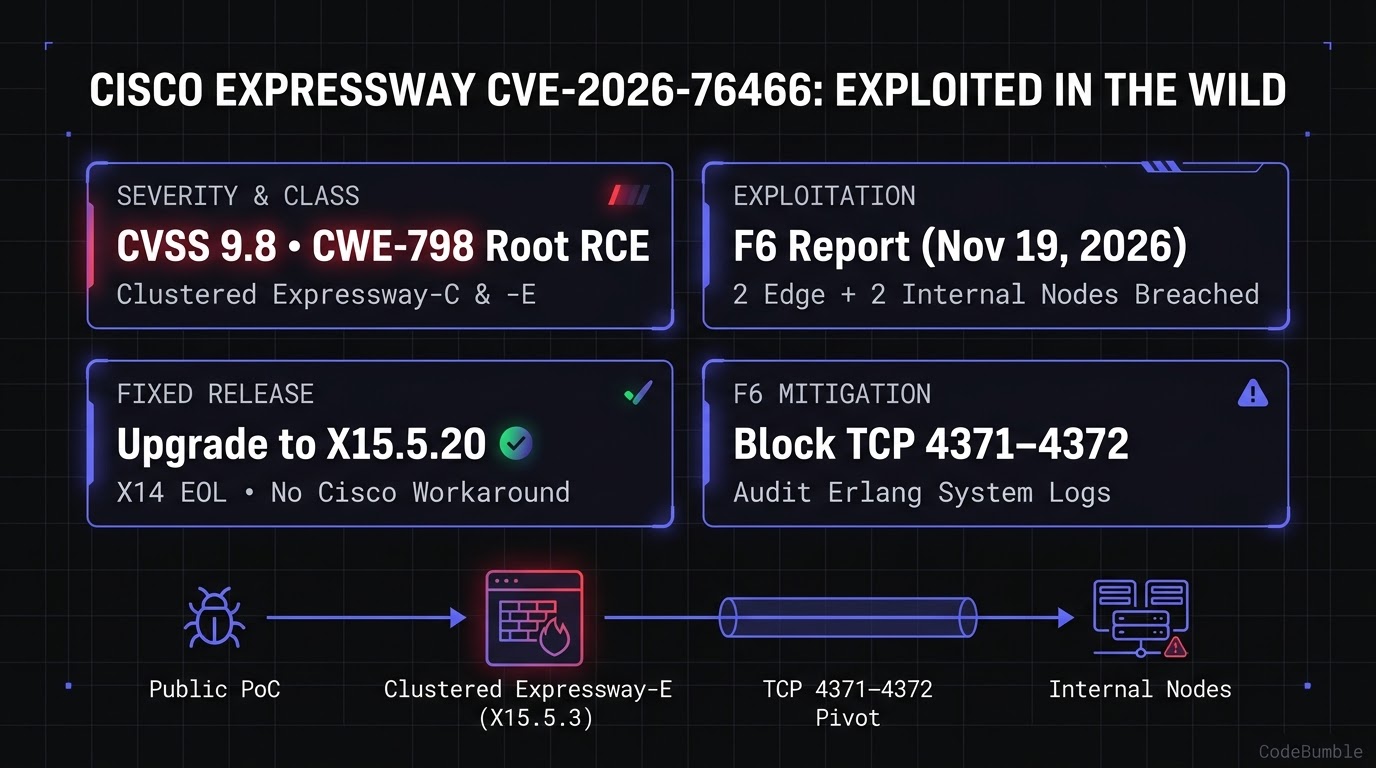
Cybersecurity firm F6 reported on November 19, 2026 that threat actors actively exploited Cisco Expressway CVE-2026-76466 (CVSS 9.8) soon after proof-of-concept code hit GitHub, breaching two edge devices and pivoting to two internal cluster nodes. With no Cisco workaround available and X14 out of support, defenders must upgrade to X15.5.20 or restrict TCP ports 4371–4372 immediately.
6 min read
Cisco Expressway CVE-2026-76466 Exploited in the Wild: Blocking TCP 4371–4372 and Upgrading to X15.5.20
Executive Summary
On November 19, 2026, cybersecurity firm F6 disclosed that threat actors actively exploited CVE-2026-76466 (CVSS v3.1 base score 9.8, Critical) in Cisco Expressway Series gateways soon after proof-of-concept exploit code was published on GitHub (SecurityWeek, MLQ.ai). In the documented incident against a Russian organization, attackers compromised two internet-facing Expressway X15.5.3 appliances and pivoted laterally to two internal cluster nodes—gaining root execution on the underlying operating system.
Cisco originally disclosed CVE-2026-76466 (cisco-sa-vcs-static-cred-hr7EWZ8t, Bug ID CSCww27732) on October 21, 2026 and shipped the fix in Expressway X15.5.20 (Cisco Advisory). Notably, as of November 19, Cisco's advisory had not yet been updated to reflect malicious use, and CVE-2026-76466 had not been added to CISA's Known Exploited Vulnerabilities (KEV) catalog as of its November 18 update (MLQ.ai). Because Cisco lists no official workarounds and Expressway X14 and earlier are end-of-life and require migration, organizations running clustered Expressway-C or Expressway-E deployments must patch immediately and apply interim firewall controls.
Confidence assessment: High confidence on root cause (CWE-798 persistent cookies + missing client certificate validation), CVSS 9.8 rating, fixed release (X15.5.20), and F6's incident findings (corroborated across Cisco PSIRT, NIST NVD, SecurityWeek, and MLQ.ai). Partial confidence on global campaign breadth, as F6 has documented one multi-node organizational intrusion without naming the victim or attributing it to a tracked threat group.
Technical Mechanics and Architecture
1. Root Cause: Persistent Cookies and Unvalidated Cluster TLS
Cisco Expressway-C (Core) and Expressway-E (Edge) appliances and virtual machines enable remote workers and external partners to connect to enterprise voice, video, and messaging infrastructure. According to NIST NVD and Cisco, CVE-2026-76466 resides in the database service feature when devices are configured in a cluster:
- Persistent cookies (
CWE-798): The database service relies on persistent cluster cookies for inter-node trust. - Insufficient client certificate validation: Even when TLS Verify Mode is set to Enabled for clustering, client certificates are not properly validated on database service connections.
- Unauthenticated RPC
rootexecution: A remote, unauthenticated attacker with network access to the clustered database service who possesses the persistent cookies can invoke specific Remote Procedure Call (RPC) commands and execute arbitrary OS commands asroot.
2. Observed Exploitation and Lateral Pivot Chain
F6's incident investigation illustrates how internet-exposed Expressway-E nodes bridge external attackers directly into internal collaboration networks:
+-----------------------+     Public PoC Exploit     +-------------------------------+
|  Threat Actor         | -------------------------> |  Expressway-E (Internet-Facing)|
|  (External)           |    CVE-2026-76466 RPC      |  Running X15.5.3 (Clustered)  |
+-----------------------+    Root RCE                +---------------+---------------+
                                                                     |
                                        Cluster DB / Erlang RPC      |
                                        (TCP ports 4371–4372)        |
                                                                     v
+-----------------------+     AI-Assisted Python     +-------------------------------+
|  Internal Targets     | <------------------------- |  2 Internal Cluster Nodes     |
|  SMB, SQL Server,     |   Lateral Recon & Cred     |  (Expressway-C / Internal)    |
|  WinRM, GitLab        |   Exfiltration             |  Root Access Established      |
+-----------------------+                            +-------------------------------+
Once inside, the attackers deployed custom Python scripts to scan internal subnets, enumerate SMB shares, interact with Microsoft SQL Server and WinRM, and search internal GitLab repositories for credentials and sensitive data (SecurityWeek). F6 noted that the scripts were actively modified during the intrusion and contained characteristic comments and fix descriptions indicating the use of an AI coding assistant.
Safe Defensive Firewall Rules (TCP 4371–4372)
Although Cisco states there are no software workarounds, F6 recommends that organizations unable to patch immediately block connections to TCP ports 4371–4372 at the perimeter and internal firewalls, permitting traffic strictly between the IP addresses of trusted cluster nodes (SecurityWeek, MLQ.ai).
# /etc/nftables.d/expressway-cluster-acl.conf
# Defensive interim control per F6 guidance:
# Restrict TCP 4371-4372 strictly to known Expressway cluster peer IPs.
table inet filter {
    set expressway_cluster_peers {
        type ipv4_addr
        elements = { 10.20.10.11, 10.20.10.12, 198.51.100.11 }
    }
    chain forward {
        type filter hook forward priority 0; policy accept;
        ip daddr @expressway_cluster_peers tcp dport 4371-4372 ip saddr != @expressway_cluster_peers drop
    }
}
Evidence: Affected Scope, Versions, and Benchmarking Gaps
Affected Configurations and Fixed Releases
| Attribute | Verified Detail | Source |
|---|---|---|
| CVE ID / Bug ID | CVE-2026-76466 / CSCww27732 (CWE-798) |
Cisco |
| CVSS v3.1 Base Score | 9.8 (CVSS:3.1/AV:N/AC:L/PR:N/UI:N/S:U/C:H/I:H/A:H) |
Cisco |
| Affected Products | Cisco Expressway-C and Expressway-E (virtual & appliance) when configured in a cluster | Cisco |
| Observed Victim Build | X15.5.3 (2 edge + 2 internal cluster nodes) |
MLQ.ai |
| Fixed Release | Expressway X15.5.20 (also note X14 and earlier must migrate) |
MLQ.ai |
| CISA KEV Status | Not listed as of Nov 18, 2026 release | MLQ.ai |
Performance benchmarks: Neither Cisco's advisory nor F6's threat report publishes CPU, memory, or call-setup latency benchmarks for X15.5.20 or for firewall filtering on TCP 4371–4372. Because TCP 4371–4372 are cluster-internal database/Erlang ports rather than media/SIP traversal ports, restricting them to peer cluster IPs should not affect external B2B or MRA media flows, though teams should validate cluster health in staging.
Hardening Playbook
Identify all clustered Expressway-C and Expressway-E nodes Audit virtual and hardware appliances for cluster membership and current software version (
Status > OvervieworClusteringconfiguration). Any clustered node belowX15.5.20—includingX15.5.3and allX14or earlier releases—is exposed.Apply immediate firewall filtering on TCP ports 4371–4372 Before and during your maintenance window, block inbound
TCP 4371–4372at perimeter firewalls and internal DMZ/core ACLs, allowing access only between the explicit IP addresses of trusted Expressway cluster peers (SecurityWeek).Upgrade to Expressway X15.5.20 (or migrate off X14) Schedule an immediate upgrade to
X15.5.20(or the latest fixed release in theX15.5train). Customers onX14or earlier must migrate to a supported fixed release (MLQ.ai).Hunt for exploitation in Erlang system logs and internal lateral movement F6 specifically highlights the Erlang system log on Expressway appliances as the primary host-based detection source (SecurityWeek). Review logs and perimeter firewall telemetry for:
- Unexpected inbound connections to
TCP 4371–4372from non-peer IPs. - Anomalous Erlang/database RPC errors or process spawns in Expressway diagnostic logs.
- Post-exploitation Python scripts, SMB/WinRM/SQL Server probing, or unauthorized GitLab queries originating from Expressway management/DMZ IPs.
- Unexpected inbound connections to
Verify cluster replication and rollback plan After upgrading to
X15.5.20, confirm all cluster peers show healthy database replication and TLS verification status. Rollback note: Take a full Expressway configuration backup and VM snapshot before upgrading. Never downgrade a patched node back to an exposedX15.5.xbuild without keepingTCP 4371–4372strictly firewalled to peer cluster IPs.
Frequently Asked Questions (FAQ)
1. Are standalone (non-clustered) Cisco Expressway devices vulnerable to CVE-2026-76466?
No. Cisco's advisory specifies that CVE-2026-76466 affects Expressway-C and Expressway-E only when configured in a cluster.
2. Does enabling TLS Verify Mode for clustering protect against CVE-2026-76466?
No. In fact, NIST NVD notes that client certificates are insufficiently validated specifically when TLS Verify Mode is set to Enabled for clustering, allowing an attacker with the persistent cookies to authenticate to the database service.
3. Why did Cisco say "no workarounds" while F6 recommends blocking TCP 4371–4372?
Cisco's advisory states there are no software configuration workarounds inside Expressway itself. F6's recommendation to block TCP ports 4371–4372 at the firewall (except from trusted cluster peer IPs) is an external network-layer compensating control until you can upgrade to X15.5.20 (MLQ.ai).
4. Is CVE-2026-76466 in the CISA KEV catalog?
Not as of CISA's November 18, 2026 release (MLQ.ai). However, because F6 confirmed active exploitation following public PoC release on GitHub, organizations should treat it with KEV-level urgency.
5. What version fixes CVE-2026-76466?
Cisco Expressway X15.5.20 fixes CVE-2026-76466. Deployments on X14 or earlier must migrate to a fixed release (MLQ.ai).
Sources
- Cisco Security Advisories — cisco-sa-vcs-static-cred-hr7EWZ8t: Cisco Expressway Series Remote Code Execution Vulnerability (October 21, 2026)
- NIST NVD — CVE-2026-76466 Detail (October 22, 2026)
- SecurityWeek — Cisco Expressway CVE-2026-76466 Exploitation Uncovered (November 19, 2026)
- MLQ.ai — Hackers exploited a critical Cisco Expressway flaw soon after exploit code went public, F6 says (November 19, 2026)