

Security
Spring Security CVE-2026-59273: How DataBinder Auto-Discovery Turns ELRequestMatcher Into SpEL RCE
On November 19, 2026, the Spring team disclosed CVE-2026-59273, a critical remote code execution flaw in Spring Security's ELRequestMatcher caused by unrestricted SpEL evaluation and PropertyEditor auto-discovery, alongside five companion vulnerabilities including two rated CVSS 4.0 9.1. Open-source fixes ship in 7.1.3 and 7.0.9, while older EOL branches receive no public updates. Here is how the binding chain works and how to audit your Java apps.
6 min read
Spring Security CVE-2026-59273: How DataBinder Auto-Discovery Turns ELRequestMatcher Into SpEL RCE
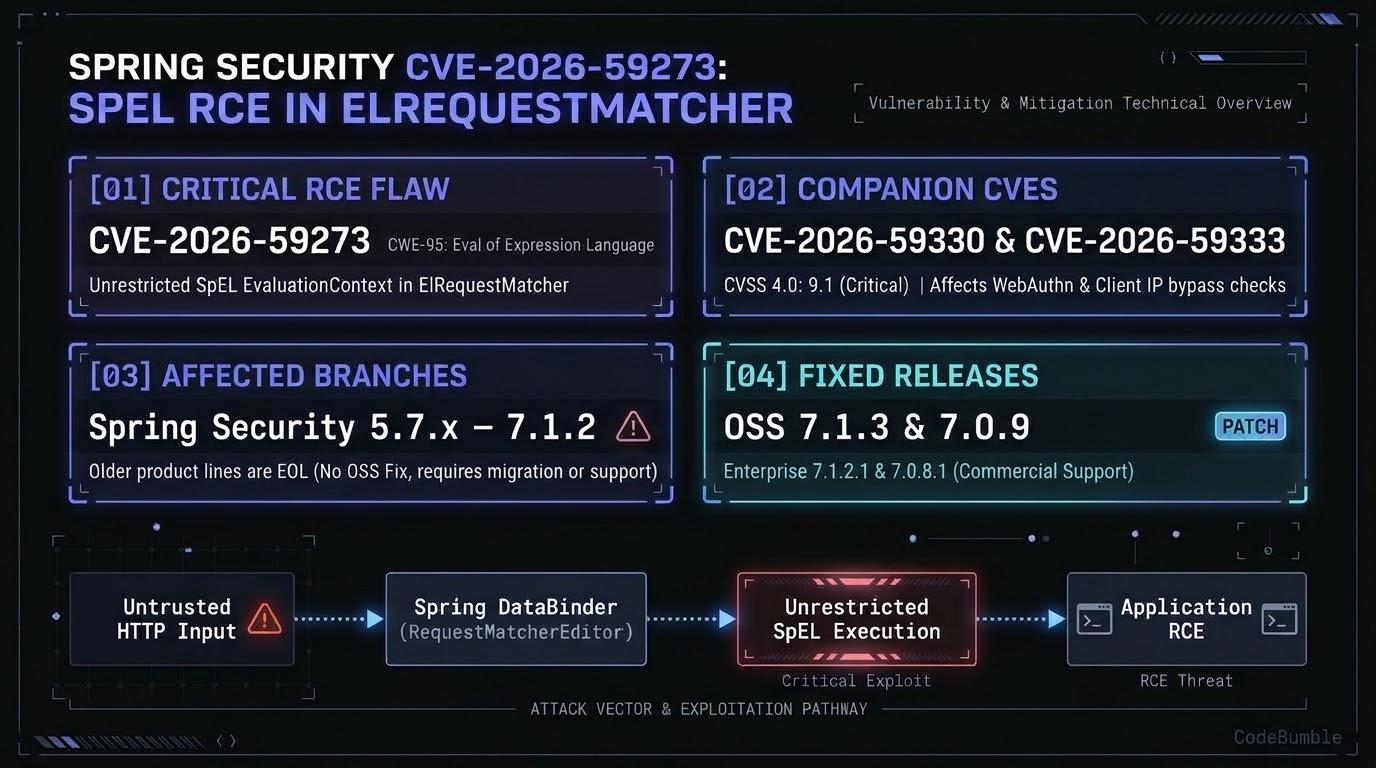
Executive Summary
On November 19, 2026, the Spring Security team disclosed CVE-2026-59273, a Critical remote code execution (RCE) vulnerability (CWE-95, Eval Injection) in org.springframework.security:spring-security-web's ELRequestMatcher class (Spring Security, HeroDevs). The flaw arises because ELRequestMatcher evaluates Spring Expression Language (SpEL) strings inside an unrestricted StandardEvaluationContext, and Spring Framework's data-binding layer automatically discovers its PropertyEditor by naming convention whenever external input binds to a RequestMatcher bean property.
The November 19–20 security bulletin (SB20261120211) also resolves five companion vulnerabilities in Spring Security, including two CVSS v4.0 9.1 (Critical) authentication and authorization flaws: CVE-2026-59330 (WebAuthn signature counter replay) and CVE-2026-59333 (IP-address matcher address-family bypass) (Cybersecurity-Help).
Open-source fixes are available in Spring Security 7.1.3 and 7.0.9, while commercial Enterprise Support builds ship in 7.1.2.1 and 7.0.8.1 (Spring Security). Affected 6.5.x, 6.4.x, 5.8.x, and 5.7.x branches are end-of-life (EOL) for community support and will not receive public OSS updates (HeroDevs).
Confidence assessment: High confidence on root cause, affected version ranges, and fixed OSS/Enterprise releases (sourced directly from Spring.io, HeroDevs, and Cybersecurity-Help). Moderate confidence on real-world prevalence of external RequestMatcher bean binding, as no ecosystem-wide telemetry on ELRequestMatcher usage has been published.
Technical Mechanics and Architecture
1. Why ELRequestMatcher + PropertyEditor Auto-Discovery Is Dangerous
In Spring Framework, DataBinder automatically resolves java.beans.PropertyEditor implementations using the <Type>Editor naming convention. Because a RequestMatcherEditor sits beside the RequestMatcher interface in spring-security-web, any Spring MVC or Spring Boot controller, configuration endpoint, or bean that binds external input (such as HTTP request parameters or externally supplied configuration) to a property of type RequestMatcher triggers automatic conversion into an ELRequestMatcher (Spring Security, HeroDevs).
Critically, ELRequestMatcher evaluates the resulting expression using StandardEvaluationContext rather than a restricted evaluation context. A StandardEvaluationContext permits full Java reflection, arbitrary method invocation, and type references (T(...)), meaning the next time matches() runs on an incoming HTTP request, the attacker-controlled SpEL expression executes with the privileges of the Java application process.
+-----------------------+     HTTP Request / Config Input     +-------------------------------+
|  External Attacker    | ----------------------------------> |  Spring MVC / DataBinder      |
|  (Controls bound str) |   Bound to RequestMatcher property  |  Auto-discovers Editor        |
+-----------------------+                                     +---------------+---------------+
                                                                              |
                                                Instantiates ELRequestMatcher |
                                                with StandardEvaluationContext|
                                                                              v
+-----------------------+     matches() Evaluates SpEL        +-------------------------------+
|  Arbitrary Code Exec  | <---------------------------------- |  Unrestricted SpEL Context    |
|  (App Process Privs)  |   Type refs & full reflection       |  (CWE-95 Eval Injection)      |
+-----------------------+                                     +-------------------------------+
2. Companion Vulnerabilities in the November 2026 Bulletin
| CVE ID | CWE / Class | CVSS v4.0 | Technical Summary |
|---|---|---|---|
| CVE-2026-59273 | CWE-95 Eval Injection |
Critical (Spring) | ELRequestMatcher evaluates bound input in unrestricted StandardEvaluationContext |
| CVE-2026-59330 | CWE-303 Auth Algorithm |
9.1 |
Webauthn4JRelyingPartyOperations fails to enforce increasing WebAuthn signature counters, enabling cloned authenticator replay |
| CVE-2026-59333 | CWE-863 Authorization |
9.1 |
IP address matchers omit address-family checks when comparing remote IPs against configured CIDR ranges |
| CVE-2026-59331 | CWE-789 Memory Alloc |
8.7 |
Unbounded memory allocation in BasicAuthenticationPayloadExchangeConverter (RSocket DoS) |
| CVE-2026-59329 | CWE-208 Timing Leak |
6.3 |
Timing discrepancy information exposure |
| CVE-2026-59400 | Sensitive Info in Logs | Not listed | ClientRegistration.toString() exposes plaintext OAuth2 client secrets in logs/exceptions |
Safe Defensive Coding Pattern (DataBinder Hardening)
While upgrading to a patched Spring Security release is the only complete remediation (Spring Security), Java teams auditing legacy codebases should ensure controllers explicitly restrict bindable fields via @InitBinder (setAllowedFields) and never expose RequestMatcher properties to external data binding:
import org.springframework.web.bind.WebDataBinder;
import org.springframework.web.bind.annotation.InitBinder;
import org.springframework.web.bind.annotation.RestControllerAdvice;

@RestControllerAdvice
public class GlobalBinderHardening {

    @InitBinder
    public void configureAllowedFields(WebDataBinder binder) {
        // Defensive allowlist: explicitly block unexpected property-editor binding
        // such as RequestMatcher fields on model objects.
        binder.setDisallowedFields("*matcher*", "*RequestMatcher*");
    }
}
Evidence: Affected Versions, Fixed Builds, and Benchmarking Gaps
Affected and Fixed Releases (CVE-2026-59273)
According to Spring Security and HeroDevs, the following version matrix applies:
| Spring Security Branch | Affected Versions | Fixed Version | Support Tier |
|---|---|---|---|
| 7.1.x | 7.1.0 – 7.1.2 |
7.1.3 (OSS) / 7.1.2.1 (Enterprise) |
Active OSS & Enterprise |
| 7.0.x | 7.0.0 – 7.0.8 |
7.0.9 (OSS) / 7.0.8.1 (Enterprise) |
Active OSS & Enterprise |
| 6.5.x | 6.5.0 – 6.5.12 |
Commercial Enterprise / NES | End of OSS Support |
| 6.4.x | 6.4.0 – 6.4.19 |
Commercial Enterprise / NES | End of OSS Support |
| 5.8.x | 5.8.0 – 5.8.28 |
Commercial Enterprise / NES | End of OSS Support |
| 5.7.x and earlier | <= 5.7.26 |
Commercial Enterprise / NES | End of OSS Support |
- Exploitation status: No confirmed in-the-wild exploitation is reported in the fetched Spring Security or HeroDevs advisories as of November 20, 2026.
- Performance benchmarks: Spring's security advisory does not publish throughput or latency benchmarks comparing
7.1.3/7.0.9against prior releases. RestrictingELRequestMatcherto a safe evaluation context affects expression evaluation rather than standard path-basedPathPatternRequestMatcherrouting.
Hardening Playbook
Inventory
spring-security-webversions across all Maven/Gradle builds Check every microservice and monolith for transitivespring-security-webdependencies:# Maven dependency check ./mvnw dependency:tree -Dincludes=org.springframework.security:spring-security-web # Gradle dependency check ./gradlew dependencies --configuration runtimeClasspath | grep spring-security-webScan codebases for
RequestMatcherdata binding andELRequestMatcherusage Search Java/Kotlin sources forELRequestMatcher,RequestMatcherbean setters exposed to@RequestBody/@ModelAttribute, and customWebDataBinderconfigurations:grep -rnE "ELRequestMatcher|setRequestMatcher|RequestMatcher" src/main/Upgrade to
7.1.3or7.0.9(or Enterprise7.1.2.1/7.0.8.1) Update your Spring Boot BOM orspring-security-bomto pull in7.1.3or7.0.9. Note that Spring Security states "No further mitigation steps are necessary" once upgraded (Spring Security). If running 6.5.x, 6.4.x, 5.8.x, or 5.7.x, either upgrade to7.0.9+or obtain commercial post-EOL patches (Spring Enterprise Support or HeroDevs NES).Audit WebAuthn, IP matchers, and OAuth2 logging for the 5 companion CVEs
- Verify whether WebAuthn (
CVE-2026-59330, CVSS 9.1) or IP-based access matchers (CVE-2026-59333, CVSS 9.1) are used in your security filter chain. - Rotate OAuth2 client secrets if
ClientRegistration.toString()(CVE-2026-59400) was ever written to centralized application logs.
- Verify whether WebAuthn (
Verify runtime dependency versions and rollback plan After building, inspect the packaged fat JAR (
jar tf app.jar | grep spring-security-web) to confirm7.1.3or7.0.9is bundled. Rollback note: If upgrading a major/minor Spring Boot train introduces breaking filter-chain API changes, apply the@InitBindersetDisallowedFieldscontrol and block external access to admin/config endpoints while completing migration testing—do not permanently pin an unpatched7.1.2or7.0.8JAR.
Frequently Asked Questions (FAQ)
1. Is every Spring Boot application using Spring Security vulnerable to CVE-2026-59273?
No. Exploitation requires the application to bind external, attacker-controlled input to a bean property of type RequestMatcher (which triggers Spring's PropertyEditor auto-discovery for ELRequestMatcher) (Spring Security).
2. Which open-source versions fix CVE-2026-59273?
Spring Security 7.1.3 and 7.0.9 are the fixed open-source releases (Spring Security).
3. Why are Spring Security 6.5.x, 6.4.x, and 5.8.x not getting an open-source patch?
Those branches have reached end of community/OSS support; fixes for EOL lines are available only through commercial Enterprise Support (7.1.2.1, 7.0.8.1 for 7.x enterprise, or HeroDevs NES for EOL lines) (HeroDevs).
4. What are the two CVSS 9.1 companion vulnerabilities in the same Spring Security release?
CVE-2026-59330 (WebAuthn signature counter validation bypass allowing cloned authenticators) and CVE-2026-59333 (missing address-family check in IP address matchers allowing IP-based access-rule bypass) (Cybersecurity-Help).
5. Do I need additional workarounds after upgrading to 7.1.3 or 7.0.9?
No. Spring Security's advisory explicitly states that upgrading to the corresponding fixed version resolves the issue and no further mitigation steps are necessary (Spring Security).
Sources
- Spring Security — CVE-2026-59273: Spring Security ELRequestMatcher allows Remote Code Execution via unrestricted SpEL evaluation (November 19, 2026)
- HeroDevs — CVE-2026-59273 Vulnerability Directory (November 20, 2026)
- Cybersecurity-Help — SB20261120211: Multiple vulnerabilities in Spring Security (November 20, 2026)
- TecnologiaGeek — Fallas de Spring con CVE-2026-59273 permiten ejecutar código (November 21, 2026)