

Security
VMware vCenter CVE-2026-123890 Exploited as a Zero-Day: How Armory Castle Hijacked vSphere SSO
Broadcom patched CVE-2026-123890 (CVSS 9.8) in VMware vCenter Server on November 19, 2026, but Mandiant confirmed the China-nexus group Armory Castle had already been exploiting it as a zero-day since early September using a custom Go tool called BONESAW. With no workaround available and vCenter 7.0 out of general support, defenders must both patch immediately and hunt for signs of SAML token forgery.
8 min read
VMware vCenter CVE-2026-123890 Exploited as a Zero-Day: How Armory Castle Hijacked vSphere SSO
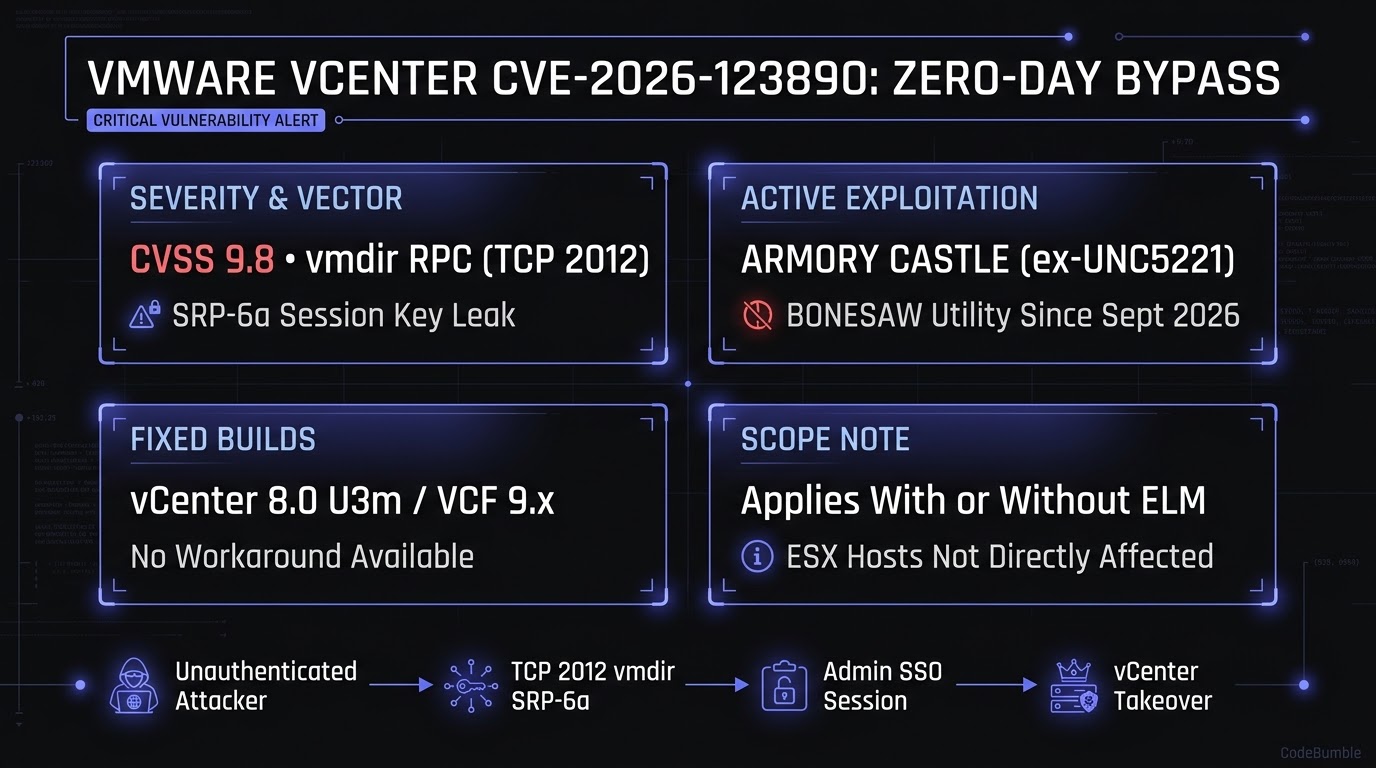
Executive Summary
On November 19, 2026, Broadcom published VMware Security Advisory VMSA-2026-0009, patching five vulnerabilities across VMware vCenter Server, VMware Tools, and SDDC Manager (Broadcom). The most severe flaw, CVE-2026-123890 (CVSS v3 base score 9.8, Critical), is an unauthenticated authentication bypass (CWE-288) in the VMware Directory Service (vmdir) that grants remote attackers an administrator@vsphere.local session over the network.
Hours after the advisory, Google Cloud's Mandiant and Threat Intelligence Group (GTIG) disclosed that ARMORY CASTLE (formerly tracked as UNC5221), a suspected China-nexus espionage group, had already been exploiting CVE-2026-123890 as a zero-day since early September 2026—more than two months before patches shipped (Google Cloud Blog, SecurityWeek). Notably, Broadcom's initial advisory did not mention in-the-wild exploitation, even though Mandiant reported the flaw and investigated multiple victim environments.
There is no workaround for CVE-2026-123890 (Rapid7). Furthermore, because ARMORY CASTLE deployed the custom Go exploitation utility BONESAW against vCenter instances already patched for an earlier July 2026 vmdir bypass (CVE-2026-59309), organizations must treat patching and post-compromise hunting as mandatory parallel workstreams.
Confidence assessment: High confidence on CVSS 9.8 rating, vmdir RPC (TCP 2012) SRP-6a session key disclosure mechanics, fixed builds, and ARMORY CASTLE post-exploitation tooling (corroborated across Broadcom, NVD, CVE.org, Google Cloud/Mandiant, and Rapid7). Partial confidence on total global victim count: GTIG notes a small number of confirmed compromises so far, while warning that additional targets have likely been impacted (Cybersecurity Dive).
Technical Mechanics and Architecture
1. How vmdir SRP-6a Key Disclosure Works
The VMware Directory Service (vmdir) underpins vCenter Single Sign-On (SSO), storing identity records, credentials, and SAML Security Token Service (STS) signing material. According to The Hacker News and Google Cloud Blog, CVE-2026-123890 is an unauthenticated Secure Remote Password (SRP-6a) session key disclosure vulnerability exposed over the vmdir Distributed Computing Environment / Remote Procedure Call (DCE/RPC) interface (vmdirdbcp) on TCP port 2012.
By obtaining the leaked SRP session key without supplying a password, a remote attacker establishes an authenticated administrator@vsphere.local session. Broadcom has not published the exact vulnerable function or packet sequence, and no public exploit code has been released (SOCRadar). Two architectural scope points from Broadcom's FAQ are critical for triage:
- Independent of Enhanced Linked Mode (ELM): The flaw resides in vCenter itself and applies whether or not ELM is enabled.
- ESXi hosts are not directly vulnerable: However, once an attacker controls vCenter as
administrator@vsphere.local, they can reach managed ESXi hosts and guest VM disks.
2. ARMORY CASTLE Intrusion Chain (BONESAW & SAWSNAKE)
Mandiant's forensic reconstruction shows CVE-2026-123890 was used as a post-compromise lateral movement and privilege-escalation primitive inside enterprise networks:
+----------------------------------+     CVE-2026-102764      +----------------------------------+
|  ARMORY CASTLE Operator          | -----------------------> |  BeyondTrust Remote Support      |
|  (ex-UNC5221)                    |                          |  (Initial Access, late Aug 2026) |
+----------------------------------+                          +----------------+-----------------+
                                                                               |
                                        Pivot to unmonitored Linux appliance   |
                                        (no EDR) + SLIMSAVAGE / CAGEMATCH      |
                                                                               v
                                                              +----------------------------------+
                                                              |  Internal Nmap Reconnaissance    |
                                                              |  TCP 443, 5480, 2012, 389        |
                                                              +----------------+-----------------+
                                                                               |
                                        BONESAW (Go) exploits CVE-2026-123890  |
                                        via vmdir RPC (TCP 2012)               |
                                                                               v
+----------------------------------+     Extract data.mdb     +----------------------------------+
|  SAWSNAKE (Go) Golden SAML       | <----------------------- |  vCenter Server Takeover         |
|  Mint forged SSO tokens,         |     Create SSO Admin     |  (administrator@vsphere.local)   |
|  bypass MFA, reach ESXi & AD VMs |                          +----------------------------------+
+----------------------------------+
- Initial foothold: ARMORY CASTLE entered via CVE-2026-102764, a BeyondTrust Remote Support zero-day exploited since late August 2026 (added to CISA KEV on October 16) (SOCRadar).
- EDR-blind pivot: Operators moved to internal Linux appliances lacking endpoint detection and response (EDR) tooling, deploying SLIMSAVAGE and CAGEMATCH JSP web shells alongside BEARBONES (a Dropbear SSH backdoor) and LAZYBONES (a Slack-C2 Go backdoor) (The Hacker News).
- vCenter takeover via
BONESAW: Usingnmap -sS -p 443,2012,389 --open, the group located vCenter servers and ran BONESAW (vcenter-db-teamcheck-go), creating a rogue SSO administrator and exfiltrating the LMDB directory database (data.mdb) overvmdirdbcp(Google Cloud Blog). - Golden SAML & workload access: SAWSNAKE (a Go port of
vcenter_saml_login.py) used stolen STS signing keys to forge SAML tokens and bypass MFA. Operators then temporarily enabled SSH via VAMI (5480), harvested the vCenter master encryption key and PostgreSQL credentials, and accessed ESXi hosts to extract Active Directoryntds.ditfiles from guest VM disks.
Safe Defensive Firewall Segmentation
While there is no software workaround for CVE-2026-123890, restricting management-plane ports (2012/tcp, 5480/tcp, 443/tcp, 389/tcp) to dedicated bastion/jump hosts prevents lateral reach from compromised edge appliances:
# /etc/nftables.d/vcenter-mgmt-acl.conf
# Defensive perimeter/VLAN ACL: restrict vmdir RPC (2012) and VAMI (5480)
# strictly to authorized bastion and peer vCenter ELM nodes.
table inet filter {
    set vcenter_trusted_peers {
        type ipv4_addr
        elements = { 10.10.50.10, 10.10.50.11 }
    }
    chain forward {
        type filter hook forward priority 0; policy accept;
        ip daddr 10.10.50.20 tcp dport { 2012, 5480 } ip saddr != @vcenter_trusted_peers drop
    }
}
Evidence: Affected Versions, Fixed Builds, and Timeline
Fixed Software Matrix (VMSA-2026-0009)
According to CVE.org, NVD, and Broadcom VMSA-2026-0009, the following versions remediate CVE-2026-123890:
| Product / Branch | Fixed Version | Notes |
|---|---|---|
| VMware Cloud Foundation / vSphere 9.1.x | 9.1.1.0200 |
Cumulative release; also fixes SDDC Manager CVEs |
| VMware Cloud Foundation / vSphere 9.0.x | 9.0.2.0200 |
Fixed build per CVE.org / Broadcom |
| VMware vCenter Server 8.0 | 8.0 U3m |
Emergency patch; applies with or without ELM |
| VMware Cloud Foundation 5.x | 5.2.5 |
Fixed build per CVE.org / Tenable |
| VMware vCenter Server 7.0 | No public patch | Reached end of general support Oct 2025; contact Broadcom Support for extended support |
Timeline and Benchmarking Gaps
- July 13, 2026: Build timestamp embedded in recovered
BONESAWGo binary (note: Mandiant cautions Go build metadata can be modified prior to compilation) (Help Net Security). - July 29, 2026: Broadcom disclosed an earlier
vmdirauth bypass (CVE-2026-59309). Mandiant reports evidence that ARMORY CASTLE knew ofCVE-2026-123890prior to July 29. - Early September 2026: First observed in-the-wild exploitation of
CVE-2026-123890against an internal vCenter server already patched forCVE-2026-59309. - November 19–20, 2026: Broadcom published
VMSA-2026-0009; Mandiant/GTIG published intrusion analysis. - Performance benchmarks: Neither Broadcom nor Mandiant published latency or CPU overhead benchmarks for vCenter
8.0 U3mor9.xvmdirRPC handling. Patching is an emergency security change with no reported performance regression in fetched advisories.
Hardening Playbook
Patch vCenter Server immediately (no workaround exists) Upgrade all vCenter 8.0 deployments to
8.0 U3m, 9.0.x to9.0.2.0200, 9.1.x to9.1.1.0200, and VCF 5.x to5.2.5. For legacy vCenter 7.0 (where Mandiant confirmedBONESAWworks), contact Broadcom Support for extended-support remediation or accelerate migration to 8.0 U3m (SecurityWeek).Segment management ports (
2012,5480,443,389) BlockTCP 2012(vmdirRPC) andTCP 5480(VAMI) from general server VLANs, remote-support appliances, and corporate user subnets. Permit access strictly from hardened administrative jump hosts and peer ELM nodes.Hunt for
BONESAWandSAWSNAKEcompromise indicators Because patching alone does not evict an attacker holding a rogue SSO admin account or stolen SAML signing keys, audit vCenter logs and directory state:# On vCenter Server Appliance (VCSA) shell: # 1. Inspect vmdir and SSO logs for unexpected administrator@vsphere.local or new SSO admin creations grep -iE "vmdirdbcp|AddUser|administrator@vsphere.local" /var/log/vmware/vmdir/*.log /var/log/vmware/sso/*.log 2>/dev/null # 2. Check VAMI / appliance logs for unauthorized SSH enablement grep -iE "ssh|enable" /var/log/vmware/applmgmt/*.log 2>/dev/nullAlso run Rapid7's unauthenticated check (released Nov 20, 2026) or equivalent vulnerability scanner to verify build versions across all vCenter instances (Rapid7).
Audit adjacent Linux appliances lacking EDR Mandiant observed ARMORY CASTLE specifically targeting internal Linux appliances without EDR. Inventory remote-support gateways (including BeyondTrust Remote Support for
CVE-2026-102764), check for unauthorized.jspweb shells (SLIMSAVAGE/CAGEMATCH), and inspect/tmpor Dropbear configs forBEARBONES.Rotate credentials and SAML signing certificates if compromise is suspected (Rollback note) If unauthorized
data.mdbaccess or rogue SSO admins are found, rotate the vCenter STS signing certificate, vCenter master encryption key, and PostgreSQL credentials immediately. Rollback note: Take an offline/file-based vCenter backup before upgrading to8.0 U3mor rotating STS certificates; rotating the STS signing certificate will invalidate active SAML sessions across connected solutions (such as Aria/vRealize or NSX) until trust is re-established.
Frequently Asked Questions (FAQ)
1. Is there any workaround for CVE-2026-123890 if I cannot patch right away?
No. Both Broadcom and Rapid7 confirm there is no software workaround. The only interim risk reduction is strict network segmentation blocking TCP 2012 and management interfaces (443, 5480) from all untrusted internal hosts.
2. If I already patched CVE-2026-59309 in July 2026, am I safe from CVE-2026-123890?
No. Broadcom confirms CVE-2026-123890 is a distinct issue, and Mandiant observed ARMORY CASTLE's BONESAW tool successfully exploiting a vCenter server that was already patched for CVE-2026-59309 (Help Net Security).
3. Are ESXi hosts directly vulnerable to CVE-2026-123890?
No, ESXi hosts are not directly vulnerable to CVE-2026-123890 (SOCRadar). However, compromising vCenter gives attackers administrative reach to managed ESXi hosts and guest VM disks.
4. Does Enhanced Linked Mode (ELM) need to be enabled for vCenter to be vulnerable?
No. Broadcom's scope note states the vulnerability resides in vCenter itself and applies whether or not Enhanced Linked Mode is configured (SOCRadar).
5. What should organizations on VMware vCenter 7.0 do?
Mandiant confirmed BONESAW works against vCenter 7.x and 8.x, and there is no public patch for 7.0 because it reached end of general support in October 2025 (SecurityWeek). Organizations still running 7.0 must contact Broadcom Support under an extended support contract or upgrade immediately to 8.0 U3m.
Sources
- Broadcom Security Advisories — VMSA-2026-0009: VMware vCenter, Tools, and SDDC Manager (November 19, 2026)
- Google Cloud / Mandiant Threat Intelligence — ARMORY CASTLE Exploits vSphere (November 19, 2026)
- NIST NVD — CVE-2026-123890 Detail (November 19, 2026)
- CVE.org — CVE Record: CVE-2026-123890 (November 20, 2026)
- Rapid7 — CVE-2026-123890: Critical Authentication Bypass in VMware vCenter (November 20, 2026)
- SecurityWeek — VMware vCenter CVE-2026-123890 Zero-Day Exploited (November 20, 2026)
- The Hacker News — China-Linked Hackers Exploit Critical VMware vCenter Zero-Day (November 20, 2026)
- Help Net Security — VMware vCenter zero-day exploited for months before patch (November 20, 2026)
- SOCRadar — CVE-2026-123890: vCenter Zero-Day Exploited by Armory Castle (November 20, 2026)