

Security
Claude Enterprise Frontier Safeguards: Zero Data Retention, Sealed Safety Data, and Customer-Owned Custody
Launched in beta on November 23, 2026, Anthropic's Enterprise Frontier Safeguards (EFS) brings Zero Data Retention to Claude's most capable models by writing encrypted Sealed Safety Data to customer-owned S3 or Google Cloud Storage buckets. Learn how the trust boundary works, what stays outside EFS, and what the 7-day Safety Case review SLA requires.
8 min read
Claude Enterprise Frontier Safeguards: Zero Data Retention, Sealed Safety Data, and Customer-Owned Custody
Executive Summary
- Zero Data Retention for Frontier Models (Claude Platform Release Notes, Nov 23, 2026): Anthropic launched Enterprise Frontier Safeguards (EFS) in beta across Claude Platform, Claude Platform on AWS, and Claude Models on Google Cloud (Anthropic managed), as well as Amazon Bedrock and Google Cloud's Agent Platform (EFS Overview, Bedrock Docs).
- Customer-Owned Storage, Anthropic-Format Encryption (EFS Overview): Prompts, responses, and model reasoning are deleted by Anthropic promptly after generation and written as Sealed Safety Data to a customer-owned Amazon S3 or Google Cloud Storage bucket—encrypted in Anthropic's format so neither the customer's team nor the cloud provider can read the sealed records.
- Shifted Review Burden & 7-Day SLA (TNW, Nov 23, 2026, CellCog, Nov 23, 2026): Anthropic Human Review is permanently disabled under EFS. When automated safety monitoring flags potential serious misuse (such as offensive cyber or biological capability development), the customer's own security team must investigate and respond to the Safety Case within 7 calendar days.
- Operational Scope & Irreversible Controls (Claude Console Setup): EFS applies to an entire workspace, excludes the Batch API, Files API uploads, code execution containers, and Claude Managed Agents sessions, and permanently enables Access Transparency across the organization.
Trust Model and Architecture
Until the November 23, 2026 beta launch of Enterprise Frontier Safeguards, organizations operating under strict data-residency or non-retention mandates faced a hard capability wall. According to Anthropic's November 9, 2026 release notes and EFS documentation, Anthropic's most capable frontier models—such as Claude Fable 5.2, Claude Mythos 5.2, and earlier Fable and Mythos releases—require 30-day data retention to detect multi-turn or split-request misuse and are unavailable under standard ("Legacy") Zero Data Retention (ZDR) without express authorization.
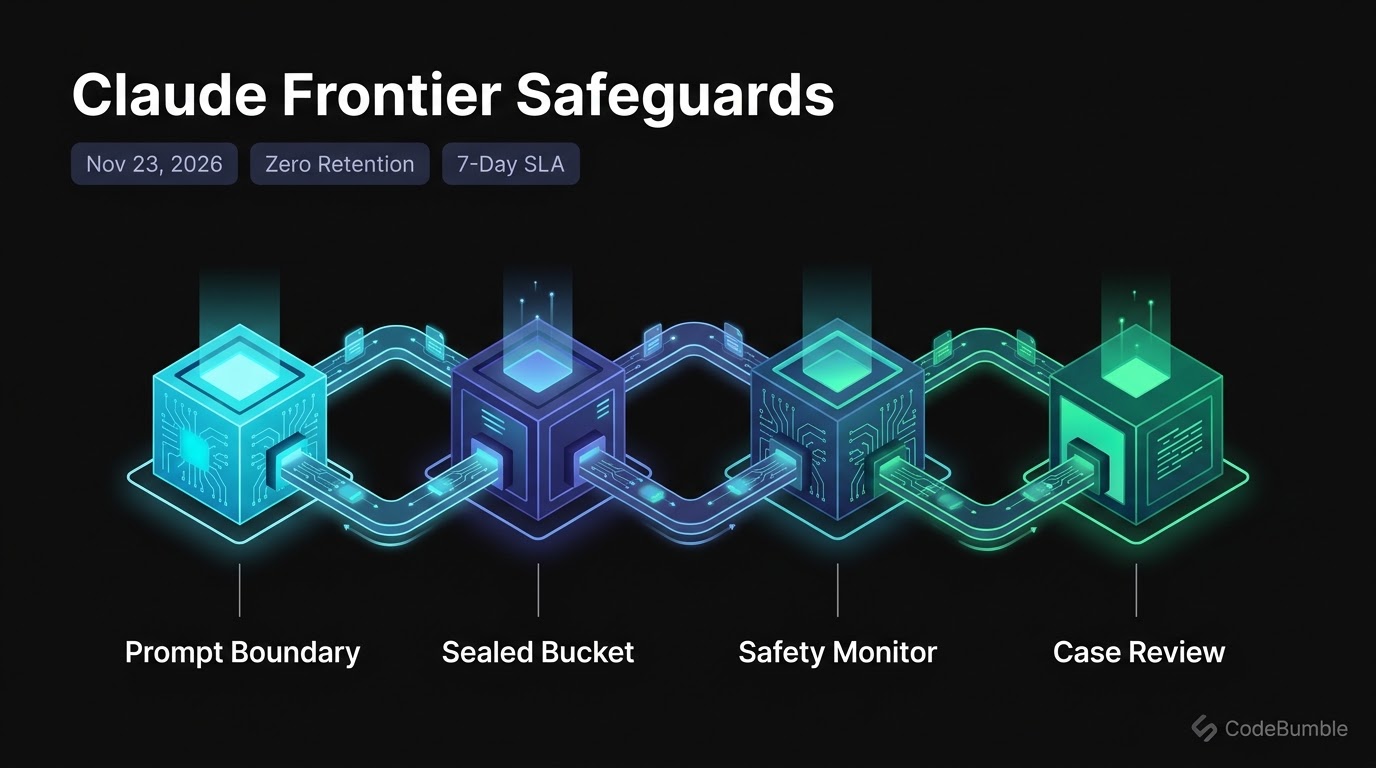
As reported by The Next Web (November 23, 2026), single-prompt stateless filters miss distributed attacks where AI agents split a campaign across many seemingly benign requests. EFS resolves this tension by separating data custody from automated safety detection:
flowchart LR
    A[Enterprise App / Workspace] -->|Inference Request| B[Claude Frontier Model]
    B -->|Response Returned & Prompt Deleted| A
    B -->|Sealed Safety Data: Encrypted Prompts, Responses, Reasoning| C[(Customer S3 / GCS Bucket)]
    C -->|Automated Safety Scan| D[Anthropic Automated Monitoring]
    D -->|Serious Risk Flagged| E[Safety Case + Optional Transcript]
    E -->|7-Calendar-Day SLA| F[Customer Security Team]
    C -.->|Daily Storage Health Check| G[Org Webhooks: external_storage.*]
Cryptographic & Storage Boundaries
Under EFS, Anthropic's Customer-Owned Storage specification separates three distinct data categories:
- Sealed Safety Data (Required): Contains prompts, responses, and model reasoning encrypted in Anthropic's format. Anthropic deletes its transient copies promptly after generating the response and writing the sealed object to the customer's bucket (
slab/orsafeguards-data/slab/). Even though the object resides in the customer's AWS or Google Cloud account, the customer's own team cannot decrypt or read Sealed Safety Data (EFS Overview). - Safety Case and Transcript Storage (Optional on Claude Platform): Readable copies of flagged prompts and responses (
Transcripts) alongsideSafety Cases,Safety Notices, and customer responses (Safety Correspondence). Organizations can route these to a separate bucket or retrieve Safety Cases via the Safety Cases API (Customer-Owned Storage Docs). - Customer-Managed Encryption Keys (Optional, Permanent): Organizations can register a customer-managed key (CMK) in AWS KMS or Google Cloud KMS to wrap data encryption. However, attaching a CMK is permanent and disables certain platform features (Setup Guide).
Access Transparency and Human Review
Because Anthropic Human Review is always off under EFS, no Anthropic reviewer inspects flagged prompts (EFS FAQ). Furthermore, enabling EFS activates Access Transparency across the entire organization within two hours—writing anthropic_access events to the Compliance API Activity Feed (delivered within two business days) whenever Anthropic personnel access covered data (Human Review & Access Transparency Docs).
What Researchers and Security Analysts Say
Enterprise security leaders and independent technical analysts have highlighted both the custody breakthrough and the operational trade-offs introduced by EFS.
Speaking to The Next Web (November 23, 2026), Munish Kumar Sharma, Chief Information Security Officer at Wells Fargo, summarized the core architectural value proposition:
"We keep custody of our data while Anthropic operates the detection."
According to The Next Web, more than 100 enterprise customers—including Bridgewater, Salesforce, and Stripe—helped shape the EFS design, positioning it alongside OpenAI's Private Safety Processing (previewed in August 2026) as a new industry pattern for regulated AI governance.
At the same time, an independent technical teardown published by CellCog (November 23, 2026)—an AI platform that runs on Claude models and disclosed that it has not yet adopted EFS—outlined key operational constraints and gaps in the beta documentation:
- Shifted Triage Burden: CellCog notes that EFS removes the 30-day retention barrier for regulated firms, "but moves work onto the customer. Someone on the team has to watch a bucket, read Safety Cases about serious misuse, and answer each within a week."
- No Automatic Push Notification for Safety Cases: Per Anthropic's docs cited in CellCog's review, Anthropic does not automatically notify teams when a new Safety Case is created; security teams must actively monitor their bucket or poll the Safety Cases API to avoid missing the 7-calendar-day response deadline, after which access can be at risk (TNW, CellCog).
- Internal-Use-Only Restriction: The EFS setup guide restricts the beta to an organization's internal use only, excluding SaaS platforms or ISVs that resell Claude to external end customers (Setup Guide).
- Undisclosed Eligibility Criteria: While Anthropic states EFS is free of charge (with cloud storage and KMS operations billed by AWS or Google Cloud), the public documentation does not publish explicit eligibility thresholds, requiring organizations to apply via an Anthropic account team or request form.
| Dimension | Legacy Zero Data Retention (ZDR) | Enterprise Data Controls | Enterprise Frontier Safeguards (EFS) |
|---|---|---|---|
| Frontier Model Access | Limited; excludes 30-day retention models unless expressly authorized | Full access to Claude's most capable models | Full access to Claude's most capable models (EFS Overview) |
| Prompt & Response Storage | Not retained | Anthropic-managed storage | Customer-owned S3 or GCS bucket (Sealed Safety Data) |
| Automated Safety Monitoring | Off | On (Anthropic-operated) | On (Anthropic-operated) |
| Human Review of Flagged Cases | N/A | Anthropic team or customer team | Customer security team only (7-day SLA) |
| Anthropic Fee | Contract-dependent | Included | None (customer pays cloud storage/KMS fees) |
Hardening and Implementation Blueprint
Deploying EFS requires careful workspace planning because several actions cannot be reversed through self-service controls.
1. Workspace Isolation and Legacy ZDR Migration
On Claude Platform, EFS applies to every request to every model in a workspace—it cannot be scoped to individual API keys within the same workspace, and the Default Workspace is ineligible (EFS Overview). Organizations with a Legacy ZDR agreement cannot toggle EFS onto an existing Legacy ZDR workspace; instead, they must create a new workspace and select the Enterprise Frontier Safeguards card during creation (Setup Guide).
Before routing production traffic to a newly configured EFS workspace, Anthropic warns teams to send only non-sensitive test requests until 10 minutes after the first object lands under slab/ or safeguards-data/slab/ in the customer bucket, because requests sent before bucket binding propagates may fall back to Anthropic-managed storage (Setup Guide).
2. Reversibility and Compatibility Guardrails
| Configuration Step | Reversible? | Side Effects & Restrictions |
|---|---|---|
| Enable EFS Organization Access | No (contact Anthropic support to remove) | Enables Compliance API and permanent Access Transparency across the entire org (Setup Guide) |
| Attach Customer-Managed Key (CMK) | No (Permanent) | Up to 24 hours to take effect on active workspaces; disables select platform features |
| Bind Customer-Owned Bucket | Partially (can swap or remove, which exits EFS) | Bucket must be dedicated to one Anthropic org; HIPAA-ready orgs are currently ineligible |
Additionally, EFS does not cover the Batch API, Files API uploads, code execution containers, or Claude Managed Agents sessions (CellCog). Teams handling regulated payloads across those surfaces should keep them in isolated workspaces or self-hosted Managed Agents environments.
3. Monitoring Storage Health via Organization Webhooks
Alongside EFS, Anthropic added two organization webhook events on November 23, 2026—external_storage.failed and external_storage.recovered—to alert security teams when a daily health check fails on a customer-owned bucket (Claude Platform Release Notes). Pair these with the external_key.failed and external_key.recovered events introduced on November 16, 2026, in your SIEM or incident-response webhook handler:
{
  "event_type": "external_storage.failed",
  "organization_id": "org_01Example",
  "timestamp": "2026-11-24T10:00:00Z",
  "recommended_action": "Verify S3/GCS IAM bucket policy, KMS key grant, and bucket lifecycle rules before daily check retry."
}
Frequently Asked Questions
Can our security team decrypt Sealed Safety Data in our own S3 or GCS bucket?
No. According to Anthropic's EFS Overview, Sealed Safety Data is encrypted in Anthropic's format and cannot be read by the customer's team, even though it resides in the customer's cloud account. To read flagged content during an investigation, configure the optional Safety Case and Transcript storage bucket or query the Safety Cases API.
What happens if we miss the 7-calendar-day Safety Case review deadline?
If automated safety monitoring opens a Safety Case and the customer's team fails to investigate and respond within 7 calendar days (or arrange an extension with their Anthropic account team), the organization risks losing API access (TNW, Nov 23, 2026, CellCog, Nov 23, 2026).
Does Enterprise Frontier Safeguards work with HIPAA-compliant organizations or external SaaS products?
No. Per the Claude Platform Setup Guide, organizations with HIPAA readiness enabled cannot get EFS, and EFS is currently restricted to an organization's internal use only.
Does EFS cover Claude Managed Agents or the Message Batches API?
No. EFS covers synchronous Messages API traffic within the configured workspace, but excludes the Batch API, Files API uploads, code execution containers, and Claude Managed Agents sessions (CellCog).
How much does Enterprise Frontier Safeguards cost?
Anthropic does not charge an additional fee for EFS and does not alter model pricing or rate limits; however, your organization pays AWS or Google Cloud directly for bucket storage, read/write operations, and KMS key usage (EFS Overview, CellCog).
Sources
- Anthropic — Claude Platform Release Notes: November 23, 2026 (November 23, 2026): https://platform.claude.com/docs/en/release-notes/overview
- Anthropic — Enterprise Frontier Safeguards Overview, Setup Guide, Customer-Owned Storage, Human Review & FAQ (Claude Platform Docs, November 23, 2026): https://platform.claude.com/docs/en/manage-claude/enterprise-frontier-safeguards/overview and https://platform.claude.com/docs/en/manage-claude/enterprise-frontier-safeguards/setup-console
- The Next Web — Anthropic can now watch for Claude misuse without keeping firms' data (November 23, 2026): https://thenextweb.com/news/anthropic-enterprise-frontier-safeguards-zero-data-retention-beta
- CellCog — Claude Enterprise Frontier Safeguards: What It Changes (November 23, 2026): https://cellcog.ai/blog/claude-enterprise-frontier-safeguards/