

Security
Ethereum PQAI #0: Hash-Based Cryptography, Formal Verification, and the Post-AI Security Roadmap
Published on November 23, 2026, the Ethereum Foundation's PQAI #0 roadmap doubles its protocol security team and outlines a three-part migration from elliptic-curve cryptography to hash-based signatures and commitments. Learn how the trust model works, what Ethlabs' pqai27 proposes, and which hardware and BLS trade-offs lie ahead.
7 min read
Ethereum PQAI #0: Hash-Based Cryptography, Formal Verification, and the Post-AI Security Roadmap
Executive Summary
- Top Protocol Priority (Ethereum Foundation, Nov 23, 2026): In PQAI #0: Preparing Ethereum for a post-quantum, post-AI world, Ethereum Foundation (EF) researcher Kev Wedderburn announced that protocol hardening is now the Foundation's highest priority, backed by a doubled protocol security team (exact headcounts were not disclosed).
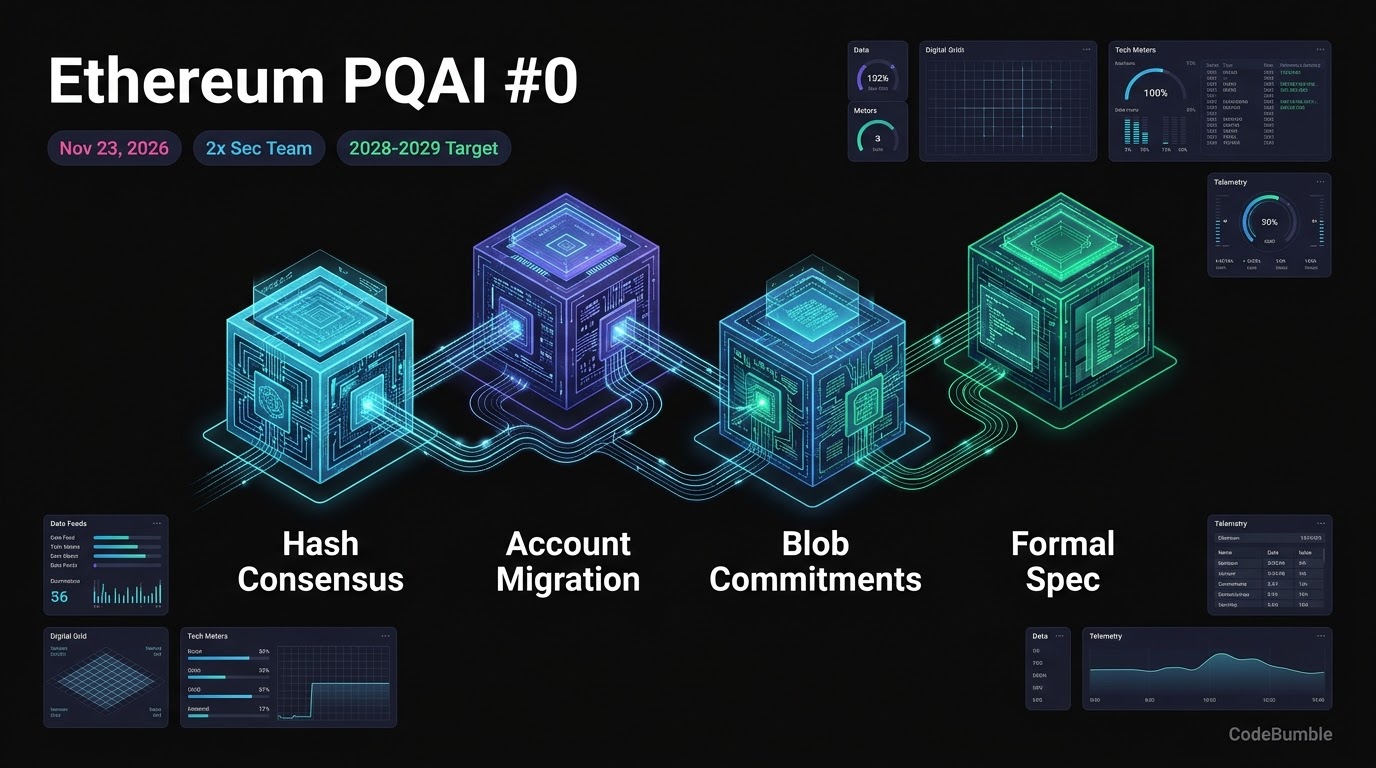
- Three-Layer Hash-Based Migration (PQAI #0): Rather than introducing new cryptographic hardness assumptions, Ethereum plans to migrate consensus validator signatures (off elliptic curves), user account wallets, and blob data commitments to hash-based cryptography, which relies only on hash functions the protocol already trusts.
- Why AI Accelerated the Clock (PQAI #0, MLQ.ai, Nov 24, 2026): While quantum computing motivated long-term planning, the EF notes that AI models are now finding production bugs faster than humans can review them—including thousands in the Linux kernel—and improving decades-old algorithms, making conservative assumptions and formal verification urgent.
- Active Devnet and Timeline Tension (Ethlabs
pqai27, Nov 11, 2026, Kriptofoni, Nov 24, 2026): Developers have started iterating on the firstpq-cldevnet, while timelines span Ethlabs' 2027pqai27proposal, Justin Drake's December 2028 target, and the EF's 2029 internal deadline (with a formal timeline review set for January 2027).
Trust Model and Architecture
In PQAI #0, the Ethereum Foundation draws a direct parallel to Ethereum's September 15, 2022 Merge—noting that replacing the network's cryptographic locks is "harder than the Merge, and we have less time." Crucially, the post clarifies that AI has not broken Ethereum's underlying cryptographic hardness assumptions today; instead, risk management favors retreating to the most conservative cryptographic assumptions available before AI or quantum capabilities mature further.
flowchart LR
    A[Elliptic-Curve & BLS Era] -->|Removed Dependency| B[Hash-Based Cryptography]
    B --> C[Consensus Layer: Hash-Based Validator Keys]
    B --> D[Execution / Wallets: Hash-Based Account Signatures]
    B --> E[Data Availability: Hash-Based Blob Commitments]
    F[Formal Verification & pq-cl Devnet] -->|Machine-Checked Specs| C
    F -->|Audit & Bug Triage| D
    F -->|Rollup Testing| E
The Three Architectural Pillars
After more than a year of evaluating candidate post-quantum signature schemes, the EF advocates standardizing on hash-based cryptography across three core layers (PQAI #0):
- Consensus Finality: Validators will sign attestations and blocks using hash-based keys so chain finality no longer depends on elliptic-curve cryptography (specifically replacing current BLS signature infrastructure).
- User Accounts and Wallets: Wallets and smart accounts will provide straightforward migration paths so users can move funds behind hash-based signatures—designed, as Wedderburn writes, for keys "someone can pass to their great-grandchildren without worrying whether the cryptography will break."
- Data Infrastructure (Blobs): Rollup data blobs will transition to hash-based cryptographic commitments, removing pre-quantum assumptions from Layer 2 data availability.
Why Formal Verification Must Scale With AI Speed
A central insight in PQAI #0 is that AI tools cut both ways: they accelerate protocol development, which also makes it easier to ship subtle implementation bugs. To prevent speed from undermining security, the EF states that core components must be formally verified against a specification to eliminate entire classes of bugs by construction, rather than relying solely on post-hoc manual code review.
What Researchers and Security Analysts Say
Both Ethereum's own protocol security engineers and external analysts emphasize that the hardest bottleneck is not finding potential flaws—it is verifying what is real and coordinating an unowned ecosystem without pricing out home node operators.
Insights From EF's AI Protocol Security Experiments
In a companion primary post referenced in MLQ.ai's coverage, EF protocol security researcher Nikos Baxevanis detailed the Foundation's experience running coordinated AI agents against Ethereum client codebases in The triage is the product (July 9, 2026):
"The surprise was how little of the work went into finding them, and how much went into telling the real bugs from the ones that just looked real."
Baxevanis documented three recurring failure modes in AI-generated security findings and formal proofs:
- Debug-only panics that wrap or behave harmlessly in release builds
- Unreachable internal states constructed by hand in a proof-of-concept that no attacker-controlled network path can trigger
- Vacuous formal-verification proofs where the theorem satisfies the verifier but is weaker than the actual security invariant intended
His conclusion aligns directly with PQAI #0's emphasis on specification-level rigor: agents are search tools, not oracles, and require reproducible, deterministic harnesses alongside human judgment.
Ecosystem Proposals and Independent Assessments
- Ethlabs'
pqai27Acceleration Proposal: Published on November 11, 2026 by Caspar Schwarz-Schilling on Ethereum Magicians, the nonprofit research group Ethlabs argued that Ethereum can reachpqai-readystatus (post-quantum consensus and account migration paths) as early as 2027 in the Hegotá hard fork, withpqai-scaledas a stretch goal. To free engineering capacity, Ethlabs withdrew its own Quick Slots proposal from Hegotá (PQAI #0). Ethlabs member Barnabé Monnot later clarified thatpqai27remains a proposal awaiting core developer consensus (TokenPost, Nov 13, 2026). - Independent Risk Assessment (Kriptofoni, Nov 24, 2026): Analysts at Kriptofoni underscore that Ethereum is not facing an active quantum attack or AI-compromised wallets today. Instead, the central architectural challenge is coordinating validators, wallet teams, smart-contract developers, and rollups—while managing larger hash-based signature sizes so hardware requirements do not price out home node operators.
| Initiative / Milestone | Target Timeline | Scope & Status | Key Trade-Off Noted |
|---|---|---|---|
Ethlabs pqai27 Proposal |
2027 (pqai-ready) |
Consensus + account migration in Hegotá; proposal only (Ethereum Magicians) | Requires pruning non-critical Hegotá features (e.g., Quick Slots withdrawn) |
| Justin Drake Devcon Target | December 2028 | Full post-quantum / post-AI transition target (PQAI #0) | Compresses testing window by 1 year ahead of EF baseline |
| Ethereum Foundation Deadline | 2029 (review Jan 2027) | Consensus, wallets, and blob commitments; pq-cl devnet active (PQAI #0) |
Larger signature payloads require careful bandwidth & home-node hardware monitoring |
Hardening and Implementation Blueprint
While mainnet migration will span multiple hard forks, protocol engineers, wallet maintainers, and rollup teams have concrete starting points defined in PQAI #0 and Ethlabs' pqai27 specification:
- Client Teams &
pq-clDevnet: Consensus and execution client developers can begin implementing early signature and key-registry specifications on thepq-cldevnet and tracking fork-pruning decisions in upcoming All Core Devs (ACD) calls and the ETH R&D Discord. - Wallet & Smart-Contract Auditing: Teams maintaining multisigs, account-abstraction contracts, or BLS-dependent tooling should inventory every assumption tied to elliptic-curve signatures (
ecrecover, BLS aggregation) and prepare user-friendly migration flows. - Staking Pools & Rollup Operators: Stakers can test validator setups using hash-based keys to measure signature verification CPU and bandwidth overhead, while rollup teams can validate compatibility against hash-based blob commitments.
- AI-Assisted Verification Guardrails: Security teams adopting LLM agents for protocol or smart-contract auditing should enforce the deterministic triage rules documented by Baxevanis (July 2026)—requiring self-contained, release-build reproducers and verifying that formal proofs constrain real invariants rather than vacuous predicates.
Frequently Asked Questions
Has AI or quantum computing broken Ethereum's cryptography today?
No. Both the Ethereum Foundation (November 23, 2026) and independent analysts (Kriptofoni, November 24, 2026) state there is no evidence that AI or quantum computers have broken Ethereum's cryptographic assumptions. The transition is a proactive risk-management measure.
Why is Ethereum choosing hash-based cryptography instead of other post-quantum schemes?
After over a year of evaluating candidate signature schemes, the EF recommends hash-based cryptography because the Ethereum protocol already relies on hash functions for security—meaning the transition avoids introducing new mathematical hardness assumptions (PQAI #0).
When will Ethereum's post-quantum upgrade actually ship?
There is no locked mainnet date yet. Justin Drake proposed December 2028 at Devcon, the Ethereum Foundation maintains 2029 as its internal deadline (with a timeline review in January 2027), and Ethlabs proposed 2027 (pqai27)—though pqai27 has not been formally adopted by core developers (PQAI #0, MLQ.ai).
What are the main engineering trade-offs of hash-based signatures?
Hash-based signatures are significantly larger than elliptic-curve or BLS signatures, requiring teams to monitor node hardware and bandwidth requirements so individuals can still run nodes at home, while also reworking BLS tooling, wallets, multisigs, and staking pools (PQAI #0).
What features are being delayed to fund this security work?
The EF warns that features developers have worked on for years will have to wait; Ethlabs has already pulled its Quick Slots proposal from the Hegotá fork, and All Core Devs calls are reviewing additional features to defer (PQAI #0).
Sources
- Ethereum Foundation Blog — PQAI #0: Preparing Ethereum for a post-quantum, post-AI world by Kev Wedderburn (November 23, 2026): https://blog.ethereum.org/2026/11/23/pqai-0
- Ethereum Foundation Blog — The triage is the product: running AI agents against Ethereum's protocol code by Nikos Baxevanis (July 9, 2026): https://blog.ethereum.org/2026/07/09/triage-is-the-product
- Ethereum Magicians — An Ethlabs view on post-quantum and post-AI timelines: pqai27 (November 11, 2026): https://ethereum-magicians.org/t/an-ethlabs-view-on-post-quantum-and-post-ai-timelines-pqai27/30351
- MLQ.ai — Ethereum Foundation doubles its protocol security team as it readies Ethereum for quantum computers and AI bug hunters (November 24, 2026): https://mlq.ai/news/ethereum-foundation-doubles-its-protocol-security-team-as-it-readies-ethereum-for-quantum-computers-and-ai-bug-hunters/
- Kriptofoni — Ethereum Foundation Unveils New Plan to Address Quantum and AI Security Threats (November 24, 2026): https://www.kriptofoni.com/en/ethereum-quantum-ai-security-pqai/