

Security
OpenAI and Cisco Shirudo: Cryptographically Signed eBPF Shields, TPM Attestation, and Linux Kernel Requirements
Launched on November 23–24, 2026 by OpenAI and Cisco under a BSD-2-Clause license, Shirudo is an open-source eBPF Linux runtime that lets AI agents generate, test, and load cryptographically signed kernel shields without restarting running services. Learn how its TPM-backed trust model works, how it blocked Java4Shell in testing, and why its 5 unmerged bpf-next kernel patches matter.
6 min read
OpenAI and Cisco Shirudo: Cryptographically Signed eBPF Shields, TPM Attestation, and Linux Kernel Requirements
Executive Summary
- Open-Source eBPF Shielding Runtime (OpenAI, Nov 23, 2026, Cisco Newsroom, Nov 23, 2026): OpenAI and Cisco released Shirudo (
github.com/shirudo-dev/shirudo) under a BSD 2-Clause license (with BPF programs dual-licensed under BSD/GPL), enabling defenders to deploy temporary eBPF kernel protections without restarting running Linux services while permanent patches are tested and rolled out. - Controlled Exploit Blocking Without Restarts (OpenAI): In a controlled test, an OpenAI Codex-generated eBPF shield attached an input check to Java's Base64 decoder inside a running Elasticsearch process, blocking a Java4Shell (CVSS 9.2) exploit attempt while legitimate traffic continued uninterrupted (MarkTechPost, Nov 24, 2026). Cisco also reported blocking a PHP flaw in testing.
- Hardware-Backed Trust Boundary (OpenAI): Every shield is cryptographically signed and verified before loading—even if an attacker has already gained administrator access—and Trusted Platform Module (TPM 2.0) attestation records every shield load or removal.
- Not Yet Ready for General Production (Techzine, Nov 24, 2026, MarkTechPost, Nov 24, 2026): Shirudo currently requires a
bpf-nextkernel (7.4.0-rc1-bpf-next+) carrying 5 unmerged kernel patches,systemd 256+, a Unified Kernel Image (UKI),clang/LLVM 23, and OpenSSL 3.5+—making it an experimental lab/VM target ahead of a December 15, 2026 technical webinar.
Trust Model and Architecture
Enterprise vulnerability management faces an asymmetric timing gap: AI-assisted discovery can surface bugs in hours, whereas testing and rolling out OS or application patches across production Linux fleets can take days or weeks. Simply blocking an entire syscall or network port often breaks legitimate application behavior.
Shirudo (Japanese for "shield") addresses this gap by letting AI agents and security engineers author targeted eBPF shields—small in-kernel programs that inspect or reject malicious inputs along a specific code path without modifying application source code or restarting the host (OpenAI).
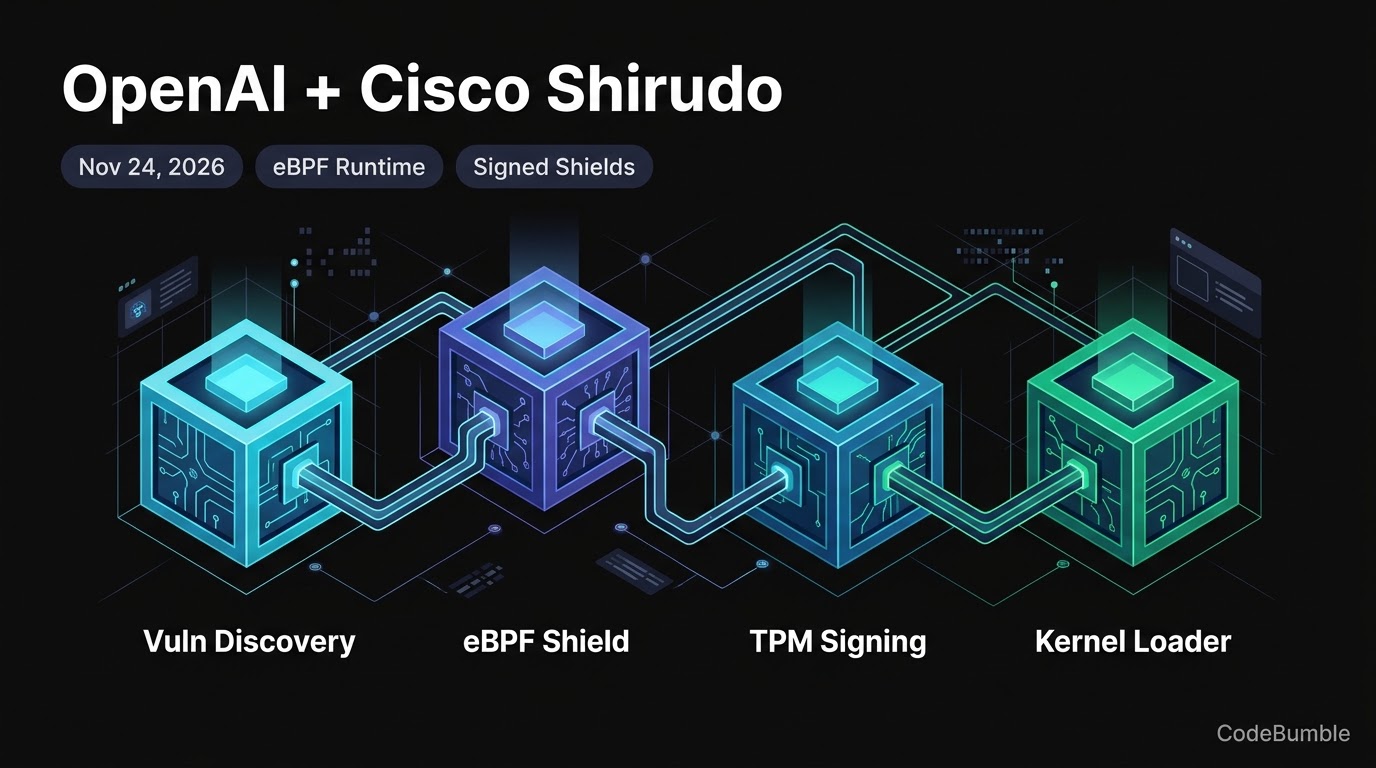
flowchart LR
    A[AI Agent / Security Engineer] -->|Generates & Tests Shield Against Exploit + Workload| B[Operator Review & Cryptographic Signing]
    B -->|Signed eBPF Program| C[Linux Kernel Signed-Loader ABI + eBPF Verifier]
    C -->|Verifies Signature Even Under Compromised Admin| D[Running Process e.g. Elasticsearch]
    C -->|Load / Unload Attestation| E[TPM 2.0 Hardware Measurement Log]
Four Core Security Guarantees
According to OpenAI's technical overview and Cisco's announcement, Shirudo's trust model rests on four mechanisms:
- Live Shadowing and Enforcement: Operators can observe how a proposed eBPF shield affects production traffic before switching it to enforcement mode, minimizing false-positive outages.
- Agentic Validation Loop: AI agents (such as Codex) investigate vulnerabilities, draft targeted eBPF shields, and validate them against both exploit reproducers and legitimate workloads—while human operators retain final approval and signing keys.
- Signed-Loader ABI & Kernel Verifier: Shields must be cryptographically signed before the kernel loads them. Even if an attacker obtains root/administrator privileges on the host, unsigned or tampered shields are rejected by the kernel's signed-loader controls alongside Linux's standard eBPF verifier.
- TPM 2.0 Hardware Attestation: Every shield load and removal event is recorded via TPM 2.0, giving fleet operators hardware-backed evidence that expected mitigations are active.
What Researchers and Security Analysts Say
Both project sponsors framed Shirudo as a defensive counterweight to machine-speed exploitation, while independent security outlets highlighted its lineage from Isovalent's Tetragon and its current pre-production status.
In the Cisco Newsroom announcement (November 23, 2026), Cisco President and Chief Product Officer Jeetu Patel emphasized the speed mismatch:
"We need self-defending infrastructure that acts at the speed of code, learns in real time, and shields itself until patches are safely rolled out."
OpenAI President and Co-founder Greg Brockman underscored why the runtime is open-sourced (OpenAI):
"We are partnering closely with Cisco on Shirudo to help teams protect the systems they need to keep running while they build and roll out a fix. So many teams rely on the same software that it makes sense to build these tools in the open."
Lineage From Tetragon and Production Caveats
As reported by Techzine (November 24, 2026) (citing The Register and SecurityWeek), Shirudo is an agent-focused rewrite of Tetragon, Isovalent's open-source eBPF security observability and enforcement platform (which Cisco already uses in derived form for Live Protect on IOS XE switches). However, SecurityWeek and Techzine explicitly note that Shirudo is not yet ready for general production use; OpenAI and Cisco aim to eventually ship tested shields alongside vulnerability disclosures.
| Dimension | Shirudo (OpenAI & Cisco) | Isovalent Tetragon |
|---|---|---|
| License | BSD 2-Clause (BPF programs dual BSD/GPL) (Techzine) | Apache-2.0 (MarkTechPost) |
| In-Kernel Blocking | Yes, real-time | Yes, real-time |
| Policy / Shield Authoring | Code-based (no DSL) (MarkTechPost) | TracingPolicy Kubernetes custom resource |
| Code-Path Replacement | Yes (e.g., input check attached to Base64 decoder) | Not disclosed |
| Kernel Readiness | Requires 7.4.0-rc1-bpf-next+ with 5 unmerged patches |
Runs on standard production Linux kernels |
Hardening and Implementation Blueprint
Because Shirudo relies on kernel-level signed eBPF loading that has not yet landed in mainline Linux distributions, security architects should evaluate it in isolated VMs rather than production hosts today.
System and Toolchain Requirements
Per Shirudo's system requirements documented by MarkTechPost (November 24, 2026), running Shirudo requires:
- Target Kernel: A
bpf-nextkernel with the signed-loader ABI (test kernel reports7.4.0-rc1-bpf-next+) plus 5 carried kernel patches not yet merged upstream intobpf-next. - Host Stack: TPM 2.0,
systemd 256or newer, and a Unified Kernel Image (UKI). - Operator Build Toolchain:
clangand LLVM 23, plus OpenSSL 3.5 or newer for shield signing.
Safe Evaluation Path
- VM Quickstart & Isovalent Lab: Follow the project's VM quickstart at
github.com/shirudo-dev/shirudoor Isovalent's self-guided lab to practice signing, loading, and verifying a test shield safely (OpenAI). - Validate Against Legitimate Workloads: Never deploy an AI-generated eBPF shield straight to enforcement; run it in observation/audit mode against canary traffic and check TPM 2.0 measurement logs.
- Maintain Traditional Patching Discipline: Treat eBPF shields strictly as temporary compensating controls to buy time for testing permanent upstream patches—never as a permanent substitute for patching vulnerable libraries or runtimes.
Frequently Asked Questions
Can I deploy Shirudo on Ubuntu, RHEL, or Debian production servers today?
Not without a custom kernel. According to MarkTechPost (November 24, 2026), Shirudo currently requires a bpf-next kernel (7.4.0-rc1-bpf-next+) with 5 unmerged kernel patches, systemd 256+, a Unified Kernel Image, and TPM 2.0, and Techzine notes it is not yet ready for general production use.
How does Shirudo prevent an attacker with root access from loading a malicious eBPF shield?
Every Shirudo shield is cryptographically signed, and the kernel's signed-loader ABI verifies the signature before allowing the eBPF program to load—while TPM 2.0 records a hardware-backed attestation log of all shield load and removal events (OpenAI, Cisco Newsroom).
What real vulnerabilities has Shirudo been tested against?
OpenAI and Cisco reported testing Shirudo against Java4Shell (CVSS 9.2, attaching a Codex-generated input check to Java's Base64 decoder in a running Elasticsearch process) and a recent PHP flaw, blocking both exploit attempts without restarting the services (OpenAI, Cisco Newsroom, MarkTechPost).
How is Shirudo licensed?
Shirudo is open-sourced at github.com/shirudo-dev/shirudo under the BSD 2-Clause license, with its eBPF kernel programs dual-licensed under BSD and GPL (OpenAI, Techzine).
How does Shirudo differ from Isovalent Tetragon?
Shirudo is an agent-focused rewrite derived from Tetragon. While Tetragon uses Apache-2.0 licensing and declarative TracingPolicy CRDs on standard Linux kernels, Shirudo uses BSD 2-Clause licensing, code-based shield authoring without a DSL, and signed-loader + TPM 2.0 attestation for temporary code-path shielding (Techzine, MarkTechPost).
Sources
- OpenAI — OpenAI and Cisco introduce Shirudo (November 23, 2026): https://openai.com/index/introducing-shirudo/
- Cisco Newsroom — Cisco and OpenAI Launch Shirudo, A New Project to Safeguard Agentic AI (November 23, 2026): https://newsroom.cisco.com/c/r/newsroom/en/us/a/y2026/m11/cisco-and-openai-launch-shirudo-a-new-project-to-safeguard-agentic-ai.html
- MarkTechPost — OpenAI and Cisco Releases Shirudo: An Open-Source Linux Runtime Allowing Agents to Defend Systems Without Downtime (November 24, 2026): https://www.marktechpost.com/2026/11/24/openai-cisco-shirudo-ebpf-linux-runtime/
- Techzine — Cisco and OpenAI's Shirudo runtime protects Linux without downtime (November 24, 2026): https://www.techzine.eu/news/security/146033/cisco-and-openais-shirudo-runtime-protects-linux-without-downtime/