

Engineering
Inside Cloudflare’s Search for Agents: How /.well-known/search, Hybrid RRF & RFC 10008 HTTP QUERY Work
On November 25, 2026, Cloudflare launched Search for Agents—exposing a /.well-known/search endpoint that speaks RFC 10008 HTTP QUERY and returns ranked Markdown chunks instead of LLM prose. Here is how the edge retrieval pipeline works, what live HTTP tests reveal, and which rate-limit and billing catches to check first.
8 min read
Inside Cloudflare’s Search for Agents: How /.well-known/search, Hybrid RRF & RFC 10008 HTTP QUERY Work
Executive Summary
On November 25, 2026, Cloudflare introduced Search for Agents (currently in beta across all plans, including Free, per Cloudflare Developer Docs). With a single dashboard toggle or API call, Cloudflare provisions an AI Search index for a zone, injects machine-readable discovery metadata into HTML and Markdown responses, and exposes a standardized retrieval endpoint at https://<YOUR_DOMAIN>/.well-known/search supporting both GET and the newly standardized HTTP QUERY method (RFC 10008).
Rather than generating an LLM-summarized answer on the server, the endpoint returns ranked Markdown passages directly from the site's hybrid vector-and-keyword index—letting the calling agent's own model synthesize the response. Early independent testing by Flavio Copes (November 27, 2026) and adoption telemetry from Searchable (November 26, 2026) highlight the key engineering and operational numbers: 1,024-token chunks with 10% overlap, a 48-hour similarity cache, a 500 pages/day crawl cap on Workers Free, and $0.75 per 1,000 agent searches after 1,000 free monthly queries starting December 1, 2026.
The Bottleneck: Why Agentic Web Scraping Breaks Standard Patterns
As automated coding assistants, research agents, and CLI tools increasingly fetch live documentation and technical references, traditional web-crawling mechanics break down in three ways:
- Multi-hop HTML scraping wastes latency and tokens: Previously, Cloudflare's Markdown for Agents solved content formatting once an agent knew the target URL (
Accept: text/markdown), but finding the right page still forced agents to crawlsitemap.xml, parse navigation menus, and fetch dozens of HTML pages sequentially. - Server-side RAG answers duplicate compute: Standard site search widgets or "Ask AI" endpoints run an extra LLM generation pass on the origin/provider side—adding latency, cost, and hallucination risk when the calling agent already has its own LLM and conversation context.
GETvs.POSTprotocol friction: Passing long natural-language prompts or structured filters inGETquery strings hits URL length limits and leaks query payloads into proxy/access logs. Falling back toPOST /searchbreaks HTTP semantics becausePOSTis neither safe nor idempotent, preventing edge caches and HTTP clients from safely retrying or caching search reads.
Inside the Solution: Architecture & Protocol Internals
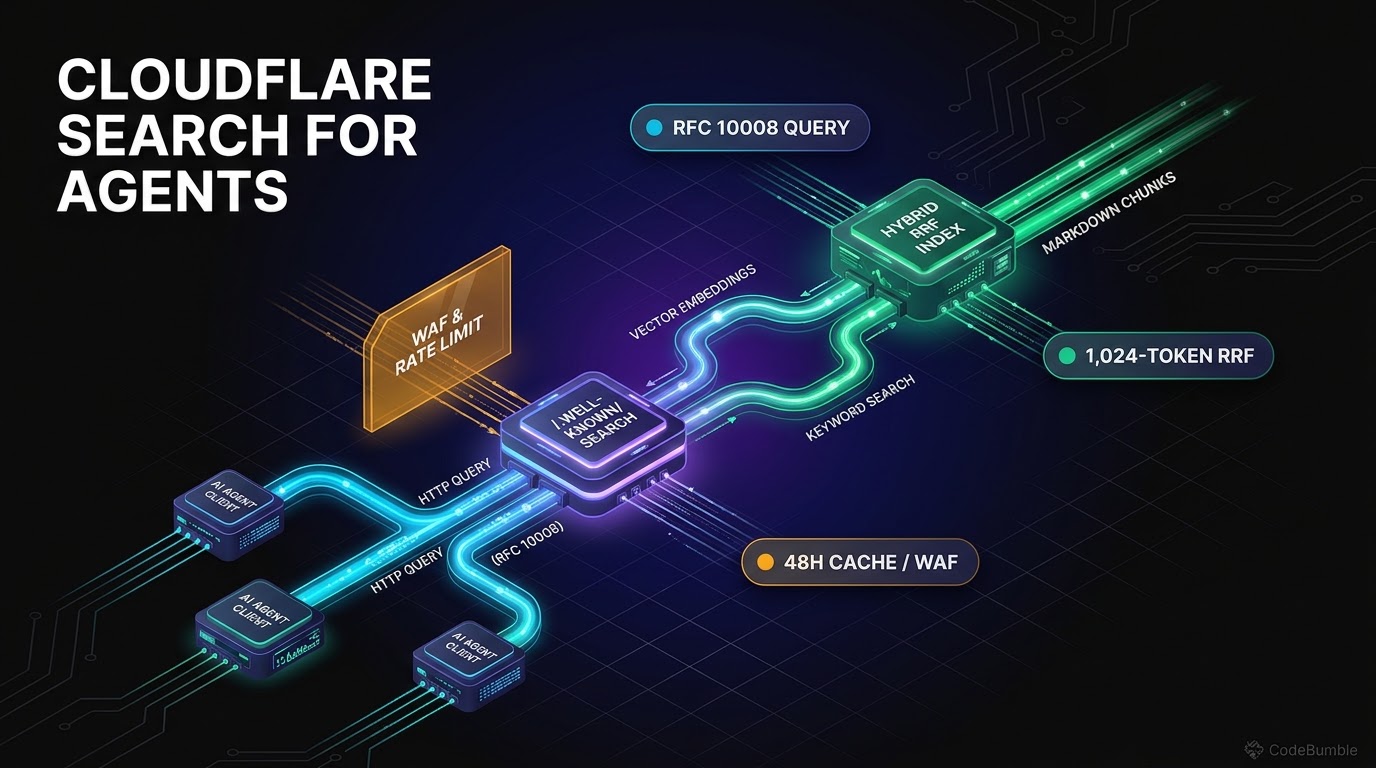
Cloudflare's Search for Agents solves discovery, retrieval, and HTTP semantics at the edge network layer without requiring origin application changes.
sequenceDiagram
    participant Agent as AI Agent / CLI (e.g. OpenCode)
    participant Edge as Cloudflare Edge (/.well-known/search)
    participant WAF as WAF & AI Crawl Control
    participant Cache as 48h Similarity Cache
    participant Index as AI Search (RRF: Qwen3-0.6B + Keyword)

    Agent->>Edge: GET / (or Accept: text/markdown)
    Edge-->>Agent: HTML <meta name="agent:*"> or YAML front matter
    Agent->>Edge: QUERY /.well-known/search (plain text or JSON body)
    Edge->>WAF: Evaluate Bot / WAF / Rate-Limit Rules
    WAF->>Cache: Check 48-hour similarity cache
    Cache-->>Edge: Cache Hit -> Return Markdown Chunks
    Cache->>Index: Cache Miss -> Hybrid Vector + Keyword RRF
    Index-->>Agent: text/markdown; charset=utf-8 (Ranked Passages + Scores)
1. Edge-Injected Discoverability (HTML & Markdown)
When Search for Agents is toggled on under Overview > Quick Actions, Cloudflare creates an AI Search instance named search-for-agents-<ZONE_ID> in the account's default namespace and automatically injects discovery instructions into responses (Cloudflare Blog):
- HTML responses receive four
<meta>tags in<head>:agent:instructions,agent:endpoint,agent:method, andagent:documentation. - Markdown responses (when Markdown for Agents is enabled via
Accept: text/markdown) receive the exact same discovery block in YAML front matter:
---
agent:
  instructions: "Use this search API to find relevant content across this site with keywords or natural-language queries, instead of crawling individual pages. Results are returned in Markdown."
  endpoint: "https://developers.cloudflare.com/.well-known/search?q={query}"
  method: "GET"
  documentation: "https://developers.cloudflare.com/ai-search/how-to/search-for-agents/"
---
2. Crawling, Chunking, and Hybrid RRF Retrieval
Based on Flavio Copes' architectural inspection of live Cloudflare instances on November 27, 2026, the provisioned search-for-agents-<ZONE_ID> instance configures two core subsystems:
- Discovery & Sync: Crawls
https://<YOUR_DOMAIN>using both XML sitemaps and internal link traversal up to five hops deep, syncing every 24 hours with a 24-hour crawl cache. - Hybrid Search with Reciprocal Rank Fusion (RRF): Combines dense vector embeddings (
@cf/qwen/qwen3-embedding-0.6b) with lexical keyword search via RRF, splitting documents into 1,024-token chunks with 10% overlap, fronted by a 48-hour similarity cache. - Zero-Config Underlying Stack & Bundled Metering: Under the hood, AI Search orchestrates Workers AI embeddings and optional reranking, R2 object storage, a Vectorize index, and Browser Run calls—and per Flavio Copes, those underlying component calls do not generate separate line-item bills on those products; only optional extras such as answer generation, query rewriting, or file summaries bill separately.
- Markdown-First Payload Structure: Responses return ranked Markdown sections annotated with their source file path and relevance score (for example,
# Search results for: "cloudflare artifacts"followed by## docs/artifacts/api/workers-binding/index.md (score: 1.000)and the matching Markdown body), allowing coding agents to ingest structured tables and limits directly without HTML parsing.
3. Native Support for RFC 10008: The HTTP QUERY Method
A standout protocol detail is Cloudflare's native support for HTTP QUERY, published by the IETF in June 2026 as RFC 10008 (co-authored by Julian Reschke of greenbytes, James M. Snell of Cloudflare, and Mike Bishop of Akamai; IETF draft).
In practice, QUERY resolves a decades-old API design compromise. Historically, engineers building complex search, GraphQL, or RAG retrieval endpoints had to choose between GET (which breaks on long prompts, hits proxy URL length caps, and logs sensitive parameters in web server access logs) and POST (which supports arbitrary request bodies but signals state mutation, disabling automatic HTTP caching and safe client retries). By declaring accept-query: text/plain, application/json on 200 and HEAD responses, /.well-known/search advertises supported query media types directly at the resource level.
Unlike POST, QUERY is formally safe and idempotent while carrying a request body—letting agents send long natural-language prompts or JSON payloads without URL-encoding constraints, while allowing caches and clients to retry safely. Search for Agents accepts both plain text and JSON bodies:
# 1. Standard GET request
curl --get "https://developers.cloudflare.com/.well-known/search" \
  --data-urlencode "q=What is the maximum push size for Cloudflare Artifacts?"

# 2. RFC 10008 HTTP QUERY with plain-text body
curl -X QUERY "https://developers.cloudflare.com/.well-known/search" \
  --data "What is the maximum payload size per ingestion request in Basin Pipelines?"

# 3. RFC 10008 HTTP QUERY with JSON body
curl -X QUERY "https://developers.cloudflare.com/.well-known/search" \
  --header "Content-Type: application/json" \
  --data '{"q":"How many bulk import requests per minute does Email Service allow?"}'
Verified Live Behavior, Quirks, and Cost Telemetry
Independent live testing and ecosystem telemetry published within 48 hours of launch surfaced several important implementation details that are easy to miss in the announcement post:
| Aspect | Verified Observation | Source |
|---|---|---|
| Supported Methods & Headers | 200 and HEAD responses include accept-query: text/plain, application/json. Sending POST returns 405 with allow: GET, HEAD, QUERY. |
Flavio Copes (Nov 27, 2026) |
| Content Negotiation Quirk | GET /.well-known/search returns text/markdown; charset=utf-8 even when Accept: application/json is sent (use separate REST/MCP endpoints for JSON). |
Flavio Copes (Nov 27, 2026) |
| Missing Query Handling | Calling GET /.well-known/search without ?q= returns HTTP 400 (Missing query parameter: ?q=). |
Flavio Copes (Nov 27, 2026) |
| Free Plan Crawl Limit | Workers Free plan is capped at 500 pages crawled per day (free plans pause once monthly limits are reached). | Flavio Copes / TechRepublic (Nov 27, 2026) |
| Paid Query Pricing (Dec 1, 2026) | 1,000 included semantic/hybrid queries/month, then $0.75 per 1,000 agent searches (AI Search billing starts Dec 1, 2026). | Searchable (Nov 26, 2026) |
| Early Adoption (Day 2) | Roughly 0.1% of tracked Cloudflare-hosted customer sites had enabled /.well-known/search by Nov 27, 2026. |
Searchable (Nov 26, 2026) |
Cloudflare also noted in its November 25 blog post that internal dogfooding on developers.cloudflare.com showed coding agents like OpenCode reliably discovering the <meta>/YAML instructions on the homepage and switching to /.well-known/search for subsequent lookups within the same session.
Practical Takeaways for Engineering Teams
- Audit Public Exposure Before Flipping the Toggle: Because
/.well-known/searchis publicly accessible on your domain and hybrid queries count against your 1,000/month included quota (and $0.75/1K overage starting December 1, 2026), ensure only public documentation/marketing content is indexed and set a billing alert before enabling it on high-traffic zones. - Put WAF Rate Limiting in Front of
/.well-known/search: Cloudflare explicitly notes that/.well-known/searchremains subject to WAF, Bot Management, and AI Crawl Control rules. Add a targeted rate-limiting rule on the/.well-known/searchpath so runaway scrapers cannot exhaust your monthly semantic query budget. - Adopt RFC 10008
QUERYin Your Own APIs: Even if you do not use Cloudflare, RFC 10008 (QUERY) is a clean architectural upgrade for internal search, GraphQL read operations, and RAG retrieval APIs—replacing non-idempotentPOST /searchhandlers with cacheable, retry-safe semantics (already supported incurlandundici). - Keep Retrieval Separate from Generation: Cloudflare's decision to return raw ranked Markdown chunks rather than LLM-generated prose is a sound pattern for any developer-facing search API: it eliminates server-side inference cost, cuts latency, and avoids double-hallucination when downstream agents already run their own frontier models.
Frequently Asked Questions (FAQ)
What does Cloudflare Search for Agents return when queried?
It returns ranked Markdown passages (text/markdown; charset=utf-8) with file/path references and relevance scores from your site's hybrid index—not an LLM-generated summary—so calling AI agents can reason over the primary text with their own models (Cloudflare Developer Docs).
What is the HTTP QUERY method (RFC 10008) used by /.well-known/search?
Published by the IETF in June 2026, RFC 10008 defines QUERY as a safe and idempotent HTTP method that carries search criteria in the request body, avoiding GET URL length limits while retaining caching and retry safety unlike POST (Cloudflare Blog).
How much does Cloudflare Search for Agents cost?
It is available on all plans (including Free, capped at 500 crawled pages/day and pausing at monthly limits). Starting December 1, 2026, AI Search billing applies: paid accounts include 1,000 semantic/hybrid queries per month, with overages billed at $0.75 per 1,000 agent searches (Searchable; Flavio Copes).
Can I restrict which agents or bots hit /.well-known/search?
Yes. Requests to /.well-known/search pass through your zone's WAF, Bot Management, and AI Crawl Control rules, allowing you to rate-limit or block abusive automated traffic (Cloudflare Developer Docs).
How do AI agents discover the /.well-known/search endpoint?
Cloudflare automatically injects four agent:* <meta> tags into HTML <head> responses and equivalent YAML front matter into Accept: text/markdown responses when Markdown for Agents is enabled (Cloudflare Blog).
Sources
- Cloudflare Blog — Introducing Search for Agents (Primary announcement, published November 25, 2026)
- Cloudflare Developer Docs — Search for Agents & Changelog (Primary documentation, published November 25, 2026)
- IETF — The HTTP QUERY Method (draft-ietf-httpbis-safe-method-w-body-14 / RFC 10008) (Primary protocol specification, RFC 10008 published June 2026)
- Flavio Copes — Cloudflare Search for Agents: how it works and the limits to check first (Secondary live testing & technical breakdown, published November 27, 2026)
- Searchable — Cloudflare Search for Agents: Cost and Adoption Data (Secondary cost & adoption telemetry, published November 26, 2026)