

Engineering
Quarkus 4.0 Internals: Vert.x 5, Netty 4.2, HTTP/3, io_uring & Breaking Upgrade Trade-Offs
Quarkus 4.0 launched on November 25, 2026, moving to Java 21+, Eclipse Vert.x 5, Netty 4.2's adaptive memory allocator and native io_uring, opt-in HTTP/3, and Jackson 3.1. Here is how the rebuilt runtime works and when to upgrade versus staying on 3.40 LTS.
8 min read
Quarkus 4.0 Internals: Vert.x 5, Netty 4.2, HTTP/3, io_uring & Breaking Upgrade Trade-Offs
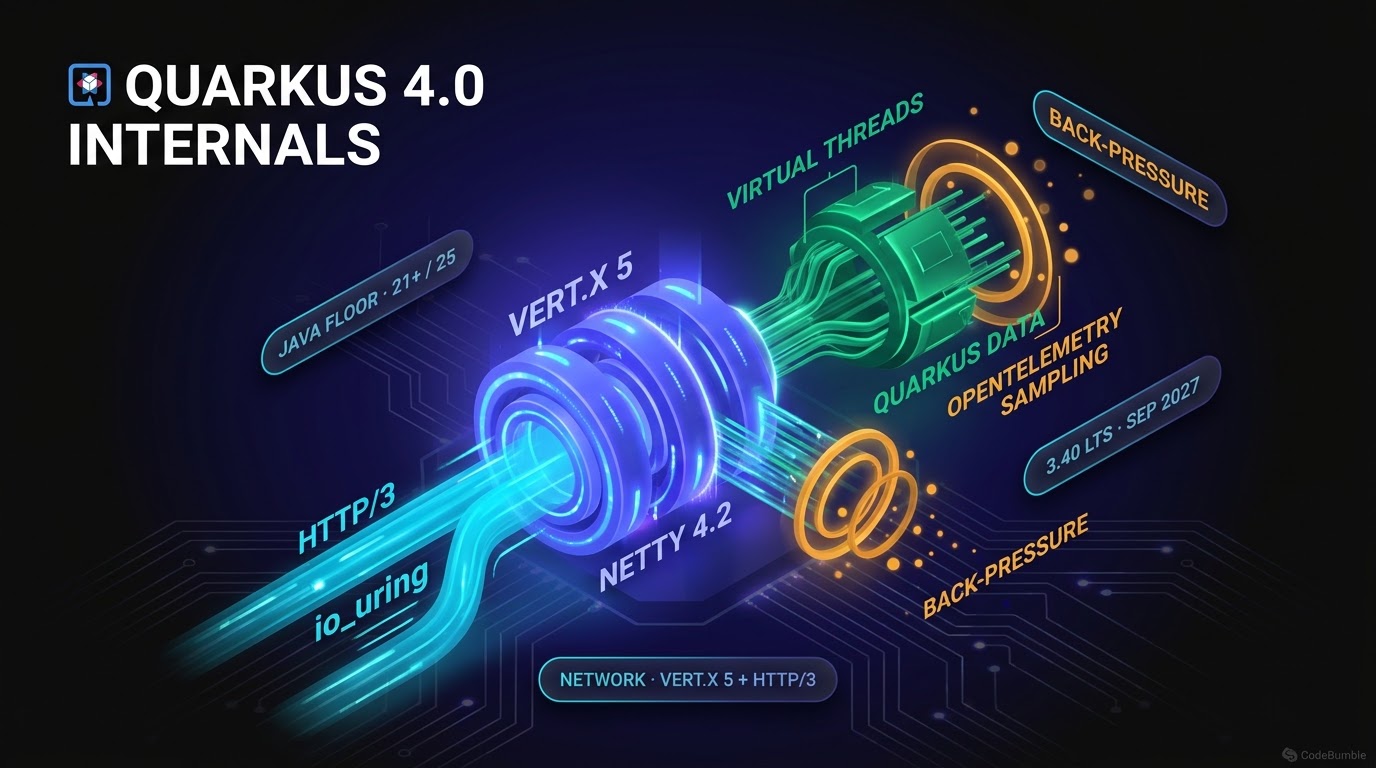
Executive Summary
On November 25, 2026, the Quarkus team released Quarkus 4.0—a major architectural overhaul two years in the making that raises the runtime baseline to Java 21+ (with Java 25 recommended) and replaces the core I/O foundation with Eclipse Vert.x 5 and Netty 4.2. Rather than a routine dependency bump, Quarkus 4.0 rewrites how the framework handles non-blocking I/O, memory allocation, native Linux transports, virtual threads, data persistence, and production telemetry.
Key verified engineering changes in Quarkus 4.0 include:
- Rebuilt networking & memory layer: Netty 4.2 enables its adaptive memory allocator by default (replacing the pooled allocator) and graduates
io_uringfrom incubating to production-ready—with bothepollandio_uringnow supported inside GraalVM native executables—while Vert.x 5 removes legacy callbacks in favor ofFuture-only async APIs. - Native HTTP/3 & bounded back-pressure: A new
quarkus-http3extension adds opt-in HTTP/3 over QUIC on the same port as HTTPS (advertisingAlt-Svc), and WebSockets Next enforces a default 256-message pending queue cap (max-pending-messages) to prevent unbounded memory growth. - Production-safe observability defaults: OpenTelemetry metrics and logs are now stable and enabled by default, switching OTLP transport from gRPC (
4317) tohttp/protobuf(4318) and cutting default trace sampling from 100% (1.0d) to 10% (0.1d). - Breaking ecosystem trade-offs: Upgrading requires migrating to Jackson 3.1, CDI 5.0, Hibernate ORM 8.0 (candidate release), and Vert.x gRPC (replacing
grpc-java), while several Quarkus Platform modules—including Camel Quarkus and Quarkus Operator SDK—are still completing 4.0 migration.
The Bottleneck & Scale Constraints in Quarkus 3.x
Supporting modern cloud-native Java workloads across both JVM and native-image deployments exposed four structural bottlenecks in the Quarkus 3.x architecture:
- Legacy async & transport fragmentation: Maintaining callback-based Vert.x 4 APIs alongside
Future/Mutiny abstractions complicated extension development, whileio_uringremained incubating in Netty 4.1 and unavailable in native executables. Meanwhile, running gRPC ongrpc-javaalongside Vert.x HTTP duplicated networking machinery. - Unbounded WebSocket buffering & thread-pinning friction: High-throughput WebSocket peers could push frames faster than application handlers drained them, buffering unbounded messages in heap memory. At the same time, migrating blocking REST endpoints to Java virtual threads required annotating individual methods with
@RunOnVirtualThread. - 100% trace sampling & dual-telemetry overhead: Quarkus 3.x's default
parentbased_always_onOpenTelemetry sampler (1.0d) captured 100% of traces out of the box—an expensive default in high-QPS microservices—while instrumenting code for both Micrometer and OpenTelemetry required separate APIs. - Java 17 & Jackson 2 ceiling: Carrying Java 17 compatibility and older Jakarta/Jackson 2.x APIs prevented Quarkus from adopting JPMS modularity, Jakarta Persistence 4.0, Jakarta Data 1.1, and immutable Jackson 3 object mappers.
Inside the Solution: Architecture & Internals
Quarkus 4.0 addresses these constraints by refactoring five core subsystems, as summarized in the Quarkus 4.0 release announcement, Quarkus 4 architecture overview, and GitHub release changelog:
flowchart LR
    A[Client Traffic<br/>HTTP/3 · HTTP/2 · gRPC · WS] --> B[Netty 4.2 Transport<br/>Adaptive Allocator · epoll / io_uring]
    B --> C[Vert.x 5 Event Loop<br/>Future-only · Vert.x gRPC · WS Back-Pressure 256]
    C --> D{Execution Model}
    D -->|Non-Blocking| E[Event Loop / Mutiny]
    D -->|Blocking REST| F[Virtual Threads<br/>execution.mode=virtual-thread]
    E --> G[Quarkus Data & Signals<br/>Hibernate ORM 8 · OTel 10% · SPIFFE PQC TLS]
    F --> G
1. Vert.x 5, Netty 4.2 & Native io_uring / HTTP/3
Moving the networking layer to Eclipse Vert.x 5 and Netty 4.2—a nearly year-long ecosystem migration tracked in GitHub discussion #55320—delivers three concrete runtime shifts:
- Adaptive memory allocator: Netty 4.2 replaces the traditional pooled allocator with an adaptive allocator by default, tuning buffer allocation dynamically to workload pressure.
- Native transports in native executables: Developers can explicitly select
epoll,kqueue, orio_uring(which is now production-ready with Unix domain socket and zero-copy file transfer support), andio_uringincludes a runtime capability check so native binaries degrade safely if the host kernel restricts it. - HTTP/3 & Vert.x gRPC: Adding
quarkus-http3enables HTTP/3 over QUIC alongside HTTPS on the same port for both the HTTP server and REST Client. Quarkus also dropsgrpc-javain favor of Vert.x 5's native gRPC stack (adding gRPC-Web, transcoding, and JSON wire format) and removes the legacy clustered Vert.x event bus (#54930).
2. Global Virtual Threads & WebSockets Back-Pressure
Instead of sprinkling @RunOnVirtualThread across every blocking endpoint, Quarkus 4.0 (#56294) introduces a single build-time property to route all blocking REST signatures onto virtual threads while keeping non-blocking signatures on the event loop:
# Route all blocking REST endpoints to Java 21+ virtual threads
quarkus.rest.blocking.signatures.execution.mode=virtual-thread

# Bound WebSockets Next per-connection buffering (default: 256)
quarkus.websockets-next.server.max-pending-messages=256
quarkus.websockets-next.client.max-pending-messages=256

# Post-quantum key exchange policy in TLS Registry
quarkus.tls.pqc-enforcement-policy=client-negotiated
For WebSockets Next (#56856), capping pending unacknowledged messages at 256 per connection enforces back-pressure automatically when a peer floods frames faster than the consumer processes them.
3. Quarkus Data, CDI 5.0 & Security Hardening
On the persistence and dependency-injection side, Quarkus 4.0 ships CDI 5.0 (standardizing @Reserve, @Eager, and @AutoClose), Hibernate ORM 8.0 (with Jakarta Persistence 4.0's EntityAgent and a new graph-based flushing engine), and Quarkus Data (ManagedEntity and RecordEntity backed by a new quarkus-data-processor replacing hibernate-processor). Notably, import.sql is deprecated in favor of schema.sql and data.sql (#58049).
In security, the TLS registry adds post-quantum key exchange (quarkus.tls.key-exchange-groups and pqc-enforcement-policy) across HTTP server/client, REST Client, and Mailer (#55624), while a new experimental SPIFFE Client extension (#55180) fetches JWT and X.509 SVIDs directly from a local SPIRE Agent via the Workload API—eliminating sidecar file mounts. OIDC extensions also add OAuth 2.0 Attestation-Based Client Authentication (#54900, secretless JWT attestation) and OAuth Client ID Metadata Documents (#55736).
4. Unified Observability, Signals & Agentic Tooling
The new quarkus-observation extension (#55145) lets teams annotate methods once with @Observed to emit both Micrometer timers and OpenTelemetry traces. OpenTelemetry now defaults to http/protobuf on port 4318 and parentbased_traceidratio at 0.1d (10% sampling), alongside a zero-config Observability dashboard in the Dev UI (#56377) with CSV export. Quarkus Signals (the loosely coupled internal event bus) now propagates OpenTelemetry trace context, signals.emissions / signals.receiver.executions Micrometer counters, and SecurityIdentity (@RolesAllowed) to receivers by default. For AI-assisted development, Quarkus Agent MCP runs quarkus dev externally so coding agents retain log access and extension quarkus-skill.md guidelines even if the application fails to boot.
Verified Release Telemetry, Breaking Changes & LTS Trade-Offs
Because Quarkus 4.0 touches nearly every foundational dependency, teams should weigh the breaking-change surface and current ecosystem readiness before upgrading:
| Subsystem | Quarkus 3.x Baseline | Quarkus 4.0 Change | Migration Impact / Caveat |
|---|---|---|---|
| JVM Floor | Java 17 supported | Java 21 minimum (Java 25 rec.) | Java 17 dropped; default container base UBI 10 |
| Networking | Vert.x 4 / Netty 4.1 / grpc-java |
Vert.x 5 / Netty 4.2 / Vert.x gRPC | Callbacks removed (Future-only); clustered event bus removed |
| JSON Mapping | Jackson 2.x | Jackson 3.1 | Immutable mappers (JsonMapper.Builder); subtle default shifts |
| Persistence | Hibernate ORM 6/7 (import.sql) |
Hibernate ORM 8.0 + Quarkus Data | ORM 8.0 is a candidate release awaiting final JPA 4.0 / Data 1.1 |
| OpenTelemetry | gRPC (4317), 1.0d (100%) |
http/protobuf (4318), 0.1d (10%) |
Updated semantic-convention metric names; Prometheus client v1.x |
| Config Escaping | Unescaped ${prop} |
Backslash escape \${my.prop} |
SmallRye Config 4; @ConfigurationProperties uses @ConfigMapping |
Source: Quarkus 4.0 Release Announcement (Nov 25, 2026) and GitHub Releases (Nov 26, 2026).
Ecosystem Readiness & LTS Support Windows
While 12 core Platform members—including Quarkus Amazon Services 4.0, Quarkus LangChain4j 2.0, Quarkus MCP Server 2.0, Debezium 3.7, Quarkus Vault 5.0, and Quarkus JMS 0.4—shipped with 4.0, Camel Quarkus, Quarkus Flow, Quarkus Google Cloud Services, Quarkus Operator SDK, Blaze-Persistence, and Quarkus HTTP Problem are still migrating and not yet in the 4.0 Platform.
To avoid forcing premature upgrades, Quarkus maintains two active 3.x LTS branches with bugfix and CVE coverage:
- Quarkus 3.33 LTS: Supported until the end of March 2027.
- Quarkus 3.40 LTS: Supported until the end of September 2027.
Practical Takeaways for Your Stack
- Stay on Quarkus 3.40 LTS for now if your production services depend on Camel Quarkus, Quarkus Operator SDK, Google Cloud Services, or Java 17 runtimes—you have until September 2027 for CVE coverage while Quarkiverse extensions finish migrating.
- Test Quarkus 4.0 in staging first if you want native
io_uring, opt-in HTTP/3, global virtual threads, or post-quantum TLS key exchange. Run the automated migration tool (quarkus update --stream=4.0,./mvnw io.quarkus.platform:quarkus-maven-plugin:4.0.1:update -N -Dstream=4.0, or./gradlew -PquarkusPluginVersion=4.0.1 quarkusUpdate --stream=4.0), then audit Jackson 3 serialization outputs and OpenTelemetry collector port4318(http/protobuf) routing. - Avoid over-engineering custom async code: If your REST APIs are I/O-bound rather than CPU-bound, setting
quarkus.rest.blocking.signatures.execution.mode=virtual-threadin Quarkus 4.0 eliminates the complexity of rewriting imperative services into reactive Mutiny pipelines.
FAQ
What is the minimum Java version required for Quarkus 4.0? Quarkus 4.0 requires Java 21 as its minimum supported version and drops Java 17. The Quarkus team recommends Java 25 for production deployments.
How does Quarkus 4.0 enable HTTP/3 and io_uring?
Adding the quarkus-http3 extension enables HTTP/3 over QUIC alongside the existing HTTPS server on the same port, advertising support via Alt-Svc. Netty 4.2 graduates io_uring to production-ready status, and Quarkus 4.0 supports configuring both epoll and io_uring inside native executables.
Did OpenTelemetry defaults change in Quarkus 4.0?
Yes. OpenTelemetry metrics and logs are now stable and enabled by default, the default OTLP protocol changed from gRPC (port 4317) to http/protobuf (port 4318), and default trace sampling dropped from 1.0d (100%) to 0.1d (10%).
Are all Quarkus extensions ready for Quarkus 4.0? Not yet. Twelve core Platform members—such as Amazon Services 4.0, LangChain4j 2.0, MCP Server 2.0, and Debezium 3.7—are available at launch, but Camel Quarkus, Quarkus Flow, Google Cloud Services, Operator SDK, Blaze-Persistence, and HTTP Problem are still migrating.
When do Quarkus 3.x LTS releases reach end of life? Quarkus 3.33 LTS receives bugfixes and CVE patches until the end of March 2027, and Quarkus 3.40 LTS is supported until the end of September 2027.
Sources
- Quarkus Blog — Quarkus 4.0, our new major release, is here! by Guillaume Smet (Published November 25, 2026): https://quarkus.io/blog/quarkus-4-0-released/
- Quarkus Project — Quarkus 4: Engineering the Next Decade (Accessed November 27, 2026): https://quarkus.io/quarkus4/
- GitHub (
quarkusio/quarkus) — Releases & Complete Changelog (4.0.0/4.0.1) (Updated November 26, 2026): https://github.com/quarkusio/quarkus/releases - GitHub Discussions (
quarkusio/quarkus) — Quarkus 4 Progress Report (#55320) (2026): https://github.com/quarkusio/quarkus/discussions/55320