

Vulnerability
CVE-2024-10441: Why CISA Added Synology DSM and BeeStation OS to KEV Amid C3RB3R Attacks
On November 18, 2026, CISA added CVE-2024-10441—a CVSS 9.8 output-escaping flaw in Synology DiskStation Manager (DSM) and BeeStation OS—to its Known Exploited Vulnerabilities (KEV) catalog with a November 21 federal deadline. Linked to C3RB3R ransomware attacks targeting internet-exposed NAS appliances, the flaw requires immediate patching and network isolation. This defensive guide covers all five fixed builds, the ongoing advisory attribution discrepancy, and immutable backup hardening.
7 min read
CVE-2024-10441: Why CISA Added Synology DSM and BeeStation OS to KEV Amid C3RB3R Attacks
Executive Summary
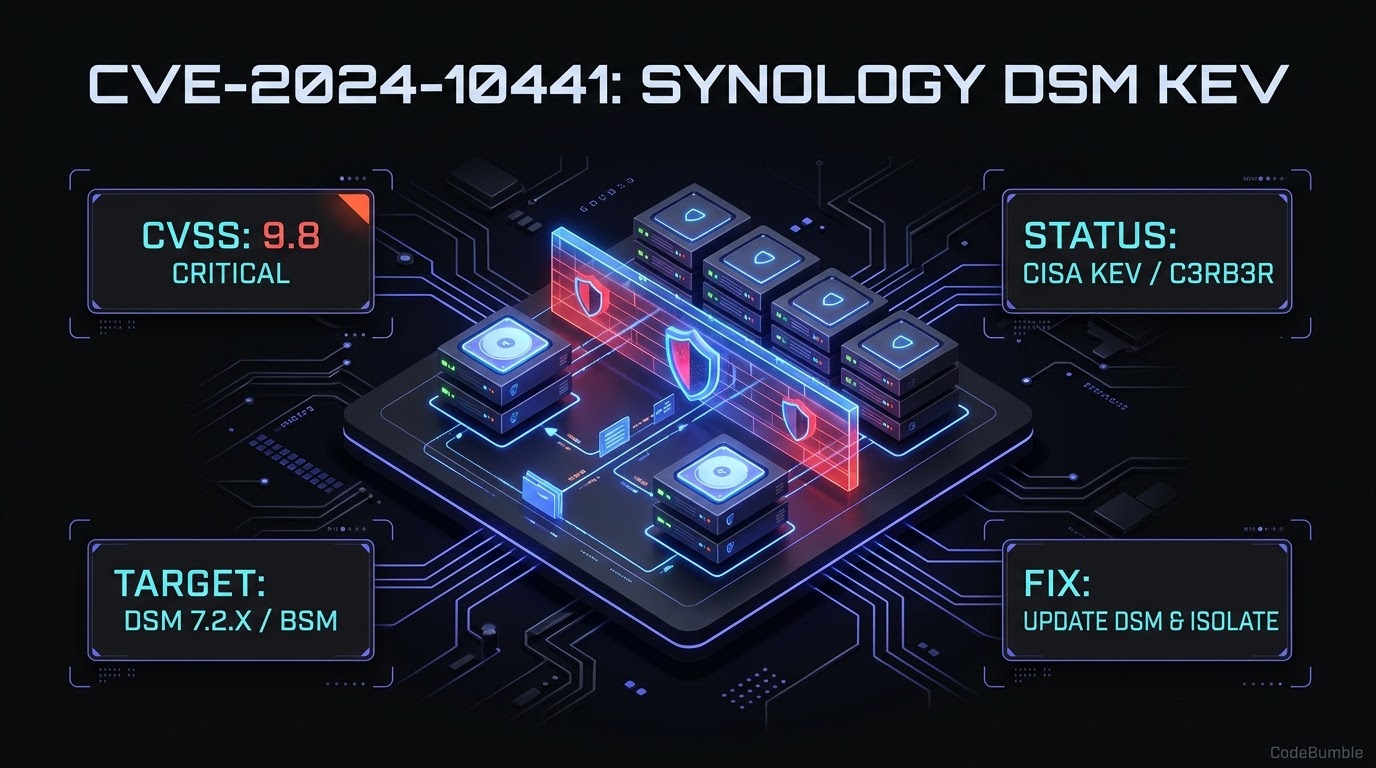
On November 18, 2026, the U.S. Cybersecurity and Infrastructure Security Agency (CISA) added CVE-2024-10441—a CVSS v3.1 9.8 (Critical) improper output encoding or escaping vulnerability (CWE-116) in Synology DiskStation Manager (DSM) and Synology BeeStation OS (BSM)—to its Known Exploited Vulnerabilities (KEV) catalog, setting a three-day federal remediation deadline of November 21, 2026.
Although Synology originally patched CVE-2024-10441 in late 2024 following Pwn2Own demonstrations, unpatched Network Attached Storage (NAS) appliances left exposed to the internet have recently been targeted in C3RB3R ransomware campaigns. Because NAS devices frequently store both production file shares and local backups, compromising an edge NAS gives attackers immediate leverage over an organization's recovery infrastructure.
There is no configuration workaround for CVE-2024-10441; remediation requires upgrading to the patched DSM (7.2.2-72806-1, 7.2.1-69057-6, 7.2-64570-4, 7.1.1-42962-7) or BeeStation OS (1.1-65374) builds and removing direct internet exposure from NAS management interfaces.
Confidence Level: High for CISA KEV status, CVSS 9.8 severity, affected/fixed build numbers, and active exploitation (corroborated across CISA, NIST NVD, and The Hacker News). Moderate regarding which specific Synology CVE serves as the primary initial access vector across all C3RB3R incidents, as Qihoo 360 and Synology point to different patched advisories (Synology-SA-24:20 vs. Synology-SA-26:13).
Technical Mechanics and Architecture
System Plugin Daemon Output-Escaping Flaw (CWE-116)
According to the NIST NVD CVE-2024-10441 record, CVE-2024-10441 is an improper encoding or escaping of output vulnerability (CWE-116) located in the system plugin daemon shared across Synology DSM and BeeStation OS. CISA's Stakeholder-Specific Vulnerability Categorization (SSVC) assessment classifies the flaw as Exploitation: active, Automatable: yes, and Technical impact: total.
[Unauthenticated Remote Attacker]
        │
        ▼  (Internet-Exposed DSM / QuickConnect / Port Forward)
┌──────────────────────────────────────────────────────────┐
│        Synology DSM / BeeStation OS Network Edge         │
│                                                          │
│   System Plugin Daemon                                   │
│    └─ CWE-116: Improper Encoding / Escaping of Output    │
│       (Reachable over network; PR:N, UI:N, AC:L)         │
└──────────────────────────────────────────────────────────┘
        │
        ▼  (Arbitrary Code Execution on NAS OS)
┌──────────────────────────────────────────────────────────┐
│          Post-Exploitation Impact on NAS                 │
│   ├──► C3RB3R Ransomware Deployment (.L0CK3D files)      │
│   ├──► Local Snapshots & Co-located Backups Compromised  │
│   └──► Lateral Pivot via Stored NAS / AD Credentials     │
└──────────────────────────────────────────────────────────┘
Because the CVSS vector is CVSS:3.1/AV:N/AC:L/PR:N/UI:N/S:U/C:H/I:H/A:H, an attacker requires no valid credentials (PR:N) and no user interaction (UI:N) to achieve remote code execution over the network whenever the vulnerable service is reachable.
Safe Read-Only Exposure & Compromise Audit Commands
Organizations managing Synology appliances should immediately verify their running DSM/BSM build and check whether any NAS management ports are exposed to untrusted networks. Run these read-only checks from an administrative workstation or via local SSH:
# 1. Check the exact installed DSM build on a Synology NAS (read-only)
cat /etc.defaults/VERSION | grep -E "productversion|buildnumber|smallfixnumber"

# 2. Check for signs of C3RB3R ransomware encryption (.L0CK3D extension or ransom notes)
find /volume* -maxdepth 4 \( -name "*.L0CK3D" -o -name "read-me3.txt" \) 2>/dev/null

# 3. Inspect active listening ports on the NAS to verify management services
ss -tulnp | grep -E "5000|5001|22|445"
Administrators can also verify the DSM version directly in the web UI under Control Panel → Update & Restore, and inspect Log Center for unexpected admin logins or newly created local administrator accounts.
Evidence: Affected Builds, C3RB3R Ransomware, and Attribution Nuance
Affected and Fixed Versions
Per NIST NVD and Spirity Enterprise's KEV advisory, the following five product branches are affected and patched in these minimum builds:
| Product | Affected Versions | Minimum Fixed Build |
|---|---|---|
| Synology DSM 7.2.2 | < 7.2.2-72806-1 |
7.2.2-72806-1 |
| Synology DSM 7.2.1 | < 7.2.1-69057-6 |
7.2.1-69057-6 |
| Synology DSM 7.2 | < 7.2-64570-4 |
7.2-64570-4 |
| Synology DSM 7.1 | < 7.1.1-42962-7 |
7.1.1-42962-7 |
| Synology BeeStation OS (BSM) | 1.0 and 1.1 < 1.1-65374 |
1.1-65374 |
(Note: DSM versions below 7.0 and BeeStation OS below 1.0 are listed as Unknown in NVD and should be audited against Synology's support lifecycle.)
Cross-Source Attribution Discrepancy
As reported by The Hacker News and DIESEC, defenders should be aware of an attribution nuance in the recent C3RB3R NAS ransomware wave:
- Synology & CISA KEV: Synology's late-October 2026 notice warned that threat actors were exploiting a flaw patched in December 2024 (
Synology-SA-24:20, which corresponds toCVE-2024-10441), and CISA formally addedCVE-2024-10441to the KEV catalog on November 18, 2026. - Qihoo 360 Investigation: Separately, Qihoo 360's anti-ransomware team investigated October 2026 NAS intrusions (featuring
.L0CK3Dencrypted files andread-me3.txtransom notes) and attributed those specific cases to two newer September 2026 flaws fromSynology-SA-26:13(CVE-2026-13639andCVE-2026-13684, both CVSS 9.8, fixed in DSM7.4-90075,7.3.2-86009-4, and7.2.2-72806-9).
Practical Takeaway: Do not stop at 7.2.2-72806-1. Updating to the latest DSM release (7.2.2-72806-9+, 7.3.2-86009-4+, or 7.4-90075+) closes both CVE-2024-10441 and the newer Synology-SA-26:13 flaws simultaneously.
Hardening Playbook: Patching, Network Isolation, and Backup Resilience
Step 1: Inventory Every Synology NAS and BeeStation Device
Shadow-IT and branch-office NAS units are frequently omitted from central patch calendars. Scan internal subnets and external perimeter ranges for Synology DSM web interfaces (default ports 5000/5001) and assign an explicit owner to every appliance.
Step 2: Patch Immediately to the Latest DSM / BSM Build
Because there is no configuration workaround for CVE-2024-10441, apply the vendor update immediately via Control Panel → Update & Restore (and enable automatic security updates for critical patches). For devices on 7.2.2, target 7.2.2-72806-9 or newer to also cover Synology-SA-26:13.
Step 3: Remove Direct Internet Exposure
Never expose DSM or BeeStation OS management interfaces directly to the public internet:
- Audit edge firewalls and routers for port-forwarding rules pointing to NAS ports
5000,5001, or22. - Review QuickConnect and DDNS settings; require an authenticated VPN or zero-trust tunnel before reaching any NAS management interface.
Step 4: Enforce Offline / Immutable Backups and Triage Compromise
Per CISA's BOD 26-04 forensics triage expectations, check unpatched internet-facing NAS units for signs of pre-patch compromise before trusting their data:
- Inspect Log Center for unknown admin accounts, unauthorized SSH logins, or disabled security packages.
- Maintain at least one immutable or offline backup copy that NAS credentials cannot delete or encrypt, and run a test restore to verify backup integrity.
Step 5: Safe Rollback and Recovery Notes
DSM updates do not support trivial in-place firmware downgrades. Before applying major DSM branch upgrades, export a .dss system configuration backup (Control Panel → Update & Restore → Configuration Backup) and verify that critical SMB/NFS/iSCSI shares and Hyper Backup tasks resume cleanly post-reboot. If a NAS shows .L0CK3D files or read-me3.txt, disconnect it from the network immediately, preserve system logs, and rebuild from verified offline backups.
Frequently Asked Questions (FAQs)
1. What is CVE-2024-10441 and why did CISA add it to KEV in November 2026?
CVE-2024-10441 is a CVSS 9.8 improper output-escaping flaw (CWE-116) in the system plugin daemon of Synology DSM and BeeStation OS. CISA added it to the KEV catalog on November 18, 2026 after evidence of active exploitation—including C3RB3R ransomware attacks against unpatched internet-facing NAS appliances.
2. Is there a workaround if I cannot update DSM right away? No official configuration workaround exists. If patching must wait briefly, immediately remove the NAS from direct internet exposure (close router port forwards, disable external QuickConnect access, and restrict management to an internal VLAN or VPN).
3. Which DSM version should I upgrade to—7.2.2-72806-1 or 7.2.2-72806-9?
Upgrade to the latest available build for your branch (such as 7.2.2-72806-9, 7.3.2-86009-4, or 7.4-90075), which remediates both CVE-2024-10441 (Synology-SA-24:20) and the newer Synology-SA-26:13 flaws (CVE-2026-13639 and CVE-2026-13684).
4. How can I check if a Synology NAS was already hit by C3RB3R ransomware?
Look for files renamed with the .L0CK3D extension, ransom notes named read-me3.txt, unknown administrator accounts, or unexpected login entries in DSM Log Center.
5. What is the CISA KEV remediation deadline for CVE-2024-10441? CISA set a federal remediation deadline of November 21, 2026—three days after its November 18, 2026 KEV addition.
Sources
- CISA Alert (Primary): CISA Adds Four Known Exploited Vulnerabilities to Catalog (Published November 18, 2026)
- NIST NVD (Primary): NVD — CVE-2024-10441 Detail (Published March 18, 2025; Modified June 16, 2026)
- The Hacker News (Press Reporting): CISA Warns of 4 Exploited Flaws Linked to Ransomware, Cryptomining, and LLMjacking Attacks (Published November 19, 2026)
- Spirity Enterprise (KEV Advisory): CVE-2024-10441: Synology DSM and BeeStation OS RCE (Published November 19, 2026)
- DIESEC (Ransomware & Attribution Analysis): Synology NAS Ransomware Hits Outdated DSM (Published November 4, 2026)