

Vulnerability
CVE-2026-90436: How an End-of-Life Apache Axis SOAP Bug Exposes Confluence and N-central
On November 18, 2026, CISA added CVE-2026-90436—an unsafe reflection vulnerability in end-of-life Apache Axis 1.x—to its Known Exploited Vulnerabilities (KEV) catalog with a three-day federal deadline of November 21. Rapid7 MDR observed active exploitation against Atlassian Confluence Data Center on November 13, alongside confirmed attacks against N-able N-central. This defensive breakdown covers the pre-handler SOAP fault reflection mechanism, affected versions, verified network IOCs, and immediate mitigation steps.
7 min read
CVE-2026-90436: How an End-of-Life Apache Axis SOAP Bug Exposes Confluence and N-central
Executive Summary
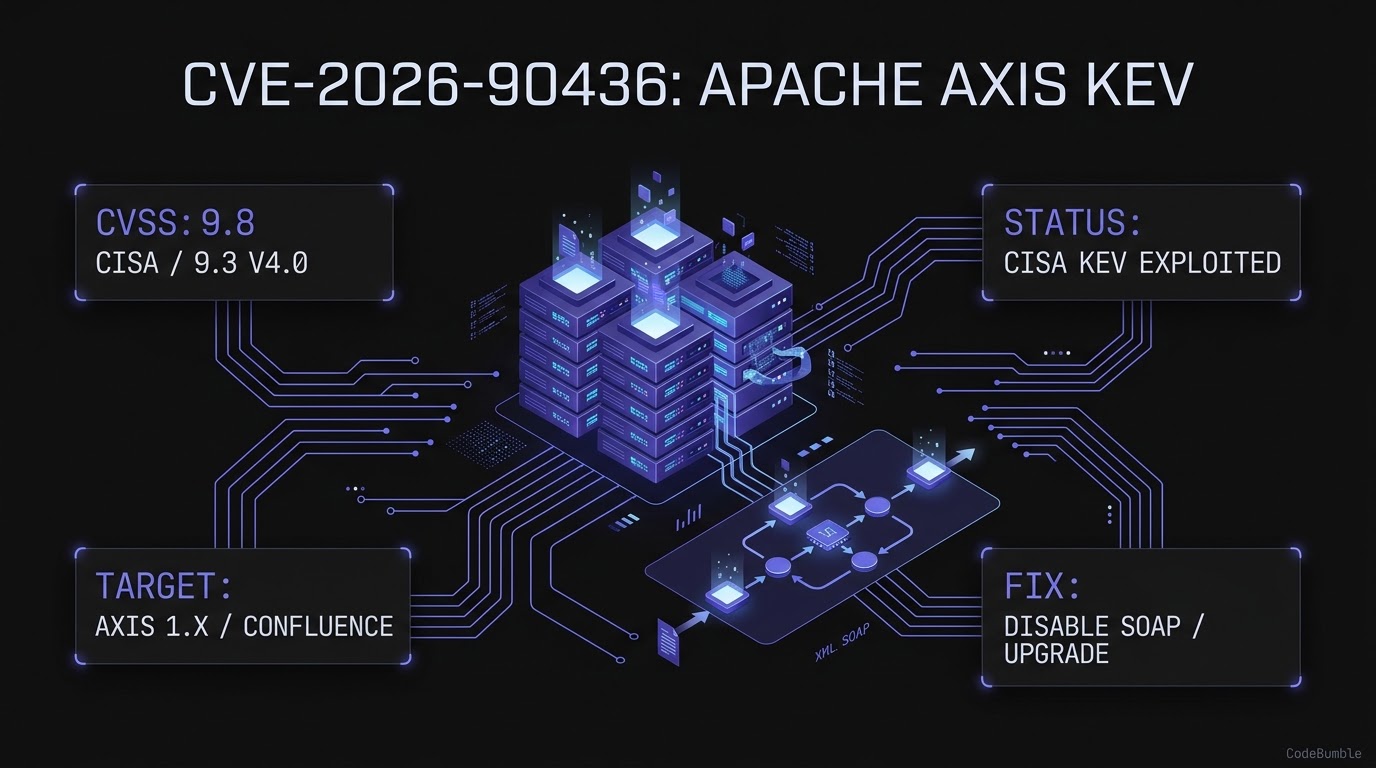
On November 18, 2026, the U.S. Cybersecurity and Infrastructure Security Agency (CISA) added CVE-2026-90436—an unsafe reflection vulnerability (CWE-470) in Apache Axis 1.x—to its Known Exploited Vulnerabilities (KEV) catalog, setting an aggressive three-day federal remediation deadline of November 21, 2026. Rated CVSS v3.1: 9.8 (Critical) by CISA-ADP and CVSS v4.0: 9.3 (Critical) by Atlassian, the flaw allows unauthenticated remote attackers to execute arbitrary code by sending a crafted SOAP <Fault> message to any exposed Axis 1.x endpoint.
Because Apache Axis 1.x (through version 1.4) reached End-of-Life (EOL), the Apache Software Foundation has stated it does not expect to issue a new Axis 1.x release. However, downstream enterprise platforms that bundle Axis 1.x—most notably Atlassian Confluence Data Center and N-able N-central—are actively being targeted in the wild. On November 13, 2026, Rapid7 MDR detected active exploitation against a customer Confluence Data Center server, and N-able reported wild exploitation against N-central on the same day.
Crucially, both Confluence Data Center and N-able N-central require non-default legacy SOAP/XML-RPC APIs to be enabled for exploitation to succeed. Organizations can immediately neutralize exposure by disabling those legacy APIs or upgrading to Confluence 9.2.28+ (or 10.x) and N-central 2026.4 HF3 (2026.4.1.39).
Confidence Level: High for CISA KEV status, root-cause unsafe reflection mechanics, affected product versions, and observed IOCs (corroborated across CISA, NVD, Rapid7 MDR, and Atlassian/N-able vendor guidance).
Technical Mechanics and Architecture
Pre-Authentication SOAP Fault Reflection (CWE-470)
Apache Axis 1.x is a legacy Java Simple Object Access Protocol (SOAP) engine. As documented in the NVD CVE-2026-90436 record, the vulnerability occurs during inbound SOAP <Fault> deserialization—before the engine dispatches the request to per-service authentication or authorization handlers:
[Unauthenticated Attacker]
        │
        ▼  POST /plugins/servlet/soap-axis1/confluenceservice-v2
┌─────────────────────────────────────────────────────────────┐
│                Apache Axis 1.x Engine (≤ 1.4)               │
│                                                             │
│  1. Resolves target service & parses inbound SOAP <Fault>   │
│     (Runs BEFORE per-service authentication handlers!)      │
│                                                             │
│  2. Reads <detail><exceptionName>ClassName</exceptionName>  │
│     ├─ Loads named class (runs static initializer!)         │
│     └─ If String <data> present: calls String constructor   │
│        BEFORE verifying class is an AxisFault               │
└─────────────────────────────────────────────────────────────┘
        │
        ▼  (Suitable gadget class on application classpath)
[Java Process Executes Arbitrary Commands (e.g., bash / curl)]
Specifically, when an inbound SOAP <Fault> contains a <detail><exceptionName> element, Axis 1.x loads the attacker-specified class and—if a String <data> element is also present—instantiates it using its String constructor before checking whether the class is actually an AxisFault. Even class loading alone triggers the target class's static initializer. Because this parsing happens while resolving the target service, authentication handlers configured on individual SOAP services provide zero protection.
Safe Read-Only Audit & Verification Commands
Before assuming a Confluence or N-central deployment is safe because legacy APIs are "off by default," verify the live configuration and check whether Axis 1.x JARs or SOAP servlets are active:
# 1. Check Confluence access logs for requests targeting the Axis 1.x SOAP servlet
grep -E "/plugins/servlet/soap-axis1/|confluenceservice-v2" \
  /var/atlassian/application-data/confluence/logs/atlassian-confluence-access*.log

# 2. Check for abnormal child processes spawned by the Confluence Java user
# (Run via EDR/auditd or inspect recent process accounting)
ausearch -x /bin/bash -ui $(id -u confluence 2>/dev/null || echo 1000) -ts recent

# 3. Verify Confluence version from application properties (read-only)
grep -i "confluence.version" /opt/atlassian/confluence/confluence/WEB-INF/classes/com/atlassian/confluence/setup/DefaultBuildInformation.properties 2>/dev/null
In the Confluence UI, administrators should navigate to General Configuration → Further Configuration and confirm that Remote API (XML-RPC & SOAP) is unchecked, and check General Configuration → System Information for the exact running Confluence version.
Evidence: Real-World Exploitation and Indicators of Compromise
Rapid7 MDR Intrusion Timeline (November 13, 2026)
Unlike theoretical vulnerabilities, CVE-2026-90436 has been weaponized in multi-stage enterprise intrusions. Rapid7's Emergent Threat Response report documented a full attack chain observed on November 13, 2026:
- Initial Access (HTTP 500 Illusion): The attacker sent unauthenticated
POSTrequests to/plugins/servlet/soap-axis1/confluenceservice-v2. Although the server returned HTTP 500 (Internal Server Error), endpoint telemetry confirmed Confluence'sjavaprocess spawnedbashandcurlwithin seconds. - Automated Post-Exploitation: The actor executed hundreds of hex-encoded shell commands and scripts fetched from temporary Pinggy and Cloudflare Tunnel domains, wrapping output in labeled delimiters with sequential task IDs—indicative of AI-assisted automated tooling.
- Credential & Data Harvesting (T+3 minutes): Within three minutes, the attacker extracted Confluence's MySQL database credentials, queried page bodies and application links, and parsed uploaded attachments under
/var/atlassian/application-data/confluence/attachments/v4/for VPN configs, private keys, and Luhn-validated payment card numbers. - Lateral Movement & Cloud Pivot (T+4 to 12 hours): Using harvested Atlassian Crowd credentials, the attacker attempted AS-REP roasting (
Impacket GetNPUsers.py) against a domain controller, queried a production cloud data warehouse within four hours, and authenticated to Microsoft 365 using legacy authentication from192.238.253[.]176roughly twelve hours later.
Product Exposure & Fixed Releases
| Product / Library | Affected Versions & Conditions | Fixed Version / Remediation |
|---|---|---|
| Apache Axis 1.x | All versions <= 1.4 (EOL) |
Migrate to Apache Axis 2/Java, or apply upstream commit 41f3b4e8d04e310ca81f86b92630ab2c11d608bd |
| Atlassian Confluence Data Center | 1.x through 9.x when Remote API (XML-RPC & SOAP) is enabled (off by default since 3.0) |
Upgrade to 9.2.28+ or 10.x (feature removed; Atlassian Cloud unaffected) |
| N-able N-central | Deployments with Legacy API enabled (even on 2026.4 HF2) |
Upgrade to 2026.4 HF3 (2026.4.1.39) (disables Legacy API and fixes 17 CVEs) |
Verified Network IOCs
Hunt for these Rapid7 and N-able indicators across firewall, proxy, and DNS logs (note that absence of these IOCs does not rule out compromise):
- Atlassian Confluence Exploitation IOCs:
192.238.253[.]176,5.133.47[.]243,163.182.68[.]109,104.13.106[.]166,*.trycloudflare[.]com,wpefh-192-238-253-176.free.pinggy[.]net,webhook[.]site - N-able N-central Exploitation IOCs:
157.20.241[.]16,139.99.69[.]109,79.76.51[.]56
Hardening Playbook: Immediate Containment and Patching
Step 1: Disable Legacy SOAP / XML-RPC APIs Immediately
If you cannot apply software updates within hours, disable the exposed attack surface without waiting for a maintenance window:
- Confluence Data Center: Open General Configuration → Further Configuration, click Edit, uncheck Remote API (XML-RPC & SOAP), and Save. This takes effect without restarting Confluence (though legacy SOAP/XML-RPC integrations will stop working).
- N-able N-central: Confirm Legacy API is disabled on all on-premises appliances, even if running
2026.4 HF2.
Step 2: Patch Outside Normal Change Cycles
- Upgrade Atlassian Confluence Data Center to 9.2.28 (or a supported 10.x release).
- Upgrade N-able N-central to 2026.4 HF3 (
2026.4.1.39) immediately. - For custom Java applications embedding Apache Axis 1.x (
<= 1.4), migrate to Apache Axis 2/Java or rebuild Axis 1.x with upstream commit41f3b4e8d04e310ca81f86b92630ab2c11d608bd.
Step 3: Hunt for Pre-Patch Compromise (BOD 26-04 Alignment)
Because CISA's BOD 26-04 requires federal agencies to check whether exposed assets were compromised before patching, inspect Confluence and N-central hosts for:
POSTrequests to/plugins/servlet/soap-axis1/*returning HTTP 500 or 200.- Java service accounts (
confluenceor N-central service users) spawningbash,sh,curl,wget, orpython. - Unexpected outbound connections to
*.trycloudflare.com,*.pinggy.net, orwebhook.site.
Step 4: Rotate Credentials and Plan Safe Rollback
If any exposed host shows signs of bash/curl execution or outbound tunneling, treat all credentials accessible to that server—including database passwords in confluence.cfg.xml, Crowd application tokens, and integration service accounts—as compromised and rotate them immediately. Before upgrading Confluence or N-central, snapshot VM disks and back up the application home directory and database so you can roll back cleanly while keeping Remote API (XML-RPC & SOAP) disabled.
Frequently Asked Questions (FAQs)
1. Is every Atlassian Confluence Data Center instance vulnerable to CVE-2026-90436?
No. Atlassian confirms that Confluence Data Center 1.x–9.x is only vulnerable when Remote API (XML-RPC & SOAP) is enabled. That setting has been disabled by default on new installations since Confluence 3.0, and the feature was removed entirely in Confluence 10.x. Atlassian Cloud is unaffected.
2. Why did the exploit requests in Rapid7's report return HTTP 500?
In CVE-2026-90436, Axis 1.x loads and instantiates the attacker-specified class while parsing the <Fault> element, which still throws an exception and returns HTTP 500 to the client—after the class's static initializer or String constructor has already executed code on the server.
3. Will Apache release a patched Apache Axis 1.4.1 version?
No. Apache Axis 1.x is End-of-Life, and the Apache Software Foundation stated it does not expect to create an Axis 1.x release fixing CVE-2026-90436. Downstream projects must either migrate to Axis 2/Java or vendor-patch Axis 1.x with commit 41f3b4e8d04e310ca81f86b92630ab2c11d608bd.
4. Do per-service SOAP authentication handlers block this attack?
No. The <Fault> deserialization occurs while Axis resolves the target service, before any per-service authentication handler chain executes.
5. What is the CISA KEV remediation deadline for CVE-2026-90436?
CISA added CVE-2026-90436 to the KEV catalog on November 18, 2026, with a federal remediation due date of November 21, 2026.
Sources
- CISA Alert (Primary): CISA Adds Four Known Exploited Vulnerabilities to Catalog (Published November 18, 2026)
- NIST NVD (Primary): NVD — CVE-2026-90436 Detail (Published November 6, 2026; Modified November 12, 2026)
- Rapid7 Emergent Threat Response (Primary Exploitation Analysis): Rapid7 Detected Exploitation of CVE-2026-90436 against Atlassian Confluence Data Center, N-able N-central also Exploited (Published November 16, 2026; Updated November 17, 2026)
- Brandefense (Secondary Analysis): CVE-2026-90436: Confluence RCE, Fix and Exploit Status (Published November 17, 2026)
- Seraph Cyber / Senserva (KEV Due Date Tracking): CVE-2026-90436 — Apache Axis Unsafe Reflection Vulnerability (Published November 19, 2026)