

Vulnerability
CVE-2026-90817: How One Public REDCap Survey Link Exposes Servers to XMRig Attacks
On November 18, 2026, CISA added CVE-2026-90817—a CVSS 9.8 code injection flaw in Vanderbilt University's REDCap—to its Known Exploited Vulnerabilities (KEV) catalog with a November 21 federal deadline. Attackers only need a valid public survey hash to reach an internal data-import controller route, drop transient web shells, and deploy XMRig miners masquerading as syslog-ng. This defensive breakdown covers the routing flaw, unaffected releases (16.0.49, 17.3.10, 17.4.4), and persistence-hunting commands.
6 min read
CVE-2026-90817: How One Public REDCap Survey Link Exposes Servers to XMRig Attacks
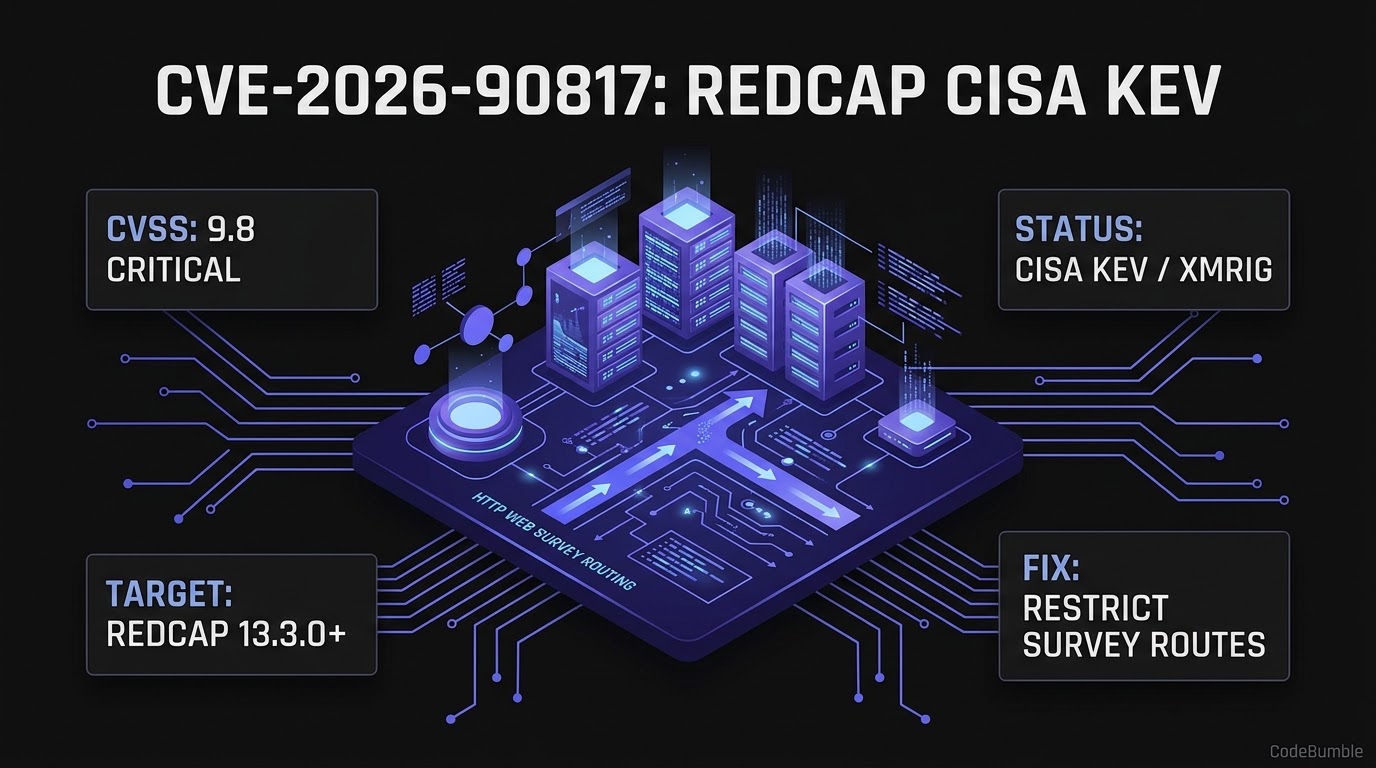
Executive Summary
On November 18, 2026, the U.S. Cybersecurity and Infrastructure Security Agency (CISA) added CVE-2026-90817—a CVSS v3.1 9.8 (Critical) code injection and path-control vulnerability (CWE-94 / CWE-73) in Vanderbilt University Research Electronic Data Capture (REDCap)—to its Known Exploited Vulnerabilities (KEV) catalog, setting a three-day federal remediation deadline of November 21, 2026.
REDCap is widely deployed across academic medical centers, clinical trial networks, and government research institutions. Because CVE-2026-90817 requires no authentication—only knowledge of a valid public survey hash—any internet-facing REDCap survey link that has been indexed by search engines or shared with study participants can be abused to reach an internal controller route and execute arbitrary code on the server.
Observed in-the-wild exploitation has already deployed transient web shells, in-memory loaders retrieving XMRig cryptocurrency miners disguised as image files, processes masquerading as syslog-ng, and persistence via cron jobs and added SSH keys. While some third-party KEV trackers still list no fixed release, the official CVE-2026-90817 record identifies 16.0.49, 17.3.10, and 17.4.4 as unaffected versions.
Confidence Level: High for CISA KEV status, CVSS 9.8 severity, affected threshold (13.3.0+), unaffected builds (16.0.49, 17.3.10, 17.4.4), and XMRig/persistence TTPs (corroborated across CISA, MITRE/CVE.org, Safe Security, and The Hacker News).
Technical Mechanics and Architecture
Survey Passthrough Routing & Data Import Path Injection (CWE-73 / CWE-94)
Discovered by Ryan Wincey of Securifera, CVE-2026-90817 resides in REDCap's survey passthrough routing and Data Import processing logic in versions 13.3.0 and higher. As analyzed by Safe Security and CISA's KEV catalog, REDCap's public survey handler contains a double-decoding flaw that allows an unauthenticated HTTP request to break out of the intended survey context:
[Unauthenticated Attacker + Valid Public Survey Hash]
        │
        ▼  Crafted HTTP Request (Double-Decoded Survey Passthrough)
┌──────────────────────────────────────────────────────────┐
│            REDCap Public Survey Handler (13.3.0+)        │
│                                                          │
│  1. Validates public survey hash (no login required)     │
│  2. Double-decoding flaw routes request to unintended    │
│     internal Data Import controller route                │
│  3. Crafted file-path / stream parameter (CWE-73)        │
│     writes attacker-controlled payload (CWE-94)          │
└──────────────────────────────────────────────────────────┘
        │
        ▼  (Application executes written file on REDCap host)
┌──────────────────────────────────────────────────────────┐
│          Observed Post-Exploitation Chain                │
│   ├──► Transient web shell staged in single request      │
│   ├──► In-memory loader pulls XMRig disguised as image   │
│   ├──► Miner masquerades as "syslog-ng"                  │
│   └──► Persistence via cron jobs + unauthorized SSH keys │
└──────────────────────────────────────────────────────────┘
Because the initial foothold only requires a valid public survey hash—often found in public study flyers, university webpages, or search indexes—any internet-reachable REDCap deployment hosting public surveys is exposed even if administrative and researcher login portals are protected by SSO or MFA.
Safe Read-Only Audit & Persistence Hunting Commands
Because Safe Security explicitly warns that patching closes the initial path but does not remove payloads already deployed, administrators must both inspect HTTP access logs and hunt for host-level persistence:
# 1. Hunt web server logs for suspicious survey passthrough / data import requests
# (Look for double-encoded characters %25 or unusual file-path/stream parameters)
grep -E "surveys/.*(%25|file-path|stream|DataImport)" /var/log/httpd/*access*.log /var/log/nginx/*access*.log 2>/dev/null

# 2. Check for processes masquerading as syslog-ng or high-CPU XMRig activity
ps aux | grep -E "syslog-ng|xmrig"

# 3. Inspect cron jobs and SSH authorized_keys for unauthorized persistence
ls -la /var/spool/cron/ /etc/cron.d/
grep -rn "." /var/spool/cron/ /etc/cron.d/ 2>/dev/null | tail -n 30
find /home /root -name "authorized_keys" -exec ls -lh {} \; -exec cat {} \; 2>/dev/null
Evidence: Version Status, Discrepancies, and Threat Activity
Affected vs. Unaffected Versions (Cross-Source Discrepancy)
Defenders should note a minor discrepancy across public vulnerability trackers regarding fixed releases:
- Official CVE Record (
cve.org): Lists REDCap13.3.0(and higher per the description) as affected, and explicitly lists16.0.49,17.3.10, and17.4.4as unaffected builds. - Secondary KEV Trackers (e.g., Spirity Enterprise): Still report "No fixed version listed yet" because the CISA KEV entry emphasizes applying vendor instructions or restricting network exposure.
| Product | Affected Versions | Unaffected / Fixed Builds (per CVE Record) |
|---|---|---|
| Vanderbilt REDCap | 13.3.0 and higher (prior to patched branches) |
16.0.49, 17.3.10, 17.4.4 |
Observed Exploitation and EPSS Context
- Active Exploitation: Confirmed by CISA (added to KEV November 18, 2026; federal due date November 21, 2026). CISA's SSVC assessment records Exploitation: active, Automatable: yes, and Technical impact: total.
- Payload Profile: The Hacker News and Safe Security report attackers staging transient web shells in a single HTTP request, loading XMRig disguised as image files in memory, renaming the miner process to
syslog-ng, and installingcronand SSH key persistence. - EPSS Score: As of November 18, 2026, FIRST EPSS stood at 3.7% (90th percentile), underscoring why KEV prioritization overrides low baseline EPSS scores once wild exploitation is confirmed.
Hardening Playbook: Containment, Upgrade, and Forensics Triage
Step 1: Verify Your REDCap Version Immediately
Log in to the REDCap Control Center and check your exact version. If you are running 13.3.0 or higher and are not on 16.0.49, 17.3.10, 17.4.4, or a newer vendor-confirmed release, treat the instance as exposed.
Step 2: Restrict Public Survey and Data Import Reachability
If you cannot upgrade immediately:
- Remove unnecessary public survey and data import endpoints from direct internet exposure, or place administrative/import routes behind a VPN or zero-trust access proxy.
- Use WAF rules to inspect and block double-encoded (
%25) path traversal or unexpectedfile-path/streamparameters hitting/surveys/endpoints.
Step 3: Upgrade to an Unaffected REDCap Release
Apply the official Vanderbilt University REDCap upgrade to 16.0.49, 17.3.10, 17.4.4, or the latest supported release for your branch through your institutional REDCap Consortium channel.
Step 4: Perform Pre-Patch Compromise Assessment (BOD 26-04)
Because patching alone will not evict an already-planted cron job, SSH key, or syslog-ng-masqueraded miner:
- Audit
/var/spool/cron/,/etc/cron.d/, and allauthorized_keysfiles for entries added since September 2026. - Inspect web root and upload directories for recently modified
.phpfiles or transient web shells. - Check outbound firewall/DNS logs from the REDCap server for Stratum mining pool traffic or unexpected HTTP fetches of image-disguised binaries.
Step 5: Safe Rollback & Recovery Notes
Before upgrading REDCap, snapshot the web application directory and take a consistent MySQL/MariaDB database backup. If you discover unauthorized cron persistence or web shells, do not rely on in-place cleanup alone—rebuild the application host from a clean OS image, restore the database and verified study files, rotate all REDCap database credentials and API tokens, and deploy the patched REDCap version before restoring network access.
Frequently Asked Questions (FAQs)
1. Do attackers need a REDCap username and password to exploit CVE-2026-90817? No. Exploitation is unauthenticated; the attacker only needs knowledge of a valid public survey hash (such as a public study URL) to reach the vulnerable survey passthrough and data import routing logic.
2. Which REDCap versions fix or are unaffected by CVE-2026-90817?
According to the official MITRE/CVE.org record (CVE-2026-90817), versions 13.3.0 and higher are affected, while 16.0.49, 17.3.10, and 17.4.4 are listed as unaffected.
3. Is patching REDCap enough if my server was already exposed?
No. Observed attacks install persistence via cron jobs, unauthorized SSH keys, and in-memory XMRig miners masquerading as syslog-ng. You must perform forensics triage and remove any existing payloads in addition to upgrading.
4. Why is CVE-2026-90817 urgent if its EPSS score is only 3.7%?
CISA added CVE-2026-90817 to the Known Exploited Vulnerabilities (KEV) catalog on November 18, 2026 with a three-day federal deadline of November 21, 2026 based on confirmed active exploitation in the wild.
5. How can I detect active exploitation attempts in my logs?
Monitor web access logs for HTTP requests to public survey routes containing double-encoded characters (%25) or unexpected file-path / stream parameters, and monitor the host for unexpected child processes spawned by the web server or processes masquerading as syslog-ng.
Sources
- CISA Alert (Primary): CISA Adds Four Known Exploited Vulnerabilities to Catalog (Published November 18, 2026)
- MITRE / CVE.org Record (Primary): CVE-2026-90817 — Vanderbilt University REDCap (Published September 20, 2026)
- The Hacker News (Press Reporting): CISA Warns of 4 Exploited Flaws Linked to Ransomware, Cryptomining, and LLMjacking Attacks (Published November 19, 2026)
- Safe Security (Exploitation & Payload Analysis): This Week in CVEs: The Week Defenders Lost the Head Start (Published October 23, 2026)
- Spirity Enterprise (KEV Advisory): CVE-2026-90817: REDCap unauthenticated RCE (KEV) (Published November 18, 2026)