

Vulnerability
CVE-2026-114938 (Java4Shell): OpenJDK AVX-512 Base64 Heap Overflow & Mitigation Guide
CVE-2026-114938 (Java4Shell) is a memory-corruption vulnerability in OpenJDK's HotSpot AVX-512 VBMI Base64 decoder affecting OpenJDK 17.0.6+ through 27 (plus Oracle Java SE 8u511b33-perf) on x86-64 CPUs with AVX-512 VBMI. Malformed Base64 input triggers a 62–63 byte out-of-bounds heap write before validation, enabling pre-authentication RCE on Keycloak, Jira, Confluence, Artifactory, Jenkins, and PingFederate. Patch immediately or apply -XX:-UseBASE64Intrinsics.
9 min read
CVE-2026-114938 (Java4Shell): OpenJDK AVX-512 Base64 Heap Overflow & Mitigation Guide
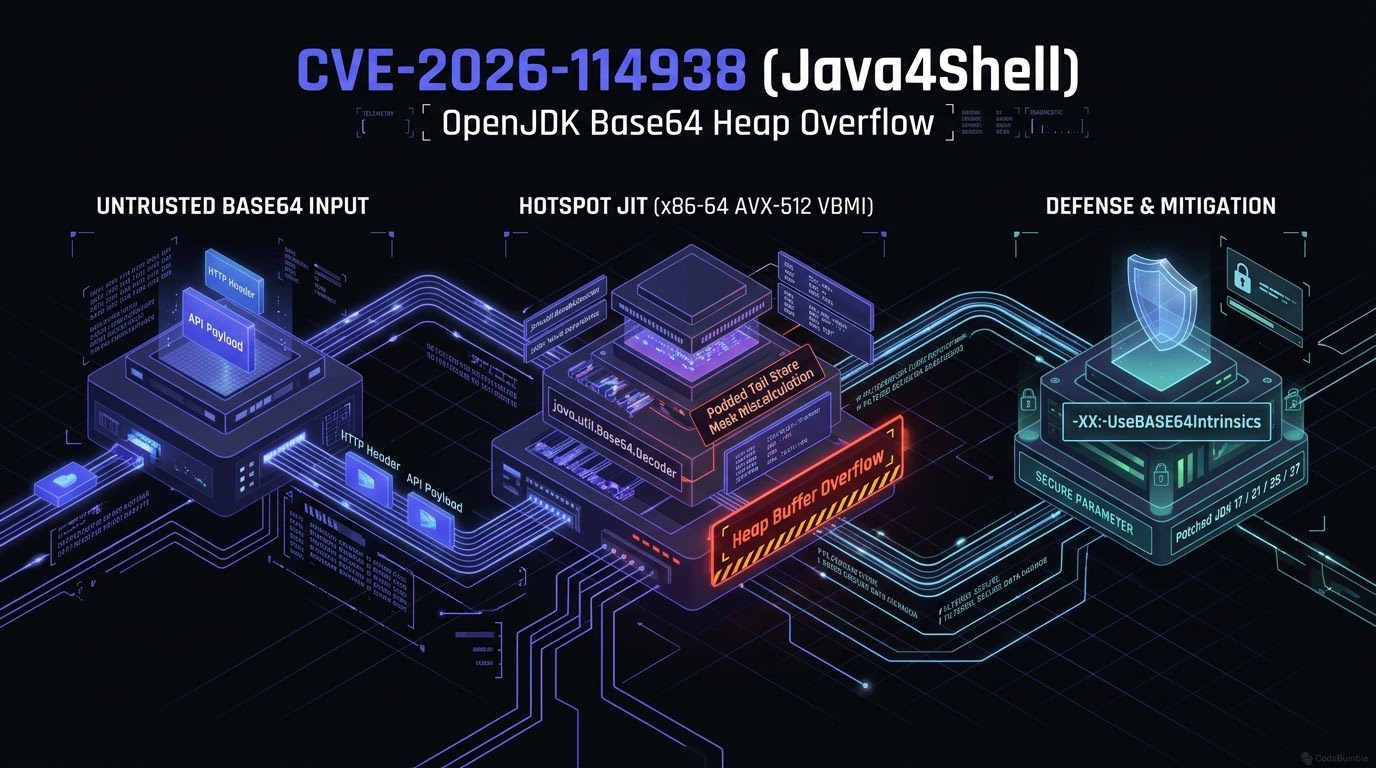
Executive Summary
On November 17, 2026, Oracle published its fix and CVE record for CVE-2026-114938—publicly tracked as Java4Shell—a heap-based buffer overflow in OpenJDK's HotSpot runtime (java.util.Base64.Decoder). Disclosed by researchers Quang Luong of Calif.io and Albert Yang, the flaw resides in handwritten x86-64 assembly that accelerates Base64 decoding on processors supporting the AVX-512 VBMI instruction set. When a malformed Base64 string (such as one ending with an extra =) reaches the JIT-compiled fast path, the decoder miscalculates the store mask for the padded tail and writes 62 or 63 bytes past the end of the output heap buffer before rejecting the input.
Because web frameworks, identity providers, and CI/CD servers routinely decode Base64-encoded HTTP Authorization headers, SAML artifacts, CSRF tokens, and file uploads prior to authentication, an unauthenticated remote attacker can trigger memory corruption, read adjacent heap secrets ("JavaBleed"), crash the JVM, or—given target-specific heap shaping—achieve remote code execution (RCE). Calif demonstrated pre-authentication RCE against default configurations of Keycloak, Atlassian Jira, Atlassian Confluence, JFrog Artifactory, Jenkins, and PingFederate.
Confidence & Evidence Caveats: Confidence in the root cause, hardware prerequisites, affected Oracle/Corretto/Zulu version ranges, and JVM flag mitigations is high based on primary advisories from CVE.org, Red Hat, and Keycloak, corroborated by technical analyses from Qualys, Aikido, and The Hacker News. Note that CVSS scoring varies across authorities—Oracle rates it 8.1 (High, AC:H), Amazon Linux scores it 8.8, Calif rates it 9.2 (Critical, CVSS v4.0), and Red Hat assigns a preliminary 9.8 (Critical, AC:L). As of November 18, 2026, no confirmed in-the-wild exploitation has been reported and the flaw is not in CISA's Known Exploited Vulnerabilities (KEV) catalog, though CISA issued an alert urging immediate patching. Calif has withheld its product-specific RCE chains while organizations patch; independent labs (Upwind and Blackpoint Cyber) have publicly reproduced JVM crashes and heap memory reads (JavaBleed), but not full RCE.
Technical Mechanics and Architecture
How the HotSpot AVX-512 VBMI Base64 Intrinsic Overflows
Java's java.util.Base64.Decoder is a core standard-library primitive rather than a third-party dependency, meaning applications inherit the vulnerability solely from the underlying JVM runtime. Under normal execution, once a method decoding Base64 becomes hot, the HotSpot C2 JIT compiler substitutes a platform-specific intrinsic (_base64_decodeBlock) implemented in handwritten assembly.
On x86-64 hosts that expose all four required CPU extensions—avx512f, avx512bw, avx512vbmi, and bmi2—HotSpot selects the AVX-512 VBMI fast path. According to technical analyses from Aikido and The Hacker News, a malformed input containing an unexpected trailing = padding character causes the optimized decoder to miscompute the SIMD store mask for the final padded block. Before the decoder returns an IllegalArgumentException, the masked vector write overruns the allocated destination byte array by 62 or 63 bytes on the Java heap.
+-----------------------------------------------------------------------+
|  1. Untrusted Input (Pre-Auth HTTP Basic Header, SAML, CSRF, Upload)  |
|     - Malformed Base64 string (e.g., extra trailing '=' padding)      |
+-----------------------------------+-----------------------------------+
                                    |
                                    v
+-----------------------------------------------------------------------+
|  2. HotSpot C2 JIT Fast Path (java.util.Base64.Decoder)               |
|     - Requires x86-64 CPU with avx512f + avx512bw + avx512vbmi + bmi2 |
|     - Miscalculates SIMD store mask on padded tail block              |
+-----------------------------------+-----------------------------------+
                                    |
                                    v
+-----------------------------------------------------------------------+
|  3. Out-of-Bounds Heap Write (CWE-787)                                |
|     - Writes 62–63 fixed bytes past end of destination buffer         |
|     - Corrupts adjacent Java heap object (length/header) before throw |
+-----------------------------------+-----------------------------------+
                                    |
        +---------------------------+---------------------------+
        |                           |                           |
        v                           v                           v
+---------------+         +-------------------+       +-----------------+
| JVM Crash     |         | JavaBleed         |       | Target-Specific |
| (DoS)         |         | (Heap Read)       |       | RCE Chain       |
| - SIGSEGV /   |         | - Expand adjacent |       | - Heap layout   |
|   hs_err_pid  |         |   array to leak   |       |   grooming per  |
|   restarts    |         |   keys & tokens   |       |   application   |
+---------------+         +-------------------+       +-----------------+
Exploitation Constraints and Client-Side Exposure
Because the 62–63 bytes written out of bounds are fixed rather than attacker-chosen, achieving RCE requires heap grooming: arranging adjacent objects so the overflow corrupts the length field of a neighboring array, which the attacker then leverages for arbitrary relative read/write ("JavaBleed") to locate and hijack code-execution primitives. Consequently, no universal exploit exists—each application requires a custom chain sensitive to network timing and memory layout. However, even a failed chain can corrupt heap metadata and crash the JVM (Blackpoint Cyber crashed a test Spring Boot instance in roughly 20 seconds using ~28,300 malformed login requests, and reproduced JavaBleed secret extraction in 30 out of 30 local runs).
Additionally, Qualys and The Hacker News note that Java clients are also in scope: researchers reported a client-side scenario (attributed to samczsun) where a Java process connecting over TLS to a malicious server can be compromised if server-supplied data reaches Base64.Decoder. Note also that reverse proxies like nginx that buffer full requests may disrupt timing-sensitive chains, but do not reliably prevent exploitation.
Safe Hardware & Runtime Check
Before applying workarounds or prioritizing nodes, verify whether the host CPU exposes avx512vbmi and whether the running JVM has UseBASE64Intrinsics enabled:
# Check Linux host/node CPU flags (vulnerable path requires all four flags)
grep -m1 '^flags' /proc/cpuinfo | tr ' ' '\n' | grep -E '^(avx512f|avx512bw|avx512vbmi|bmi2)$'

# Query a live JVM process for the effective Base64 intrinsic flag
jcmd <pid> VM.flags -all | grep -F UseBASE64Intrinsics
Evidence: Affected Versions, Vendor Fixes, and Impacted Applications
Vendor Patch Matrix (as of November 18, 2026)
| Java Distribution / Line | Affected Versions | Fixed Release / Status | Source |
|---|---|---|---|
| Oracle Java SE 17 | 17.0.6 – 17.0.21.0.3 |
17.0.21.1 |
CVE.org, The Hacker News |
| Oracle Java SE 21 | 21.0.13.0.3 and earlier |
21.0.13.1 |
CVE.org, Aikido |
| Oracle Java SE 25 | 25.0.5.0.3 and earlier |
25.0.5.1 |
CVE.org, Aikido |
| Oracle Java SE 27 | 27.0.1.0.3 and earlier |
27.0.1.1 |
CVE.org, Aikido |
| Oracle Java SE 8 Performance Pack | 8u511b33-perf |
8u513-perf (8u513) |
CVE.org, Qualys |
| Standard Java 8 & 11 | Not affected | — |
Aikido |
| Oracle GraalVM (JDK / EE) | 17.0.21.0.3, 21.0.13.0.3, EE 21.3.20.0.3 |
17.0.21.1, 21.0.13.1, EE 21.3.20.1 |
The Hacker News |
| Amazon Corretto (17, 21, 25, 27) | 17.0.6+ and unpatched 21/25/27 |
17.0.21.1.2, 21.0.13.1.2, 25.0.5.1.2, 27.0.1.1.4 |
Aikido, The Hacker News |
| Azul Zulu (17, 21, 25, 27) | 17.0.6+ and unpatched 21/25/27 |
17.70.201, 21.54.201, 25.38.201, 27.30.201 |
The Hacker News |
| Red Hat OpenJDK / RHEL 8, 9, 10 | 17.0.6+, 21, 25 |
Fixes in progress (RHSB-2026-018) |
Red Hat |
| Eclipse Temurin / MS OpenJDK / Liberica | 17.0.6+, 21, 25, 27 |
No confirmed upstream fix at check time (Aikido offers patched Temurin images) | Aikido, The Hacker News |
Demonstrated Application Exposure
| Authentication Requirement | Demonstrated Applications | Source |
|---|---|---|
| None (Pre-Authentication) | Keycloak (e.g., images 26.8.2-1, 26.8.2-2 bundling OpenJDK 21.0.13), Atlassian Jira, Atlassian Confluence, JFrog Artifactory, Jenkins, PingFederate |
Keycloak, Qualys |
| Authenticated User | Apache Kafka Broker, Apache Solr, Elasticsearch, Gerrit, Netflix Spinnaker | Qualys, The Hacker News |
Hardening Playbook & Incident Response
Six-Step Mitigation & Remediation Playbook
- Inventory Every Bundled and Containerized JDK: Do not rely on OS package managers or application version numbers alone. Many products (including Keycloak, Jenkins, and Atlassian appliances) bundle their own OpenJDK runtime inside container layers or installation directories. Inspect running processes and container images directly.
- Prioritize Internet-Facing Identity and CI/CD Systems: Triage internet-facing identity providers (Keycloak, PingFederate) and build/artifact servers (Jenkins, JFrog Artifactory, Jira, Confluence) first, followed by internal data platforms (Kafka, Elasticsearch, Solr) and Java clients making outbound TLS connections.
- Apply the Preferred Interim JVM Flag (
-XX:-UseBASE64Intrinsics): Where patched vendor builds are not yet available, start affected JVMs with-XX:-UseBASE64Intrinsicsand restart every service or pod. This disables only the vulnerable Base64 fast path while preserving other AVX-512 optimizations and works safely across both x86-64 and ARM64 nodes. Avoid-XX:UseAVX=2in mixed-architecture fleets because ARM64 JVMs fail to start with it, and never use-XX:DisableIntrinsic=_base64_decodeBlockalone, which prevents Java from starting. - Verify Live JVM Flags with
jcmd: Confirming an environment variable (JAVA_OPTS_APPENDorJDK_JAVA_OPTIONS) in Kubernetes manifests orsystemdunits is insufficient—verify the running JVM reportsbool UseBASE64Intrinsics = falseviajcmd <pid> VM.flags -all | grep -F UseBASE64Intrinsics. - Upgrade to Vendor-Patched JDKs and Rebuild Images: Once your JDK vendor ships a confirmed fix (e.g., Oracle
17.0.21.1/21.0.13.1/25.0.5.1/27.0.1.1or Amazon Corretto17.0.21.1.2/21.0.13.1.2), rebuild custom container images, redeploy workloads, and remove the interim flag only after confirming the patched runtime is active. - Monitor Logs for Exploitation Attempts: Hunt web access logs, WAF telemetry, and JVM crash directories for malformed Base64 probes and unexpected restarts.
Defensive Detection Queries
Use these defensive checks to identify vulnerable runtimes and potential probing (note that absence of these indicators does not guarantee a host is uncompromised):
# 1. Locate all Java binaries across a host to catch bundled JREs/JDKs
find / -xdev -type f -name "java" -executable -exec sh -c 'echo "=== $1 ==="; "$1" -version 2>&1 | head -n 2' _ {} \; 2>/dev/null

# 2. Check for unexplained JVM crash dumps (hs_err_pid*.log)
find /var/log /tmp /opt /app -name "hs_err_pid*.log" -mtime -7 2>/dev/null

# 3. Scan HTTP access / application logs for suspiciously padded Base64 tokens (>=32 chars ending in '=' not %4)
grep -E "Authorization: Basic [A-Za-z0-9+/]{31,}=" /var/log/nginx/access.log 2>/dev/null
In application logs, also alert on sudden bursts of java.lang.IllegalArgumentException originating from java.util.Base64$Decoder correlated with hs_err_pid restarts.
Rollback & Remediation Notes
Applying -XX:-UseBASE64Intrinsics disables hardware-accelerated Base64 decoding, which can increase CPU overhead on services that decode high volumes of Base64 payloads; benchmark throughput in staging if possible. Rolling back the flag is as simple as removing -XX:-UseBASE64Intrinsics from JAVA_OPTS_APPEND or JDK_JAVA_OPTIONS and restarting the JVM—only do so after verifying that the underlying JDK build contains the upstream fix for CVE-2026-114938.
Frequently Asked Questions
1. Are ARM64 servers or older x86-64 CPUs affected by CVE-2026-114938? No. According to Red Hat and Qualys, the vulnerable intrinsic runs only on x86-64 CPUs supporting AVX-512 VBMI (Intel Ice Lake through Granite Rapids, AMD Zen 4 and newer). ARM64 systems are not affected, though workloads should still be patched in case a container is rescheduled onto AVX-512 hardware.
2. Are Java 8 and Java 11 vulnerable?
Standard OpenJDK 8 and OpenJDK 11 are not affected. The sole Java 8 exception is Oracle's Java SE 8 Enterprise Performance Pack (8u511b33-perf), which Oracle fixed in 8u513-perf (8u513).
3. Why should I prefer -XX:-UseBASE64Intrinsics over -XX:UseAVX=2?
-XX:-UseBASE64Intrinsics disables only the vulnerable Base64 fast path while keeping all other AVX-512 vector optimizations intact, and it is accepted by both x86-64 and ARM64 JVMs. By contrast, -XX:UseAVX=2 disables AVX-512 globally and causes ARM64 JVMs to fail on startup.
4. Does placing an nginx reverse proxy in front of Java stop Java4Shell?
No. While request buffering in nginx can disrupt some timing-sensitive exploit chains, The Hacker News and Qualys explicitly warn that reverse-proxy buffering is not a reliable mitigation. Patch the JDK or apply -XX:-UseBASE64Intrinsics.
5. Why did Oracle score CVE-2026-114938 as 8.1 while Red Hat scored 9.8 and Calif scored 9.2?
Oracle's CVSS 3.1 vector (AC:H) reflects that RCE requires target-specific heap grooming and is sensitive to memory layout. Red Hat's preliminary CVSS 3.0 score (9.8, AC:L) reflects unauthenticated network exposure across default middleware configurations, while Calif's 9.2 uses CVSS v4.0.
Sources
- CVE.org (Oracle CNA) — CVE Record: CVE-2026-114938 (Published November 17, 2026)
- Red Hat Product Security — CVE-2026-114938 - Red Hat Customer Portal (Last modified November 18, 2026; Security Bulletin
RHSB-2026-018) - Keycloak Official Security Advisory — Java4Shell: What Keycloak admins need to do (CVE-2026-114938) (Updated November 18, 2026)
- Qualys Threat Research Unit — How to Find, Mitigate, and Patch the Critical Java4Shell Flaw (CVE-2026-114938) Now (Published November 18, 2026)
- Aikido Security — Java4Shell RCE: Affected Versions & Fix (CVE-2026-114938) (Published November 17, 2026)
- The Hacker News — Java4Shell Flaw (CVE-2026-114938) Enables Pre-Auth RCE in Jira, Jenkins, Keycloak and More (Published November 18, 2026)