

Vulnerability
Oracle November 2026 Critical Security Patch Update: 652 Patches Across 21 Product Families With CVSS 10.0 Exposure
Oracle's November 17, 2026 Critical Security Patch Update (CSPU) addresses 652 new security patches across 21 product families, reaching CVSS v3.1 Base Score 10.0 in Fusion Middleware and Analytics and 9.9 in Database Server, Hyperion, and Supply Chain. Read the version matrix, architectural exposure analysis, and defensive hardening playbook.
10 min read
Oracle November 2026 Critical Security Patch Update: 652 Patches Across 21 Product Families With CVSS 10.0 Exposure
Executive Summary
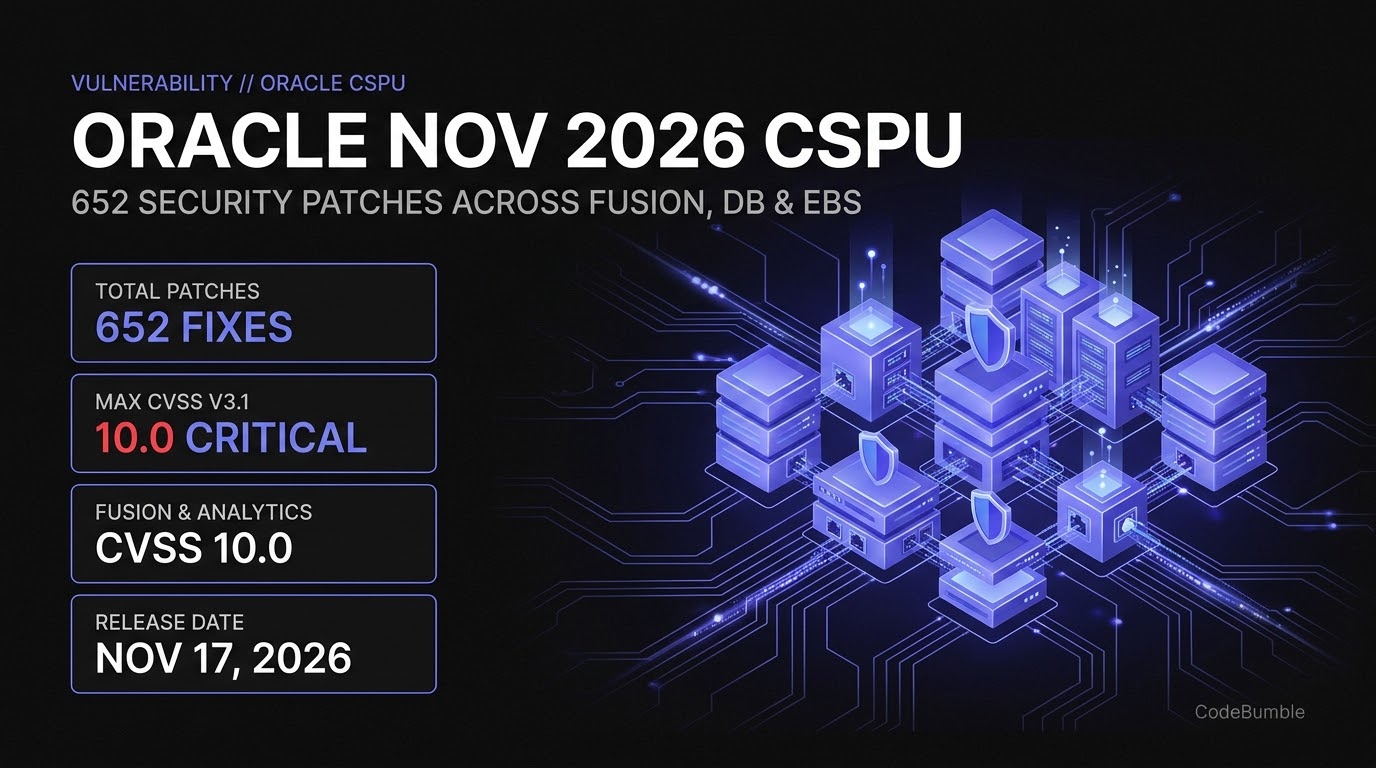
On November 17, 2026, Oracle issued its November 2026 Critical Security Patch Update (CSPU) Pre-Release Announcement, detailing 652 new security patches across 21 enterprise product families. Thirteen of those 21 families carry a maximum CVSS v3.1 Base Score of 9.0 or higher, led by 10.0 in Oracle Fusion Middleware and Oracle Analytics, and 9.9 in Oracle Database Server, Oracle Hyperion, and Oracle Supply Chain.
Across the 21 executive summaries published in the November 2026 advisory, 302 family-level patch entries are remotely exploitable without authentication—meaning an attacker can target exposed network listeners without valid user credentials. Note that Oracle explicitly cautions that some vulnerabilities affect multiple products, so individual CVEs may appear in more than one product family's count.
This release follows Oracle's monthly CSPU cadence introduced on May 28, 2026. Unlike Oracle's quarterly cumulative Critical Patch Updates (CPUs), monthly CSPUs ship on the third Tuesday of each month in a smaller, targeted format designed for rapid deployment in customer-managed environments without waiting for the next quarterly cycle (the next quarterly CPU is scheduled for January 19, 2027, following the December 15, 2026 CSPU). Because the November 17, 2026 pre-release advisory does not yet publish per-CVE exploitability telemetry or independent performance benchmarks, confidence is high on version scope and CVSS ceilings, and partial on individual CVE-to-component mappings until the final Risk Matrix posts.
Technical Mechanics and Architecture
Enterprise Oracle deployments rarely expose a single monolithic binary. Instead, modern topologies chain an edge HTTP proxy or load balancer into Java EE middleware (WebLogic Server, Helidon, Oracle HTTP Server, SOA Suite), application tiers (E-Business Suite, PeopleSoft, Siebel CRM, APEX, ORDS), analytics engines (BI Publisher, OBIEE), and core persistence layers (Oracle Database Server, MySQL).
When 53 of 71 Fusion Middleware vulnerabilities and 9 of 29 Analytics vulnerabilities are remotely exploitable without authentication at CVSS up to 10.0, the primary risk sits at the unauthenticated ingress boundary—specifically T3/IIOP listeners, HTTP/REST endpoints, and unauthenticated SOAP/XML or BIEE presentation services.
[Untrusted Network / Internet]
       |
       v  (Unauthenticated Ingress: HTTP/S, T3, IIOP, ORDS)
+---------------------------------------------------------------+
| Tier 1: Edge & Middleware (CVSS 10.0 Ceiling)                 |
|  - Oracle HTTP Server (12.2.1.4.0, 14.1.2.0.0)                |
|  - Oracle WebLogic Server (12.2.1.4.0 - 15.1.1.0.0)           |
|  - Helidon (3.0.0-3.2.22, 4.0.0-4.5.6, 27.0.0-27.0.1)         |
|  - Oracle REST Data Services (24.2.0 - 26.2.3) [CVSS 9.8]      |
+---------------------------------------------------------------+
       |
       v  (East-West Service Mesh / Internal RPC / JDBC)
+---------------------------------------------------------------+
| Tier 2: Enterprise Apps & Analytics (CVSS 9.3 - 10.0)         |
|  - Oracle Analytics / BI Publisher (up to 26.1.0.0.0) [10.0]  |
|  - Oracle E-Business Suite (12.2.3 - 12.2.15) [9.8]           |
|  - Oracle Hyperion (11.2.26.0.0) [9.9]                        |
|  - Oracle APEX (24.1.22, 24.2.21, 26.1.5, 26.2.0) [9.8]       |
+---------------------------------------------------------------+
       |
       v  (Authenticated / Listener Protocol: SQL*Net, MySQL)
+---------------------------------------------------------------+
| Tier 3: Data & Telemetry Plane (CVSS 9.1 - 9.9)               |
|  - Oracle Database Server (19.3-19.33, 21.3-21.24, 23.4-23.26)|
|  - MySQL Server & Cluster (8.0.0-8.0.50, 8.4.0-8.4.13, 9.7.x) |
|  - Autonomous Health Framework (26.4 - 26.10) [9.1]            |
+---------------------------------------------------------------+
Why Monthly CSPUs Change Patch Architecture
Historically, organizations built quarterly maintenance windows around Oracle's January, April, July, and October CPUs. Under the 2026 monthly CSPU model, monthly CSPUs deliver targeted fixes for critical issues while quarterly CPUs remain cumulative rollups containing all prior CSPU patches. For customer-managed infrastructure, this creates a two-speed patching requirement:
- Triage by network reachability: Client-only Oracle Database installations are explicitly unaffected by the 7 Oracle Database Server patches (and likewise for Enterprise Manager client-only setups). Server-side listeners and middle-tier HTTP/T3 endpoints carry the immediate unauthenticated risk.
- Continuous inventory verification: Because a single CVE can span multiple Java SE, WebLogic, or Common Libraries dependencies, teams must verify both application-tier patch levels and embedded JDK versions (such as Oracle Java SE
8u511,11.0.33,17.0.21,21.0.13,25.0.5, and27.0.1listed in this CSPU).
Defensive Inventory Script (Read-Only Version Audit)
Before applying patches or staging maintenance windows, defenders can run a non-intrusive inventory check across Linux hosts to map installed Oracle Database homes, WebLogic/Java runtimes, and MySQL instances against the November 2026 CSPU affected version ranges. The Python script below performs read-only version inspection and flags hosts requiring immediate review—no network probing or exploit checks are performed.
#!/usr/bin/env python3
"""Read-only local inventory check for Oracle Nov 2026 CSPU affected versions."""
import os
import re
import subprocess
from typing import Optional, Tuple

AFFECTED_JAVA_VERSIONS = {
    "1.8.0_511", "8u511", "11.0.33", "17.0.21", "21.0.13", "25.0.5", "27.0.1"
}

def parse_semver(ver: str) -> Optional[Tuple[int, int, int]]:
    m = re.search(r"(\d+)\.(\d+)\.(\d+)", ver)
    return (int(m.group(1)), int(m.group(2)), int(m.group(3))) if m else None

def check_mysql_version() -> str:
    try:
        out = subprocess.check_output(["mysqld", "--version"], text=True, stderr=subprocess.STDOUT)
    except (FileNotFoundError, subprocess.CalledProcessError):
        return "mysqld: not installed locally"
    ver = parse_semver(out)
    if not ver:
        return f"mysqld: unparsed output ({out.strip()})"
    in_80 = (8, 0, 0) <= ver <= (8, 0, 50)
    in_84 = (8, 4, 0) <= ver <= (8, 4, 13)
    in_97 = (9, 7, 0) <= ver <= (9, 7, 4)
    status = "REVIEW_REQUIRED (Nov 2026 CSPU)" if (in_80 or in_84 or in_97) else "Outside listed CSPU range"
    return f"mysqld {ver[0]}.{ver[1]}.{ver[2]} -> {status}"

def check_java_homes() -> list[str]:
    findings = []
    candidates = [os.environ.get("JAVA_HOME", ""), "/usr/bin/java"]
    for path in filter(None, candidates):
        bin_path = path if path.endswith("java") else os.path.join(path, "bin", "java")
        if not os.path.exists(bin_path):
            continue
        try:
            out = subprocess.check_output([bin_path, "-version"], text=True, stderr=subprocess.STDOUT)
            matched = any(v in out for v in AFFECTED_JAVA_VERSIONS)
            first_line = out.splitlines()[0] if out else "unknown"
            tag = "REVIEW_REQUIRED (Java SE CSPU)" if matched else "Check full Risk Matrix"
            findings.append(f"{bin_path}: {first_line} -> {tag}")
        except subprocess.CalledProcessError as exc:
            findings.append(f"{bin_path}: error ({exc.returncode})")
    return findings

if __name__ == "__main__":
    print(check_mysql_version())
    for item in check_java_homes():
        print(item)
Evidence: Product-by-Product Breakdown and Exposure Surface
All figures below are sourced directly from the Oracle Critical Security Patch Update Advisory - November 2026. The table summarizes every product family included in the November 17, 2026 release, ordered by maximum CVSS v3.1 Base Score.
| Product Family | Total Patches | Unauth Remote | Max CVSS v3.1 | Affected Versions |
|---|---|---|---|---|
| Oracle Fusion Middleware | 71 | 53 | 10.0 | Helidon 3.0.0–3.2.22, 4.0.0–4.5.6, 27.0.0–27.0.1; WebLogic 12.2.1.4.0, 14.1.1.0.0, 14.1.2.0.0, 15.1.1.0.0; OHS/SOA/ADF/OAM 12.2.1.4.0, 14.1.2.x |
| Oracle Analytics | 29 | 9 | 10.0 | BI Publisher & OBIEE 8.2.0.0.0, 12.2.1.4.0, 26.1.0.0.0 |
| Oracle Hyperion | 267 | 107 | 9.9 | Hyperion DRM, FCM, FDMEE, Financial Mgmt, Infrastructure, Planning, PCM, Workspace 11.2.26.0.0 |
| Oracle Supply Chain | 74 | 36 | 9.9 | Agile EDM 6.2.1, Agile PLM 9.3.6, Agile PLM for Process 6.2.4, AutoVue 21.1.0 / 21.1.0.7, PLA 3.6.1 |
| Oracle Database Server | 7 | 3 | 9.9 | 19.3–19.33, 21.3–21.24, 23.4.0–23.26.4 (server only) |
| Oracle E-Business Suite | 72 | 22 | 9.8 | 12.2.3–12.2.15 |
| Oracle Communications | 28 | 18 | 9.8 | BRM 15.0–15.2; DSR 9.0–9.1; Service Catalog & Design 8.0–8.26; Unified Assurance 6.1.1–7.0.0; UIM 7.5.0–8.26.0 |
| Oracle REST Data Services | 9 | 5 | 9.8 | 24.2.0–26.2.3 |
| Oracle APEX | 2 | 2 | 9.8 | 24.1.22, 24.2.21, 26.1.5, 26.2.0 |
| Oracle PeopleSoft | 13 | 5 | 9.3 | PeopleTools 8.61–8.63 |
| Oracle MySQL | 8 | 2 | 9.1 | MySQL Server & Cluster 8.0.0–8.0.50, 8.4.0–8.4.13, 9.7.0–9.7.4 |
| Oracle Enterprise Manager | 5 | 3 | 9.1 | Base Platform 13.5, 24.1 (server only) |
| Oracle Autonomous Health Framework | 3 | 3 | 9.1 | 26.4–26.10 |
| Oracle Siebel CRM | 19 | 9 | 8.8 | Siebel Applications 17.0–26.9 |
| Oracle Application Testing Suite | 3 | 1 | 8.8 | 13.3.0.1 |
| Oracle Virtualization | 11 | 3 | 8.6 | Oracle VM VirtualBox 7.2.22 |
| Oracle Java SE | 11 | 11 | 8.1 | Java SE 8u511, 8u511-perf, 11.0.33, 17.0.21, 21.0.13, 25.0.5, 27.0.1; GraalVM 17.0.21, 21.0.13, 21.3.20.0.3; JavaFX 21.0.13, 25.0.5, 27.0.1 |
| Oracle Financial Services | 11 | 2 | 7.5 | Customer Screening, Enterprise Case Management, Regulatory Reporting 8.1.2.10 |
| Oracle Commerce | 6 | 6 | 7.5 | Guided Search / Experience Manager 11.4.0; Commerce Platform 11.4.0 |
| Oracle Construction & Engineering | 2 | 2 | 7.5 | Primavera Unifier 22.12.0–22.12.15, 23.12.0–23.12.16 |
| Oracle JD Edwards | 1 | 0 | 6.5 | EnterpriseOne Localizations 9.2 |
Key Analytical Observations
- Hyperion and Supply Chain dominate patch volume: Together, Oracle Hyperion (267 patches, 107 unauthenticated remote) and Oracle Supply Chain (74 patches, 36 unauthenticated remote) account for over half of all family-level entries in the November 2026 CSPU.
- WebLogic, Helidon, and Analytics represent the highest severity ceiling: With CVSS v3.1 Base Score 10.0, unauthenticated remote vulnerabilities in Fusion Middleware and Oracle Analytics require immediate perimeter verification—especially because
53 of 71Fusion Middleware patches can be triggered over the network without credentials. - Siebel CRM comparison highlights monthly CSPU focus: Independent tracking by Bloomspire (November 15, 2026) notes that Siebel CRM's 19 patches (9 unauthenticated remote, max CVSS 8.8) are significantly more focused than October 2026's quarterly CPU, which shipped 122 Siebel CRM patches (66 unauthenticated remote).
- Java SE is 100% unauthenticated remote: All 11 Oracle Java SE patches in this CSPU are remotely exploitable without authentication (max CVSS 8.1), impacting client/server runtimes from JDK 8 through JDK 27.0.1.
Hardening Playbook
Apply these defensive steps in order of network exposure. Oracle explicitly notes in its October 2026 CPU guidance and May 2026 CSPU announcement that Oracle-managed cloud services receive security updates automatically, whereas customer-managed deployments must stage and apply patches directly.
1. Restrict Unauthenticated Perimeter Listeners Immediately
Before patch windows open, verify that administrative and internal RPC ports are never reachable from untrusted networks:
- Block WebLogic T3/T3S (
7001/7002default) and IIOP listeners at edge firewalls and via WebLogic Connection Filters (weblogic.security.net.ConnectionFilterImpl). - Place Oracle REST Data Services (
24.2.0–26.2.3), Oracle APEX (24.1.22–26.2.0), and Oracle BI Publisher / OBIEE behind an authenticated reverse proxy or WAF enforcing strict path allowlists.
2. Run Automated Patch-Level Checks (EBS & Database)
For Oracle E-Business Suite (12.2.3–12.2.15), run the EBS Java Critical Patch Update Checker (EJCPUC) referenced in Oracle's EBS security guidance to enumerate every JAVA_HOME across application and database tiers.
For Oracle Database (19.3–19.33, 21.3–21.24, 23.4.0–23.26.4), inspect applied PSU/RU/CSPU levels using opatch before scheduling downtime:
# Read-only check of installed Oracle Database patches
$ORACLE_HOME/OPatch/opatch lsinventory -bugs_fixed | grep -iE "CPU|CSPU|SECURITY"
3. Hunt for Anomalous Pre-Patch Activity
While waiting for maintenance windows, query web server and middleware access logs for unexpected POST requests to administrative or serialization endpoints, and monitor Linux hosts for unexpected child processes spawned by java, httpd, or tnslsnr:
# Inspect recent suspicious child processes or network listeners on Linux hosts
ps -eo pid,ppid,user,comm,args --sort=-start_time | grep -E "java|ohs|tnslsnr|mysqld" | head -n 40
ss -tulnp | grep -E ":(7001|7002|1521|3306|8080|9502)\b"
4. Stage Rollback Snapshots Before Patching
- Database & Middleware: Take cold or consistent storage snapshots of
$ORACLE_HOMEand domain directories, and recordopatch lsinventoryoutput prior to applying CSPU patches soopatch rollback -id <PATCH_ID>can cleanly revert any regression. - Upcoming Schedule: Mark your calendar for the next confirmed Oracle security releases: December 15, 2026 (CSPU), January 19, 2027 (quarterly cumulative CPU), February 16, 2027 (CSPU), and March 16, 2027 (CSPU).
Frequently Asked Questions (FAQ)
What is the difference between an Oracle CSPU and a quarterly CPU?
A Critical Security Patch Update (CSPU) is a smaller, targeted monthly release (shipped on the third Tuesday of the month since May 2026) focused on high-priority critical vulnerabilities. Quarterly Critical Patch Updates (CPUs) remain cumulative and bundle all fixes from prior monthly CSPUs.
How many patches are in the November 2026 Oracle CSPU?
The November 17, 2026 pre-release announcement lists 652 new security patches across 21 product families. Because some vulnerabilities affect multiple products, the sum of per-family counts equals 652 entries, with 302 family-level entries marked as remotely exploitable without authentication.
Which Oracle products have CVSS 10.0 vulnerabilities in November 2026?
Oracle Fusion Middleware (including Helidon, WebLogic Server, Oracle HTTP Server, SOA Suite, and Access Manager) and Oracle Analytics (BI Publisher and OBIEE) both carry a maximum CVSS v3.1 Base Score of 10.0.
Are Oracle Database client-only installations affected?
No. Oracle explicitly states in the November 2026 Database Server Executive Summary that none of the 7 Database Server patches apply to client-only installations without Oracle Database Server installed.
Do Oracle Cloud (OCI) managed services require manual patching?
Per Oracle's Security Blog, customers using Oracle-managed cloud services receive security updates automatically as part of the service. Customer-managed on-premises and self-hosted cloud deployments must apply the CSPU patches manually.
Sources
- Oracle Security Alerts: Oracle Critical Security Patch Update Advisory - November 2026 (Published November 17, 2026)
- Oracle Security Blog: Update: Monthly Critical Security Patch Updates (CSPUs) Begin May 28, 2026 (Published May 4, 2026)
- Oracle EBS Tech Blog: Critical Patch Update for October 2026 Now Available (Published October 20, 2026)
- Oracle EBS Tech Blog: October 2026 Updates to EBS Java Critical Patch Update Checker (EJCPUC) (Published October 21, 2026)
- Bloomspire: Siebel November 2026 CSPU: 19 Security Patches (Published November 15, 2026)