

Vulnerability
CVE-2026-90436 Actively Exploited: Apache Axis 1.x RCE Hits Confluence and N-central
CVE-2026-90436 (CVSS 9.8 Critical) in end-of-life Apache Axis 1.x is actively exploited against Atlassian Confluence Data Center and N-able N-central. Learn how the pre-auth SOAP Fault RCE works, review Rapid7 MDR's IOCs, and apply emergency patches or API mitigations.
8 min read
CVE-2026-90436 Actively Exploited: Apache Axis 1.x RCE Hits Confluence and N-central
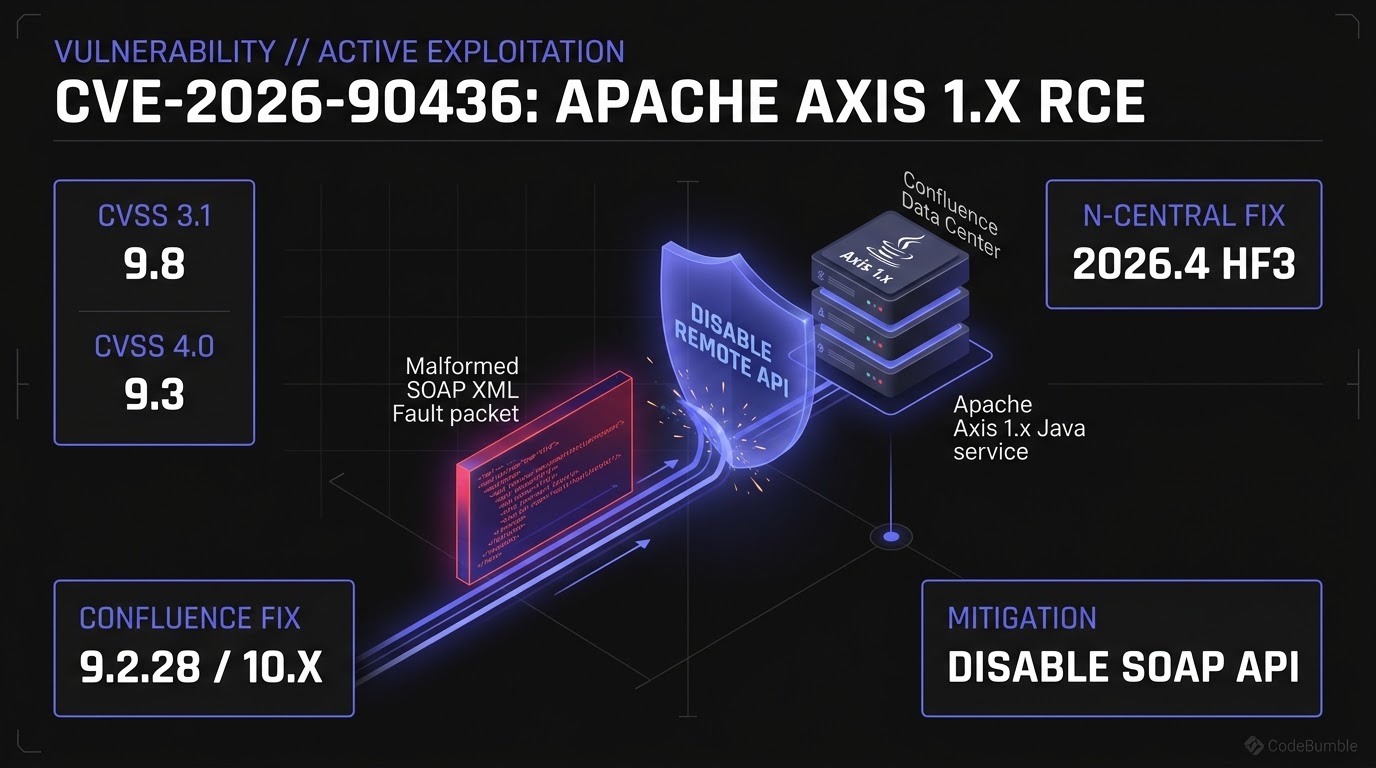
Executive Summary
An unauthenticated remote code execution (RCE) vulnerability in end-of-life Apache Axis 1.x—tracked as CVE-2026-90436 (CWE-470, unsafe reflection)—is being actively exploited in the wild against self-managed Atlassian Confluence Data Center and N-able N-central deployments. Originally disclosed by the Apache Software Foundation on November 6, 2026, the flaw allows an unauthenticated attacker to trigger arbitrary Java class loading and static initializer execution via a crafted SOAP <Fault> message before any per-service authentication handler runs.
On November 16–17, 2026, Rapid7 Emergent Threat Response reported that Rapid7 MDR observed active exploitation of CVE-2026-90436 against a customer's Confluence Data Center instance on November 13, 2026, alongside separate in-the-wild exploitation reported by N-able against N-central. CISA assigned CVE-2026-90436 a CVSS 3.1 score of 9.8 Critical, while Atlassian's security advisory rates it CVSS 4.0 9.3 Critical.
Both Confluence Data Center and N-able N-central require a non-default legacy API setting to be enabled for exploitation (Remote API (XML-RPC & SOAP) in Confluence; Legacy API in N-central). Rapid7 recommends emergency out-of-band remediation for all exposed instances.
Confidence Level: High. Root-cause mechanics, affected versions, active exploitation telemetry, and indicators of compromise (IOCs) are corroborated across primary advisories from NVD/Apache, Atlassian, and Rapid7's first-hand MDR incident response report, with secondary tracking from Brandefense.
Technical Mechanics & Architecture
Apache Axis 1.x is a legacy Java SOAP implementation that reached end of life (EOL) with version 1.4. Because the Apache Axis project does not plan to issue a new Axis 1.x release, downstream enterprise platforms bundling Axis 1.x must either patch their embedded library, disable the SOAP surface, or migrate to another SOAP engine such as Apache Axis 2/Java.
Root Cause: Pre-Authentication SOAP <Fault> Class Instantiation
Per the Apache-sourced NVD description, CVE-2026-90436 occurs during deserialization of an inbound SOAP <Fault> element:
- Pre-Auth Engine Parsing: When an HTTP POST request arrives at an Axis 1.x servlet endpoint (such as
/plugins/servlet/soap-axis1/confluenceservice-v2in Confluence), the Axis engine parses the SOAP envelope while resolving the target service—before any per-service authentication handler chain executes. - Unchecked
<exceptionName>Loading: If the<Fault>payload contains a<detail><exceptionName>element, Axis 1.x loads the named Java class immediately without verifying that the class is an expectedAxisFaultsubclass. Loading the class executes its static initializer. - String Constructor Invocation: If a
<data>string element is also present, Axis 1.x instantiates the loaded class via itsStringconstructor before performing type validation. When suitable gadget classes exist on the application's classpath, this achieves unauthenticated RCE.
+------------------------------------------------------------------------+
|                UNAUTHENTICATED ATTACKER (HTTP POST)                    |
|  Target: /plugins/servlet/soap-axis1/confluenceservice-v2              |
|  Payload: SOAP <Fault> containing <detail><exceptionName>...</detail>  |
+-----------------------------------+------------------------------------+
                                    |
                                    v
+------------------------------------------------------------------------+
|           APACHE AXIS 1.x SERVLET (PRE-AUTH SERVICE RESOLUTION)        |
|  * Runs BEFORE per-service authentication handlers                     |
|  * Confluence: Exposed only if "Remote API (XML-RPC & SOAP)" is ON     |
|  * N-central:  Exposed only if "Legacy API" is ON                      |
+-----------------------------------+------------------------------------+
                                    |
          +-------------------------+-------------------------+
          | (Legacy API Enabled & Unpatched)                  | (Patched 9.2.28 / 10.x /
          v                                                   |  2026.4 HF3 or API Disabled)
+---------------------------------------------------+         v
|  UNSAFE REFLECTION (CWE-470)                      |  [ HTTP 403 Forbidden / Blocked ]
|  1. Loads class from <exceptionName>              |  (Axis commit 41f3b4e8 validates
|  2. Executes static initializer / String ctor     |   AxisFault type before loading)
|  3. Note: HTTP 500 often returned even on RCE!    |
+-------------------------+-------------------------+
                          |
                          v
+------------------------------------------------------------------------+
|           CONFLUENCE / N-CENTRAL JAVA PROCESS (RCE)                    |
|  [ Spawns bash / curl -> Tunnel C2 -> DB / Attachment / Cloud Pivot ]  |
+------------------------------------------------------------------------+
Notice a critical operational detail from Rapid7's telemetry: the exploit requests returned HTTP 500 (Internal Server Error) in Confluence access logs, yet still executed arbitrary commands within seconds. Defenders must not assume an HTTP 500 response in web logs means an exploitation attempt failed.
Affected & Patched Versions
| Product | Affected Versions | Exposure Condition | Fixed / Unaffected Versions |
|---|---|---|---|
| Apache Axis 1.x | 1.x through 1.4 (EOL) |
Inbound SOAP <Fault> parsing |
Commit 41f3b4e8 or migrate to Axis 2/Java |
| Atlassian Confluence Data Center | 1.x through 9.x |
Remote API (XML-RPC & SOAP) enabled (off by default since 3.0) |
9.2.28 fixed; 10.x & Atlassian Cloud unaffected |
| N-able N-central | Builds prior to 2026.4 HF3 |
Legacy API enabled (off by default) |
2026.4 HF3 (2026.4.1.39) disables Legacy API |
Evidence & Active Exploitation Telemetry
Rapid7 MDR Intrusion Timeline (November 13, 2026)
In its November 17, 2026 update, Rapid7 MDR documented the full post-exploitation sequence observed on a compromised Atlassian Confluence Data Center host:
- Initial Access (
T+0s): UnauthenticatedPOSTrequests hit/plugins/servlet/soap-axis1/confluenceservice-v2, returning HTTP500. Within seconds, Confluence's Java process spawnedbashandcurlunder theconfluenceservice account. - Automated Staging: The attacker executed hundreds of hex-encoded shell commands and scripts fetched from temporary Pinggy and Cloudflare Tunnel domains. Rapid7 noted that commands wrapped output in labeled delimiters with sequential task IDs—indicative of AI-assisted automated tooling.
- Database & Attachment Harvesting (
T+3m): Roughly three minutes after initial execution, the attacker extracted Confluence's database credentials, authenticated to MySQL, queried page bodies and application links, and searched/var/atlassian/application-data/confluence/attachments/v4/for Office documents containing credentials, VPN configurations, private keys, and payment card numbers (filtered via Luhn checks). - Internal & Cloud Lateral Movement (
T+4htoT+12h): After querying the internal Atlassian Crowd API and attempting Kerberos AS-REP roasting via Impacket'sGetNPUsers.py, the attacker used harvested service account credentials roughly four hours in to query a production cloud data warehouse, and at ~12 hours signed into Microsoft 365 using legacy authentication from192.238.253[.]176.
Separately, on November 13, 2026, N-able reported in-the-wild exploitation against N-central customers with Legacy API enabled, following a public PoC targeting N-central published on November 12, 2026.
Published Indicators of Compromise (IOCs)
Rapid7 and N-able published the following network IOCs associated with observed exploitation (note that absence of these indicators does not guarantee an exposed server was not compromised):
- Atlassian Confluence Data Center (Rapid7 MDR):
- IPv4 addresses:
192.238.253[.]176,5.133.47[.]243,163.182.68[.]109,104.13.106[.]166 - Tunnel / exfiltration domains:
*.trycloudflare[.]com,wpefh-192-238-253-176.free.pinggy[.]net,webhook[.]site
- IPv4 addresses:
- N-able N-central (N-able Nov 13 Update):
- IPv4 addresses:
157.20.241[.]16,139.99.69[.]109,79.76.51[.]56
- IPv4 addresses:
Hardening & Remediation Playbook
Execute the following defensive steps immediately for all internet-facing and internal Confluence Data Center and N-able N-central deployments.
1. Verify Exposure Safely Without Exploitation
Administrators can verify whether Confluence Data Center exposes the vulnerable Axis 1.x servlet by issuing a benign GET or HEAD request (or browsing directly) to the SOAP endpoint:
# Benign read-only check for Confluence SOAP Axis1 exposure
# Expected output when mitigated/disabled: HTTP/1.1 403 Forbidden
curl -i -s -o /dev/null -w "%{http_code}\n" \
  "https://<confluence-base-url>/plugins/servlet/soap-axis1/confluenceservice-v2"
Per Atlassian's advisory, a properly mitigated instance returns HTTP Status 403 - Forbidden. Check the running version under General Configuration → System Information on every Confluence node.
2. Apply Emergency Patches
- Atlassian Confluence Data Center: Upgrade immediately to
9.2.28or migrate to an unaffected10.xrelease (which removed the legacy XML-RPC/SOAP feature). - N-able N-central: Upgrade immediately to
2026.4 HF3(2026.4.1.39), released November 16, 2026, which disables theLegacy APIsurface and patches 17 additional CVEs, and follow N-able's Agent and Probe upgrade guidance. - Custom Java Applications Bundling Axis 1.x: Migrate to Apache Axis 2/Java or rebuild Axis 1.x with upstream commit
41f3b4e8d04e310ca81f86b92630ab2c11d608bd.
3. Disable Legacy APIs Immediately if Patching Must Wait
For Confluence Data Center (1.x–9.x):
- Log in as an administrator and navigate to General Configuration → Further Configuration (
<base_url>/admin/viewspacesconfig.action). - Click Edit, clear the checkbox for Remote API (XML-RPC & SOAP), and click Save.
- The change takes effect without restarting Confluence. Re-run the
curlcheck above to confirmHTTP 403.
For N-able N-central, confirm Legacy API is disabled on all on-premises instances (even 2026.4 HF2) per N-able's security update.
4. Hunt Access Logs, Process Telemetry, and Cloud Sign-Ins
Run the following queries across web access logs, EDR, and identity providers for any instance that had Remote API or Legacy API enabled:
# Search Confluence/reverse-proxy access logs for SOAP Axis1 requests (note HTTP 500s!)
grep -E "/plugins/servlet/soap-axis1/confluenceservice-v2" /var/log/nginx/access.log* /opt/atlassian/confluence/logs/access*
// Microsoft Defender / Sentinel: Hunt Confluence/Java spawning shells or tunnel/curl utilities
DeviceProcessEvents
| where Timestamp > ago(14d)
| where InitiatingProcessFileName in~ ("java", "java.exe")
| where FileName in~ ("bash", "sh", "dash", "curl", "wget", "python3", "cmd.exe", "powershell.exe")
| project Timestamp, DeviceName, AccountName, InitiatingProcessCommandLine, FileName, ProcessCommandLine
| order by Timestamp desc
Also audit Microsoft 365 / IdP logs for legacy authentication sign-ins from 192.238.253[.]176 or other Rapid7/N-able IOCs, and check MySQL/PostgreSQL audit logs for unexpected queries against Confluence page/attachment tables.
5. Rollback & Incident Containment Notes
Disabling Remote API (XML-RPC & SOAP) in Confluence or Legacy API in N-central can break legacy scripts, automations, or third-party add-ons. If a critical integration breaks, migrate that integration to REST APIs rather than re-enabling XML-RPC/SOAP on an unpatched node. If any evidence of post-exploitation (bash/curl child processes, tunnel domains, or IOC hits) is found, isolate the host, preserve logs and memory, rotate all Confluence database credentials, application link secrets, and cloud service account tokens, and rebuild from a clean image.
Frequently Asked Questions
Does CVE-2026-90436 affect Atlassian Cloud or Confluence 10.x?
No. Atlassian confirms that Atlassian Cloud sites (atlassian.net / jira.com) are not affected, and Confluence 10.x removed the legacy XML-RPC and SOAP feature entirely.
Is every Confluence Data Center 9.x server vulnerable by default?
No. Atlassian turned Remote API (XML-RPC & SOAP) off by default for new installations starting in Confluence 3.0. Only instances where an administrator enabled the setting (or upgraded from a pre-3.0 config) are exposed.
Why did Rapid7 observe HTTP 500 errors during successful exploitation?
In Axis 1.x, the malicious <detail><exceptionName> class loading and static initializer execution happen during SOAP fault parsing before the request fails type-checking and returns an HTTP 500 error. Always correlate HTTP 500 hits on /plugins/servlet/soap-axis1/ with EDR process telemetry.
Is CVE-2026-90436 in the CISA KEV catalog?
As of November 17, 2026, CVE-2026-90436 had not yet been added to the CISA KEV JSON feed (catalogVersion 2026.11.13), even though Rapid7 MDR and N-able both confirmed active exploitation in the wild on November 13, 2026. Treat it as actively exploited regardless of catalog lag.
Why won't Apache release an official Axis 1.5 patch?
Apache Axis 1.x (through 1.4) is end of life. Apache advises migrating to Apache Axis 2/Java or applying commit 41f3b4e8d04e310ca81f86b92630ab2c11d608bd if maintaining a custom Axis 1.x build.
Sources
- Rapid7 Emergent Threat Response — Rapid7 Detected Exploitation of CVE-2026-90436 against Atlassian Confluence Data Center, N-able N-central also Exploited (Published November 16, 2026; Updated November 17, 2026)
- Atlassian Security Advisory — CVE-2026-90436 - Remote Code Execution in Confluence Data Center (November 9–10, 2026)
- NIST NVD — CVE-2026-90436 Detail (Apache Software Foundation) (Published November 6, 2026; Last Modified November 12, 2026)
- Brandefense — CVE-2026-90436: Confluence RCE, Fix and Exploit Status (November 17, 2026)