

Vulnerability
CVE-2026-129289 in PHP-FPM (CVSS 9.2): Affected Versions, WordPress Exposure, and Patch Guide
Disclosed on November 19, 2026, CVE-2026-129289 is a critical CVSS v4.0 9.2 PHP-FPM request smuggling flaw that allows unauthenticated remote code execution when a web server reuses persistent FastCGI connections. Wordfence reproduced the attack against stock WordPress 7.1.5 running PHP 8.2.35 behind NGINX with fastcgi_keep_conn enabled. Here are the affected branches, fixed PHP releases (8.2.36, 8.3.37, 8.4.28, 8.5.13, and 8.6.0), and safe mitigation steps.
7 min read
CVE-2026-129289 in PHP-FPM (CVSS 9.2): Affected Versions, WordPress Exposure, and Patch Guide
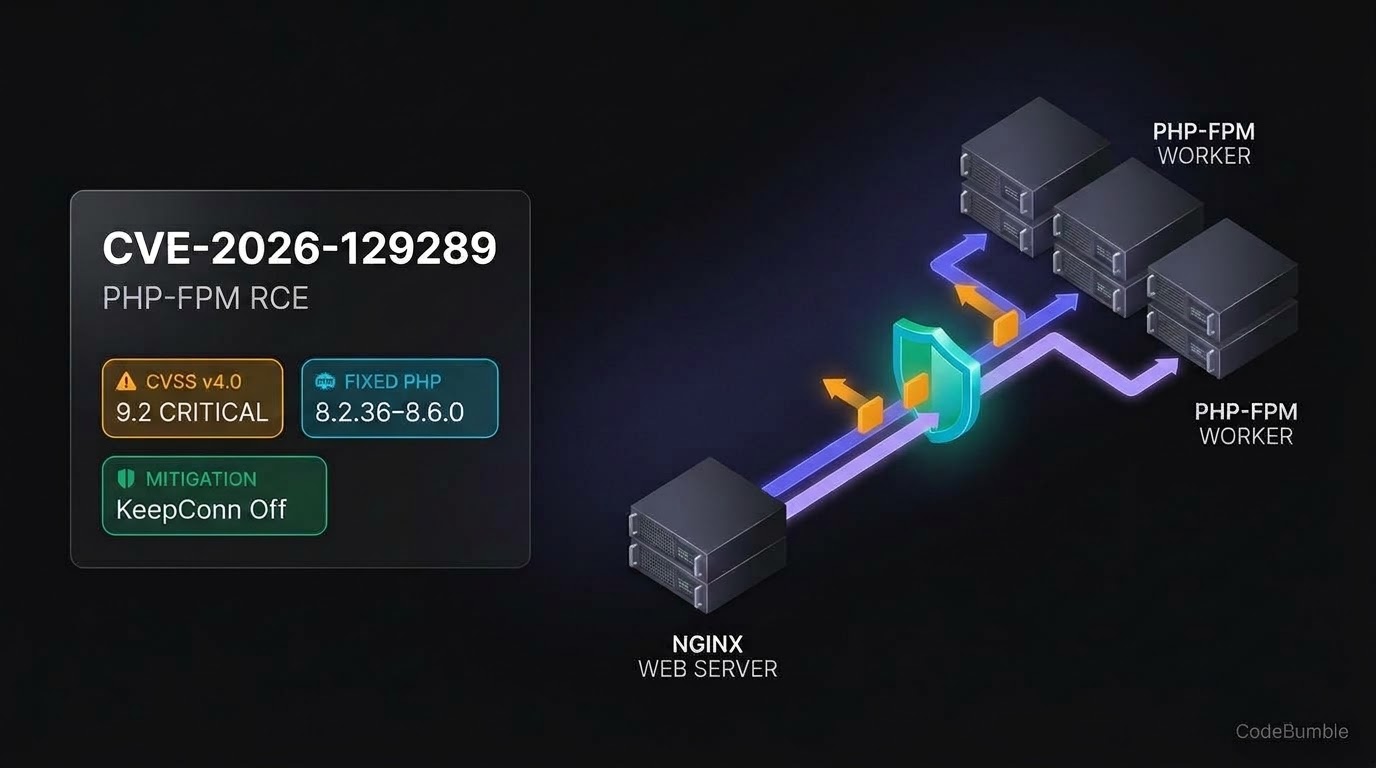
Executive Summary
- CVE Identifier:
CVE-2026-129289(NIST NVD), disclosed alongside six other critical PHP vulnerabilities on November 19, 2026 (Wordfence). - Severity & Flaw Class: Critical — CVSS v4.0 score
9.2/ 10 (Wordfence); HTTP request smuggling / FastCGI request forgery (CWE-444,CWE-670) (IONIX). - Exploitation Status: Not listed in CISA's Known Exploited Vulnerabilities (KEV) catalog as of November 20, 2026 (Wordfence). However, public technical details exist and the Wordfence Threat Response team confirmed unauthenticated PHP code execution in an isolated lab against stock WordPress 7.1.5 running PHP 8.2.35 behind NGINX with FastCGI connection reuse enabled (Wordfence).
- Fixed Versions: Upgrade immediately to PHP
8.2.36,8.3.37,8.4.28,8.5.13, or8.6.0(all released November 19, 2026) (PHP.net Announcements, Cloudflare).
Affected Versions & Exposure Scope
CVE-2026-129289 originates in PHP's FastCGI Process Manager (sapi-fpm) and LSAPI request-body handling, with vulnerable code dating back to PHP 5.6.0 (Wordfence, Amazon Linux Security Center). Importantly, this is a vulnerability in PHP itself, not WordPress Core, plugins, or themes—updating WordPress will not patch CVE-2026-129289 (Wordfence).
| PHP Branch | Vulnerable Versions | First Fixed Release | Notes & Backport Guidance | Source |
|---|---|---|---|---|
| PHP 5.6 – 8.1 | 5.6.0 through 8.1.x |
None (End-of-Life) | Unsupported upstream; migrate to a supported fixed branch or vendor-patched LTS image. | Wordfence |
| PHP 8.2 | 8.2.0 through 8.2.35 |
8.2.36 |
Released Nov 19, 2026 (note: PHP 8.2 reaches EoL Dec 31, 2026). | PHP.net |
| PHP 8.3 | 8.3.0 through 8.3.36 |
8.3.37 |
Released Nov 19, 2026. | PHP.net |
| PHP 8.4 | 8.4.0 through 8.4.27 |
8.4.28 |
Released Nov 19, 2026. | PHP.net |
| PHP 8.5 | 8.5.0 through 8.5.12 |
8.5.13 |
Released Nov 19, 2026. | PHP.net |
| PHP 8.6 | 8.6.0 release candidates |
8.6.0 |
GA release published Nov 19, 2026. | Cloudflare |
Container Images & Linux Distribution Backports
Linux distributions (Ubuntu, Red Hat, Amazon Linux) and managed WordPress hosts frequently backport upstream security patches without incrementing the X.Y.Z upstream minor version (Wordfence, Ubuntu). For containerized workloads, rebuilding and redeploying from a patched base image is mandatory—restarting an existing container preserves the vulnerable binary inside the container filesystem (Wordfence).
Companion Critical CVEs in the November 19 Cycle
PHP's November 19 security release also patched six additional critical flaws—including CVE-2026-115560 (session upload-progress serializer mismatch RCE, phpAfterShell), CVE-2026-126714 (session file TOCTOU RCE), CVE-2026-129496 (date-extension timezone cache use-after-free), CVE-2026-129481 (session shutdown use-after-free), and PHP 8.5-only backtrace use-after-free bugs CVE-2026-129182 and CVE-2026-129474 (Upwind, SANS NewsBites). Upgrading to the fixed releases above remediates all applicable flaws in one step (Wordfence).
Root Cause & Attack Vector Analysis
Under normal operation, a front-end reverse proxy such as NGINX or Apache terminates the client's HTTP request, applies routing and access-control rules, and forwards the request over a private FastCGI socket to PHP-FPM (Wordfence).
[Client] ──(1) Crafted HTTP Body──▶ [NGINX / Apache (keepalive / enablereuse=on)]
                                          │
                                          ▼ (2) FastCGI Socket (Reused)
                                    [PHP-FPM Worker]
                                          ├─ Opens php://input without full read
                                          ├─ Leaves unread bytes in socket buffer
                                          └─ (3) Next iteration parses leftover bytes
                                                 as forged FastCGI request (bypasses proxy)
CVE-2026-129289 occurs because PHP-FPM fails to discard unread portions of an HTTP request body at request shutdown when an application opens php://input without reading it completely (IONIX, SANS NewsBites). When the front-end web server keeps that private FastCGI connection open and reuses it for subsequent traffic, PHP-FPM interprets the leftover bytes as a brand-new FastCGI request containing forged parameters such as SCRIPT_FILENAME or PHP_ADMIN_VALUE—completely bypassing the front-end web server's routing and access checks (IONIX, Wordfence).
Required Preconditions (Why AT:P Applies)
The CVSS v4.0 vector marks attack requirements as present (AT:P) because exploitation requires two server conditions (IONIX, Wordfence):
- Persistent FastCGI Connection Reuse Enabled: NGINX disables reuse by default (
fastcgi_keep_conn off), but popular WordPress server stacks such as WordOps explicitly enablefastcgi_keep_conn onin their NGINX templates (Wordfence). PHP's advisory also flags Apachemod_proxy_fcgiwithenablereuse=on, HAProxy FastCGI setups retaining backend connections, and LSAPI (SANS NewsBites). - Application Opens
php://input: In stock WordPress, REST API endpoints invokeWP_REST_Server::serve_request(), which callsWP_REST_Server::get_raw_data()to readphp://input(Wordfence). Wordfence confirmed in lab testing that a crafted request body caused PHP's parser to stop early on stock WordPress 7.1.5, leaving smuggled bytes on the reused socket with no authentication, plugin, or user session required (Wordfence).
Unlike memory-corruption bugs, CVE-2026-129289 does not depend on corrupting memory, bypassing ASLR, or winning a timing race (Wordfence).
Detection, Hunting & Mitigation
1. Safe Inventory & Version Verification Commands
Do not rely solely on php -v (which checks the CLI binary) or WordPress Site Health (which cannot detect OS vendor backports or stale worker processes) (Wordfence). Check the active PHP-FPM binary and inspect web server configs for connection reuse:
# Check the PHP-FPM daemon version serving web traffic
php-fpm -v || php-fpm8.2 -v || php-fpm8.3 -v || php-fpm8.4 -v || php-fpm8.5 -v

# Audit NGINX configs for FastCGI connection reuse
grep -rn "fastcgi_keep_conn" /etc/nginx/

# Audit Apache configs for mod_proxy_fcgi connection reuse
grep -rn "enablereuse" /etc/apache2/ /etc/httpd/
2. Compensating Controls (If Immediate Patching Is Blocked)
If OS vendor packages or managed-host rollouts are still pending, apply these interim mitigations immediately:
- Disable FastCGI Connection Reuse: In NGINX, set
fastcgi_keep_conn off;inside yourupstreamorlocationblocks and reload NGINX (nginx -t && systemctl reload nginx). In Apachemod_proxy_fcgi, removeenablereuse=onor setenablereuse=off. Wordfence verified this blocks the demonstratedCVE-2026-129289execution path, though it does not mitigate the six companion PHP flaws (Wordfence). - Enable Cloudflare WAF Rules: On Cloudflare paid plans, ensure the Cloudflare Managed Ruleset is active and switch the new
CVE-2026-129289,CVE-2026-15353, andCVE-2026-129506rules from Log mode to Block mode (Cloudflare). - Harden
php.inifor Companion Flaws: Setsession.upload_progress.enabled=0(mitigatesCVE-2026-115560) and, on PHP 8.5, setfatal_error_backtraces=0(Cloudflare).
3. Post-Patch Verification & Hunting
After installing PHP 8.2.36, 8.3.37, 8.4.28, 8.5.13, or 8.6.0, restart the php-fpm master process (and Apache if using mod_proxy_fcgi) so no pre-patch worker processes remain in memory (Cloudflare). Review PHP-FPM slow/error logs and NGINX/Apache access logs for anomalous REST API POST requests (/wp-json/) paired with unexpected PHP-FPM script executions that lack corresponding front-end access-log entries.
Frequently Asked Questions (FAQ)
Does updating WordPress Core or plugins fix CVE-2026-129289?
No. CVE-2026-129289 is a flaw in PHP's sapi-fpm / FastCGI handling, not WordPress Core (Wordfence). While WordPress's stock REST API (WP_REST_Server::get_raw_data()) triggers the php://input condition, you must patch PHP itself (or ask your managed host to patch PHP-FPM) (Wordfence).
Is NGINX vulnerable by default?
No. Standard NGINX configurations default to fastcgi_keep_conn off, which closes the FastCGI connection after each request and prevents leftover bytes from smuggling into a second request (Wordfence). However, performance-tuned templates—including WordOps—explicitly enable fastcgi_keep_conn on (Wordfence).
Is CVE-2026-129289 being actively exploited in the wild?
As of November 20, 2026, CVE-2026-129289 is not listed in CISA's Known Exploited Vulnerabilities (KEV) catalog (Wordfence). Because public technical details and lab-verified reproduction steps exist, defenders should treat patching as urgent.
Can I just restart my Docker container after running an update?
No. If your PHP-FPM service runs in a container, you must rebuild and redeploy the container image from an updated PHP 8.2.36, 8.3.37, 8.4.28, 8.5.13, or 8.6.0 base image; restarting an existing container keeps the vulnerable PHP binary (Wordfence, Cloudflare).
Does disabling fastcgi_keep_conn fix all seven November 19 PHP CVEs?
No. Disabling FastCGI connection reuse mitigates CVE-2026-129289 specifically, but does not address the six other critical flaws in the November 19 release cycle—such as CVE-2026-115560 (phpAfterShell) or CVE-2026-129496 (Wordfence, Upwind). Upgrading PHP remains mandatory.
Sources
- NIST National Vulnerability Database —
CVE-2026-129289— https://nvd.nist.gov/vuln/detail/cve-2026-129289 (Published November 20, 2026) - PHP.net Security Releases (
8.2.36,8.3.37,8.4.28,8.5.13,8.6.0) — https://www.php.net/ and https://news-web.php.net/php.announce/start/499 (Published November 19, 2026) - Amazon Linux Security Center —
CVE-2026-129289— https://explore.alas.aws.amazon.com/CVE-2026-129289.html (Published November 19, 2026) - Wordfence Threat Response —
CVE-2026-129289and Other Critical PHP Vulnerabilities — https://www.wordfence.com/blog/2026/11/cve-2026-129289-wordpress-php-vulnerabilities/ (Published November 20–21, 2026) - Cloudflare Blog — How Cloudflare WAF helps protect against phpAfterShell and other PHP vulnerabilities — https://blog.cloudflare.com/phpaftershell-waf-protection/ (Published November 21, 2026)
- IONIX Threat Center —
CVE-2026-129289— https://www.ionix.io/threat-center/cve-2026-129289/ (Published November 20, 2026) - SANS Internet Storm Center NewsBites Vol. XXVIII, Issue 87 — https://www.sans.org/newsletters/newsbites/xxviii-87 (Published November 20–21, 2026)
- Upwind Security — PHP Critical Vulnerabilities: Affected Versions and Mitigations — https://www.upwind.io/blog/php-critical-vulnerabilities-affected-versions-and-mitigations (Published November 19, 2026)