

Security
CVE-2026-76466: Cisco Expressway Cluster Flaw Actively Exploited for Root Access After PoC Release
Attackers are actively exploiting CVE-2026-76466 (CVSS 9.8) against clustered Cisco Expressway-C and Expressway-E gateways shortly after a PoC hit GitHub. Learn how persistent database cookies and unvalidated TLS cluster certificates grant root execution, which releases are affected, and how to block ports 4371-4372 while upgrading to X15.5.20.
11 min read
CVE-2026-76466: Cisco Expressway Cluster Flaw Actively Exploited for Root Access After PoC Release
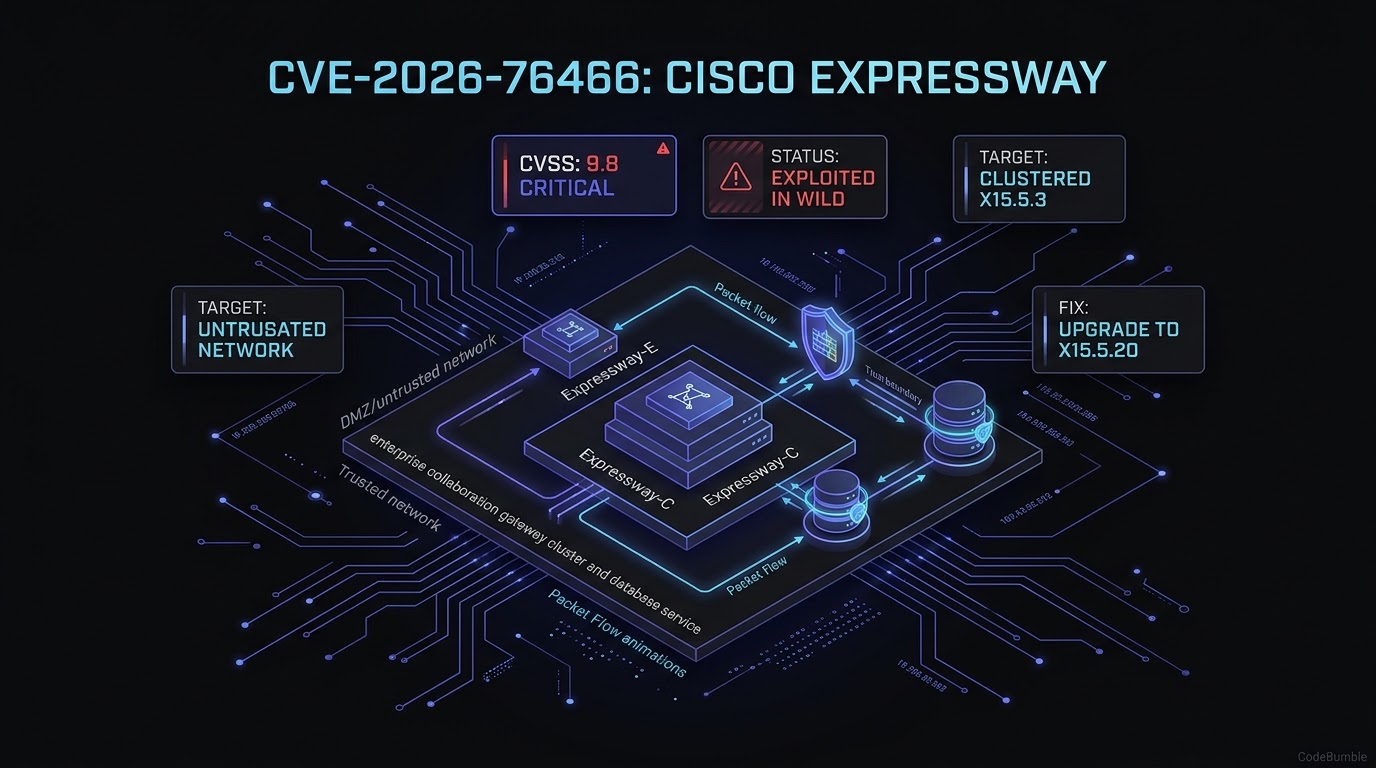
Executive Summary
Active exploitation has been confirmed against CVE-2026-76466 (CVSS v3.1 9.8 Critical), a root-level remote code execution vulnerability affecting clustered deployments of Cisco Expressway-C (Expressway Core) and Cisco Expressway-E (Expressway Edge). Tracked under Cisco Bug ID CSCww27732 and advisory cisco-sa-vcs-static-cred-hr7EWZ8t, the flaw stems from CWE-798 (use of hard-coded or persistent credentials/cookies) combined with insufficient validation of client certificates in the Expressway database service when TLS Verify Mode is set to Enabled for clustering.
Cisco originally published its advisory on October 21, 2026 (16:00 GMT), crediting Stefan Aleksic of Jane Street and designating X15.5.20 as the first fixed release for the X15.5 branch (with X14 and earlier requiring migration to a fixed release). At the time of publication, Cisco stated it was not aware of any public announcements or malicious use, and listed no official workarounds.
On November 19, 2026, cybersecurity firm F6 and SecurityWeek reported that threat actors began actively exploiting CVE-2026-76466 shortly after proof-of-concept (PoC) exploit code was published on GitHub. In the documented incident against a Russian organization, attackers breached two internet-exposed Expressway X15.5.3 appliances, pivoted to two internal cluster nodes, and deployed custom Python scripts—apparently modified on the fly using an AI assistant—to enumerate SMB shares, SQL Server, WinRM, and GitLab repositories for credentials.
As of November 18, 2026, CVE-2026-76466 had not been added to CISA's Known Exploited Vulnerabilities (KEV) catalog, and Cisco's October 21 advisory had not yet been revised to reflect the November 19 exploitation reports. Organizations running clustered Expressway appliances—particularly internet-facing Expressway-E nodes on X15.5.3 or earlier or X14 and earlier—should immediately restrict TCP ports 4371–4372 to trusted cluster peer IPs as an interim containment measure and upgrade to X15.5.20 or later.
| Attribute | Verified Value | Source |
|---|---|---|
| CVE Identifier | CVE-2026-76466 | Cisco Advisory / SecurityWeek |
| Cisco Advisory / Bug ID | cisco-sa-vcs-static-cred-hr7EWZ8t / CSCww27732 |
Cisco Advisory |
| Weakness Class | CWE-798 (Persistent Cookies + Missing Client Cert Validation) | Cisco Advisory |
| CVSS v3.1 Base Score | 9.8 Critical (AV:N/AC:L/PR:N/UI:N/S:U/C:H/I:H/A:H) |
Cisco Advisory |
| Affected Scope | Cisco Expressway-C & Expressway-E (virtual & appliance), clustered only | Cisco Advisory |
| Affected / Fixed Versions | X14 and earlier (migrate); X15.5.3 and earlier -> Fixed in X15.5.20 |
Cisco Advisory |
| Exploitation Status | Actively exploited in the wild following GitHub PoC release | F6 / SecurityWeek (Nov 19, 2026) |
| CISA KEV Status | Not listed as of November 18, 2026 release | MLQ.ai (Nov 19, 2026) |
| Interim Firewall Mitigation | Block TCP ports 4371–4372 except from trusted cluster node IPs |
F6 via SecurityWeek |
Technical Mechanics and Architecture
Cisco Expressway-C and Expressway-E operate as enterprise collaboration and session border gateways, typically deployed in multi-node clusters for high availability and traversal across DMZ and internal network boundaries. To synchronize configuration, state, and session metadata across nodes, Expressway relies on an internal database service backed by an Erlang runtime and distributed node-to-node communication channels.
Root Cause Breakdown
According to Cisco's October 21, 2026 security advisory, CVE-2026-76466 arises from two compounding design and validation failures in the database service feature when clustering is enabled:
- Insufficient Client Certificate Validation (
TLS Verify Mode: Enabled): Even when administrators configure TLS Verify Mode to Enabled for cluster communications—expecting mutual TLS (mTLS) authentication to restrict database service access strictly to authorized cluster peers—the database service fails to properly validate incoming client certificates. - Persistent Cookies (
CWE-798): The database service relies on persistent authentication cookies rather than uniquely bound, per-deployment ephemeral secrets or strictly verified peer identities.
Because client certificates are not validated when TLS Verify Mode is enabled, an unauthenticated remote attacker who can reach the database service port and possesses the persistent cookies can establish an authenticated session with the cluster database service. Once connected, the attacker can invoke specific remote procedure call (RPC) commands exposed by the database service to execute arbitrary operating system commands with root privileges on the underlying Expressway appliance.
Cluster Exposure and Pivot Architecture
+-----------------------------------------------------------------------+
|                        UNTRUSTED INTERNET                             |
+-----------------------------------+-----------------------------------+
                                    |
                     TCP 4371-4372  |  (Exposed Database / Cluster RPC)
                                    v
+-----------------------------------------------------------------------+
|  DMZ: Internet-Exposed Cisco Expressway-E Cluster (e.g., X15.5.3)     |
|  - TLS Verify Mode: Enabled (Client Certs NOT Validated)              |
|  - Persistent Cookies Accepted -> Arbitrary RPC -> ROOT OS Execution  |
+-----------------------------------+-----------------------------------+
                                    |
                   Internal Cluster |  Pivot via Cluster Trust / RPC
                   Replication Link |
                                    v
+-----------------------------------------------------------------------+
|  INTERNAL NETWORK: Cisco Expressway-C Cluster Nodes                   |
|  - Compromised as Root -> Staging Point for Internal Recon            |
+-------+---------------------------+---------------------------+-------+
        |                           |                           |
        v                           v                           v
  [SMB Shares]              [SQL Server / WinRM]         [GitLab Repos]
  (File Recon)              (Lateral Execution)         (Credential Hunt)
Note that standalone (non-clustered) Expressway-C and Expressway-E deployments are not affected by CVE-2026-76466, as the vulnerable database clustering RPC exposure is only active when devices are configured in a cluster.
Defensive Verification and Network Containment
While Cisco states that no official workarounds exist, F6 recommends blocking TCP ports 4371–4372 at the network perimeter and host firewall layers for all sources except the explicit IP addresses of trusted cluster nodes.
Below is a safe, defensive nftables policy template illustrating how perimeter or intermediate Linux firewalls protecting an Expressway DMZ segment can enforce strict peer-only access to the cluster database ports:
#!/usr/sbin/nft -f
# Defensive perimeter/DMZ filter for Cisco Expressway cluster ports (TCP 4371-4372)
# Reference: F6 mitigation guidance for CVE-2026-76466

table inet expressway_containment {
    set trusted_cluster_peers {
        type ipv4_addr
        flags interval
        elements = {
            198.51.100.10,   # Replace with Expressway-E Node 1 IP
            198.51.100.11,   # Replace with Expressway-E Node 2 IP
            192.0.2.20,      # Replace with Expressway-C Node 1 IP
            192.0.2.21       # Replace with Expressway-C Node 2 IP
        }
    }

    chain forward_expressway_guard {
        type filter hook forward priority filter; policy accept;

        # Log and drop unauthorized access to Expressway cluster DB/Erlang ports
        tcp dport { 4371, 4372 } ip saddr != @trusted_cluster_peers \
            log prefix "CVE-2026-76466_BLOCK: " counter drop
    }
}
For environments using iptables, the equivalent defensive rule sequence is:
# Allow only verified cluster peer IPs to reach TCP 4371-4372
iptables -N EXPRESSWAY_CLUSTER_GUARD
iptables -A EXPRESSWAY_CLUSTER_GUARD -s 198.51.100.10 -j RETURN
iptables -A EXPRESSWAY_CLUSTER_GUARD -s 198.51.100.11 -j RETURN
iptables -A EXPRESSWAY_CLUSTER_GUARD -s 192.0.2.20 -j RETURN
iptables -A EXPRESSWAY_CLUSTER_GUARD -s 192.0.2.21 -j RETURN
iptables -A EXPRESSWAY_CLUSTER_GUARD -j LOG --log-prefix "CVE-2026-76466_DROP: "
iptables -A EXPRESSWAY_CLUSTER_GUARD -j DROP

iptables -I FORWARD -p tcp --dport 4371:4372 -j EXPRESSWAY_CLUSTER_GUARD
And for defenders auditing their own external attack surface without sending any exploit payloads, a passive TCP reachability check from an external vantage point (outside the trusted peer list) can verify whether ports 4371–4372 are filtered:
#!/usr/bin/env python3
"""
Defensive reachability check for TCP ports 4371-4372 on Expressway nodes.
Tests only TCP handshake connectivity; sends no RPC or application payloads.
"""
import socket
import sys

def check_port(host: str, port: int, timeout: float = 3.0) -> str:
    try:
        with socket.create_connection((host, port), timeout=timeout):
            return "OPEN (EXPOSED - RESTRICT IMMEDIATELY)"
    except socket.timeout:
        return "FILTERED (TIMEOUT)"
    except ConnectionRefusedError:
        return "CLOSED (REFUSED)"
    except OSError as exc:
        return f"ERROR ({exc})"

if __name__ == "__main__":
    if len(sys.argv) < 2:
        print(f"Usage: {sys.argv[0]} <expressway_external_ip>")
        sys.exit(1)
    target = sys.argv[1]
    for p in (4371, 4372):
        print(f"{target}:{p} -> {check_port(target, p)}")
Evidence & Operational Impact
Confirmed Wild Exploitation Timeline
- October 21, 2026 (16:00 GMT): Cisco publishes Security Advisory
cisco-sa-vcs-static-cred-hr7EWZ8tfor CVE-2026-76466 (CVSS 9.8), disclosing the persistent-cookie and client-certificate validation flaw in clustered Expressway-C and Expressway-E appliances and releasing X15.5.20. Cisco notes no known public announcements or malicious use at publication. - Mid-November 2026: A proof-of-concept exploit for CVE-2026-76466 is published on GitHub.
- November 18, 2026: CISA publishes its KEV catalog update; CVE-2026-76466 is not included in that release.
- November 19, 2026: F6 and SecurityWeek disclose active exploitation in the wild targeting a Russian organization.
Observed Post-Exploitation Behavior (F6 Findings)
In the incident analyzed by F6 (reported by SecurityWeek on November 19, 2026), the intrusion followed a rapid, high-privilege lateral progression:
- Initial Access: Threat actors targeted two internet-exposed Cisco Expressway devices running version X15.5.3, exploiting CVE-2026-76466 to obtain root shell execution.
- Cluster Pivot: From the internet-facing nodes, the attackers pivoted laterally into two internal cluster nodes, leveraging the trusted cluster topology to bridge the DMZ into the internal network.
- AI-Assisted Post-Exploitation Tooling: After gaining root access, the attackers deployed custom Python scripts that appeared to be modified on the fly. F6 observed comments and descriptions embedded inside the scripts indicating the attackers used an AI assistant to adapt their tooling during the operation.
- Internal Discovery & Credential Harvesting: The custom Python scripts were used to scan internal network segments, locate SMB shares, interact with Microsoft SQL Server and WinRM services, and search GitLab repositories for exposed credentials.
Confidence Level & Source Discrepancies
- Exploitation & Impact Confidence (High): F6's incident telemetry, corroborated by SecurityWeek and MLQ.ai on November 19, 2026, establishes active exploitation against clustered
X15.5.3nodes shortly after a GitHub PoC release. - Advisory & Catalog Lag: Cisco's advisory page has remained at Version 1.0 (October 21, 2026) and still carries the original statement that Cisco PSIRT is unaware of malicious use. Similarly, CISA KEV had not yet added CVE-2026-76466 as of November 18, 2026. Security teams should not treat the absence of a KEV entry or an unrevised vendor advisory banner as evidence of low risk.
- Performance & Upgrade Benchmarks: Quantitative throughput, memory, or failover latency benchmarks comparing X15.5.3 to X15.5.20 are unavailable in the fetched vendor advisory and incident reports.
Hardening Playbook
Execute the following steps in order to contain exposure and remediate CVE-2026-76466:
Inventory Expressway Deployments and Clustering State
- Identify all Cisco Expressway-C and Expressway-E virtual machines and hardware appliances.
- Verify whether each node is configured in a cluster and record its software version. Any clustered node running X15.5.3 or earlier or X14 and earlier is vulnerable.
Apply Emergency Firewall Containment (TCP 4371–4372)
- Immediately configure perimeter firewalls, DMZ ACLs, and cloud security groups to block inbound TCP ports 4371 and 4372 from the public internet and all untrusted internal subnets.
- Permit TCP
4371–4372strictly between the explicit IP addresses of verified cluster peer nodes.
Upgrade to Fixed Software Releases
- For the X15.5 branch (
X15.5.3 and earlier): Upgrade all cluster nodes to X15.5.20 or later. - For X14 and earlier: Plan and execute a migration to a supported, fixed release (such as X15.5.20), as Cisco has not backported a patch to X14.
- Because CVE-2026-76466 grants root access, treat any internet-exposed clustered node on X15.5.3 or earlier that had TCP 4371–4372 reachable externally as potentially compromised—reimage or rebuild from trusted media rather than patching in place if suspicious activity is found.
- For the X15.5 branch (
Hunt for Exploitation in Erlang System Logs & Internal Services
- Per F6's guidance, inspect the Erlang system log on all clustered Expressway-C and Expressway-E appliances for unexpected RPC invocations, anomalous cluster connection attempts from non-peer IPs, or crash/restart events coinciding with post-PoC timelines.
- Correlate Expressway host egress and internal network logs for anomalous Python execution or outbound connections from Expressway-C/E nodes toward internal SMB (TCP 445), SQL Server (TCP 1433), WinRM (TCP 5985/5986), and GitLab instances.
Example SIEM detection query (Splunk/SPL-style) for lateral movement originating from Expressway appliance IPs:
index=firewall OR index=network
src_ip IN ("<EXPRESSWAY_E_IPS>", "<EXPRESSWAY_C_IPS>")
dest_port IN (445, 1433, 5985, 5986, 80, 443)
| stats count values(dest_port) as ports values(dest_ip) as targets by src_ip, _time span=1h
| where count > 10
Rollback and Change-Control Notes
- Firewall Rule Rollback: If restricting TCP
4371–4372disrupts legitimate cluster replication, verify that every cluster node's management/peer IP (including NAT/VIP addresses if applicable) is included in the allowlist before relaxing any drop rules—never reopen4371–4372to0.0.0.0/0. - Software Upgrade Rollback: Before upgrading a cluster to X15.5.20, take full configuration backups and VM snapshots (where supported) during a maintenance window, and upgrade nodes sequentially per Cisco's cluster upgrade guide to preserve call/traversal continuity.
- Firewall Rule Rollback: If restricting TCP
Frequently Asked Questions (FAQ)
1. Are standalone (non-clustered) Cisco Expressway-C or Expressway-E appliances vulnerable to CVE-2026-76466? No. According to Cisco's security advisory, CVE-2026-76466 only affects Cisco Expressway-C and Expressway-E devices (virtual and appliance) when they are configured in a cluster.
2. Does enabling TLS Verify Mode for clustering mitigate CVE-2026-76466? No. In fact, the vulnerability specifically occurs when TLS Verify Mode is set to Enabled for clustering, because the database service fails to validate client certificates properly and accepts persistent cookies, allowing an attacker with the cookies to invoke RPC commands as root.
3. Is there an official Cisco workaround if we cannot immediately upgrade to X15.5.20? Cisco's advisory states that no workarounds are available. However, cybersecurity firm F6 recommends an effective network-level mitigation: block TCP ports 4371–4372 at the firewall for all sources except the IP addresses of trusted cluster nodes.
4. Why isn't CVE-2026-76466 in the CISA KEV catalog yet if it is actively exploited? As of CISA's November 18, 2026 KEV release, CVE-2026-76466 had not been added, and F6/SecurityWeek publicly reported the active exploitation on November 19, 2026. KEV additions often trail initial threat-intelligence disclosures; defenders should treat the flaw as actively exploited now.
5. What should we check if our Expressway X15.5.3 cluster was exposed to the internet? Review the Erlang system log on all Expressway-E and Expressway-C nodes for signs of unauthorized RPC activity, and audit internal network logs for unexpected connections from Expressway appliances to SMB shares, SQL Server, WinRM, or GitLab repositories. If compromise is suspected, rebuild the nodes from clean images before rejoining the cluster.
Sources
- Cisco Security Advisory — Cisco Expressway Series Remote Code Execution Vulnerability (
cisco-sa-vcs-static-cred-hr7EWZ8t, Bug IDCSCww27732, CVE-2026-76466). Published: October 21, 2026 (16:00 GMT). URL: https://sec.cloudapps.cisco.com/security/center/content/CiscoSecurityAdvisory/cisco-sa-vcs-static-cred-hr7EWZ8t - SecurityWeek (By Eduard Kovacs) — Hackers Exploit Cisco Expressway Vulnerability Soon After PoC Release. Published: November 19, 2026 (8:12 AM ET). URL: https://www.securityweek.com/hackers-exploit-cisco-expressway-vulnerability-soon-after-poc-release/
- MLQ.ai — Hackers exploited a critical Cisco Expressway flaw soon after exploit code went public, F6 says. Published: November 19, 2026 (2:41 PM). URL: https://mlq.ai/news/hackers-exploited-a-critical-cisco-expressway-flaw-soon-after-exploit-code-went-public-f6-says/