

Technology
DocumentDB 1.0 Reaches General Availability: MIT-Licensed MongoDB Compatibility on PostgreSQL—With Telemetry and Latency Caveats
Open-source DocumentDB 1.0 is now generally available under the permissive MIT license, pairing a native BSON PostgreSQL extension with a MongoDB wire-protocol gateway and Kubernetes Operator 1.0.0. Here is how the architecture works across PostgreSQL 15–18, what early YCSB benchmarks against FerretDB and MongoDB 9.0.4 show, and how to harden deployments—including disabling default Scarf container telemetry.
8 min read
DocumentDB 1.0 Reaches General Availability: MIT-Licensed MongoDB Compatibility on PostgreSQL—With Telemetry and Latency Caveats
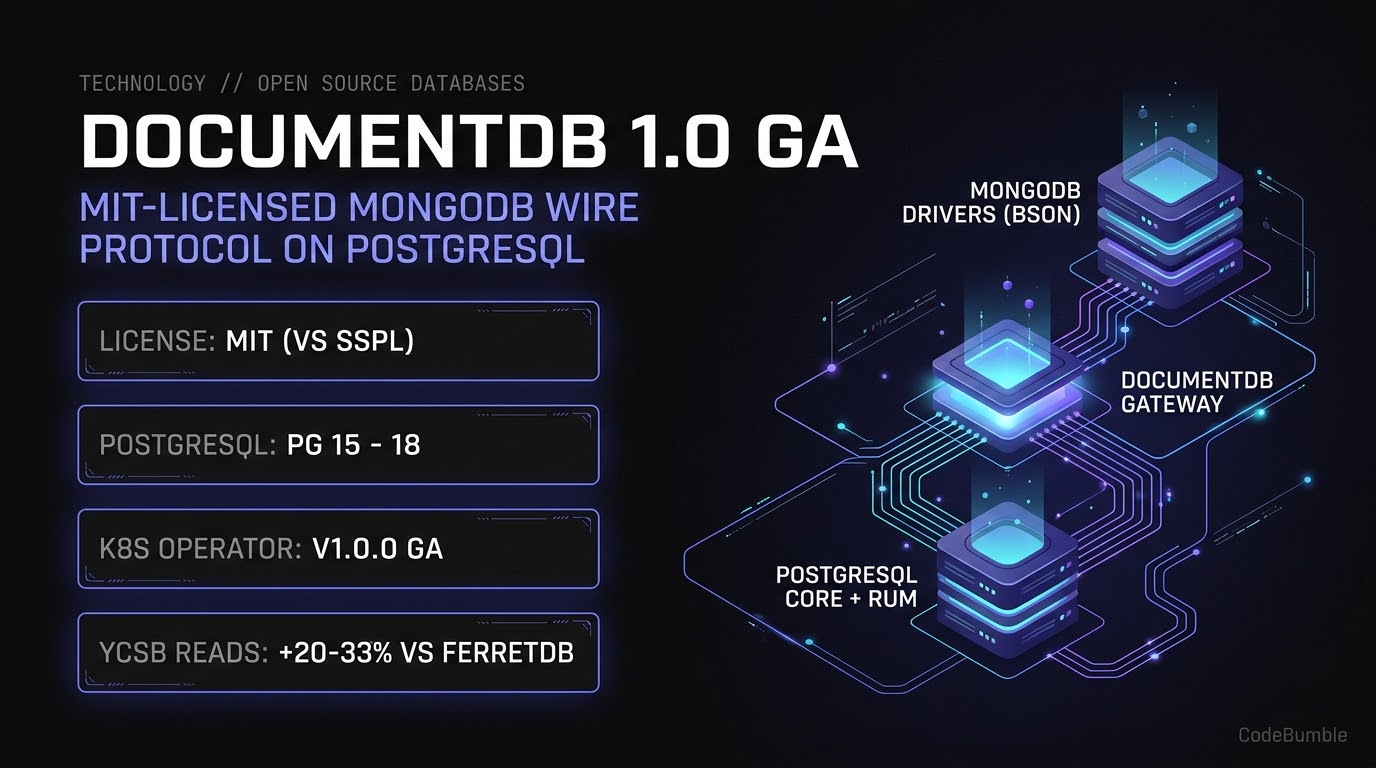
Executive Summary
DocumentDB 1.0—the open-source, MIT-licensed document database built on PostgreSQL with MongoDB wire-protocol compatibility—has reached General Availability, alongside DocumentDB Kubernetes Operator 1.0.0 and the DocumentDB Extension for Visual Studio Code 1.0 (InfoQ, November 14, 2026; DocumentDB 1.0 Announcement, October 19, 2026). Originally announced by Microsoft in early 2025 and later hosted under the Linux Foundation with backing from AWS, Cockroach Labs, Google, Snowflake, and Yugabyte, DocumentDB 1.0 (v1.0-0) is built from the same commit as v1.0-RC2 and focuses on security, stability, and correctness rather than expanding API surface area (InfoQ; DocumentDB 1.0 Release Notes).
For platform and database engineers evaluating alternatives to MongoDB's Server Side Public License (SSPL), DocumentDB 1.0's permissive MIT license allows commercial use, modification, and hosted deployment without source-disclosure obligations (InfoQ). The engine supports PostgreSQL 15–18 via container images and provides native Linux packages (amd64 and arm64) for PostgreSQL 17 and 18 on Ubuntu 24.04 and EL9 (DocumentDB 1.0 GA).
At the same time, practitioners should weigh three real-world caveats before migrating production workloads:
- Unverified latency vs. MongoDB 9.0.4: While an initial Layerbase YCSB test showed DocumentDB delivering 20–33% higher read throughput than FerretDB, an open GitHub issue reports higher query latency in DocumentDB 1.0 than MongoDB 9.0.4 across several workloads (InfoQ).
- Default container telemetry: Starting in 1.0, the
documentdb-localDocker image sends startup and hourly usage telemetry to Scarf unless explicitly disabled (DocumentDB 1.0 Blog). - No RC-to-GA in-place upgrade: Upgrading hosts or volumes that ran
1.0-RC1or1.0-RC2to final1.0.0is not supported (DocumentDB Release Candidates).
Technical Mechanics and Architecture
1. Gateway + Native BSON Extension Architecture
DocumentDB splits responsibilities between a wire-protocol gateway and a PostgreSQL extension (documentdb_core) that stores native BSON inside PostgreSQL rather than mapping documents into generic JSONB tables:
+-----------------------------------------------------------------------------+
|                         APPLICATION / DRIVER LAYER                          |
|  MongoDB Drivers (Node.js, Python, Go, Java) | mongosh | VS Code Ext 1.0    |
+--------------------------------------+--------------------------------------+
                                       |  MongoDB Wire Protocol (TCP :10260)
                                       v
+-----------------------------------------------------------------------------+
|                      DOCUMENTDB PROTOCOL GATEWAY                            |
|  - Translates MongoDB wire commands into PostgreSQL calls                   |
|  - Enforces SASLprep password validation (createUser / updateUser)          |
|  - Returns retryable error codes (exits cleanly if PG unreachable)          |
+--------------------------------------+--------------------------------------+
                                       |  SQL / Extension Calls
                                       v
+-----------------------------------------------------------------------------+
|                  POSTGRESQL CORE (PG 15 - 18) + EXTENSIONS                  |
|  +----------------------------------+  +---------------------------------+  |
|  | Native BSON Storage & Operators  |  | Index & Geospatial Subsystems   |  |
|  | - $getField/$setField, $facet    |  | - RUM Index (Vacuum/Scan fixes) |  |
|  | - Opt-in Collation (off default) |  | - 2dsphere (-180 lon fixes)     |  |
|  +----------------------------------+  +---------------------------------+  |
+-----------------------------------------------------------------------------+
It is also important to distinguish DocumentDB from FerretDB (InfoQ):
- DocumentDB ships both the PostgreSQL extensions and its own MongoDB-compatible gateway.
- FerretDB is a separate project that uses DocumentDB's PostgreSQL extensions as its storage backend while implementing its own MongoDB-compatible interface.
2. What Changed in 1.0.0 (v1.0-0)
According to the DocumentDB 1.0 announcement, the GA release concentrates on four areas:
- Security fixes:
findandaggregatewithbatchSize: 0now run permission checks;$mergeand$outrequire write permission on the target collection; andcreateUser/updateUserreject passwords that failSASLprep. - Stability: Fixes backend crashes in
$getField/$setField,$firstN/$lastN, and$documentsinside$facet, resolves a deadlock between concurrentdropIndexesoperations, fixes several RUM index vacuum and ordered-scan issues, and updates the gateway to return specific retryable error codes instead ofInternalError(and exit cleanly rather than panicking if PostgreSQL is unreachable at startup). - Opt-in collation: When
documentdb_core.enableCollationis enabled, additional operators (count,$stdDevPop,$stdDevSamp,$median,$percentile, and the symbol BSON type) honor collation. Collation remains off by default, anddistinct,findAndModify, andupdatedo not yet support it. - Geospatial correctness:
$near,$nearSphere, and$geoNearno longer fail on nearly coincident points or at longitude-180on a2dsphereindex.
3. Safe Hardened Deployment & Telemetry Opt-Out Configuration
When deploying documentdb-local for CI/CD integration tests or staging validation, disable default Scarf telemetry (DOCUMENTDB_USAGE_TELEMETRY=false or DO_NOT_TRACK=1), bind to loopback (127.0.0.1), and enforce strong credentials.
# docker-compose.documentdb.yml — Hardened local/CI DocumentDB 1.0 deployment
services:
  documentdb:
    image: ghcr.io/documentdb/documentdb/documentdb-local:pg17-1.0.0
    container_name: documentdb-ga
    restart: unless-stopped
    ports:
      - "127.0.0.1:10260:10260"
    environment:
      USERNAME: "${DOCDB_ADMIN_USER:?Set DOCDB_ADMIN_USER}"
      PASSWORD: "${DOCDB_ADMIN_PASS:?Set DOCDB_ADMIN_PASS}"
      DOCUMENTDB_USAGE_TELEMETRY: "false"
      DO_NOT_TRACK: "1"
    volumes:
      - documentdb_pg17_data:/var/lib/postgresql/data
    healthcheck:
      test: ["CMD-SHELL", "pg_isready -U ${DOCDB_ADMIN_USER} || exit 1"]
      interval: 10s
      timeout: 5s
      retries: 5

volumes:
  documentdb_pg17_data:
For production Kubernetes clusters, deploy via the DocumentDB Kubernetes Operator 1.0.0 (released October 19, 2026), which defaults to engine 1.0.0 (extension schema 1.0-0) and requires cert-manager (DocumentDB Operator Changelog; DocumentDB 1.0 GA).
4. Known Issues, Versioning Policy, and Pre-Migration Verification
Before scheduling a production cutover, engineering teams should account for three documented operational boundaries in the DocumentDB 1.0 Release Notes and announcement post:
- Partial collation support: Even when
documentdb_core.enableCollationis turned on,distinct,findAndModify, andupdateoperations do not yet honor collation settings in1.0.0. Applications that rely on locale-aware case-insensitive sorting or unique indexes in those write paths must validate query behavior in staging first. - Pending LTS and versioning policy: The DocumentDB maintainers plan to split future releases into a long-term support (LTS) track and a feature development track (
1.1and beyond), with the formal policy still under community discussion indocumentdb/documentdb#597(DocumentDB 1.0 Blog). - Separate operator and engine versioning: The DocumentDB Kubernetes Operator 1.0.0 maintains its own version stream independent of the core database engine (
1.0.0, extension schema1.0-0), so GitOps manifests should pin both chart and engine tags explicitly (DocumentDB Operator Changelog).
To verify that a newly provisioned DocumentDB 1.0 instance enforces SASLprep, disables Scarf telemetry, and passes basic BSON round-trip checks without modifying production collections, run a read-only pre-flight check using mongosh or pymongo against your staging endpoint before shifting application traffic.
Evidence: Licensing, Benchmarks, and Compatibility Trade-Offs
Benchmark & Ecosystem Comparison
Cross-referencing InfoQ and DocumentDB's official documentation highlights how DocumentDB 1.0 compares against FerretDB and MongoDB 9.0.4:
| Dimension | DocumentDB 1.0 | FerretDB (on DocumentDB ext) | MongoDB 9.0.4 |
|---|---|---|---|
| License | MIT (permissive) | Apache 2.0 (uses MIT DocumentDB ext) | SSPL (copyleft / cloud restriction) |
| PostgreSQL Support | PG 15–18 (containers), PG 17–18 (Linux pkgs) | Uses DocumentDB PG extensions | N/A (WiredTiger engine) |
| YCSB Read Throughput (Layerbase) | +20–33% higher than FerretDB (preliminary) | Baseline | Not in Layerbase comparison |
| Mixed Update Tail Latency | Higher than FerretDB in Layerbase test | Lower tail latency in mixed updates | Not in Layerbase comparison |
| Query Latency vs MongoDB 9.0.4 | Higher latency reported in open GitHub issue | Not tested in that issue | Lower latency in reported issue |
Confidence & Benchmark Note: InfoQ explicitly notes that Layerbase's YCSB comparison between DocumentDB and FerretDB is not conclusive, and that the open GitHub issue reporting higher query latency in DocumentDB 1.0 compared to MongoDB 9.0.4 has not been independently verified. Teams considering migration should run their own query-shape and tail-latency benchmarks against realistic data volumes before cutting over.
Operational & Naming Considerations
Two practical friction points surfaced in the November 2026 community reception (InfoQ):
- Name collision: Because AWS operates a proprietary managed service named Amazon DocumentDB and Microsoft operates Azure DocumentDB, the open-source project maintains a dedicated disambiguation page—yet developers on Hacker News and Reddit still report confusion when searching for driver and deployment docs.
- Telemetry transparency: While DocumentDB 1.0's Linux packages, extensions, and gateway collect no telemetry, the
documentdb-localcontainer image reports version, OS, and CPU architecture to Scarf at startup and hourly, exposing the host's network IP address unlessDOCUMENTDB_USAGE_TELEMETRY=falseis set (DocumentDB 1.0 Blog).
Hardening Playbook: Deploying and Auditing DocumentDB 1.0
Follow this numbered operational playbook before promoting DocumentDB 1.0 beyond local development:
- Start from a clean
1.0.0volume (never upgrade from RC1/RC2): DocumentDB explicitly blocks upgrades from1.0-RC1or1.0-RC2hosts or volumes to1.0.0. Provision fresh PostgreSQL 17 or 18 volumes and migrate data viamongodump/mongorestore(DocumentDB Release Candidates). - Disable container telemetry in CI and air-gapped environments: Always pass
-e DOCUMENTDB_USAGE_TELEMETRY=false -e DO_NOT_TRACK=1todocumentdb-localcontainers so outbound Scarf beacons do not leak internal network IPs or trigger egress alerts. - Validate password compliance with
SASLprep: Audit automated user-provisioning scripts forcreateUserandupdateUsercalls, as DocumentDB 1.0 now strictly rejects passwords that failSASLprepnormalization. - Test
$merge,$out, andbatchSize: 0roles: Verify least-privilege application roles in staging;batchSize: 0queries now enforce read permission checks, and$merge/$outpipelines require explicit write permissions on target collections. - Keep
documentdb_core.enableCollationoff unless tested: Leave collation disabled by default unless your workload specifically requires it, and verify that your queries do not rely ondistinct,findAndModify, orupdatewith collation (DocumentDB 1.0 Blog). - Monitor RUM index bloat and query latency: Use PostgreSQL's native observability (
pg_stat_statements,pg_stat_user_indexes,EXPLAIN (ANALYZE, BUFFERS)) to catch slow aggregation pipelines and verify RUM vacuum behavior under write-heavy workloads. - Rollback plan: Because DocumentDB speaks the MongoDB wire protocol, keep your application's MongoDB connection string (
MONGODB_URI) parameterized via secrets management so you can fail back to a managed MongoDB or replica set without changing application driver code.
Frequently Asked Questions (FAQ)
Is DocumentDB 1.0 truly open source compared to MongoDB?
Yes. DocumentDB 1.0 is released under the permissive MIT license under the Linux Foundation, allowing commercial use, modification, and hosted SaaS offerings without the source-disclosure requirements of MongoDB's SSPL (InfoQ).
Which PostgreSQL versions does DocumentDB 1.0 support?
Container images support PostgreSQL 15 through 18 (with pg17-1.0.0 as the default quick-start tag), while native Linux APT and YUM packages (amd64 and arm64) are provided for PostgreSQL 17 and 18 on Ubuntu 24.04 and EL9 (DocumentDB 1.0 GA).
How is DocumentDB different from FerretDB?
DocumentDB provides both the native BSON PostgreSQL extensions and its own MongoDB wire-protocol gateway. FerretDB is a separate project that uses DocumentDB's PostgreSQL extensions as its storage backend while maintaining its own MongoDB-compatible frontend interface (InfoQ).
Does DocumentDB 1.0 send telemetry?
Only the documentdb-local container image sends usage telemetry (version, OS, and CPU architecture) to Scarf at startup and hourly by default. You can disable it by setting DOCUMENTDB_USAGE_TELEMETRY=false or DO_NOT_TRACK=1. The Linux packages, extensions, and gateway collect no telemetry (DocumentDB 1.0 Blog).
Can I upgrade an existing 1.0-RC1 or 1.0-RC2 cluster to DocumentDB 1.0?
No. Upgrades from release candidates to 1.0.0 are not supported. You must deploy a fresh 1.0.0 instance or volume and reload your data (DocumentDB Release Candidates).
Sources
- DocumentDB Official Blog — DocumentDB 1.0 is here (Published October 19, 2026)
- DocumentDB Documentation — Generally Available: DocumentDB 1.0 & DocumentDB 1.0 Release Notes (Published October 19, 2026)
- DocumentDB GitHub — documentdb-kubernetes-operator CHANGELOG (v1.0.0) (October 19, 2026)
- InfoQ — Open Source DocumentDB 1.0 Reaches General Availability (Published November 14, 2026)
- Layerbase — DocumentDB 1.0 on Layerbase: our 19th Cloud engine (Published October 23, 2026)