

Technology
.NET 11 Launches With C# 15 Union Types and CoreCLR for MAUI as .NET 8 and .NET 9 Reach End of Support
Released November 10, 2026 alongside .NET Conf 2026, .NET 11 (STS, supported through November 14, 2028) introduces C# 15 union types and closed hierarchies, a Native AOT CLI host, OpenAPI 3.2 defaults, and CoreCLR on .NET MAUI—on the exact day .NET 8 and .NET 9 reached end of support. Here is the technical breakdown, .NET 10 LTS vs .NET 11 comparison, and upgrade checklist.
8 min read
.NET 11 Launches With C# 15 Union Types and CoreCLR for MAUI as .NET 8 and .NET 9 Reach End of Support
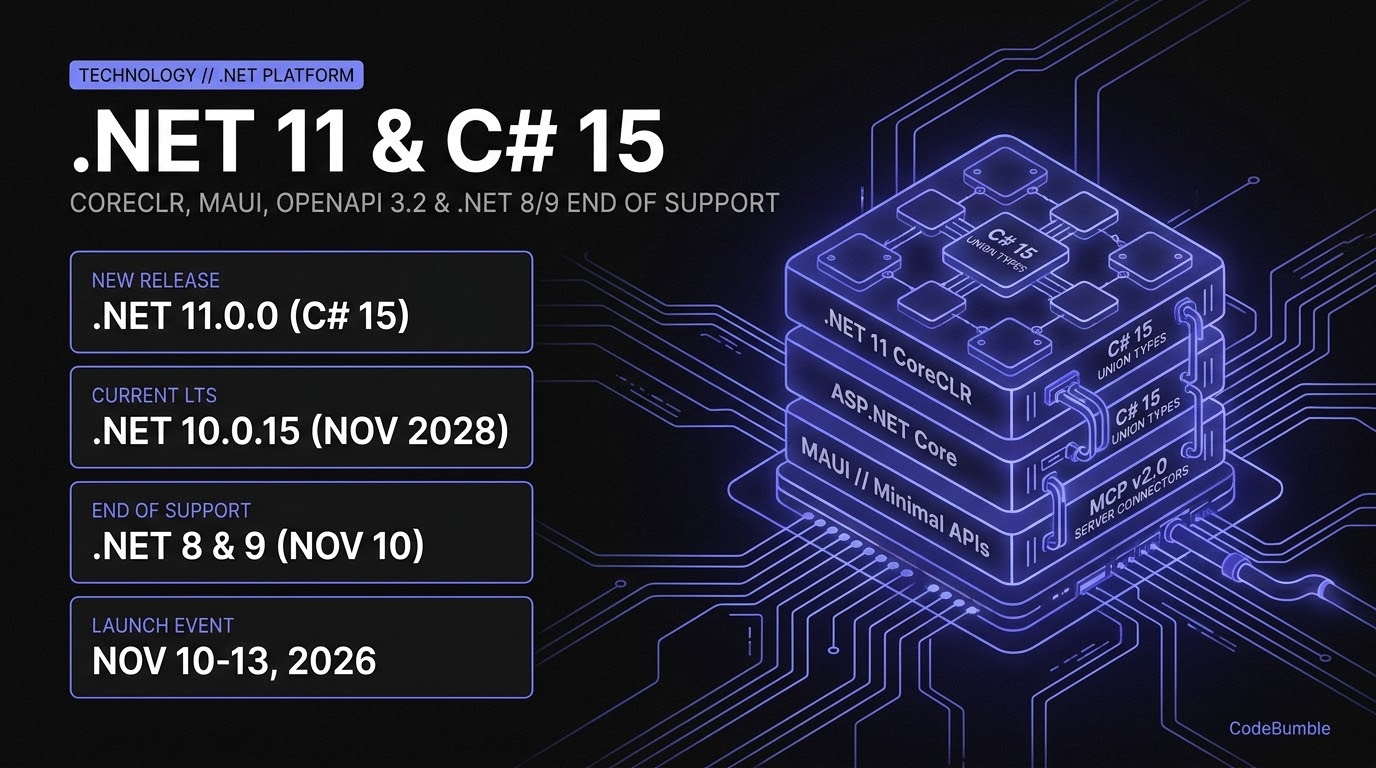
Executive Summary
On November 10, 2026—marking the kickoff of .NET Conf 2026 (November 10–13)—Microsoft released .NET 11.0.0 (SDK 11.0.100) and C# 15, on the exact same day that both .NET 8 (LTS) and .NET 9 (STS) reached End of Support. As of November 17, 2026, any production workload still running on .NET 8 or .NET 9 no longer receives security patches or technical support, making migration to .NET 10.0.15 (LTS) or .NET 11.0.0 (STS) an immediate operational priority.
Under Microsoft's updated support policy, .NET 11 is a Standard Term Support (STS) release with two years of support—ending November 14, 2028, the exact same end-of-support date as .NET 10 (LTS) (released November 11, 2025). That alignment gives engineering teams a rare choice: adopt .NET 11 today for C# 15 union types and closed hierarchies, ASP.NET Core OpenAPI 3.2, EF Core 11, and CoreCLR on .NET MAUI, or standardize on .NET 10 LTS without sacrificing support longevity.
Because Microsoft's November 10, 2026 announcement does not publish a single cross-workload synthetic throughput benchmark suite, confidence is high on all version numbers, support dates, language features, and CVE lists (verified across Microsoft Developer Blogs, Microsoft Learn, and Visual Studio Magazine), while runtime speedup claims are scoped strictly to documented architectural changes rather than unverified percentages.
Technical Mechanics and Architecture
.NET 11 (11.0.0) delivers structural changes across four layers of the stack: compiler/language (C# 15), SDK/build tooling (Native AOT CLI + warm MSBuild server), web/AI (ASP.NET Core, OpenAPI 3.2, MEAI, MCP C# SDK v2.0), and cross-platform runtime (CoreCLR across .NET MAUI and x86-64-v2 CPU baseline).
+-------------------------------------------------------------------+
| Language & Web Layer (C# 15 + ASP.NET Core 11 + EF Core 11)       |
|  - union types & closed class hierarchies (exhaustive switch)     |
|  - OpenAPI 3.2 default + Minimal API async validation             |
|  - Blazor AI (AG-UI experimental) + MCP C# SDK v2.0 (stateless)   |
+-------------------------------------------------------------------+
         |                                      |
         v  (SDK 11.0.100 Tooling)              v  (Unified Runtime)
+-------------------------------------------------------------------+
| Build & Runtime Plane (.NET 11.0.0)                               |
|  - Native AOT CLI host + warm MSBuild server (lower CLI overhead) |
|  - CoreCLR default on .NET MAUI (Android, iOS, Mac Catalyst)      |
|  - Built-in Zstandard compression + zero-copy memory APIs         |
+-------------------------------------------------------------------+
         |
         v  (Hardware & Lifecycle Boundary)
+-------------------------------------------------------------------+
| Platform & Servicing Floor                                        |
|  - x86/x64 minimum CPU: x86-64-v2 (older CPUs may fail to start)  |
|  - .NET 11 (STS) & .NET 10.0.15 (LTS) supported through Nov 2028  |
|  - .NET 8 & .NET 9: End of Support Nov 10, 2026 (No new patches)  |
+-------------------------------------------------------------------+
Headline Language & Framework Additions
- C# 15 Union Types and Closed Hierarchies: Documented in What's new in C# 15 and enabled by default when targeting
net11.0,uniontypes andclosedclass hierarchies allow developers to model finite domain states at compile time. Because aclosedclass restricts direct derivation to its declaring assembly,switchexpressions covering all declared subtypes are compiler-checked for exhaustiveness without requiring a fallback_ => throw ...arm. - CoreCLR Becomes Default for .NET MAUI: On Android, iOS, and Mac Catalyst, .NET MAUI adopts CoreCLR as its default runtime (on Apple platforms that disallow JIT, precompiled code and the interpreter are used), unifying runtime behavior across server, desktop, and mobile.
- OpenAPI 3.2, Async Validation, and Agentic Tooling: ASP.NET Core 11 switches its default OpenAPI output to OpenAPI 3.2 (including per-event payloads for Server-Sent Events), adds Minimal API async validation and C# union support, and pairs with Microsoft.Extensions.AI (MEAI), Microsoft Agent Framework (MAF), and MCP C# SDK v2.0 (stateless-by-default for scalable AI tool servers). Experimental Blazor AI components also integrate with the Agent User Interaction Protocol (AG-UI), while Runtime Async retains preview status per Visual Studio Magazine.
Safe C# 15 & Pre-Upgrade Audit Snippets
Below is a safe, compile-time-checked C# 15 pattern demonstrating closed hierarchies / union state modeling in an ASP.NET Core Minimal API handler, followed by a read-only CLI audit command to detect .NET 8 / .NET 9 end-of-support targets across your repository:
// C# 15 (.NET 11): Exhaustive domain state modeling without defensive throw-away defaults
public union PaymentResult(PaymentAuthorized, PaymentDeclined, PaymentPending);

public sealed record PaymentAuthorized(string TransactionId, decimal Amount);
public sealed record PaymentDeclined(string ReasonCode);
public sealed record PaymentPending(string PollingUrl);

public static string FormatStatus(PaymentResult result) => result switch
{
    PaymentAuthorized ok => $"Authorized: {ok.TransactionId} ({ok.Amount:C})",
    PaymentDeclined err => $"Declined: {err.ReasonCode}",
    PaymentPending wait => $"Pending: poll {wait.PollingUrl}"
};
Before retargeting production servers to .NET 11, run a read-only inventory check to locate any net8.0 or net9.0 target frameworks and verify host CPU compatibility (x86-64-v2 on Linux):
# 1. Scan repository for unsupported net8.0 / net9.0 TargetFrameworks
grep -rnE "<TargetFramework(s)?>.*net(8|9)\.0" . --include="*.csproj" --include="*.props"

# 2. Verify installed .NET SDKs and runtimes on build agents
dotnet --info

# 3. Check Linux x86-64 CPU flags for x86-64-v2 baseline (requires SSE4.2 / POPCNT)
grep -E "flags.*(sse4_2|popcnt)" /proc/cpuinfo | head -n 1
Evidence: Lifecycle Alignment, Security Servicing & Platform Matrix
The November 10, 2026 release simultaneously reshaped .NET's support matrix and patched four CVEs documented in Microsoft's November 2026 Servicing Updates.
.NET Support & Migration Matrix
| Release | Support Type | Release Date | End of Support | Key Decision Criteria |
|---|---|---|---|---|
| .NET 11.0.0 | STS (2 years) | Nov 10, 2026 | Nov 14, 2028 | Required for C# 15 unions/closed hierarchies, EF Core 11, OpenAPI 3.2 default, CoreCLR MAUI |
| .NET 10.0.15 | LTS (3 years) | Nov 11, 2025 | Nov 14, 2028 | Best conservative target if upgrading off .NET 8/9 without adopting .NET 11 breaking changes |
| .NET 9 | STS | Nov 12, 2024 | Nov 10, 2026 (EOL) | No longer receives security patches; migrate immediately |
| .NET 8 | LTS | Nov 14, 2023 | Nov 10, 2026 (EOL) | No longer receives security patches; migrate immediately |
November 2026 Security Servicing Scope
In the November 2026 servicing post, Microsoft addressed four CVEs across .NET and Visual Studio:
CVE-2026-114157: ASP.NET Core Security Feature Bypass Vulnerability (affects .NET 8, 9, 10, 11).CVE-2026-114158: Visual Studio Remote Code Execution Vulnerability (affects .NET 8, 9, 10, 11).CVE-2026-114159: Visual Studio Remote Code Execution Vulnerability (affects .NET 8, 9, 10, 11).CVE-2026-118748: ASP.NET Core Denial of Service Vulnerability (affects .NET 11).
Runtime, JIT, and Standard Library Highlights
Beyond language syntax and support timelines, .NET 11 and Oflight's release summary document targeted runtime and library improvements: the JIT compiler removes additional redundant bounds checks and branches while expanding devirtualization and constant folding, and the base class libraries introduce built-in Zstandard compression, simpler process execution APIs, richer JSON support, and zero-copy in-memory data primitives.
Note that November 10, 2026 represents the final servicing update for .NET 8 and .NET 9; future CVEs discovered after November 10 will only be patched in .NET 10 and .NET 11.
Upgrade & Hardening Playbook
Follow this sequence to retire .NET 8 / .NET 9 workloads safely and validate .NET 11 compatibility:
1. Audit Hardware and Container Base Images for x86-64-v2
As highlighted in Microsoft's .NET 11 announcement and Oflight's upgrade guide, .NET 11 raises the x86/x64 minimum CPU requirement to x86-64-v2. Legacy virtual machines, older Xeon hosts, or restricted hypervisor CPU profiles below x86-64-v2 may fail to start. Verify VM CPU types in production and staging before swapping container base images to mcr.microsoft.com/dotnet/aspnet:11.0.
2. Update global.json and Explicit TargetFramework Properties
Installing the .NET 11 SDK (11.0.100) on a build agent does not automatically retarget existing applications. To upgrade cleanly:
- Update
global.jsonto pin11.0.100(and remove anyrollForwardprerelease settings if moving from RC1/RC2). - Update
<TargetFramework>net11.0</TargetFramework>(ornet10.0if choosing LTS) across.csprojfiles, preserving platform-specific suffixes such asnet11.0-androidornet11.0-ios. - Upgrade NuGet packages (
Microsoft.EntityFrameworkCore11.x,Swashbuckle/Microsoft.AspNetCore.OpenApi) in lockstep.
3. Validate OpenAPI 3.2 Consumers and MAUI Android Minimums
- API Gateways & Codegen: Because ASP.NET Core 11 defaults to OpenAPI 3.2, verify that downstream API gateways, Swagger UI instances, and client generators (Kiota, NSwag, OpenAPI Generator) parse the 3.2 schema cleanly—or pin an earlier OpenAPI version explicitly in
AddOpenApi()if consumers fail. - Mobile (.NET MAUI): Test CoreCLR runtime behavior and verify Android minimum API level requirements (Android API 24 minimum per Oflight's breaking-change summary) before releasing mobile builds.
4. Apply November 2026 Servicing Updates Immediately
For teams remaining temporarily on .NET 10 LTS, apply .NET 10.0.15 immediately to close CVE-2026-114157, CVE-2026-114158, and CVE-2026-114159, and ensure Visual Studio 2026 installations are patched.
5. Rollback Plan
Maintain side-by-side .NET 10.0.15 runtime images in your container registry during .NET 11 canary rollouts. Because both .NET 10 and .NET 11 share the November 14, 2028 support horizon, reverting a service from net11.0 back to net10.0 (provided no C# 15 or EF Core 11-only APIs were committed) keeps you on a fully supported LTS baseline.
Frequently Asked Questions (FAQ)
Is .NET 11 an LTS release?
No. .NET 11 is a Standard Term Support (STS) release with two years of support, ending November 14, 2028—which happens to match the end-of-support date of .NET 10 (LTS).
Will my .NET 8 and .NET 9 apps stop running after November 10, 2026?
No, existing applications will continue to execute, but no new security patches or technical support will be provided after November 10, 2026. Microsoft recommends migrating to .NET 10 (LTS) or .NET 11 (STS).
What are the headline features of C# 15 in .NET 11?
C# 15 introduces union types (union keyword) and closed class hierarchies (closed modifier) for compiler-checked exhaustive pattern matching, along with collection expression with(...) arguments, extension indexers, and non-virtual static interface members on older runtimes.
Why might .NET 11 fail to start on older servers?
.NET 11 raises the minimum x86/x64 CPU baseline to x86-64-v2. Servers or VMs running on older CPU architectures without x86-64-v2 instructions (such as SSE4.2 and POPCNT) may fail to launch.
Does installing the .NET 11 SDK automatically upgrade my project?
No. You must explicitly update <TargetFramework> to net11.0 in your project files, update compatible NuGet packages and workloads, and test against .NET 11 breaking changes.
Sources
- Microsoft .NET Blog: Announcing .NET 11 (Published November 10, 2026)
- Microsoft .NET Blog: .NET and .NET Framework November 2026 servicing updates (Published November 10, 2026)
- Microsoft .NET Blog: .NET 8 and .NET 9 will reach End of Support on November 10, 2026 (Published June 29, 2026)
- Microsoft Learn: What's new in C# 15 (Published November 10, 2026)
- Visual Studio Magazine: .NET 11 Ships with C# 15 Unions, Faster Tools and CoreCLR for MAUI (Published November 11, 2026)
- Oflight: .NET 11 Released: C# 15 Unions, Upgrade from .NET 8/9 (Published November 13, 2026)