

Device
Edge AI Silicon in 2026: Measured YOLO26 Benchmarks on Jetson, DGX Spark, Raspberry Pi 5 Hailo-8 & NPUs
Peak TOPS numbers on edge AI spec sheets rarely predict real-world detector latency. Using Ultralytics' November 25, 2026 YOLO26 device benchmarks alongside official NVIDIA and Raspberry Pi silicon specs, this deep dive compares TensorRT FP16/INT8, Hailo-8, DEEPX, RK3588, Snapdragon Hexagon, Apple Neural Engine, and STM32N6 trade-offs so you can size hardware by workload rather than marketing claims.
11 min read
Edge AI Silicon in 2026: Measured YOLO26 Benchmarks on Jetson, DGX Spark, Raspberry Pi 5 Hailo-8 & NPUs
Executive Summary
Spec-sheet tera-operations per second (TOPS) figures routinely mislead hardware buyers because compiler support, memory bandwidth, and host-to-NPU PCIe transfers determine actual frame latency. On November 25, 2026, Ultralytics published its unified YOLO26 edge device benchmark guide, consolidating measured latency and mAP50-95 accuracy across nine silicon classes—from the 1,000-TOPS NVIDIA DGX Spark GB10 desktop system down to the 600-GOPS STM32N6 microcontroller.
Key findings from the November 2026 measurements and vendor datasheets:
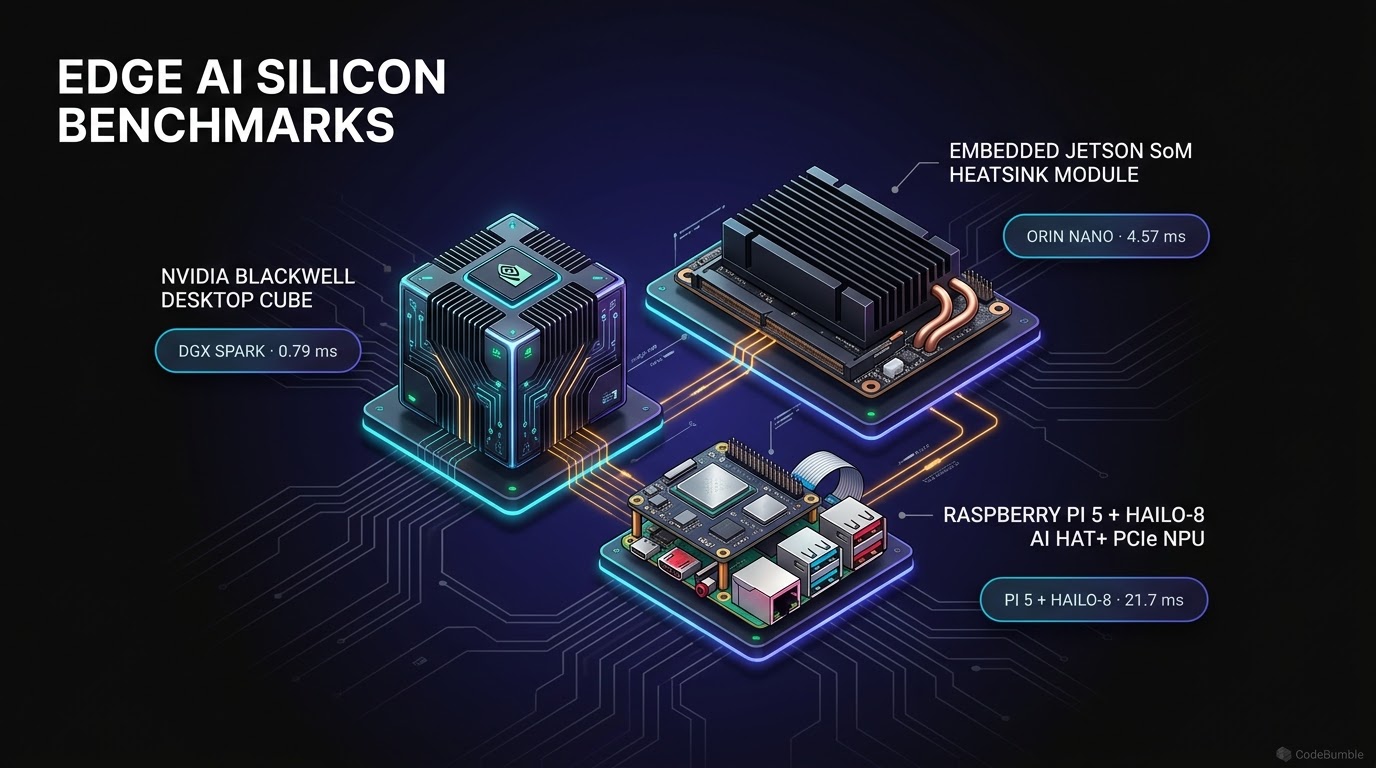
- INT8 is not universally faster than FP16: On TensorRT-backed Blackwell silicon, INT8 ran slower and scored lower accuracy than FP16 for YOLO26n on both Jetson AGX Thor (1.52 ms INT8 vs. 1.39 ms FP16) and DGX Spark (1.43 ms INT8 vs. 0.79 ms FP16).
- Add-on NPUs bridge the SBC CPU gap with caveats: Pairing a Raspberry Pi 5 with the 26-TOPS Hailo-8 AI HAT+ cuts YOLO26n inference from 67.03 ms (NCNN FP32 on CPU) or 364.6 ms (unexported PyTorch) down to 21.7 ms in INT8—though Hailo's YOLO26 exporter excludes instance segmentation, pose, and OBB.
- Embedded SoMs keep larger models real-time: The 67-TOPS Jetson Orin Nano Super (7 W–25 W) runs YOLO26n in 4.57 ms (FP16) and YOLO26m in 13.59 ms (0.6225 mAP50-95 on COCO128), while Orin NX 16GB runs YOLO26x at 26.76 ms.
- Methodology discipline matters: Ultralytics cautions against ranking devices across separate benchmark pages because harnesses differ on dataset (
COCO128vs.COCO val2017), runtime versions, and whether pre/post-processing is timed.
For engineers, the takeaway is clear: size edge silicon by model variant (n through x), camera count, power envelope, and compiler task coverage—not peak TOPS.
Silicon & Hardware Architecture
Edge vision deployments span five tiers: desktop unified-memory superchips, embedded GPU/DLA system-on-modules (SoMs), single-board computers (SBCs) with discrete PCIe/M.2 NPUs, mobile/laptop SoCs, and microcontroller-class TinyML silicon.
flowchart LR
    A[Camera Stream] --> B{Deployment Tier}
    B -->|Desktop 140W TDP| C[DGX Spark GB10<br/>128 GB LPDDR5x · 273 GB/s<br/>TensorRT FP16: 0.79 ms]
    B -->|Robotics 7W–60W| D[Jetson Orin / Thor<br/>Unified Ampere/Blackwell<br/>Orin Nano Super: 4.57 ms]
    B -->|SBC + PCIe NPU| E[Raspberry Pi 5 + Hailo-8<br/>PCIe 2.0 · 26 TOPS INT8<br/>21.7 ms vs 67.03 ms CPU]
    B -->|Mobile / Laptop SoC| F[Snapdragon / Apple Silicon<br/>Hexagon QNN / Core ML ANE<br/>4.7 ms–27.2 ms]
    B -->|Battery / mJ Budget| G[STM32N6 MCU<br/>Cortex-M55 + 600 GOPS NPU<br/>Whole-Graph INT8]
Desktop Unified-Memory Silicon: NVIDIA DGX Spark (GB10)
Per NVIDIA's DGX Spark Hardware Overview (updated November 25, 2026), DGX Spark is a compact desktop system (150 × 150 × 50.5 mm, 1.2 kg) built around the Grace Blackwell GB10 Superchip. GB10 pairs a 20-core Arm CPU (10 Cortex-X925 + 10 Cortex-A725) with a Blackwell GPU featuring 6,144 CUDA cores, 5th-generation Tensor Cores (supporting FP4), and two copy engines. Compute blocks share 128 GB of LPDDR5x unified memory over a 256-bit interface (273 GB/s bandwidth). Peak AI compute reaches 1,000 TOPS (1 PFLOP FP4 sparse) within a 140 W SoC TDP and a mandatory 240 W PSU, with 10 GbE, ConnectX-7 Smart NIC, Wi-Fi 7, Bluetooth 5.4, and four USB-C ports.
Embedded System-on-Modules: NVIDIA Jetson Orin & Thor
For robotics and multi-camera lines, NVIDIA's Jetson Orin family integrates CPU, GPU, and memory into compact modules. The Jetson Orin Nano Super Developer Kit ($249) pairs a 6-core Arm Cortex-A78AE CPU with a 1,024-core Ampere GPU (32 Tensor Cores) and 8 GB 128-bit LPDDR5 (102 GB/s), delivering 67 INT8 TOPS across 7 W–25 W. Orin NX 16GB reaches 100 INT8 TOPS (10 W–25 W / 40 W Super mode), AGX Orin 64GB scales to 275 TOPS (15 W–60 W), and Blackwell-based Jetson AGX Thor reaches 2,070 TFLOPS (FP4 sparse) with a 2,560-core GPU and 14-core Arm Neoverse-V3AE CPU.
Single-Board Computers & Discrete NPUs: Raspberry Pi 5, Hailo-8, DEEPX & RK3588
- Raspberry Pi AI HAT+ (Hailo-8 / Hailo-8L): Per official Raspberry Pi documentation, the AI HAT+ attaches over PCIe 2.0 in 13-TOPS (Hailo-8L) or 26-TOPS (Hailo-8) INT8 variants, sharing host Pi 5 RAM for vision models. The 40-TOPS (INT4) AI HAT+ 2 (Hailo-10H) adds 8 GB of onboard SDRAM to run local LLMs and VLMs up to ~6B parameters.
- DEEPX DX-M1 & Rockchip RK3588: The DEEPX DX-M1 connects via M.2 to a Pi 5 and splits execution between its INT8 NPU and host CPU. Boards like the Radxa Rock 5B integrate Rockchip's RK3588 SoC with an on-die NPU using the RKNN runtime.
Mobile, Laptop & Microcontroller Tiers
Xiaomi 17 (Snapdragon 8 Elite Gen 5) and Snapdragon X Elite laptops target Qualcomm's Hexagon NPU via QNN (W8A16), while iPhone 17 Pro and Apple M4 Macs target the Apple Neural Engine via Core ML. At the microcontroller tier, STMicroelectronics' STM32N6 pairs an Arm Cortex-M55 with a 600-GOPS NPU and 4.2 MB of internal RAM, requiring whole-graph INT8 quantization via ST Edge AI Core.
Hardware Architecture & Spec Comparison
| Device / Silicon Class | Architecture & Compute | Memory & Bandwidth | Peak AI Rating | Power / Thermal Envelope |
|---|---|---|---|---|
| NVIDIA DGX Spark (GB10) | Blackwell GPU (6,144 CUDA) + 20-core Arm | 128 GB LPDDR5x (273 GB/s) | 1,000 TOPS / 1 PFLOP (FP4) | 140 W SoC TDP (240 W PSU) |
| NVIDIA Jetson AGX Thor | Blackwell GPU (2,560 CUDA) + 14-core Neoverse | High-bandwidth unified memory | 2,070 TFLOPS (FP4 sparse) | High-end robotics envelope |
| NVIDIA Jetson AGX Orin 64GB | Ampere GPU (2,048 CUDA) + 12-core Cortex-A78AE | 64 GB LPDDR5 (204 GB/s) | 275 INT8 TOPS | 15 W–60 W configurable |
| NVIDIA Jetson Orin Nano Super | Ampere GPU (1,024 CUDA) + 6-core Cortex-A78AE | 8 GB LPDDR5 (102 GB/s) | 67 INT8 TOPS | 7 W–25 W (MAXN Super) |
| Raspberry Pi 5 + AI HAT+ | Broadcom BCM2712 + Hailo-8 (PCIe 2.0) | Host Pi 5 RAM (HAT+ 2: 8 GB) | 26 INT8 TOPS (Hailo-8) | ~5 W–15 W total system |
| STM32N6 Microcontroller | Arm Cortex-M55 + embedded NPU | 4.2 MB internal RAM | 600 GOPS (INT8) | Battery / mJ-class sensor |
Real-World Performance, Thermals & Efficiency
Ultralytics' November 25, 2026 YOLO26 benchmark roundup exposes sharp gaps between theoretical TOPS and measured execution. YOLO26 (released January 14, 2026) adds optional NMS-free inference (nms=False) and removes Distribution Focal Loss (DFL) to simplify edge exports, per Ultralytics YOLO26 docs.
Measured YOLO26 Latency Across Silicon Tiers
Because Ultralytics' device pages vary by dataset (COCO128 vs. COCO val2017) and timing scope (inference-only vs. full predict() wall time), the table below preserves each device's exact conditions:
| Hardware Target | Runtime & Precision | Model & Input | Measured Latency & Accuracy | Scope & Dataset |
|---|---|---|---|---|
| DGX Spark (GB10) | TensorRT 11.2.1.2 FP16 | YOLO26n / m (640) |
0.79 ms (0.4032) / 2.70 ms (0.5266) | Inference, COCO val2017 |
| DGX Spark (GB10) | TensorRT 11.2.1.2 INT8 | YOLO26n (640) | 1.43 ms (−0.011 to −0.018 mAP) | Inference, COCO val2017 |
| Jetson AGX Thor | TensorRT FP16 / INT8 | YOLO26n (640) | 1.39 ms (FP16) / 1.52 ms (INT8) | Inference only, COCO128 |
| Jetson Orin Nano Super | TensorRT FP16 | YOLO26n / m (640) |
4.57 ms (0.4800) / 13.59 ms (0.6225) | Inference only, COCO128 |
| Jetson Orin Nano Super | TensorRT INT8 | YOLO26n (640) | 3.80 ms (0.4490 mAP50-95) | Inference only, COCO128 |
| Jetson Orin NX 16GB | TensorRT FP16 | YOLO26x (640) | 26.76 ms (0.6632 mAP50-95) | Inference only, COCO128 |
| Raspberry Pi 5 (CPU) | NCNN FP32 | YOLO26n / s (640) |
67.03 ms (0.4784) / 172.88 ms (0.5684) | Inference only, COCO128 |
| Pi 5 + Hailo-8 AI HAT+ | Hailo HEF INT8 | YOLO26n (unstated) | 21.7 ms (0.455 mAP50-95) | Inference, COCO128 |
| Pi 5 + DEEPX DX-M1 | DEEPX INT8 | YOLO26n (unstated) | 34.6 ms (0.4660 mAP50-95) | Inference, COCO128 |
| Radxa Rock 5B (RK3588) | RKNN FP16 / INT8 | YOLO26n | 58.5 ms (FP16) / 41.2 ms (INT8) | Inference only, COCO128 |
| Xiaomi 17 (SD 8 Elite G5) | QNN W8A16 (Hexagon) | YOLO26n (640) | 10.2 ms total (6.0 ms inference) | Full predict(), latency |
| Snapdragon X Elite | QNN W8A16 (Hexagon) | YOLO26n (640) | 27.2 ms total (vs. 91.4 ms CPU) | Full predict(), latency |
| iPhone 17 Pro (iOS 26.6) | Core ML INT8 (ANE) | YOLO26n / m / x |
4.7 ms / 11.8 ms / 20.5 ms | Full predict(), latency |
| Apple M4 Mac (macOS 27.2) | Core ML FP16 / INT8 | YOLO26n / x (640) |
6.0 ms (n FP16) / 24.3 ms (x INT8) |
Inference, COCO val2017 |
Four Takeaways on Precision, Thermals & Overhead
- FP16 beats INT8 on Blackwell silicon: On DGX Spark and Jetson AGX Thor, INT8 TensorRT engines ran slower than FP16 for YOLO26n (1.43 ms vs. 0.79 ms on DGX Spark; 1.52 ms vs. 1.39 ms on AGX Thor) while losing accuracy. Conversely, Ampere-based Jetson Orin Nano Super (4.57 ms FP16 → 3.80 ms INT8, mAP50-95 0.4800 → 0.4490) and RK3588 (58.5 ms → 41.2 ms) gain speed from INT8.
- CPU vs. NPU speedup on SBCs: Unexported PyTorch YOLO26n takes 364.6 ms on a Pi 5. Exporting to NCNN FP32 cuts that to 67.03 ms, while Hailo-8 AI HAT+ reaches 21.7 ms and frees CPU cores for tracking and RTSP decoding.
- Thermal design dictates sustained throughput: NVIDIA notes in its JetPack 6.2 Super Mode guide that uncapped
MAXN SUPERmodes thermally throttle if module power exceeds chassis TDP. Likewise, Raspberry Pi AI HAT+ docs recommend installing both the Active Cooler and (on AI HAT+ 2) the bundled NPU/SDRAM heatsink before running sustained benchmarks. - Pre/post-processing eats into wall-clock FPS: On Xiaomi 17, NPU inference takes 6.0 ms, yet full
predict()wall time is 10.2 ms—41% of latency sits outside the NPU. Always time the complete camera pipeline.
Ecosystem, Repairability & Practical Verdict
Compiler Lock-In & Task Coverage Gaps
While Ultralytics provides a unified export API (model.benchmark(...) and yolo export), vendor compilers impose hard boundaries:
- Task support: Hailo's YOLO26 exporter supports detection (21.7 ms), semantic segmentation (34.8 ms), depth estimation (29.6 ms), and classification (2.0 ms), excluding instance segmentation, pose, and OBB. DEEPX DX-M1 supports five tasks (pose at 37.6 ms, OBB at 56.4 ms), but ImageNet100 top-1 accuracy dropped from 0.431 in PyTorch to 0.333 after DEEPX compilation.
- Host cross-compilation: Jetson, Pi CPU, and Macs export and benchmark on-device. Hailo, DEEPX, Rockchip RKNN (non-portable across 11 Rockchip chips), and STM32N6 require exporting on an x86-64 host or Ultralytics Platform.
- Microcontroller limits: STM32N6's 4.2 MB RAM requires whole-graph INT8 quantization. STM32N6 YOLO26 results are currently host-validated on 4–8 image datasets with no on-device YOLO26 latency published yet (ST's published board reference is ~29 ms and 9.4 mJ for YOLOv8n at 256×256).
Benchmarking Your Target Hardware
Run Ultralytics' benchmark mode on your own validation data before locking a hardware BOM:
from ultralytics import YOLO

model = YOLO("yolo26n.pt")
model.benchmark(data="your_data.yaml", imgsz=640)
model.benchmark(data="your_data.yaml", imgsz=640, format="engine", quantize=16)
Repairability, Modularity & Buying Guidance
Raspberry Pi 5 + AI HAT+ and M.2 accelerators (DEEPX DX-M1) offer clean modularity: NPUs swap independently of the SBC, though Raspberry Pi warns against removing push-pin coolers once mounted because thermal pads degrade. Jetson SoMs standardize carrier-board pinouts across Orin Nano and Orin NX tiers. DGX Spark prioritizes 1.2 kg desktop density with unified memory, limiting upgrades to M.2 NVMe storage.
- Raspberry Pi 5 (CPU only): Single-camera prototypes under ~15 FPS using
yolo26nNCNN. - Pi 5 + Hailo-8 AI HAT+: Compact detection/segmentation nodes needing ~40+ FPS inference without GPU overhead.
- Jetson Orin Nano Super ($249): Multi-camera robotics,
yolo26mmodels (13.59 ms), or CUDA/ROS 2 pipelines. - DGX Spark: Local training, multi-stream pipelines, or 200B-class agents needing 128 GB unified memory.
FAQ
Why did INT8 run slower than FP16 on NVIDIA DGX Spark and Jetson AGX Thor? In Ultralytics' November 25, 2026 benchmarks, TensorRT INT8 engines for YOLO26n were slower than FP16 on DGX Spark (1.43 ms vs. 0.79 ms) and Jetson AGX Thor (1.52 ms vs. 1.39 ms), with a 0.011–0.018 mAP50-95 drop on DGX Spark. Blackwell's 5th-generation Tensor Cores optimize FP16/FP4 execution, whereas INT8 calibration/dequantization overhead can outweigh compute savings on small nano graphs.
Can a Raspberry Pi 5 run YOLO26 in real time without an AI HAT+? Yes, for one camera at moderate frame rates. Using NCNN FP32 at 640×640, a Pi 5 CPU runs YOLO26n in 67.03 ms (~14.9 FPS inference only), compared to 364.6 ms in unexported PyTorch. Adding a Hailo-8 AI HAT+ drops inference latency to 21.7 ms.
What is the difference between Raspberry Pi AI HAT+ and AI HAT+ 2? AI HAT+ uses a Hailo-8L (13 TOPS INT8) or Hailo-8 (26 TOPS INT8) NPU and shares Pi 5 host RAM for vision workloads. AI HAT+ 2 upgrades to a 40-TOPS (INT4) Hailo-10H NPU with 8 GB of dedicated onboard SDRAM, enabling local LLMs and VLMs up to ~6 billion parameters.
Are Ultralytics' published YOLO26 device benchmarks directly comparable across brands?
No. Ultralytics warns against cross-page ranking because different guides use different datasets (COCO128 vs. COCO val2017), Ultralytics versions, and timing scopes (mobile QNN/Core ML tables include pre/post-processing wall time, whereas Jetson, Pi, and RKNN tables measure inference only).
Can YOLO26 run on microcontrollers like the STM32N6 today? STMicroelectronics compiled whole-graph INT8 exports for all seven YOLO26 tasks using ST Edge AI Core, with host validation showing YOLO26n detection moving from 0.686 to 0.639 mAP50-95 on small sample sets. However, Ultralytics has not yet published on-device YOLO26 latency for the STM32N6; the published board reference remains ~29 ms and 9.4 mJ for YOLOv8n at 256×256.
Sources
- Ultralytics Blog — Edge AI Devices for Computer Vision: Ultralytics YOLO26 Results by Onuralp Sezer (Published November 25, 2026): https://www.ultralytics.com/blog/edge-ai-devices
- NVIDIA Documentation — Hardware Overview — DGX Spark User Guide (Last updated November 25, 2026): https://docs.nvidia.com/dgx/dgx-spark/hardware.html
- NVIDIA Embedded Systems — Jetson Orin Series & Orin Nano Super Developer Kit Specifications (Accessed November 27, 2026): https://www.nvidia.com/en-us/autonomous-machines/embedded-systems/jetson-orin/nano-super-developer-kit/ and https://www.nvidia.com/en-us/autonomous-machines/embedded-systems/
- Raspberry Pi Documentation — AI HATs (AI HAT+ and AI HAT+ 2) Hardware & Assembly Guide (Accessed November 27, 2026): https://www.raspberrypi.com/documentation/accessories/ai-hat-plus.html
- Ultralytics Documentation — YOLO26 Model Architecture & Tasks Overview (Published January 14, 2026; Tasks updated November 1, 2026): https://docs.ultralytics.com/models/yolo26