

Device
Microsoft and Intel Expand Azure Silicon with EMIB, Diamond Rapids, CXL Flat Memory Mode, QAT, and TDX Live Migration
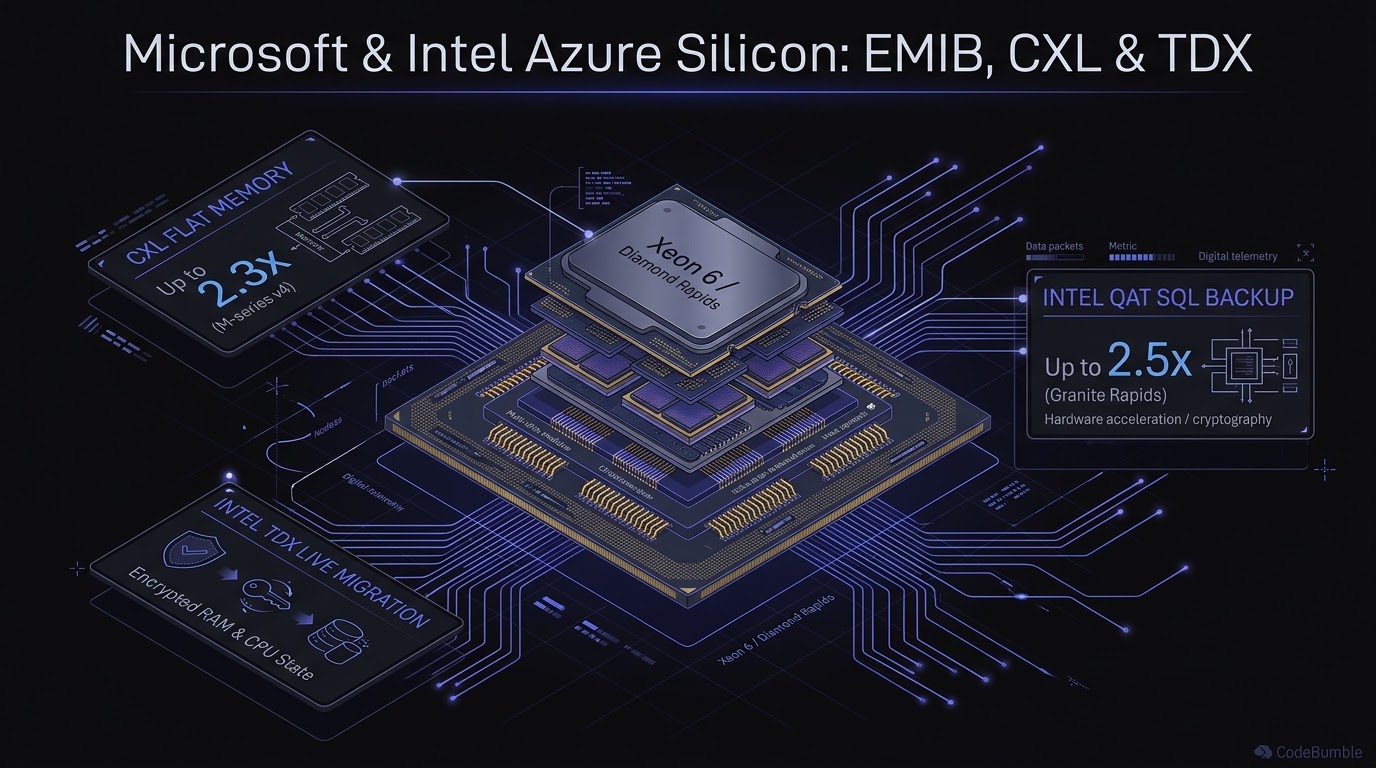
Microsoft and Intel announced a multi-year Azure infrastructure expansion on November 18, 2026, spanning Intel Foundry EMIB packaging for Azure first-party silicon, next-generation Diamond Rapids Xeon supply, CXL memory with Intel Flat Memory Mode (up to 2.3x throughput in vendor testing), Intel QAT-accelerated SQL backups (up to 2.5x faster), and Intel TDX confidential VM live migration. This analysis breaks down the architecture, benchmark caveats, and defensive verification steps.
10 min read
Microsoft and Intel Expand Azure Silicon with EMIB, Diamond Rapids, CXL Flat Memory Mode, QAT, and TDX Live Migration
Executive Summary
On November 18, 2026, Microsoft and Intel announced an expanded, multi-year silicon and cloud infrastructure collaboration spanning custom foundry packaging, next-generation server CPUs, tiered memory, cryptographic/compression offload, and confidential computing. According to primary releases from Microsoft Source and Intel Newsroom, Microsoft is the first company to announce adopting Intel Foundry's EMIB (Embedded Multi-die Interconnect Bridge) advanced packaging technology for Azure first-party silicon, alongside a multi-year supply commitment for Intel Xeon processors that includes future Diamond Rapids instances.
At the virtual machine and workload tier, the collaboration highlights three concrete infrastructure capabilities: Compute Express Link (CXL) memory paired with Intel Flat Memory Mode on Xeon 6-based Azure M-series v4 VMs (reported at up to 2.3x higher performance and memory flexibility), the first cloud VMs with Intel QuickAssist Technology (QAT) acceleration for SQL backups (reported at up to 2.5x faster throughput), and Intel Trust Domain Extensions (Intel TDX) confidential VM live migration.
Confidence Assessment:
- High Confidence: The five architectural pillars, executive statements, and specific benchmark hardware/software configurations are directly documented in primary announcements from Microsoft and Intel published November 18, 2026.
- Medium-Low Confidence (Operational Specifics): General availability dates, regional rollout schedules, pricing, and full VM SKU matrices were not disclosed in the announcements. Furthermore, independent analysis from WindowsForum highlights that both headline performance claims (
2.3xand2.5x) compare asymmetric hardware configurations rather than isolated single-feature deltas.
Technical Mechanics & Architecture
1. Intel Foundry EMIB for Azure First-Party Silicon
Microsoft confirmed it will use Intel Foundry's EMIB advanced 2.5D packaging technology for future Azure first-party silicon. Unlike full-interposer silicon designs that require a large, expensive passive silicon interposer beneath all chiplets, EMIB embeds small, high-density silicon bridges directly inside the organic package substrate only where die-to-die interconnects are needed.
For hyperscale cloud silicon—such as custom AI accelerators, DPUs, or specialized compute tiles—EMIB reduces interposer reticle-size constraints while preserving high-bandwidth, low-power die-to-die routing. Naga Chandrasekaran, EVP, Chief Technology and Operations Officer, and General Manager of Intel Foundry, noted that the partnership validates Intel Foundry's advanced packaging capabilities at hyperscale.
2. Multi-Year Xeon Supply and Diamond Rapids
The agreement secures multi-year Intel Xeon supply capacity for Azure data centers, explicitly covering upcoming instances powered by Intel's next-generation server processor codenamed Diamond Rapids. While neither Microsoft nor Intel disclosed core counts, TDP envelopes, or SKU launch dates for Diamond Rapids in the November 18 announcements, WindowsForum's reporting notes an important architectural shift for security teams: Diamond Rapids is expected to represent the final Xeon generation supporting Intel SGX (Software Guard Extensions) as Intel consolidates confidential computing around VM-level isolation with Intel TDX.
3. CXL Memory Expansion and Intel Flat Memory Mode
Azure M-series v4 VMs built on Intel Xeon 6 processors pair local DDR5 DRAM with CXL-attached memory managed through Intel Flat Memory Mode. Rather than forcing applications or guest operating systems to manually pin allocations across separate NUMA nodes (one fast DRAM node, one slower CXL node), Intel Flat Memory Mode presents the combined capacity as a single flat address space at the hardware/platform layer, dynamically migrating hot pages into DRAM and colder pages into CXL memory.
This model targets memory-bound cloud workloads—such as in-memory databases, large-scale data analytics, and AI agent sandboxes—where capacity-per-vCPU bottlenecks otherwise force operators to overprovision expensive, DRAM-only VM sizes.
4. Intel QAT Offload for SQL Server Backups
Azure is introducing its first cloud VMs with Intel QuickAssist Technology (QAT) enabled for SQL backup acceleration. QAT offloads bulk compression and cryptographic operations from general-purpose CPU cores onto dedicated hardware accelerators integrated into the Xeon platform. In database maintenance windows, backup compression typically competes with query execution for CPU cycles; offloading compression to QAT frees host cores while accelerating backup stream throughput.
5. Intel TDX Confidential VM Live Migration
Confidential VMs isolate guest memory and CPU state from the cloud hypervisor and host OS using hardware-rooted encryption. Historically, migrating a confidential VM between physical hosts without breaking memory confidentiality or requiring a cold reboot has been operationally complex. With Intel TDX live migration, Azure encrypts both guest VM memory pages and CPU register state in transit between source and destination hosts, enabling routine host maintenance, kernel patching, and hardware rebalancing without terminating confidential workloads.
Architectural Data Flow
+-----------------------------------------------------------------------------+
|                        AZURE HARDWARE & SILICON LAYER                       |
|                                                                             |
|  [ Azure First-Party Silicon ]       [ Intel Xeon 6 / Diamond Rapids Host ] |
|  +---------------------------+       +------------------------------------+ |
|  | Die A |== EMIB ==| Die B  |       | Cores + Intel TDX Crypto Engine    | |
|  +---------------------------+       | Intel QAT (Compression / Crypto)   | |
|                                      +-----------------+------------------+ |
|                                                        |                    |
|                                      +-----------------v------------------+ |
|                                      |     Intel Flat Memory Mode         | |
|                                      |  [Local DRAM] <---> [CXL Memory]   | |
|                                      +------------------------------------+ |
+-----------------------------------------------------------------------------+
                                                         |
                                                         v
+-----------------------------------------------------------------------------+
|                      GUEST VM & WORKLOAD EXECUTION LAYER                    |
|                                                                             |
|  [ M-series v4 VM ]            [ SQL Server 2025 ]     [ Confidential VM ]  |
|  Flat 1.76 TB Address Space    QAT Backup Offload      TDX Live Migration   |
|  (e.g., cube-hypervisor)       (Offloaded Compression) (Encrypted State)    |
+-----------------------------------------------------------------------------+
Defensive Hardware & Platform Inspection Commands
When evaluating or auditing newly provisioned Azure Linux VMs for CXL tiering, QAT device availability, and Intel TDX attestation readiness, systems engineers should use read-only kernel and sysfs inspection commands before deploying production workloads:
# 1. Verify CPU topology, NUMA layout, and virtualization/TDX flags
lscpu | grep -E "Model name|CPU\(s\)|NUMA|Flags"
sudo dmesg | grep -iE "tdx|cxl|qat|flat"

# 2. Inspect CXL bus devices and NUMA memory tiers (read-only)
ls -la /sys/bus/cxl/devices/ 2>/dev/null || echo "No CXL sysfs bus exposed to guest"
numactl --hardware

# 3. Check for Intel QAT PCIe devices exposed to the VM (Vendor ID 8086)
lspci -nn -d 8086: | grep -iE "qat|quickassist|4940|4942|4944"

# 4. Verify Intel TDX guest device node presence for attestation
ls -l /dev/tdx_guest /dev/tdx-guest 2>/dev/null || echo "TDX guest device not present"
If dmesg or /dev/tdx_guest is absent on a confidential VM SKU, verify that the guest kernel version and Azure VM generation (Gen2) match Microsoft's TDX guest image requirements before relying on hardware-rooted attestation.
Evidence & Benchmark Analysis
Both primary announcements cite impressive top-line multipliers (2.3x for CXL + Flat Memory Mode and 2.5x for QAT SQL backups), accompanied by detailed test footnotes. A rigorous engineering review reveals why these figures must be treated as system-level workload comparisons rather than isolated silicon microbenchmarks.
| Capability Claim | Reported Gain | Baseline Configuration | Test Configuration | Methodological Caveat |
|---|---|---|---|---|
| CXL + Intel Flat Memory Mode (Tested Nov 10, 2026) | Up to 2.3x performance & memory flexibility | Standard_M64lds_v4: 64 vCPUs, 1,007 GB DRAM-only, 2 NUMA nodes |
Standard_M76ds_2_v4: 76 vCPUs, 1,764 GB total (1 TB DRAM + 1 TB CXL), Intel Flat Memory Mode |
Compares 76 vCPUs / 1.76 TB against 64 vCPUs / 1.0 TB; higher sandbox concurrency is partly driven by raw vCPU and RAM expansion. |
| Intel QAT SQL Backups (Tested Nov 2, 2026) | Up to 2.5x faster SQL backups | 2-socket Intel Xeon Gold 8362 (128 CPUs, 1,024 GB DDR4-2933, Windows Server 2025) | Azure VM on Intel Xeon 6973P-C (Granite Rapids, 384 processors, 2.06 TB RAM, 6 NUMA nodes, Windows Server 2025 Datacenter, SQL Server 2025) | Compares a 384-processor Granite Rapids VM against a 128-CPU Ice Lake-era baseline, blending generational CPU/I/O gains with QAT offload. |
Workload Context: AI Sandbox Concurrency
In the November 10, 2026 CXL test, Microsoft evaluated a cube-hypervisor microVM sandbox workload simulating AI agent execution—specifically, each sandbox used 2 vCPUs and 24 GB of memory running a persistent Python interpreter with a 12 GB dataset, executing 9 tools across 13 steps per cycle with a 6-second think time per step (126-second total cycle). Because each sandbox requires 24 GB of memory, expanding total guest memory from 1,007 GB to 1,764 GB via CXL directly unlocks higher sandbox density per VM. However, because the test VM also had 18.75% more vCPUs (76 vs 64), teams evaluating Standard_M76ds_2_v4 should measure tail-latency (p99) degradation if working-set hot pages exceed the 1 TB DRAM tier and spill into CXL.
Executive Context
Saurabh Dighe, Corporate Vice President of Azure System and Architecture at Microsoft, emphasized that the collaboration spans silicon packaging, system architecture, and cloud infrastructure to deliver differentiated performance and security for AI and enterprise workloads. Still, as WindowsForum noted, Azure has not yet published a binding deployment calendar or a complete SKU availability matrix for Diamond Rapids or TDX live migration.
Hardening & Evaluation Playbook
Infrastructure architects and security engineers planning around Azure's upcoming Intel-backed VM tiers should execute the following six-step evaluation and hardening workflow:
- Inventory Memory-Bound and Confidential Workloads: Catalog current Azure
M-seriesDRAM-only VMs where memory capacity—not CPU utilization—forces SKU upgrades, alongside confidential workloads currently anchored on Intel SGX. - Benchmark CXL Working-Set Spillover: When testing
Standard_M76ds_2_v4or sibling CXL SKUs, run synthetic or replay workloads whose active hot set exceeds 50% of total memory (i.e., > 1 TB) to quantify Intel Flat Memory Mode page-migration latency under your actual access patterns. - Isolate QAT Offload Gains in SQL Server 2025: Compare SQL backup throughput and CPU utilization on the same Xeon 6973P-C VM with QAT hardware compression enabled versus software compression (
ZSTDorMS_XPRESS) so you separate QAT offload value from generational core-count scaling. - Enforce TDX Attestation Before Allowing Live Migration: Configure relying-party attestation policies to verify TDX
TDREPORT/ quote measurements and ensure your key-release policies (e.g., Azure Key Vault Managed HSM) explicitly permit live-migrated TDX host transitions without weakening TCB (Trusted Computing Base) minimum firmware versions. - Plan SGX-to-TDX Migration Roadmaps: Because Diamond Rapids is expected to be the final Xeon generation with SGX support, begin refactoring enclave-based SGX applications toward VM-level Intel TDX confidential containers or confidential VMs to avoid hardware lock-in.
- Establish Monitoring and Rollback Triggers: Set automated alerts for CXL PCIe Correctable/Uncorrectable errors, QAT ring-buffer stalls, and TDX live-migration duration spikes, with documented fallback procedures to standard DRAM-only M-series SKUs or cold-redeploy confidential maintenance windows.
Telemetry & Detection Checks
To monitor hardware health and confidential state transitions on Linux guests, add the following defensive checks to your observability pipeline:
# Monitor kernel ring buffer for CXL memory errors or PCIe AER events
journalctl -k --since "1 hour ago" | grep -iE "cxl|aer|pcie.*error|mce"

# Verify QAT service status and device utilization (when qatlib/adf_ctl is installed)
which adf_ctl >/dev/null 2>&1 && sudo adf_ctl status || echo "adf_ctl not installed"
For Azure Monitor / Sentinel environments, query Syslog or Perf tables to alert on unexpected NUMA/memory pressure or TDX guest driver warnings:
Syslog
| where TimeGenerated > ago(24h)
| where Facility == "kern"
| where SyslogMessage has_any ("tdx", "cxl", "qat", "Hardware Error", "AER")
| project TimeGenerated, Computer, SeverityLevel, SyslogMessage
| order by TimeGenerated desc
Frequently Asked Questions (FAQ)
1. When will Diamond Rapids VMs and TDX live migration be generally available on Azure?
Neither Microsoft nor Intel provided specific general availability dates, regional availability, or full VM SKU lists in their November 18, 2026 announcements. Teams should treat these capabilities as staged roadmap items until Azure publishes formal region-by-region SKU documentation.
2. Does Intel Flat Memory Mode require guest OS or application code changes?
No application code changes are required. Intel Flat Memory Mode presents local DRAM and CXL memory as a single flat address space managed below the guest OS, though workloads with poor spatial locality that exceed the local DRAM tier may still observe higher memory access latency.
3. Why are the 2.3x CXL and 2.5x QAT benchmark figures caveated?
In both vendor-disclosed tests, the baseline and test environments differed in more than one variable. The CXL test compared a 76-vCPU, 1.76 TB VM against a 64-vCPU, 1.0 TB VM, while the QAT SQL backup test compared a 384-processor Granite Rapids VM against a 128-CPU Xeon Gold 8362 baseline.
4. What does Microsoft adopting Intel Foundry EMIB mean for Azure customers?
EMIB is a chiplet packaging technology used by Intel Foundry to build Microsoft's Azure first-party silicon. Customers will not configure EMIB directly, but it underpins Microsoft's roadmap for denser, custom Azure infrastructure silicon.
5. Should organizations still build new workloads on Intel SGX?
If you are starting a greenfield confidential computing project, Intel TDX confidential VMs are the strategic path forward. With Diamond Rapids expected to be the last Xeon platform supporting SGX, new deployments should favor VM-level TDX isolation unless an existing enclave dependency strictly requires SGX.
Sources
- Microsoft Source (Primary): Microsoft and Intel deepen collaboration to deliver differentiated Azure infrastructure — Published November 18, 2026.
- Intel Newsroom (Primary): Microsoft and Intel Deepen Collaboration to Deliver Differentiated Azure Infrastructure — Published November 18, 2026.
- WindowsForum (Secondary Technical Analysis): Microsoft-Intel Azure Deal: CXL Memory, QAT SQL Backups, TDX Confidential VMs, and Diamond Rapids — Published November 18, 2026.