

Device
NVIDIA RTX PRO 6000 Blackwell (SM120): NVFP4 Register Recycling, Sustained Benchmarks & Thermal Limits
NVIDIA's November 25, 2026 SM120 register-recycling optimization cuts NVFP4 attention kernel latency by up to 1.64x on the RTX PRO 6000 Blackwell, while independent Hugging Face tests hit 190.6 tok/s. Here is how its 96 GB GDDR7 bandwidth, 600 W thermal envelope, and SM120 pipeline compare.
9 min read
NVIDIA RTX PRO 6000 Blackwell (SM120): NVFP4 Register Recycling, Sustained Benchmarks & Thermal Limits
Executive Summary
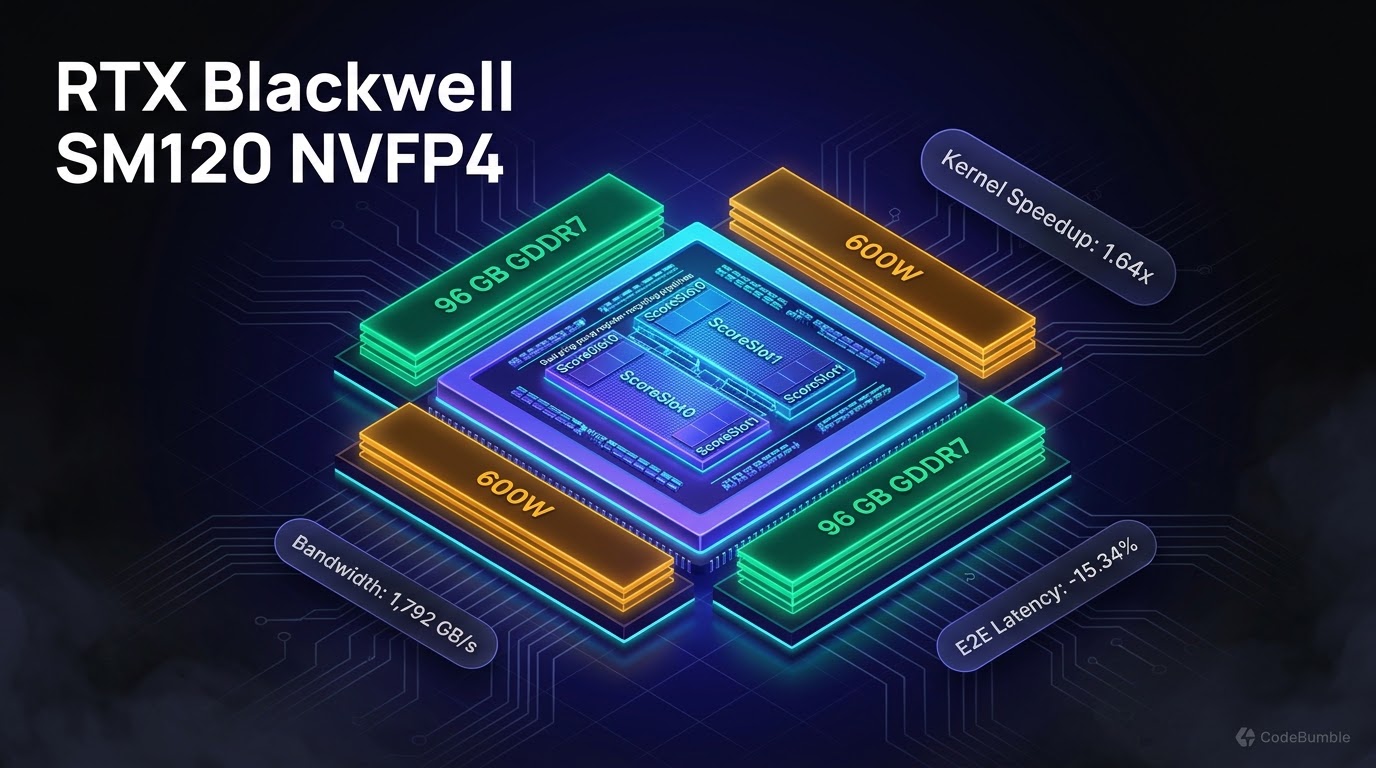
On November 25, 2026, NVIDIA published an architectural deep dive detailing how register recycling in the SageAttention3 kernel unlocks up to 1.64x faster 4-bit (NVFP4) attention on the NVIDIA RTX PRO 6000 Blackwell (SM120), cutting end-to-end inference latency by up to 15.34% in production world-model serving (NVIDIA Technical Blog). On the same day, Hugging Face published independent single-card benchmarks on an RTX PRO 6000 96 GB ($2.75/hour on Hugging Face Inference Endpoints), pushing mixed NVFP4/MXFP8 Mixture-of-Experts decoding from 136 tok/s to 190.6 tok/s—roughly 95% of the card's measured memory-bandwidth ceiling (Hugging Face).
- The Silicon Reality: Unlike data-center Blackwell GPUs (
SM100B200/GB300), workstation and server RTX Blackwell (SM120) GPUs have lower BF16 matrix-multiply throughput and use synchronous MMA instructions (mma.sync.aligned), making BF16 attention compute-bound rather than softmax-bound (NVIDIA Technical Blog). - The Bandwidth & Power Envelope: The RTX PRO 6000 Blackwell pairs 96 GB of ECC GDDR7 on a 512-bit bus (
1,792 GB/stheoretical,1,469 GB/smeasured copy) with 4,000 AI TOPS (theoretical FP4 with sparsity) inside a 600 W Workstation/Server or 300 W Max-Q thermal envelope (NVIDIA; PNY). - Primary Takeaway: Theoretical
4,000 TOPSpeak numbers only translate to real speedups when kernels respectSM120's tight 95.3% register-file budget and1,469 GB/sGDDR7 bandwidth wall. TheSM120NVFP4 optimization is already merged into the FlashInfer main branch for production deployment.
Silicon & Hardware Architecture
Built on TSMC's 4N NVIDIA Custom Process with 92.2 billion transistors across a 750 mm² die, the RTX PRO 6000 Blackwell (SM120) brings 5th-generation Tensor Cores with native hardware FP4 matrix multiplication to PCIe 5.0 workstations and servers (PNY; NVIDIA).
| Specification | RTX PRO 6000 Workstation Edition | RTX PRO 6000 Server Edition | RTX PRO 6000 Max-Q Workstation |
|---|---|---|---|
| Architecture & Process | NVIDIA Blackwell (SM120), TSMC 4N (92.2B transistors, 750 mm²) |
NVIDIA Blackwell (SM120) |
NVIDIA Blackwell (SM120) |
| CUDA / Tensor / RT Cores | 24,064 CUDA / 752 5th-Gen Tensor / 188 4th-Gen RT |
24,064 CUDA / 752 Tensor / 188 RT |
24,064 CUDA / 752 Tensor / 188 RT |
| Peak FP32 / AI TOPS (FP4 Sparse) | 125 TFLOPS FP32 / 4,000 AI TOPS |
120 TFLOPS FP32 |
110 TFLOPS FP32 / 3,511 AI TOPS |
| Memory & Bandwidth | 96 GB GDDR7 w/ ECC (512-bit, 1,792 GB/s) |
96 GB GDDR7 w/ ECC |
96 GB GDDR7 w/ ECC (512-bit, 1,792 GB/s) |
| Max Power & Cooling | 600 W (Double-Flow-Through) |
400–600 W configurable |
300 W (Active, 4.4" × 10.5") |
| MIG Partitioning & I/O | Up to 4× 24 GB, 2× 48 GB, 1× 96 GB; PCIe 5.0 x16, 4× DP 2.1b |
Multi-GPU server chassis | Up to 4× 24 GB, 2× 48 GB, 1× 96 GB; PCIe 5.0 x16 |
Note: NVIDIA's product page lists 4,000 AI TOPS as peak theoretical FP4 performance using sparsity at GPU Boost Clock (NVIDIA). In independent non-sparse probing on Hugging Face Jobs, a single RTX PRO 6000 Server/Inference card measured 416 TFLOPS BF16, 792 TFLOPS FP8, and 1,469 GB/s sustained memory copy bandwidth (Hugging Face).
Why SM120 Breaks SM100 Attention Pipelines (And How Register Recycling Fixes It)
On data-center Hopper and Blackwell (SM100) GPUs, FlashAttention-3 and FlashAttention-4 overlap Tensor Core matrix multiply-accumulate (MMA) instructions with softmax inside a thread block. However, SM120 (RTX Blackwell) uses a different Tensor Core execution model (NVIDIA Technical Blog):
- Synchronous MMA Stalls:
SM120TMA loads are bound to128×128shapes, while its PTX NVFP4 instruction (mma.sync.aligned.kind::mxf4nvf4.block_scale.scale_vec::4X.m16n8k64) is constrained tom16n8k64. Coveringk=128requires issuing two sequentialk=64synchronous MMA instructions, leaving Tensor Cores idle while the 8 consumer warps compute online softmax, two-level scaling, and NVFP4 quantization. - 95.3% Register File Saturation: In the baseline SageAttention3 cooperative thread array (CTA), 4 producer warps consume
3,072registers and 8 consumer warps consume59,392registers—62,464 registers total, or 95.3% of the SM's register capacity—making it impossible to allocate a second fullN128score buffer for double-buffering. - N64/N64 Cross-Block Ping-Pong: NVIDIA's optimization splits each
N128score tile into twoN64register slots (ScoreSlot0for columns[0:64]andScoreSlot1for[64:128]). Online softmax state (OnlineMax,OnlineSum) is still updated across the fullN128tile, but as soon asScoreSlot0is exponentiated and quantized into packed NVFP4 probabilities, its registers are dead and immediately overwritten with the next tile'sQKcomputation—interleaving adjacent tiles with zero extra register allocation.
flowchart LR
    P["4 Producer Warps<br/>(3,072 Regs · 3-Stage Async TMA K/V)"] --> S0["ScoreSlot0 [0:64]<br/>QK OMMA (Tile N)"]
    P --> S1["ScoreSlot1 [64:128]<br/>QK OMMA (Tile N)"]
    S0 --> SM["Joint N128 Online Softmax<br/>(OnlineMax & OnlineSum)"]
    S1 --> SM
    SM --> Q0["Exponentiate & NVFP4 Quantize<br/>(Probability0)"]
    Q0 -->|Recycle Dead Regs| N0["ScoreSlot0 = QK OMMA (Tile N+1)"]
    Q0 --> PV0["Execute PV OMMA (Tile N, [0:64])"]
Real-World Performance, Thermals & Efficiency
NVFP4 Kernel & World-Model Benchmarks (NVIDIA + Reactor)
Evaluated by Reactor on an NVIDIA RTX PRO 6000 Blackwell Server Edition (96 GB, SM120) at batch size 1, 24 heads, and head dimension 128, the register-recycling schedule improved core NVFP4 attention kernel latency across every tested sequence length (NVIDIA Technical Blog):
| Workload / Mask (Sequence Length) | Original NVFP4 (ms) | Optimized NVFP4 (ms) | Kernel Speedup |
|---|---|---|---|
LongLive (7,040 / noncausal) |
0.75052 |
0.63548 |
1.18x |
LongLive (7,040 / causal) |
0.44992 |
0.37927 |
1.19x |
Synthetic (4,096 / causal) |
0.21199 |
0.16087 |
1.32x |
Synthetic (8,192 / noncausal) |
1.00177 |
0.85648 |
1.17x |
Synthetic (8,192 / causal) |
0.76466 |
0.46659 |
1.64x |
Synthetic (16,384 / causal) |
2.20630 |
1.78152 |
1.24x |
When integrated into Reactor's production serving stack (where BF16 baselines used native cuDNN attention and timings included quantization, layout conversion, and decoded CPU frames), end-to-end latency dropped across all four production world models:
- OmniDreams (moving, 2,045 frames / 256 chunks):
155.92 s(BF16) →132.00 s(NVFP4), a 15.34% end-to-end latency reduction (8 framesdropped from0.60 sto0.51 s,-14.95%). - LongLive (32 frames,
704×1280):5.13 s→4.79 s(6.70% reduction; 1,021-frame long run dropped162.52 s→151.89 s, 6.54%). - Helios (1,056 frames, largest self-attention calls):
190.88 s→187.48 s(1.78% reduction). - Cosmos 3 Nano Policy Droid (32×8 action prediction):
1.72 s→1.69 s(1.70% reduction).
Single-Card MoE Decode & Memory Bandwidth Ceiling (Hugging Face)
Independent testing by Hugging Face on November 25, 2026 benchmarked Inkling 2 Mini (~26B total parameters, 3B active per token, shipped in mixed NVFP4 + MXFP8 with a bundled DSpark drafter) on a single 96 GB RTX PRO 6000 (Hugging Face):
- Throughput Gains: Across 46 runs, switching from SGLang baseline (
134–139 tok/s) to vLLM nightly + DSpark (7 drafts, probabilistic sampling) raised single-user decode to 190.6 tok/s (+40%), 8-user aggregate throughput from~570 tok/sto 716 tok/s (+26%), and 4K/32K prefill to 20.7K / 20.6K tok/s with40 msTTFT (194.9 tok/sand198 msTTFT over the internet endpoint). - Bandwidth Saturation: Because Inkling 2 Mini's 48-layer traversal reads
5.6 GBper plain decode step,1,469 GB/scopy bandwidth sets a theoretical single-user ceiling of~256 tok/s; with DSpark verifying 8 positions (40%of routed experts per layer at~2.3accepted tokens/step), the hardware ceiling drops to~201 tok/s. At 190.6 tok/s, the RTX PRO 6000 hits ~95% of its memory-bandwidth limit, proving that further software flags cannot bypass GDDR7 bandwidth without higher drafter acceptance.
Power, Thermals & Acoustic Trade-Offs
Sustaining 416–792 TFLOPS demands careful chassis airflow planning:
- The Workstation Edition draws up to 600 W over a single PCIe CEM5 16-pin connector in an extended-height dual-slot form factor (
5.4" H × 12.0" L,1.950 kg) using a Double-Flow-Through cooler (PNY; NVIDIA). - Teams packing multiple cards into standard
4.4" × 10.5"workstation slots must step down to the 300 W Max-Q Edition, which trades12%of peak AI TOPS (3,511vs.4,000 TOPS) and12%of FP32 (110vs.125 TFLOPS) to halve board power while retaining the full 96 GB GDDR7 ECC pool and1,792 GB/sbus (NVIDIA Max-Q Datasheet).
Ecosystem, Repairability & Practical Verdict
- Software & Kernel Readiness: While the
SM120NVFP4 register-recycling kernel is merged into FlashInfer, Hugging Face noted that upstream serving recipes often targetSM100(B200/GB300) first—requiring nightly builds (vLLM 0.34.0rc1) and explicit flags like--max-model-len 262144and--gpu-memory-utilization 0.85to prevent the KV cache from OOMing a 5 GiB speculative drafter on 96 GB VRAM (Hugging Face). - Multi-Tenant Isolation & Lock-In: Native MIG support (
4× 24 GBor2× 48 GB) lets teams partition a single 96 GB card into hardware-isolated QoS instances, and96 GBECC GDDR7 fits 26B–70B quantized models on one PCIe slot without NVLink fabric lock-in. However,SM120NVFP4 kernels depend on NVIDIA's proprietary PTX (mma.sync.aligned.kind::mxf4nvf4) and CUDA 12.8+ toolchain. - Who Should Deploy or Skip:
- Deploy the
600 WWorkstation/Server card if you run local world models, 70B-class quantized LLMs, or long-context MoE inference on a single node ($2.75/hourcloud parity) and can accommodate600 WDouble-Flow-Through cooling. - Choose the
300 WMax-Q for dense multi-GPU workstation towers where chassis airflow or PSU headroom cannot sustain multiple600 W16-pin rails. - Skip if your workload is strictly unquantized BF16 multi-user batching that exceeds
1,792 GB/sGDDR7 bandwidth and requires HBM3e (SM100B200/GB300) memory speeds.
- Deploy the
Frequently Asked Questions
Why is NVIDIA RTX PRO 6000 Blackwell (SM120) different from B200 (SM100) for attention kernels?
SM120 uses synchronous NVFP4 MMA instructions (mma.sync.aligned) and has lower BF16 matmul throughput relative to data-center SM100 GPUs, meaning BF16 attention on RTX Blackwell is MMA-bound and cannot directly reuse FlashAttention-3/4 SM100 asynchronous pipelines (NVIDIA Technical Blog).
How much real-world speedup does NVFP4 register recycling deliver on RTX PRO 6000?
In Reactor's benchmarks on an RTX PRO 6000 Blackwell Server Edition, the optimized SageAttention3 kernel achieved 1.17x to 1.64x kernel speedups (peaking at 8,192 causal tokens) and up to 15.34% end-to-end latency reduction on OmniDreams world-model inference (NVIDIA Technical Blog).
What is the real-world memory bandwidth and token speed of an RTX PRO 6000 96 GB?
While theoretical GDDR7 bandwidth is 1,792 GB/s, Hugging Face measured 1,469 GB/s sustained copy bandwidth (416 TFLOPS BF16, 792 TFLOPS FP8) and reached 190.6 tok/s single-user decode (~95% of bandwidth ceiling) on Inkling 2 Mini (NVFP4/MXFP8) using vLLM nightly + DSpark (Hugging Face).
What is the power difference between the RTX PRO 6000 Workstation and Max-Q editions?
The Workstation Edition draws up to 600 W (4,000 AI TOPS, 125 TFLOPS FP32, 5.4" × 12.0" Double-Flow-Through), whereas the Max-Q Workstation Edition is capped at 300 W (3,511 AI TOPS, 110 TFLOPS FP32, 4.4" × 10.5") while keeping all 96 GB GDDR7 ECC and 1,792 GB/s bandwidth (NVIDIA; PNY).
Where can developers get the optimized SM120 NVFP4 attention kernel?
NVIDIA confirmed the SM120 register-recycling optimization has been merged into the FlashInfer main branch for source installation and integration into attention layers on RTX Blackwell GPUs (NVIDIA Technical Blog).
Sources
- NVIDIA Technical Blog — How to Optimize NVFP4 Attention on NVIDIA RTX Blackwell Through Register Recycling (Atharva Joshi, published November 25, 2026): https://developer.nvidia.com/blog/how-to-optimize-nvfp4-attention-on-nvidia-rtx-blackwell-through-register-recycling/
- Hugging Face Blog — Hill-climbing Inkling 2 Mini inference on one RTX PRO 6000 (Niels Rogge, published November 25, 2026): https://huggingface.co/blog/inkling-2-mini-inference-hillclimb
- NVIDIA Official Product Page — NVIDIA RTX PRO 6000 Blackwell Workstation Edition (Verified November 26, 2026): https://www.nvidia.com/en-us/products/workstations/professional-desktop-gpus/rtx-pro-6000/
- PNY Official Spec Sheet — NVIDIA RTX PRO 6000 Blackwell Workstation Edition (Verified November 26, 2026): https://www.pny.com/nvidia-rtx-pro-6000-blackwell-ws