

Security
How Ethereum's PQAI Architecture and Keccak-256 Harden Consensus, Accounts, and Blobs for Post-Quantum Security
On November 23–24, 2026, the Ethereum Foundation published PQAI #0 and PQAI #1, prioritizing a protocol-wide shift from elliptic curves to hash-based cryptography anchored on Keccak-256. Here is how the Keccak-f[1600] trust model, leanVM proving targets, and node-level trade-offs stack up.
8 min read
How Ethereum's PQAI Architecture and Keccak-256 Harden Consensus, Accounts, and Blobs for Post-Quantum Security
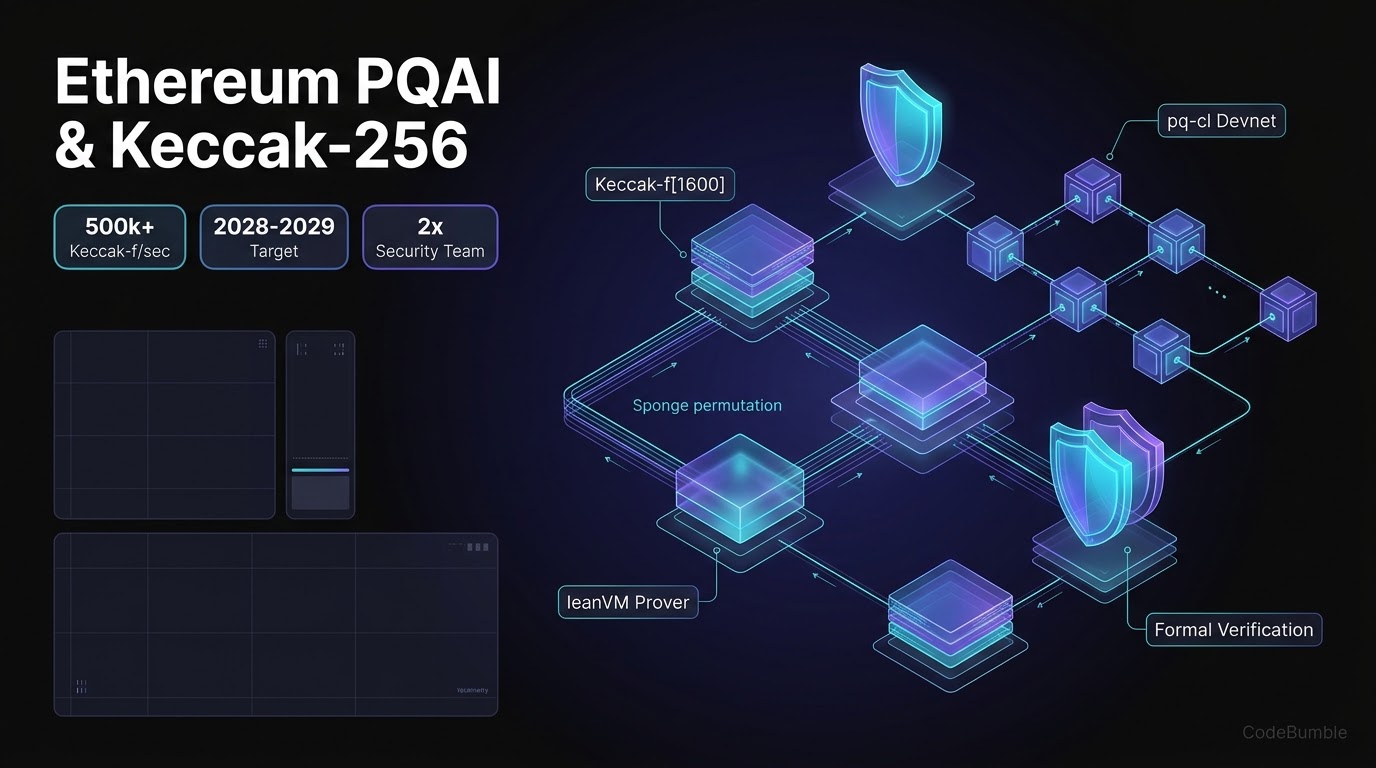
Executive Summary
On November 23 and November 24, 2026, the Ethereum Foundation published PQAI #0 and PQAI #1, elevating post-quantum and post-AI cryptographic hardening to the protocol's top engineering priority. The core defensive capability replaces quantum-vulnerable elliptic-curve primitives (ECDSA, BLS signatures, and KZG pairings) across consensus, user accounts, and blob data commitments with hash-based cryptography standardized on the Keccak-f[1600] permutation family (Keccak-256, Keccak-duplex, and SHAKE256).
The primary architectural trade-off is deliberate: Keccak-256 is slower to prove inside zero-knowledge virtual machines than BLAKE3 and slower natively than SHA2-256, and hash-based signatures carry significantly larger byte footprints than BLS signatures—requiring node hardware monitoring and feature deferrals (such as withdrawing Ethlabs' Quick Slots proposal from Hegotá) in exchange for nearly two decades of unbroken cryptanalysis and zero new hardness assumptions (PQAI #0; PQAI #1).
Trust Model and Architecture
In PQAI #0, Ethereum Foundation researcher Kev Wedderburn frames the threat model around two converging pressures: long-term quantum computers (Shor's algorithm breaking elliptic-curve discrete logarithms) and near-term AI-assisted cryptanalysis and bug discovery. Because AI models are already discovering vulnerabilities in production codebases faster than human review—and beginning to improve decades-old mathematical algorithms—the Foundation argues that protocol security should rest on the most conservative cryptographic assumptions, backed by formal verification against a specification and a doubled protocol security team.
Once Ethereum transitions to hash-based signatures and commitments, the entire protocol's security reduces to the underlying hash function. The architecture spans three protocol layers and three execution environments:
- Consensus Layer (CL): Validators sign attestations and blocks using hash-based keys instead of BLS elliptic-curve signatures, eliminating elliptic-curve dependence for finality. In the long term, PQAI #1 recommends migrating SSZ Merkleization from
SHA2-256toKeccak-256. - User Accounts (Execution Layer): Wallets and smart contracts adopt hash-based signature verification and key-registry migrations, reusing the existing
KECCAK256opcode without adding a third general-purpose hash to execution clients. - Data Availability (Blobs): Elliptic-curve-pairing KZG commitments are replaced with hash-based commitments.
flowchart TD
    A[User Wallets & Accounts] -->|Keccak-256 Signatures| E[Execution Layer EVM]
    V[Consensus Validators] -->|Hash-Based Keys| L[leanVM zkVM Prover]
    L -->|">= 500K Keccak-f/s"| C[Consensus Layer Finality]
    D[Rollup Blob Data] -->|Hash-Based Commitments| C
    S[Keccak-f 1600 Permutation] --> K1[Keccak-256 Hashing]
    S --> K2[Keccak-duplex Fiat-Shamir]
    S --> K3[SHAKE256 PRBG & Key Derivation]
    K1 --> E
    K2 --> L
    K3 --> V
Why Sponge Mode (Keccak-f[1600]) Matters for Trust Boundaries
Hash-based signature schemes and the Fiat–Shamir transforms inside recursive SNARGs model the hash function as a random oracle. As PQAI #1 explains, SHA2-256 uses a Merkle–Damgård construction, meaning length-extension properties distinguish it from a random oracle and force protocols like SLH-DSA-SHA2 to wrap calls in HMAC and MGF1.
By contrast, Keccak-256 is built on a sponge construction over Keccak-f[1600]. Research presented at QCrypt 2026 (Tokat, Alagic, Carolan, and Majenz) proved that the sponge construction is indifferentiable from a random oracle against classical adversaries—and, with a loose bound, against quantum adversaries (PQAI #1). That structural property lets Ethereum derive Keccak-256 (standard hashing), Keccak-duplex (Fiat–Shamir sponge object), and SHAKE256 (pseudorandom bit generation and key derivation) from a single audited permutation.
What Researchers and Analysts Say
In PQAI #1, Ethereum Foundation researchers (including Justin Drake, Thomas Coratger, Dmitry Khovratovich, Antonio Sanso, and Vitalik Buterin) evaluated five hash candidates across security margin, random-oracle suitability, zkVM proving throughput, and protocol integration cost:
| Candidate Hash | Round / Construction | Known Cryptanalysis Limit | Proving / Speed Notes | EF Verdict |
|---|---|---|---|---|
| Poseidon / Poseidon2 | Prime-field algebraic | Round-reduced attacks via Bariant et al. (2022), Sanso & Vitto (2025), Bak et al. (2026) | Formerly favored for prime-field SNARKs; advantage eroded by binary-field SNARKs | Rejected (cryptanalysis still maturing) |
| BLAKE3 | 7-round ARX (reduced from BLAKE2's 10) | Sparse record; no mode security proof; blockcipher distinguishers on many rounds | Fastest: ~2.2M compressions/s on 16-vCPU machine (Flock Challenge) |
Rejected (reduced rounds & sparse proofs) |
| BLAKE2 | 10-round ARX | <10 published attacks; best reaches 2.5 rounds (blake2f in EIP-152) |
Fast natively and in circuits | Rejected (less cryptanalysis than incumbents) |
| SHA2-256 | 64-round Merkle–Damgård | Practical collisions at 35/64 rounds; best theoretical at 38/64 rounds (2026) |
Fast natively (x86 SHA-NI); requires HMAC/MGF1 random-oracle patches | Retained only as legacy CL/EL until migration |
| Keccak-256 | 24-round Keccak-f[1600] sponge |
Practical collisions at 5/24 rounds; theoretical at 6/24 rounds |
>500K Keccak-f/s in leanVM on EIP-7870 hardware (~1K attestations/s) |
Recommended (largest margin, zero new EL hash) |
Key Findings, Proving Breakthroughs, and Caveats
- Binary-Field SNARKs Removed the Algebraic Hash Advantage: For years, researchers assumed post-quantum Ethereum signatures would require an algebraic hash like Poseidon because traditional hashes were too expensive to prove in SNARKs. Binary-field SNARKs (
Binius,Flock) and GKR-based provers changed that equation, enablingleanVMto prove over500,000Keccak-foperations per second on EIP-7870 hardware—enough for roughly1,000consensus-layer attestations per second (PQAI #1; Crypto.news). - AI-Assisted Cryptanalysis Has Not Broken Keccak-256: According to PQAI #1,
Keccak-256's security margin (6of24rounds in theoretical collision attacks) has so far remained unaffected by AI-assisted cryptanalysis, though the researchers note that direct attacks on the internalKeccak-fpermutation remain the primary theoretical vector to watch. - FIPS Compliance Trade-Off: Although
SHA3-256is FIPS-approved andKeccak-256is not (they shareKeccak-f[1600]and differ only in padding bits), the Foundation rejectedSHA3-256because the underlying post-quantum signature scheme is not FIPS-approved anyway, and addingSHA3-256alongsideKECCAK256would invite padding-byte integration bugs (PQAI #1). - Ecosystem & Timeline Caveats: Independent coverage from FXStreet and Kriptofoni emphasizes that neither Justin Drake's December 2028 target nor the Foundation's 2029 internal deadline is guaranteed; a formal timeline review is scheduled for January 2027. Meanwhile, ForkLog notes that larger hash-based signatures could raise hardware requirements for home node operators if aggregation budgets are not tightly controlled.
Hardening and Implementation Blueprint
While Ethereum's pq-cl devnet is still in early iteration (PQAI #0), security architects and infrastructure teams running Ethereum nodes, custody systems, or enterprise PKI can align immediately with both Ethereum's PQAI trajectory and broader post-quantum migration standards—such as NIST's IR 8547 transition guidance (published October 2026 on NIST CSRC) and Executive Order 14412 deadlines (2030 for PQC encryption, 2031 for PQC authentication, per Cloudflare).
1. Client, Wallet, and Infrastructure Readiness Controls
- Execution & Consensus Client Teams: Reuse existing
Keccak-256implementations and prepare forpq-cldevnet signature and key-registry specifications; avoid introducingSHA3-256padding variants into EVM-adjacent tooling (PQAI #1). - Wallet, Multisig, and Staking Operators: Audit smart contracts and multisig policies that hardcode
ecrecoveror BLS key assumptions, and plan user-friendly key-registry migration flows that do not expose unrotated long-lived public keys unnecessarily (PQAI #0). - Transport & Enterprise Perimeter Hardening: Enable hybrid post-quantum key establishment (such as
X25519MLKEM768per NIST FIPS 203 / IR 8547) on RPC, validator-beacon, and custody APIs today to mitigate "harvest now, decrypt later" collection (IT Security Guru).
Below is a safe, declarative policy configuration snippet (illustrative Open Policy Agent / Rego guardrail for CI/CD cryptographic inventory checks) that enforces conservative hash and TLS policies in line with PQAI and NIST IR 8547 crypto-agility rules:
package security.crypto_agility

# Deny legacy/weak hash primitives in new protocol or custody configs
deny[msg] {
  input.hash_algorithm == "poseidon2"
  msg := "Poseidon/Poseidon2 disallowed for new long-term commitments per EF PQAI #1 guidance"
}

deny[msg] {
  input.tls_kex == "ECDHE_ONLY"
  msg := "Require hybrid PQC key exchange (e.g., X25519MLKEM768) for external custody/RPC endpoints"
}
2. Operational Overhead and Complexity Trade-Offs
- Signature Size & Bandwidth: Hash-based signatures are substantially larger than 48–96 byte BLS signatures, increasing peer-to-peer gossip bandwidth and disk I/O unless recursive aggregation in
leanVMcompresses committee attestations before block inclusion (PQAI #0; PQAI #1). - Hardware Baseline:
leanVM's500K Keccak-f/starget is benchmarked against EIP-7870 equivalent hardware, meaning operators running under-provisioned home validators should track devnet memory and CPU profiles closely throughout 2027 (PQAI #1). - Formal Verification Bottleneck: Accelerating protocol delivery risks shipping consensus or signature-verification bugs; Ethereum's decision to double its protocol security team reflects the reality that formal verification—not just differential fuzzing—must gate every fork (PQAI #0).
Frequently Asked Questions
Why did the Ethereum Foundation choose Keccak-256 over Poseidon or BLAKE3?
Binary-field SNARKs (Binius, Flock) and GKR provers eliminated the proving-speed advantage that algebraic hashes like Poseidon once held. With leanVM proving over 500,000 Keccak-f operations per second on EIP-7870 hardware, researchers chose Keccak-256 for its nearly 20-year cryptanalysis track record (only 5–6 of 24 rounds reached) and because Ethereum already relies on it on the execution layer (PQAI #1).
Is Keccak-256 the same as NIST's SHA3-256?
They share the exact same Keccak-f[1600] permutation, rate, capacity, and security margin, differing only in domain-separation padding bits. The Ethereum Foundation selected Keccak-256 to avoid maintaining two nearly identical hash functions in EVM and client codebases, noting that SHA3-256 would not make the surrounding custom signature scheme FIPS-compliant anyway (PQAI #1).
Has AI already broken Ethereum's current elliptic-curve cryptography?
No. Both PQAI #0 and independent reporting (Kriptofoni) state explicitly that AI has not broken Ethereum's cryptography. The Foundation is acting proactively because AI models are already finding bugs in production codebases like the Linux kernel and advancing mathematical proof techniques.
What is the target timeline for Ethereum's post-quantum transition?
Ethereum researcher Justin Drake proposed December 2028 as a target, while the Ethereum Foundation maintains 2029 as its internal deadline, with a formal timeline review scheduled for January 2027 (PQAI #0; FXStreet).
How does Ethereum's PQC shift compare to enterprise NIST PQC timelines?
NIST finalized its IR 8547 transition report in October 2026, setting a 2035 deprecation horizon for quantum-vulnerable algorithms, while U.S. Executive Order 14412 targets 2030 for federal PQC encryption and 2031 for PQC authentication (NIST; Cloudflare). Ethereum's 2028–2029 target is more aggressive because public ledgers cannot easily rotate exposed keys retroactively.
Sources
- Ethereum Foundation Blog — PQAI #1: One hash to rule them all — Keccak-256 for Ethereum's post-quantum, post-AI era (Kev Wedderburn, published Nov 24, 2026): https://blog.ethereum.org/2026/11/24/pqai-1
- Ethereum Foundation Blog — PQAI #0: Preparing Ethereum for a post-quantum, post-AI world (Kev Wedderburn, published Nov 23, 2026): https://blog.ethereum.org/2026/11/23/pqai-0
- FXStreet — Ethereum Foundation selects Keccak-256 for post-quantum cryptography push (Published Nov 25, 2026): https://www.fxstreet.com/cryptocurrencies/news/ethereum-foundation-selects-keccak-256-for-post-quantum-cryptography-push-202611250519
- Crypto.news — Ethereum Foundation recommends Keccak-256 to secure Ethereum against quantum, AI threats (Published Nov 25, 2026): https://crypto.news/ethereum-foundation-keccak-256-post-quantum-security/
- Kriptofoni — Ethereum Foundation Unveils New Plan to Address Quantum and AI Security Threats (Mesut İnan, published Nov 24, 2026): https://www.kriptofoni.com/en/ethereum-quantum-ai-security-pqai/
- ForkLog — Ethereum Foundation Accelerates Preparations for Quantum Threats and AI Development (Published Nov 24, 2026): https://forklog.com/en/ethereum-foundation-accelerates-preparations-for-quantum-threats-and-ai-development/
- NIST — Transition to Post-Quantum Cryptography Standards (NIST IR 8547) (Published Oct 27, 2026): https://www.nist.gov/publications/transition-post-quantum-cryptography-standards
- IT Security Guru — NIST Finalises Post-Quantum Cryptography Guidance as Agencies Struggle to Prepare (Published Nov 20, 2026): https://www.itsecurityguru.org/2026/11/20/nist-finalises-post-quantum-cryptography-guidance-as-agencies-struggle-to-prepare/