

Security
What Trail of Bits Found in SimpleX Chat's 2026 Audit: Post-Quantum Ratchet, 16 Audited Areas & v7.1.4 Hardening
On November 24, 2026, SimpleX Chat published the results of a comprehensive Trail of Bits security audit spanning 16 areas—from its post-quantum double ratchet and simplexmq library to on-device secret storage. Here is what researchers found, how 49 issues were resolved in v7.1.4, and where metadata and IP trade-offs remain.
8 min read
What Trail of Bits Found in SimpleX Chat's 2026 Audit: Post-Quantum Ratchet, 16 Audited Areas & v7.1.4 Hardening
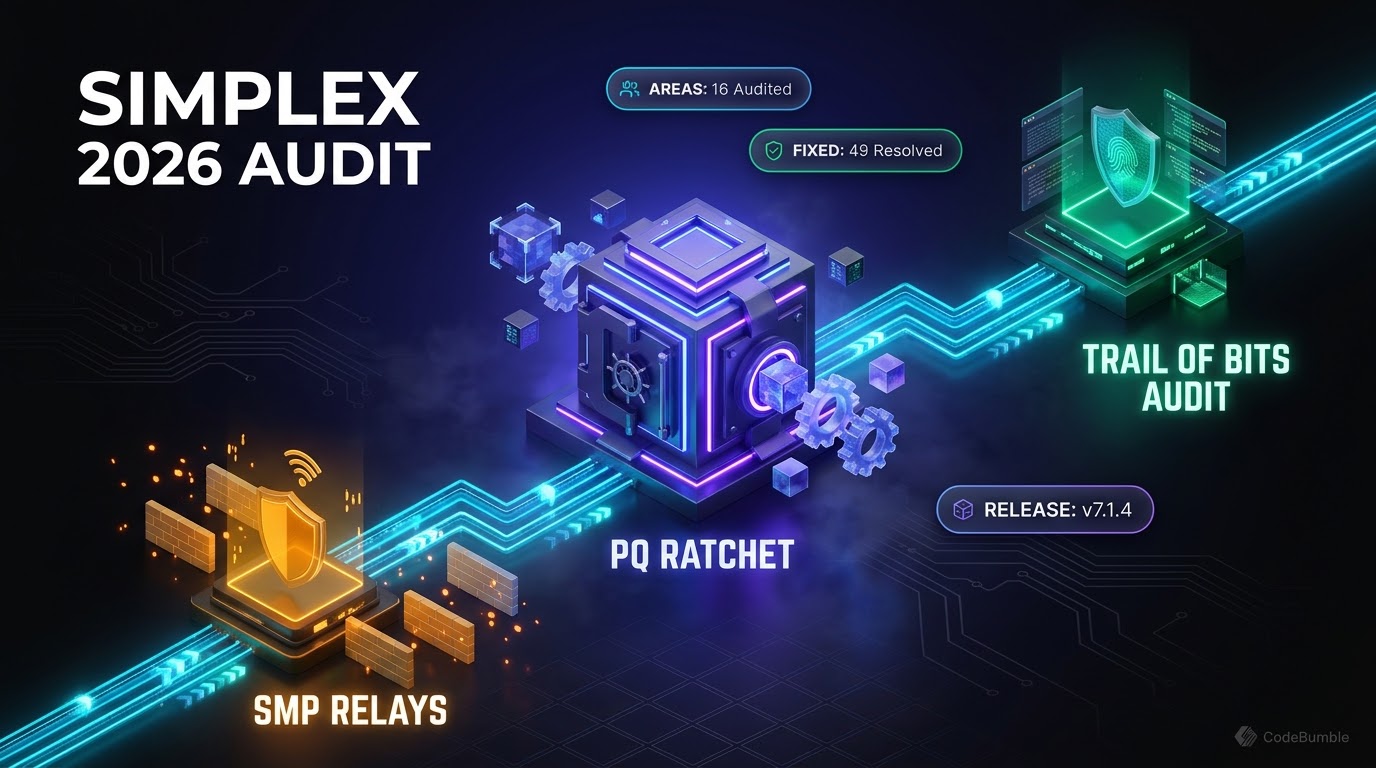
Executive Summary
On November 24, 2026, SimpleX Chat published the results of its most comprehensive third-party security audit to date, conducted by Trail of Bits across its iOS, Android, and desktop clients as well as the simplexmq library (SimpleX Chat Blog). Spanning 16 technical areas—including the post-quantum double ratchet, group and channel protocols, file transfers, audio/video calls, desktop remote access, and on-device secret storage—the engagement combined two engineer-weeks of human review with AI-assisted code analysis and formal protocol modeling (SimpleX Chat Blog).
- Remediation Status: Out of 75 tracked items reviewed after fixes, Trail of Bits marked 49 issues as resolved and 12 as partially resolved, with 14 remaining items comprising 2 issues resolved post-review in SimpleX Chat v7.1.4, intentional design decisions, security-model boundaries, or planned future work (SimpleX Chat Blog).
- Primary Defensive Capability: SimpleX eliminates global user identifiers (no phone numbers, emails, or persistent user IDs) by isolating each conversation inside unidirectional
NaClcryptobox message queues paired with a post-quantum-resistant double ratchet (ExplainX.ai; PyShine). - Primary Operational Trade-Off: Removing global identities and central social graphs shifts responsibility to endpoint device security, out-of-band key verification, and network-layer privacy—because direct connections to SimpleX Messaging Protocol (SMP) relay servers still expose a client's public IP address unless Private Message Routing or Tor is enabled (Hide.me; PyShine).
Trust Model & Architecture
Most encrypted messengers—even those using strong end-to-end encryption—rely on a centralized or federated identity directory (phone numbers, usernames, or public-key indices) that creates a metadata graph of who communicates with whom. SimpleX Chat's trust model is built around zero user identifiers: for $n$ users, the network can maintain up to $n \times (n - 1)$ independent, pairwise unidirectional message queues, each addressed by a temporary queue identifier rather than a user account (PyShine).
Four-Layer Cryptographic Isolation
SimpleX separates transport, queue routing, end-to-end message confidentiality, and server-to-recipient delivery into four distinct cryptographic layers (ExplainX.ai; PyShine):
- Transport Layer (
TLS 1.2 / 1.3): Protects client-to-relay connections in transit. - Per-Queue
NaClCryptobox (Layer 1): Each unidirectional queue uses its ownNaClcryptobox keypair. Even if identical plaintext is sent to two contacts, the resulting ciphertexts differ, preventing a relay operator from correlating traffic across conversations. - Post-Quantum Double Ratchet (Layer 2 & Layer 3): Every conversation runs a Signal-style double ratchet with a post-quantum-resistant key exchange executed on each ratchet step, providing forward secrecy and post-compromise security against both classical and future quantum adversaries (PyShine).
- Delivery-Layer
NaClCryptobox (Layer 4): An additionalNaClcryptobox encrypts messages between the SMP relay server and the recipient client, ensuring the server cannot correlate sent and received queue ciphertexts (PyShine).
flowchart LR
    A["Sender Client<br/>(Local Keys & DB)"] -->|"Layer 2/3: PQ Double Ratchet<br/>+ Layer 1: Queue NaCl Cryptobox"| B["Optional Relay Hop / Tor<br/>(Hides Sender IP)"]
    B -->|"TLS 1.2/1.3"| C["SMP Relay Server<br/>(In-Memory Queues, Zero User IDs)"]
    C -->|"Layer 4: Delivery NaCl Cryptobox<br/>+ TLS 1.2/1.3"| D["Recipient Client<br/>(Local Decryption & Verification)"]
    E["Untrusted Observer / Compromise"] -.->|"Cannot Correlate Queues<br/>or Read Plaintext"| C
Trust Boundaries & Unidirectional Queues
In this model, SMP servers act as stateless, memory-backed message pipes that do not communicate with one another and store no user accounts (PyShine). Message metadata—including server receive timestamps rounded to the nearest second—travels inside the encrypted envelope rather than in cleartext headers. However, because invitation links establish the initial key exchange over an external channel (such as SMS, email, or QR code), SimpleX relies on out-of-band security code verification (reading a short security code over a voice call) to defeat active man-in-the-middle (MitM) substitution during initial contact setup (ExplainX.ai).
What Researchers & Analysts Say
SimpleX Chat has undergone three distinct external security reviews by Trail of Bits—in October 2022, July 2024, and November 2026—providing a rare multi-year longitudinal view of how its defensive architecture matured (Trail of Bits Library; SimpleX Chat Blog).
| Audit / Review Milestone | Date | Scope & Methodology | Key Outcome / Findings Summary |
|---|---|---|---|
| Trail of Bits Implementation Audit | Oct 2022 | 1-week cryptography & simplexmq networking review |
Identified 4 issues; no major architectural flaws reported (Trail of Bits Library; Hide.me). |
| Trail of Bits Cryptographic Design Review | Jul / Oct 2024 | Protocol & cryptographic design review (v6.1) |
Zero critical findings; 3 medium-severity and 1 low-severity issues difficult to exploit in practice, addressed in v6.1 (Hide.me). |
| Trail of Bits Comprehensive Audit | Nov 2026 | 16 areas across iOS, Android, desktop & simplexmq; 2 engineer-weeks + AI-assisted analysis & formal protocol modeling |
49 resolved, 12 partially resolved, 14 remaining (including 2 resolved post-review in v7.1.4 and design/future items) (SimpleX Chat Blog). |
Key Takeaways from the 2026 Audit & Independent Analyses
- AI-Assisted Formal Modeling Expanded Coverage: SimpleX notes that Trail of Bits achieved 16-area coverage in two engineer-weeks by pairing human security engineers with frontier AI models for code analysis and formal protocol modeling (SimpleX Chat Blog). Half of the high-severity issues were patched early in SimpleX Chat v7.0.0 (July 2026), with remaining fixes landing in November 2026 (
v7.1.4). - Post-Quantum Key Exchange Verification Gap (Planned Work): Among the 14 non-resolved items, SimpleX explicitly highlights planned future work to include the parameters of the post-quantum key exchange inside the user-facing security code (SimpleX Chat Blog). Until that ships, out-of-band security code checks verify classical identity keys rather than the full post-quantum parameter set.
- Network-Layer IP Exposure Caveat: Independent security analysts at Hide.me emphasize that while SimpleX's relay servers cannot see user identities or message contents, any relay server a client connects to directly can still observe the client's public IP address unless Private Message Routing (multi-hop relay forwarding) or Tor is enabled.
- Continuous Dependency & Scanner Pipeline: Beyond periodic audits, SimpleX integrated Anthropic's OSS Scanner into its ongoing security process to surface frontier-model findings during dependency upgrades, alongside earlier remediation work under Trail of Bits' June 2026 Patch the Planet program (SimpleX Chat Blog).
Hardening & Implementation Blueprint
For security teams, privacy-sensitive organizations, and self-hosters deploying SimpleX Chat and SMP/XFTP relays, cryptographic guarantees only hold when paired with disciplined client configuration and relay isolation.
1. Client-Side Hardening Checklist (v7.1.4+)
- Enforce Minimum Client Version (
v7.1.4): Require all endpoints (iOS, Android, desktop, and CLI) to upgrade to v7.1.4 or later, and verify that external contacts also upgrade so both ends of the double ratchet benefit from the November 2026 fixes (SimpleX Chat Blog). - Enable Private Message Routing or Tor: In
Settings → Network & Servers, enable Use Tor (or keep Private Message Routing active) to prevent any single SMP relay from logging your source IP address (ExplainX.ai; Hide.me). - Verify Security Codes Out-of-Band: For high-assurance contacts, confirm the short security code over an independent voice/video channel after accepting an invitation link (ExplainX.ai).
- Use Ephemeral / Incognito Profiles: When joining public groups or untrusted channels, enable incognito mode to generate a randomized local profile per conversation (Whonix Wiki).
2. Self-Hosted SMP Relay Hardening Blueprint
Organizations hosting private SMP relay servers (smp-server) should isolate the relay behind a strict firewall, enforce TLS, and strip unnecessary metadata logging at the reverse proxy or host layer. Below is a safe systemd and firewall hardening baseline for a dedicated SMP relay host:
# /etc/systemd/system/smp-server.service.d/hardening.conf
# Defense-in-depth process isolation for a self-hosted SimpleX SMP relay
[Service]
NoNewPrivileges=yes
PrivateTmp=yes
ProtectSystem=strict
ProtectHome=yes
ReadWritePaths=/var/opt/simplex
CapabilityBoundingSet=
RestrictAddressFamilies=AF_INET AF_INET6
LockPersonality=yes
MemoryDenyWriteExecute=yes
# Minimal UFW firewall policy for a dedicated SMP relay (port 5223)
ufw default deny incoming
ufw default allow outgoing
ufw allow 5223/tcp comment 'SimpleX SMP Relay TLS'
ufw enable
Operational Overhead & Trade-Offs
- Latency vs. Anonymity: Enabling Private Message Routing or Tor adds multi-hop round-trip latency and increases battery/data usage on mobile clients, particularly during large file transfers (up to 2 GB / 5 GB with supporter badges) or WebRTC calls (SimpleX Chat Blog; Hide.me).
- Queue Scaling (
O(n²)Pairwise State): Because SimpleX avoids central account directories by creating pairwise queues, clients with hundreds of active contacts or large groups must manage more local queue state and background polling than single-socket centralized messengers (PyShine). - Device-Only Recovery: With no cloud account or phone-number recovery, losing a device without an encrypted local backup permanently severs access to existing conversation queues—making encrypted local backups mandatory for operational continuity (ExplainX.ai).
Frequently Asked Questions
What did Trail of Bits find in the November 2026 SimpleX Chat audit?
Trail of Bits audited 16 areas across SimpleX Chat's iOS, Android, and desktop apps and the simplexmq library over two engineer-weeks using AI-assisted analysis and formal protocol modeling. Following fix verification, 49 issues were marked resolved, 12 partially resolved, and 14 remained (including 2 resolved post-review in v7.1.4, design decisions, and planned future work) (SimpleX Chat Blog).
Which SimpleX Chat version includes all 2026 Trail of Bits audit fixes?
SimpleX Chat advises all users and their contacts to upgrade to v7.1.4 or later, which includes all resolved audit fixes—building on high-severity fixes that shipped earlier in v7.0.0 in July 2026 (SimpleX Chat Blog).
Does SimpleX Chat already use post-quantum encryption?
Yes. SimpleX Chat added post-quantum resistance to its Signal-style double ratchet in v5.6 / v5.7, executing a post-quantum-resistant key exchange on every ratchet step (PyShine). However, the 2026 audit notes that including the post-quantum key exchange parameters in the user-facing security code remains planned future work (SimpleX Chat Blog).
Can SimpleX relay servers see my IP address or contacts?
Relay servers cannot see your contacts, user ID, or message plaintext because SimpleX uses zero user identifiers and four encryption layers (TLS, per-queue NaCl cryptobox, post-quantum double ratchet, and delivery-layer NaCl cryptobox) (ExplainX.ai; PyShine). However, a relay server you connect to directly can see your public IP address unless you use Private Message Routing or Tor (Hide.me).
Why does SimpleX Chat mention Anthropic's OSS Scanner alongside Trail of Bits?
SimpleX Chat states that it pairs periodic third-party audits with continuous dependency reviews and Anthropic's OSS Scanner, which provides ongoing security findings from frontier AI models between formal audit cycles (SimpleX Chat Blog).
Sources
- SimpleX Chat Blog — SimpleX Chat Security Audit by Trail of Bits and Our Security Process (Published November 24, 2026): https://simplex.chat/blog/20261121-simplex-chat-security-audit-trail-of-bits-security-process.html
- Trail of Bits — SimpleX Chat Security Assessment Library (2022–2026 Archive): https://trailofbits.com/library/simplex-chat/
- ExplainX.ai — SimpleX Chat: No-Identifier Private Messenger 2026 (Updated November 2, 2026): https://explainx.ai/blog/simplex-chat-no-identifier-private-messaging-2026
- PyShine — SimpleX Chat: The Messenger With No User IDs, Running on Relay Servers (Published September 25, 2026): https://pyshine.com/SimpleX-Chat-Private-Messaging-Without-User-IDs/
- Hide.me — What is SimpleX Chat? The Private Messenger With No User ID (Published July 1, 2026): https://hide.me/en/blog/what-is-simplex-chat/