

Security
EU Quantum Act PQC Mandate: What Researchers Said About Crypto-Agility, NIS2 Procurement, and 2030 Migration
The European Commission's November 25, 2026 Quantum Act pairs NIS2 post-quantum procurement rules with QUTAC's 5-step industrial PQC blueprint. Here is what researchers and analysts say about crypto-agility, silicon roots of trust, and 2030 migration deadlines.
9 min read
EU Quantum Act PQC Mandate: What Researchers Said About Crypto-Agility, NIS2 Procurement, and 2030 Migration
Executive Summary
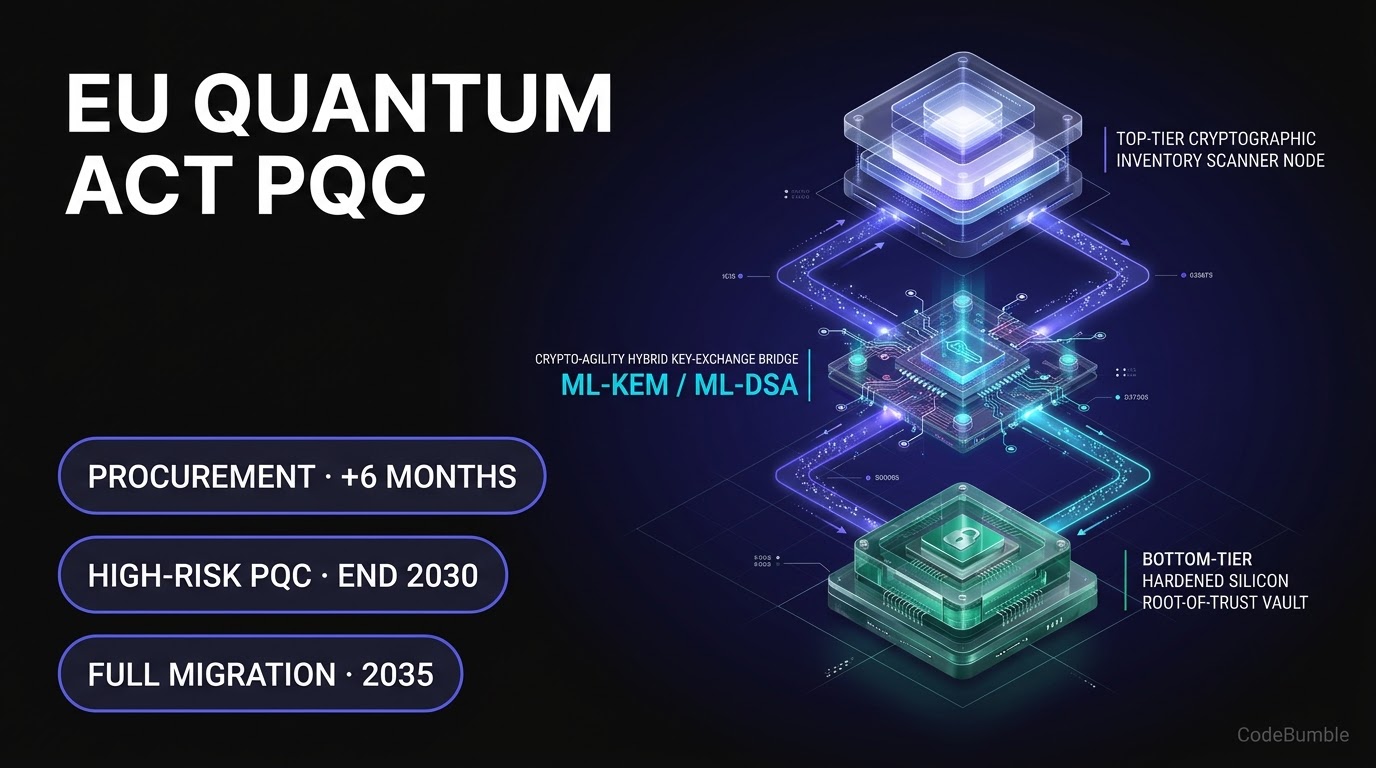
On November 25, 2026, the European Commission proposed the EU Quantum Act, pairing industrial quantum scale-up and a new Sovereign Tech Equity Fund (STEF) with binding cybersecurity preparedness for Post-Quantum Cryptography (PQC). On the same day, the Quantum Technology & Application Consortium (QUTAC) published its industrial whitepaper, Introducing Post-Quantum Cryptography (PQC) to Industrial Systems, defining a five-step migration architecture for long-lived IT and operational technology (OT) environments.
While the Quantum Act does not mandate immediate replacement of every legacy system, the European Commission's FAQ confirms that targeted digital procurement rules for public administrations under NIS2 will apply six months after the Regulation enters into force. Security researchers and legal analysts reacting on November 26, 2026 emphasized that PQC readiness is shifting from theoretical cryptography to immediate procurement compliance, cryptographic bills of materials, side-channel-resistant implementations, and silicon-level roots of trust.
Confidence in the regulatory timeline is high based on primary European Commission documentation, though exact technical specifications for NIS2 public procurement will be finalized through subsequent implementing acts and legislative review by the European Parliament and Council.
Trust Model & Architecture
The Cryptographic Threat Model
Modern public-key infrastructure—built on RSA and elliptic-curve cryptography (ECC)—protects TLS sessions, firmware signing, identity tokens, and device attestation. As detailed in the European Commission's PQC policy brief, sufficiently powerful quantum computers will break these asymmetric primitives, threatening both confidentiality and authenticity.
Because cryptographic transitions across enterprise networks and industrial control systems take years, defenders face an active Store Now, Decrypt Later threat model: adversaries capture encrypted traffic and long-lived secrets today with the intent to decrypt them once cryptographically relevant quantum computers mature. To counter this without requiring quantum hardware on the defender's side, PQC runs on conventional processors using mathematical problems—such as module lattices and stateless hashes—standardized by NIST in FIPS 203 (ML-KEM), FIPS 204 (ML-DSA), and FIPS 205 (SLH-DSA).
Architectural Flow & Trust Boundaries
The EU Quantum Act connects three operational layers into a unified defensive architecture:
- Governance & Standards Layer: The Quantum Europe Framework Initiative coordinates national and EU roadmaps, aligning with the NIS Cooperation Group's Coordinated Implementation Roadmap (which targets initial PQC transition by end of 2026 and high-risk systems by end of 2030).
- Procurement & Supply-Chain Gate: Six months after the Regulation enters into force, NIS2-covered public administrations must procure systems capable of using quantum-secure algorithms—or require a documented migration plan when PQC-native products are not yet available.
- Crypto-Agile Runtime & Silicon Root of Trust: Systems decouple application logic from cryptographic primitives so algorithms (
ML-KEM,ML-DSA,SLH-DSA, or hybridX25519+ML-KEM-768) can be swapped without re-architecting hardware or protocols.
flowchart LR
    A[Asset & Crypto Inventory] -->|CBOM Discovery| B[Crypto-Agility Abstraction Layer]
    B -->|Key Encapsulation| C[Hybrid TLS 1.3: X25519 + ML-KEM-768]
    B -->|Code & Artifact Signing| D[FIPS 204 ML-DSA / FIPS 205 SLH-DSA]
    C --> E[Side-Channel Hardened HSM & Silicon Root of Trust]
    D --> E
    E -->|Compliance Gate| F[NIS2 Public Procurement +6 Mo / High-Risk 2030]
Cross-Jurisdictional PQC Migration Timelines
Organizations operating across European, North American, and Asia-Pacific supply chains must reconcile overlapping regulatory milestones:
| Authority / Framework | Scope | Near-Term Milestone | High-Risk / CII Deadline | Full Transition Target |
|---|---|---|---|---|
| EU Quantum Act Proposal | NIS2-covered public administrations | Procurement rules +6 months post-entry | Implementing acts per criticality | Coordinated EU lifecycle |
| EU NIS Cooperation Group | EU Member States & public utilities | Start PQC transition by end of 2026 | High-risk use cases by end of 2030 | Ongoing second deliverable |
| German BSI (via QUTAC) | Industrial IT/OT & enterprises | Immediate systematic preparation | High-risk apps by end of 2030 | Largely completed by 2035 |
| NIST IR 8547 | U.S. federal & standards ecosystem | Adopt FIPS 203, 204, 205 now | High-risk systems earlier | Deprecate vulnerable algos by 2035 |
| CSA Singapore | Critical Information Infrastructure | Migration plans established by 2027 | CII migration completed by 2031 | General transition by 2035 |
What Researchers & Analysts Say
Security researchers, cryptographers, and legal analysts evaluating the November 25, 2026 EU Quantum Act proposal highlighted both its supply-chain leverage and the engineering depth required to avoid superficial compliance.
Silicon Roots of Trust and Side-Channel Resistance
In commentary published on November 26, 2026 by Industrial Cyber and The Quantum Insider, Ali El Kaafarani, CEO and founder of PQC hardware and software specialist PQShield, welcomed the Act's recognition that Europe's quantum ambitions depend on resilient underlying supply chains. He noted that 2027 will likely bring sharper supplier scrutiny:
"With post-quantum standards and migration timelines now in place, 2027 should bring much greater scrutiny of supplier readiness. I expect to see clearer procurement requirements, more cryptographic RFIs, and more organisations asking suppliers when and how they will support PQC."
El Kaafarani warned engineering teams against treating PQC as a simple application-layer patch, emphasizing that devices designed today will remain operational a decade from now:
"Secure boot, firmware updates, device identity, communications and roots of trust all need to be considered now. And readiness has to mean more than supporting the right algorithm: implementations need to be secure, resistant to side-channel attacks, and crypto-agile enough to adapt as standards and threats evolve."
Procurement Compliance Before Quantum Maturity
From a regulatory and legal perspective, Juliana Kliesch, Counsel at Bird & Bird, noted in The Quantum Insider's industry reaction roundup that the Quantum Act turns public procurement into a direct compliance lever. Because the Act obliges Member States to enforce PQC requirements in designated procurements, quantum readiness becomes a commercial eligibility issue years before fault-tolerant quantum computers exist. Kliesch also flagged a key governance trade-off: rules restricting strategic quantum contracts to Union-controlled entities could complicate foreign investment and global partnerships unless carefully balanced.
Industrial OT Realities and Sovereign Scale
European Commission Executive Vice-President Henna Virkkunen framed the legislative intent around combining industrial scale with cyber resilience, stating in the Commission's press release that the Act puts key elements in place to strengthen critical supply chains and prepare for cyber risks linked to quantum computing. Meanwhile, industrial practitioners behind the QUTAC whitepaper—including Markus Ruppert, IT security consultant and PQC expert at Lufthansa Industry Solutions (LHIND)—stressed that industrial OT environments cannot simply halt operations for forklift upgrades, making phased migration and crypto-agility mandatory.
Hardening & Implementation Blueprint
QUTAC's 5-Step Industrial PQC Migration Model
To bridge policy deadlines and production engineering, the QUTAC PQC working group structures migration into five repeatable stages:
- Assign Responsibilities: Establish PQC as an executive-sponsored architectural priority with clear ownership across IT, OT, and procurement teams.
- Establish Visibility: Build a systematic cryptographic inventory (Cryptographic Bill of Materials, or CBOM) mapping every certificate, key-exchange protocol, HSM, firmware signing key, and data-retention window.
- Enable Crypto-Agility: Decouple applications from hardcoded cipher suites using abstraction layers, standardized PKCS#11/OpenSSL providers, and automated certificate lifecycle management.
- Implement Migration in Phases: Prioritize high-risk systems and long-lived confidentiality assets first—such as TLS gateways, VPN concentrators, root CAs, and OT firmware-update pipelines—aligned with the end-of-2030 high-risk target.
- Continuously Strengthen Security: Audit implementations against side-channel leakage, validate NIST CAVP compliance, and track backup standards such as NIST's ongoing FN-DSA (FALCON) and HQC standardization.
Defensive Configuration: Policy-as-Code & Hybrid TLS
Security architects preparing for NIS2 procurement RFIs and 2030 high-risk deadlines can enforce PQC readiness in CI/CD pipelines and ingress gateways using declarative policy gates and hybrid key exchange.
1. Cryptographic Policy & Procurement Gate (YAML)
The following defensive policy schema enforces hybrid key exchange on external ingress, requires ML-DSA-65 or dual-signed artifacts for new deployments, and mandates a documented migration exception when legacy OT hardware lacks PQC support—matching the EU Quantum Act's procurement fallback rule:
apiVersion: security.codebumble.internal/v1
kind: PQCReadinessPolicy
metadata:
  name: nis2-pqc-baseline-2026
spec:
  enforcementMode: audit-and-gate
  tls:
    minVersion: "1.3"
    allowedKeyExchange:
      - X25519MLKEM768          # Hybrid classical + NIST FIPS 203 ML-KEM-768
      - SecP256r1MLKEM768       # Hybrid ECDH P-256 + ML-KEM-768
    rejectClassicalOnlyHighRisk: true
  artifactSigning:
    primaryAlgorithm: ML-DSA-65 # NIST FIPS 204
    backupAlgorithm: SLH-DSA-SHA2-128s # NIST FIPS 205 hash-based backup
  procurementException:
    requireDocumentedMigrationPlan: true
    maxExceptionTargetDate: "2030-12-31"
2. Hybrid TLS 1.3 Gateway Hardening
At the edge proxy or load balancer, operators should enable hybrid X25519MLKEM768 alongside classical fallbacks only for non-critical legacy clients, while monitoring packet fragmentation:
# Defensive TLS 1.3 Hybrid Key Exchange Pattern (OpenSSL 3.5+ / PQC-enabled builds)
ssl_protocols TLSv1.3;
ssl_ecdh_curve X25519MLKEM768:X25519:prime256v1;
ssl_prefer_server_ciphers off;

# Enforce strict transport security and log negotiated KEM group
add_header Strict-Transport-Security "max-age=63072000; includeSubDomains" always;
Operational Overhead & Engineering Trade-Offs
Moving to lattice-based PQC introduces concrete operational trade-offs that teams must benchmark before production cutover:
- Larger Key & Handshake Sizes: As documented in AWS's NIST PQC deployment presentation,
ML-KEMpublic keys and ciphertexts are substantially larger than classical ECDH shares, which can fragment TLSClientHellopackets and trigger drops on legacy enterprise middleboxes. In AWS backbone benchmarks, however, the overall median handshake latency impact was minimal (~0.1% of total request latency at 107.44 ms median total time). - HSM & Embedded Silicon Constraints: Hardware security modules and embedded OT controllers require firmware updates or next-generation silicon accelerators that implement masked, constant-time
ML-KEMandML-DSAoperations to prevent power-analysis and timing side-channel attacks. - Certificate Chain Bloat:
ML-DSAsignatures and public keys are significantly larger than ECDSA P-256 equivalents, increasing TLS handshake byte overhead when full certificate chains use post-quantum signatures. Hybrid or KEM-only transitions (X25519MLKEM768for confidentiality first, followed byML-DSAroot/intermediate CAs) reduce immediate bandwidth pressure while neutralizing Store Now, Decrypt Later risk.
Frequently Asked Questions (FAQ)
1. Does the EU Quantum Act require replacing every existing IT system?
No. According to the European Commission's Quantum Act FAQ, the specific post-quantum cryptography rules apply to future public procurement procedures initiated by NIS2-covered public administrations, rather than forcing an immediate blanket replacement of all existing IT infrastructure.
2. When do the EU Quantum Act's PQC procurement rules take effect?
The Commission proposed that targeted PQC procurement requirements apply to procedures initiated six months after the Regulation enters into force, which itself occurs 20 days after publication in the Official Journal following adoption by the European Parliament and Council.
3. What happens if a PQC-ready product is not yet available for a procurement?
Under the Quantum Act proposal, when suitable post-quantum solutions are unavailable for a covered procurement, the buyer must require a documented migration plan ensuring the system can transition as cryptographic standards and vendor support mature.
4. How do NIST FIPS 203, 204, and 205 map to EU and QUTAC migration steps?
NIST's finalized standards—ML-KEM (FIPS 203) for key encapsulation, ML-DSA (FIPS 204) for general digital signatures, and SLH-DSA (FIPS 205) as a hash-based signature backup—provide the concrete algorithms deployed during Step 3 (Crypto-Agility) and Step 4 (Phased Migration) of QUTAC's five-step industrial framework.
5. Why do security researchers emphasize silicon roots of trust over software-only PQC?
As PQShield CEO Ali El Kaafarani highlighted in Industrial Cyber, hardware designed today will remain in service for a decade or longer. If secure boot, device identity, and firmware verification keys remain classical or lack side-channel masking, attackers can undermine system trust even if upper-layer TLS traffic uses PQC.
Sources
- European Commission: Commission proposes Quantum Act and new Sovereign Tech Equity Fund (Nov 25, 2026)
- European Commission: The Quantum Act explained (FAQ, Nov 25, 2026)
- European Commission: Post-Quantum Cryptography Policy & NIS Cooperation Group Roadmap (Updated Nov 25, 2026)
- Lufthansa Industry Solutions / QUTAC: Introducing Post-Quantum Cryptography (PQC) to Industrial Systems (Nov 25, 2026)
- The Quantum Insider: European Quantum Community Reacts to New Quantum Strategy (Nov 26, 2026)
- Industrial Cyber: EU proposes Quantum Act to strengthen industrial capabilities, secure supply chains, advance post-quantum readiness (Nov 26, 2026)
- NIST CSRC: Post-Quantum Cryptography Standards & NIST IR 8547 Migration Timeline
- NIST News: NIST Releases First 3 Finalized Post-Quantum Encryption Standards (FIPS 203, 204, 205)
- NIST CSRC / AWS Presentation: Deploying FIPS 203 (ML-KEM) at AWS