

Security
What Researchers Found Testing 37 AI and MCP Endpoints for X25519MLKEM768 Post-Quantum TLS
A November 26, 2026 audit of 37 live AI endpoints found 28 negotiating hybrid X25519MLKEM768 key exchange, but 6 of 16 remote MCP servers and legacy TLS proxies still fall back to classical cryptography.
9 min read
What Researchers Found Testing 37 AI and MCP Endpoints for X25519MLKEM768 Post-Quantum TLS
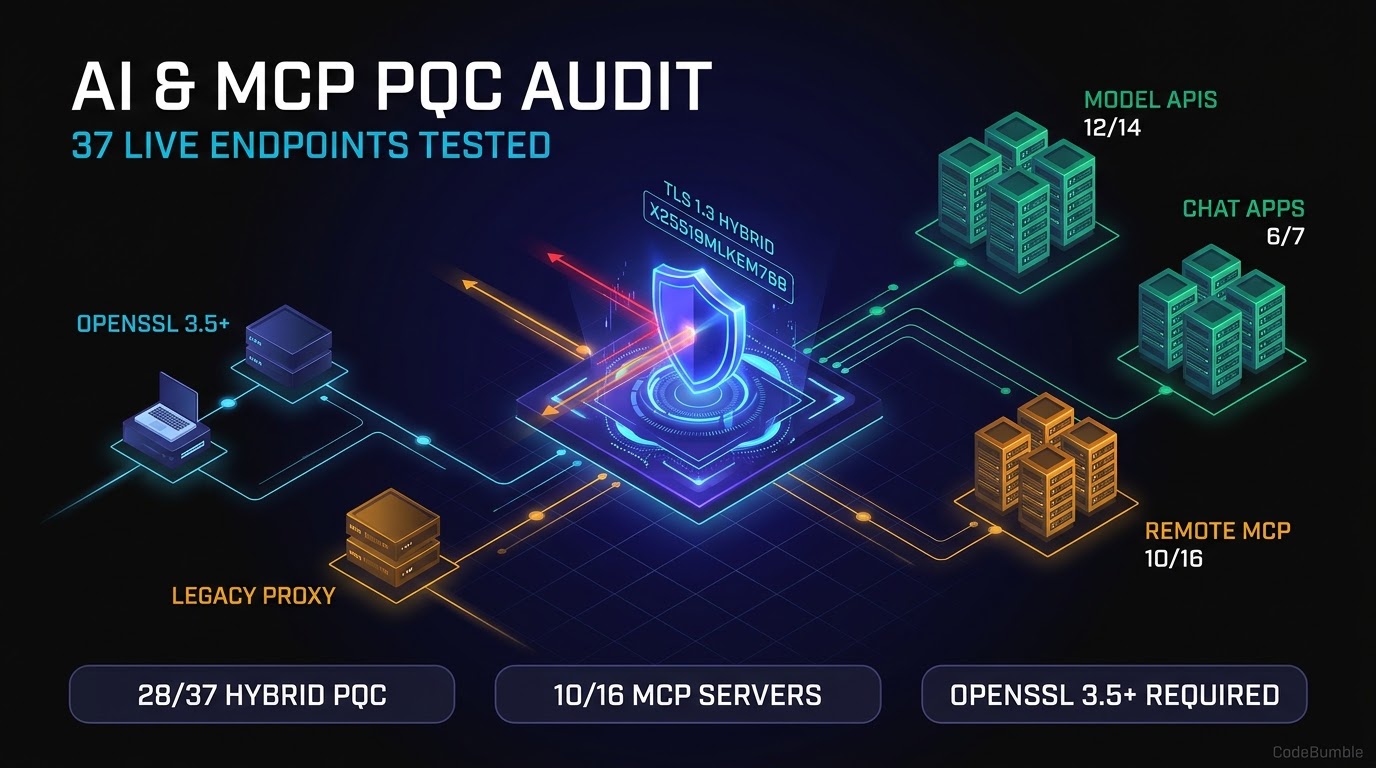
On November 26, 2026, security researchers at AccuroAI published an empirical TLS 1.3 handshake audit of 37 production AI endpoints—spanning model APIs, chat interfaces, and remote Model Context Protocol (MCP) servers—to measure real-world readiness against harvest-now-decrypt-later (HNDL) attacks. While 28 of 37 endpoints negotiated hybrid post-quantum key exchange (X25519MLKEM768), the weakest links sat inside the agent-integration tier: only 10 of 16 remote MCP servers negotiated hybrid post-quantum cryptography, alongside silent classical fallbacks triggered by older client runtimes and TLS-terminating proxies.
Cross-referenced against NIST IR 8547 (finalized October 27, 2026), OpenSSL's ML-KEM documentation, Cloudflare's origin post-quantum telemetry, and the European Data Protection Supervisor (EDPS) TechSonar 2026–2027 report, the findings show that post-quantum transport security in AI stacks is a two-sided negotiation problem rather than a single vendor checkbox.
Executive Summary
- Core defensive capability: Hybrid TLS 1.3 key exchange (
X25519MLKEM768) combines classical ECDHE (X25519) with NIST FIPS 203ML-KEM-768so session keys remain confidential against future cryptographically relevant quantum computers (CRQCs) as long as either primitive holds. - Target architecture and gap: Across 37 endpoints tested on November 26, 2026, 12 of 14 model APIs and 6 of 7 AI chat apps negotiated
X25519MLKEM768, whereas 6 of 16 remote MCP servers (37.5%) negotiated classicalX25519orP-256—and one (mcp.terraform.io) negotiatedP-256over TLS 1.2. - Silent client and proxy downgrades: Even when an AI provider enables
X25519MLKEM768, older client TLS stacks (such as macOS system Python3.9.6on LibreSSL2.8.3or systemcurlon LibreSSL3.3.6) and corporate TLS-inspection middleboxes silently fall back to classical key exchange without logging an error. - Primary engineering trade-off: Hybrid
X25519MLKEM768increases key-share size (1,184-byte ML-KEM-768 plus32-byte X25519 public key) and requires OpenSSL3.5+(or modern BoringSSL/rustls) across every hop, while protecting only data in transit—not classical certificate signatures or data stored at rest.
Trust Model and Architecture
Harvest-now-decrypt-later attacks require two ingredients: passive recording of encrypted network traffic today, and a future quantum computer capable of running Shor's algorithm to break classical elliptic-curve or RSA key exchange. As the EDPS TechSonar report notes, estimates for the noisy qubits required to break 2048-bit RSA dropped from 20 million in 2019 to fewer than 500,000 in March 2026, making long-shelf-life AI traffic—such as RAG corpora, fine-tuning datasets, proprietary source code in prompts, and long-lived OAuth refresh tokens—an immediate confidentiality concern.
In TLS 1.3, X25519MLKEM768 defends the key-establishment boundary. Per OpenSSL's EVP_PKEY-MLX-KEM specification, the client and server exchange a 1,184-byte ML-KEM-768 public key alongside a 32-byte X25519 public key and concatenate both 32-byte shared secrets into the session key derivation. Notably, OpenSSL documents that although X25519 is not FIPS-approved on its own, the hybrid X25519MLKEM768 combination is permitted under FIPS 140-3 because ML-KEM is FIPS-approved (while SecP256r1MLKEM768 pairs two FIPS-approved primitives).
flowchart LR
    A[Agent Container / SDK Client] -->|ClientHello: X25519MLKEM768 + X25519| B{TLS-Terminating Proxy / Gateway}
    B -->|Legacy Stack: Drops ML-KEM| C[Classical Upstream Leg: X25519 Only]
    B -->|OpenSSL 3.5+ / BoringSSL: Preserves Hybrid| D[Hybrid Upstream Leg: X25519MLKEM768]
    C -->|Vulnerable to HNDL Recording| E[AI Model API or Remote MCP Server]
    D -->|Quantum-Resistant Confidentiality| E
Because TLS key exchange is negotiated independently on every TCP connection, a corporate DLP proxy, API gateway, or service mesh sidecar breaks the end-to-end guarantee if its upstream TLS client library predates hybrid ML-KEM support. An employee's browser or local IDE may negotiate X25519MLKEM768 with the proxy's ingress listener, while the proxy's egress leg—the exact segment traversing the public internet to an AI API or MCP server—quietly downgrades to classical X25519.
What Researchers and Analysts Say
In the November 26, 2026 AccuroAI study, Principal Security Researcher Dr. Marcus Chen evaluated 37 endpoints from a single network location using two independent harnesses: Test A (Node.js 24.14.1 linked against OpenSSL 3.5.5, offering strictly X25519MLKEM768) and Test B (OpenSSL 3.6.2 s_client with default groups prioritizing X25519MLKEM768). Both harnesses agreed on every host.
| Endpoint Category | Hybrid X25519MLKEM768 |
Classical Key Exchange | Verified Classical Hosts |
|---|---|---|---|
| AI Model APIs (14 tested) | 12 (85.7%) |
2 (14.3%) |
bedrock-runtime.us-east-1.amazonaws.com (X25519), models.github.ai (X25519) |
| AI Chat Apps (7 tested) | 6 (85.7%) |
1 (14.3%) |
m365.cloud.microsoft (secp384r1 / P-384) |
| Remote MCP Servers (16 tested) | 10 (62.5%) |
6 (37.5%) |
api.githubcopilot.com, mcp.atlassian.com, mcp.context7.com, mcp.slack.com, mcp.stripe.com (X25519); mcp.terraform.io (P-256 over TLS 1.2) |
| Total AI Endpoints (37 tested) | 28 (75.7%) |
9 (24.3%) |
— |
Three findings from the researchers and independent infrastructure analysts stand out:
- Inconsistent posture within the same cloud vendor: AccuroAI observed that
aws-mcp.us-east-1.api.awsnegotiatedX25519MLKEM768, whereasbedrock-runtime.us-east-1.amazonaws.comin the very same AWS region negotiated classicalX25519. Security teams cannot assume uniform PQC support across a provider's subdomains. - Client runtime lag matches origin lag: AccuroAI tested five local clients against a test server requiring
X25519MLKEM768.Node.js 24.14.1(OpenSSL 3.5.5), HomebrewPython 3.12.15(OpenSSL 3.6.2), andOpenSSL 3.6.2 s_clientsucceeded, while macOS defaultPython 3.9.6(LibreSSL 2.8.3) and systemcurl(LibreSSL 3.3.6) failed—meaning against real AI APIs, those legacy runtimes silently fall back to classical TLS. This mirrors Cloudflare's September 8, 2026 origin study, which reported that while browser/client PQC adoption topped 60% globally in early 2026, only 12.8% of origin servers supported post-quantum key exchange, prompting Cloudflare to roll out out-of-band Automatic Key Exchange probing to avoid HelloRetryRequest (HRR) round-trip latency. - Hybrid complexity, side channels, and signature caveats: Both NIST IR 8547 and the EDPS TechSonar report emphasize that hybrid cryptography is more computationally demanding and complex to implement cleanly. The UK National Cyber Security Centre (NCSC), cited by EDPS, recommends hybridization strictly as an interim measure within a crypto-agile architecture, noting past chosen-ciphertext power-analysis side-channel research on Kyber/ML-KEM and the reality that larger PQC keys and signatures (
ML-DSA, FIPS 204) can more than double transmitted handshake bytes on non-resumed QUIC connections. Moreover,X25519MLKEM768secures only confidentiality in transit—all 37 tested AI endpoints still used classical certificates for server authentication, which NIST IR 8547 notes are not vulnerable to HNDL but still face future "trust-now-forge-later" risks.
Regulatory and Compliance Timelines
For engineering leads planning cryptographic roadmaps, multiple binding and advisory deadlines converged in 2025–2026:
- NIST IR 8547 (Finalized October 27, 2026): Deprecates quantum-vulnerable public-key algorithms (RSA, ECDH, ECDSA) after 2030 and disallows them after 2035, referencing FIPS 203 (
ML-KEM), FIPS 204 (ML-DSA), and FIPS 205 (SLH-DSA). - US Executive Order 14412 & OMB M-26-15 (June 2026): Directs US federal agencies (and covered federal contractors via FAR rules) to transition high-value/high-impact systems to PQC key establishment by December 31, 2030, PQC signatures by December 31, 2031, and mandates TLS-terminating network infrastructure (firewalls, VPNs, API proxies) support PQC key exchange by January 2, 2030.
- EU Quantum Act Proposal & NIS Cooperation Roadmap (November 25, 2026): The European Commission's Quantum Act FAQ pairs the EU's existing December 31, 2026 milestone for Member State PQC transition plans and 2030 high-risk migration deadline (for data needing 10+ years of confidentiality) with proposed post-quantum procurement rules for NIS2-covered public administrations starting six months after entry into force.
Hardening and Implementation Blueprint
Securing AI and MCP pipelines against harvest-now-decrypt-later requires auditing both client egress and proxy hops, not waiting for upstream vendors alone.
1. Verify Live Handshakes From Actual Execution Environments
Run TLS probes from inside your CI runners, Kubernetes agent pods, and egress proxies—not just a developer laptop—using OpenSSL 3.5.0 or newer (which added X25519MLKEM768 to default TLS keyshares on April 8, 2025):
openssl version
openssl s_client -connect api.example.com:443 -brief </dev/null
Confirm the output reports Negotiated TLS1.3 group: X25519MLKEM768. If it reports Peer Temp Key: X25519, 253 bits or falls back to TLS 1.2 (P-256), either the remote endpoint or an intermediate TLS-inspecting middlebox lacks hybrid ML-KEM support.
2. Upgrade Agent Runtimes, Gateways, and Telemetry
- Eliminate legacy TLS stacks in containers: Rebuild Python, Node.js, and Go agent images against
OpenSSL 3.5+,BoringSSL, or modernrustls, and remove hardcodedssl_ecdh_curveorSupportedGroupsoverrides in Nginx, Envoy, or HAProxy configs that inadvertently stripX25519MLKEM768. - Log negotiated key-exchange groups: On edge proxies such as Cloudflare, enable TLS telemetry fields (
ClientTLSKeyExchangeGroupfor inbound clients andOriginTLSKeyExchangeGroupfor upstream origins) to spot non-PQC API clients or legacy MCP origins. If an internal origin cannot be upgraded immediately, place it behind a post-quantum-capable tunnel (cloudflarednegotiatesX25519MLKEM768to the edge) rather than forcing strictPost-quantum hybridmode on an incompatible origin—which Cloudflare warns will fail all TLS 1.3 connections. - Shorten credential TTLs and scrub MCP configs: Because an unrevoked API key or OAuth refresh token harvested today remains valid if decrypted years later, enforce short-lived OAuth tokens, set explicit API key expiration windows (e.g., 90 days or shorter), and keep plaintext secrets out of prompts and local MCP JSON configs.
Frequently Asked Questions
Does X25519MLKEM768 protect prompts and embeddings stored on an AI provider's servers?
No. X25519MLKEM768 only secures TLS 1.3 data in transit between two endpoints. Prompts, RAG documents, and logs stored by an AI provider or MCP server remain governed by the vendor's encryption-at-rest and data-retention policies.
Why did 6 of 16 remote MCP servers fail to negotiate post-quantum key exchange in the November 2026 test?
In AccuroAI's November 26, 2026 probe from one network location, six MCP hosts—including api.githubcopilot.com, mcp.atlassian.com, mcp.context7.com, mcp.slack.com, mcp.stripe.com, and mcp.terraform.io—negotiated classical X25519 or P-256 (with mcp.terraform.io using TLS 1.2). The study noted that public edge responses reflect current server/CDN TLS stack configurations and can change as providers upgrade.
Will enabling X25519MLKEM768 break older clients or proxies?
In standard hybrid TLS 1.3 negotiation, clients and servers fall back to classical X25519 if either side lacks X25519MLKEM768, preserving connectivity. However, Chrome's rollout experience showed that some legacy TLS middleboxes mishandle larger hybrid ClientHello packets, and forcing strict post-quantum-only compliance on an unsupported origin will break TLS 1.3 handshakes.
What is the minimum OpenSSL version needed for X25519MLKEM768 by default?
OpenSSL 3.5.0 (released April 8, 2025) introduced X25519MLKEM768 in its default TLS 1.3 keyshares and supported-groups list. Runtimes linked against OpenSSL 3.0–3.4 or macOS system LibreSSL will not offer X25519MLKEM768 by default.
Are classical TLS certificates also vulnerable to harvest-now-decrypt-later?
No. As NIST IR 8547 clarifies, digital signatures used in TLS certificates are not vulnerable to passive harvest-now-decrypt-later decryption. Quantum computers threaten signatures via future forgery ("trust-now-forge-later"), which NIST addresses separately with ML-DSA (FIPS 204) and SLH-DSA (FIPS 205).
Sources
- Post-Quantum AI Security: What 37 AI Endpoints Show — AccuroAI (Dr. Marcus Chen) — Published November 26, 2026
- Transition to Post-Quantum Cryptography Standards (NIST IR 8547) — NIST — Published October 27, 2026 (updated November 2, 2026)
- EVP_PKEY-MLX-KEM Manual — OpenSSL Documentation — Accessed November 28, 2026
- Automatic Key Exchange: Faster, Post-Quantum Secure Origin Connections — Cloudflare Blog — Published September 8, 2026
- Is Your Domain Using Post-Quantum Encryption? — Cloudflare Blog — Published September 29, 2026
- Post-Quantum Cryptography — European Data Protection Supervisor (EDPS TechSonar 2026–2027) — Published November 24, 2026
- The Quantum Act Explained — European Commission — Updated November 25, 2026