

AI
Gemini 4 Neon: Independent Benchmarks, $3/$15 Token Pricing, and Production API Trade-Offs
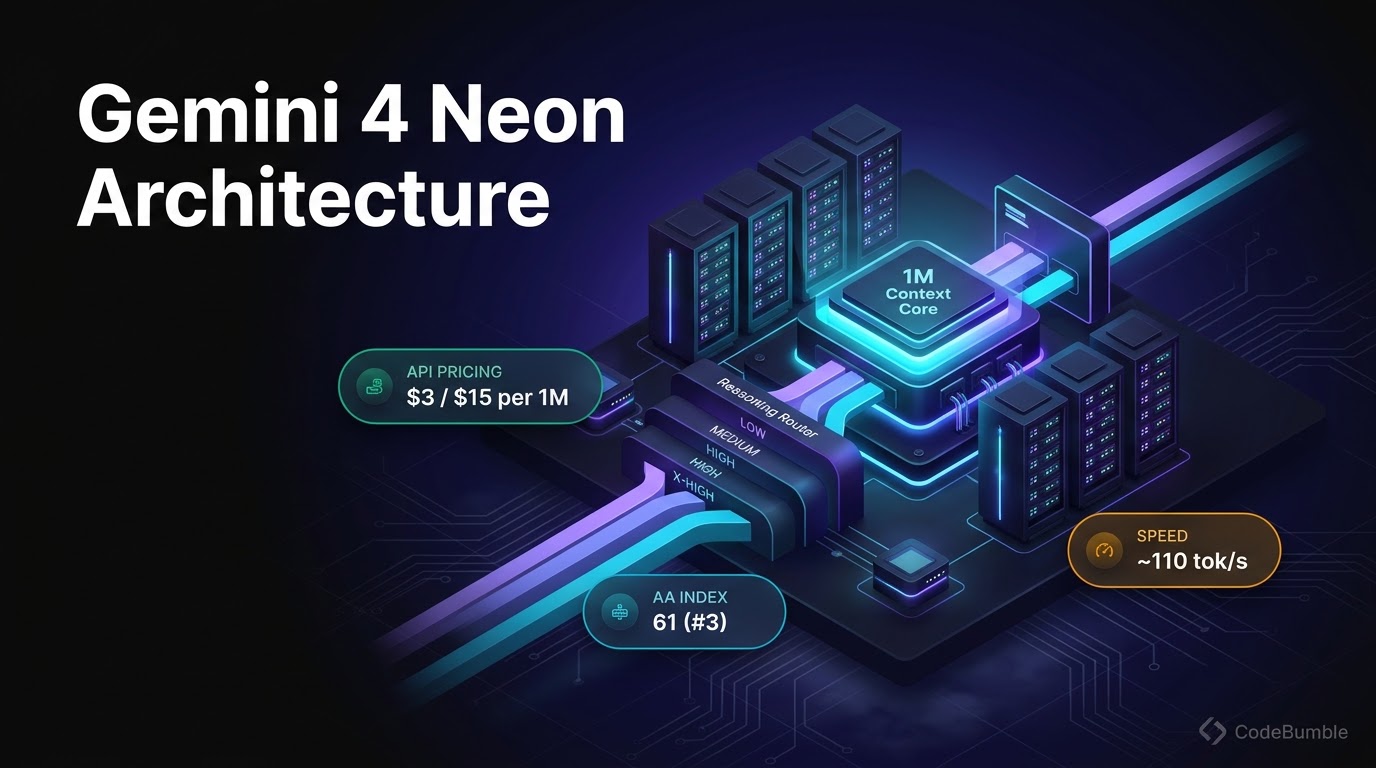
Released on November 18, 2026, Gemini 4 Neon scores 61 (#3 overall) on the Artificial Analysis Intelligence Index at $3/$15 per million tokens and ~110 output tokens per second. While Google DeepMind highlights 40% faster end-to-end task completion than Gemini 4 Carbon, independent testing shows Neon uses ~15% more output tokens per task and temporarily costs more per token than Carbon's discounted rate through November 30. Here is the full benchmark, pricing, and routing breakdown.
7 min read
Gemini 4 Neon: Independent Benchmarks, $3/$15 Token Pricing, and Production API Trade-Offs
Executive Summary
- Model & Release: Gemini 4 Neon, Google DeepMind's fourth Gemini 4 family release in seven weeks, announced on November 18, 2026 (Google Blog, Artificial Analysis).
- Core Capabilities & Specs: 1,048,576 (1M) token context window, multimodal input (text, image, video, speech) with text output, and four configurable thinking effort levels (
low,medium,high,xhigh) (Artificial Analysis). - API Pricing:
$3.00per 1M input tokens,$0.15per 1M cached input tokens (95% discount), and$15.00per 1M output tokens (thinking tokens bill at the output rate; no free API tier) (Google Blog, NeuralTrust). - Primary Developer Takeaway: On independent Artificial Analysis testing, Neon (
xhigh) scores61on the Intelligence Index (#3overall) at~110output tokens/sec and$6.44per task—~40% faster than Gemini 4 Carbon (high, ~36 min vs ~21 min). However, Neon emits ~15% more output tokens per task, and until Carbon's introductory$2/$10discount expires on November 30, 2026, Carbon remains cheaper per token (Artificial Analysis).
Architecture & How It Works
Within the Gemini 4 lineup, Google DeepMind positions Gemini 4 Neon between Gemini 4 Hydrogen (fast everyday execution with free API tier access) and Gemini 4 Carbon (heaviest long-horizon projects) (Google Blog). Neon is engineered specifically for high-frequency agentic loops, multi-file repository edits, and visual/document synthesis across a unified 1M-token context window with flat token pricing (NeuralTrust).
Thinking Effort Routing & Orchestrator-Worker Pattern
Rather than a single fixed reasoning budget, Neon exposes four effort tiers (low, medium, high [API default], and xhigh) (Artificial Analysis). In Google Antigravity, Neon also operates as a fast Orchestrator that delegates parallel subtasks to smaller Hydrogen worker subagents while managing context compaction across long sessions (Google Blog).
[Multimodal Inputs: Text / Image / Video / Speech (up to 1M tokens)]
                                  │
                                  ▼
                   [Gemini 4 Neon API / Antigravity]
                     ├─ effort: low / medium ──▶ Fast classification & tool routing
                     ├─ effort: high (default) ─▶ $3.74/task avg (AA Index ~59.6)
                     └─ effort: xhigh ─────────▶ $6.44/task avg (AA Index 61, #3)
                                  │
                    ┌─────────────┴─────────────┐
                    ▼                           ▼
         [Direct Tool Execution]     [Parallel Hydrogen Subagents]
API Request Configuration Example
Because thinking tokens bill at the $15/1M output rate, production services should explicitly set the thinking level per route rather than leaving every endpoint on xhigh:
{
  "model": "gemini-4-neon",
  "generationConfig": {
    "thinkingConfig": {
      "thinkingLevel": "high"
    },
    "temperature": 0.2
  },
  "contents": [
    {
      "role": "user",
      "parts": [
        { "text": "Audit this repository diff for SQL injection and race conditions." }
      ]
    }
  ]
}
At its default high effort, Neon avoids the extra $2.70 per-task reasoning overhead of xhigh while retaining near-peak coding and analytical accuracy (dev.to / Studio1HQ).
Benchmarks, Cost & Latency Analysis
Separating Google DeepMind's self-reported evaluation suite from independent third-party telemetry highlights where Neon genuinely leads—and where harness or pricing nuances matter.
Independent & Vendor Benchmark Comparison
| Benchmark / Metric | Gemini 4 Neon | Claude Opus 5.5 | GPT-6.2 Sol | Verification Source |
|---|---|---|---|---|
| AA Intelligence Index v5.0.1 | 61 (xhigh, #3 overall) |
59 |
57 |
DeepMind, Artificial Analysis |
| Vals Index v2.2 | 70.9% (#2) |
70.1% |
66.1% |
DeepMind |
| AA Coding Agent Index | 59 (xhigh, Antigravity) / 58.6 |
58 |
— | Artificial Analysis, Google Blog |
| Terminal-Bench 4.1 | 65.2% |
65.8% |
61.5% |
DeepMind |
| FrontierCode 2.0 | 46.2% (high) |
47.3% |
43.8% |
DeepMind |
| SWE-sweep (Provider / Mini-SWE) | 39.0% / 12.8% |
10.1% / 3.6% |
8.3% / 11.6% |
DeepMind |
| Zapier AutomationBench | 56.3% (#1) |
42.5% |
41.3% |
DeepMind |
| GraphWalks (256k–1M BFS F1) | 95.2% |
66.8% |
80.1% |
DeepMind |
| HLE-Diamond / RiemannBench | 71.3% / 84.0% |
67.9% / 80.0% |
64.0% / 80.0% |
DeepMind |
| SEC-bench Pro / CWE-Bench v2 | 90.5% / 70.7% |
— / 67.1% |
88.3% / 66.0% |
DeepMind |
Cost-Per-Task, Speed & Benchmark Caveats
- The Harness Multiplier on SWE-sweep: Neon's
SWE-sweepscore jumps more than 3× from12.8%on the genericmini-SWEharness to39.0%inside Google Antigravity (Google Blog, DeepMind). Teams calling Neon over raw APIs without Antigravity's tool harness should benchmark against the12.8%baseline rather than assuming39.0%. - Token Verbosity vs. Token Price: According to Artificial Analysis, Neon (
xhigh) generates ~15% more output tokens per task than Gemini 4 Carbon (high). Its$6.44average cost per task (~17% below Carbon's$7.76standard rate) is driven entirely by its 25% lower list pricing ($3/$15vs.$4/$20). - Throughput Advantage: Neon streams at
~110output tokens/second versus~57tokens/second for Carbon—cutting average end-to-end task wall time by ~40% (~21 minutes vs. ~36 minutes across the AA suite) (Artificial Analysis). - Coding Agent Cost Comparison: On the AA Coding Agent Index, Neon in Antigravity averages
$6.86per task, nearly half of Claude Opus 5.5 (max,$12.61) and less than half of Claude Fable 5.2 (xhigh,$15.47) (Artificial Analysis). - Multimodal & Document Synthesis: On
AA-Briefcase, Neon (xhigh) leads Presentation Quality at1771Elo (45 points ahead of Claude Sonnet 5.5maxat1726) and hits56%Climb WSR on the Multimodal Knowledge Agent (MKA) evaluation (Artificial Analysis).
Production Deployment & Trade-Offs
When to Choose Gemini 4 Neon vs. Alternatives
- Choose Gemini 4 Neon (
highorxhigh) for latency-sensitive agentic coding, long-context retrieval (256k–1Mtokens, where it scores95.2%F1 on GraphWalks), and visual document pipelines (PDFs, charts, spreadsheets) where~110 tok/sthroughput and$0.15/1Mcached input pricing materially cut runtime and cost (DeepMind, Artificial Analysis). - Stick with Gemini 4 Carbon (until November 30, 2026) if you are running batch workloads that are not latency-bound: Carbon's promotional
$2/$10pricing remains 33% cheaper per token than Neon until December 1, 2026 (Artificial Analysis, NeuralTrust). - Use Gemini 4 Hydrogen for high-volume worker subagents, simple classification, or projects requiring a free API tier—Neon has no free API tier (dev.to / Studio1HQ).
- Evaluate Claude Opus 5.5 if your workload centers on raw CLI/container coding benchmarks like
Terminal-Bench 4.1(65.8%vs.65.2%) orFrontierCode 2.0(47.3%vs.46.2%), where Opus 5.5 still edges Neon by roughly a point (DeepMind, dev.to / Studio1HQ).
Operational Gotchas
- Thinking Token Billing: Because reasoning tokens are billed as
$15/1Moutput tokens, verbosexhighprompts without explicitthinkingLevelcaps can inflate bills unexpectedly (NeuralTrust). - Security & Alignment Profile: Google reports
0.0%attack success on Gray Swan's indirect prompt injection (IPI) benchmark atxhighwith real-time safeguards enabled, alongside a0.09%misaligned action rate and1.98%false refusal rate on Terminal-Bench 4.0 (Google Blog). Keep real-time safeguards enabled when processing untrusted web pages or emails.
Frequently Asked Questions (FAQ)
How much does the Gemini 4 Neon API cost?
Gemini 4 Neon costs $3.00 per 1M input tokens, $0.15 per 1M cached input tokens (95% discount), and $15.00 per 1M output tokens—flat across the entire 1M-token context window (Google Blog, NeuralTrust). Thinking tokens are billed at the output rate, and there is no free API tier.
Should I use high or xhigh thinking effort in production?
Start with high (the API default). Independent testing shows high delivers a 59.6 AA Index score at an average of $3.74 per task, whereas xhigh adds roughly 1.8 index points (reaching 61) at $6.44 per task and higher latency (dev.to / Studio1HQ, Artificial Analysis). Reserve xhigh for hardest-tier engineering or scientific tasks.
How does Gemini 4 Neon compare to Gemini 4 Carbon?
At standard pricing, Neon ($3/$15) is 25% cheaper per token than Carbon ($4/$20), streams nearly twice as fast (~110 vs. ~57 output tok/s), and scores 1 point higher on the AA Intelligence Index (61 vs. 60) (Artificial Analysis). However, Neon emits ~15% more output tokens per task, and Carbon's discounted $2/$10 rate remains active through November 30, 2026 (Artificial Analysis).
Does Gemini 4 Neon beat Claude Opus 5.5 on coding?
It depends on the harness and benchmark. On SWE-sweep inside Google Antigravity, Neon scores 39.0% vs. 10.1% for Opus 5.5, and on the AA Coding Agent Index Neon averages $6.86 per task vs. $12.61 for Opus 5.5 (max) (DeepMind, Artificial Analysis). On Terminal-Bench 4.1 (65.8% vs. 65.2%) and FrontierCode 2.0 (47.3% vs. 46.2%), Claude Opus 5.5 holds a slight edge (DeepMind).
Where can developers access Gemini 4 Neon today?
Gemini 4 Neon is available in the Gemini API via Google AI Studio and Android Studio (paid tier), Gemini for business, Google Antigravity (Pro/Ultra subscribers), the Gemini app (Pro/Ultra), and for cybersecurity defenders via the Fairwind Program (Google Blog).
Sources
- Google Blog — Introducing Gemini 4 Neon — https://blog.google/innovation-and-ai/models-and-research/gemini-models/introducing-gemini-4-neon/ (Published November 18, 2026)
- Google DeepMind — Gemini Model Performance & Evals — https://deepmind.google/models/gemini/ (Verified November 21, 2026)
- Artificial Analysis — Google continues to accelerate its release cadence with Gemini 4 Neon — https://artificialanalysis.ai/articles/gemini-4-neon-intelligence-gain (Published November 18, 2026)
- NeuralTrust — Gemini 4 Neon: Benchmarks & Security — https://neuraltrust.ai/blog/gemini-4-neon (Published November 19, 2026)
- dev.to / Studio1HQ — Gemini 4 Neon Review: Pricing, Benchmarks, and Coding Tests — https://dev.to/studio1hq/-gemini-4-neon-review-pricing-benchmarks-and-coding-tests-pfe (Published November 20, 2026)