

Automation
GitLab 19.6.1, 19.5.8, and 19.4.10 Fix Ruby2Shell (CVE-2026-132825) Ahead of November 25 PoC
On November 20, 2026, GitLab shipped critical patch releases 19.6.1, 19.5.8, and 19.4.10 bundling Ruby 3.3.14 and 3.4.13 to remediate Ruby2Shell (CVE-2026-132825) ahead of Veria Labs' planned November 25 Rails PoC release. While GitLab.com and GitLab Dedicated are already patched, self-managed CE/EE instances require an immediate upgrade—with zero migrations and no multi-node downtime.
7 min read
GitLab 19.6.1, 19.5.8, and 19.4.10 Fix Ruby2Shell (CVE-2026-132825) Ahead of November 25 PoC
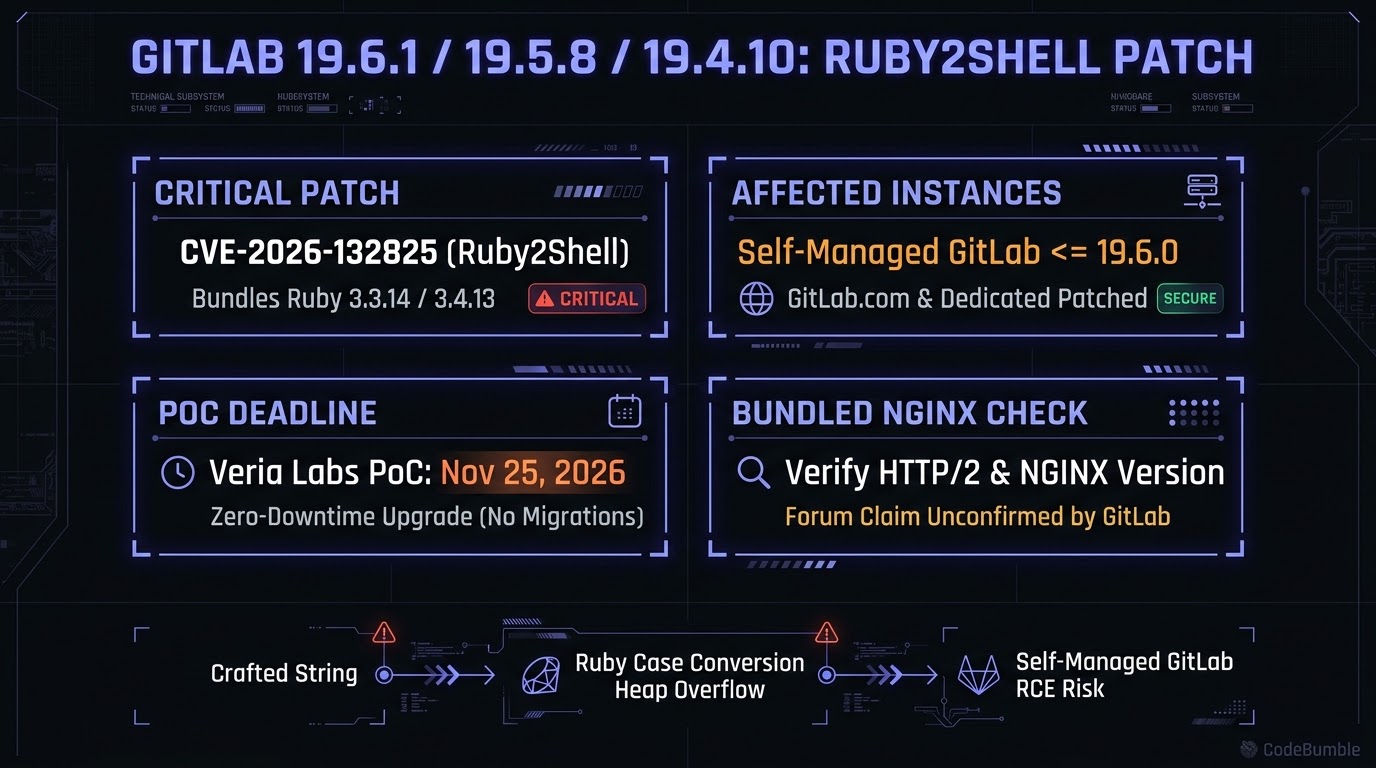
Executive Summary
On November 20, 2026, GitLab released critical patch versions 19.6.1, 19.5.8, and 19.4.10 for GitLab Community Edition (CE) and Enterprise Edition (EE) to remediate CVE-2026-132825 (Ruby2Shell, GHSA-34m4-m9fh-gqp5) along with six companion vulnerabilities from Ruby's Regexp and String security advisory (GitLab Release Notes). While GitLab.com and GitLab Dedicated are already running patched builds, all self-managed Omnibus, Helm, container, and source-compiled GitLab instances on 19.6.0 and earlier remain exposed until upgraded (Veria Labs).
The urgency is driven by an explicit disclosure clock: Veria Labs, which discovered CVE-2026-132825 independently and first demonstrated remote code execution, stated it plans to publish a proof-of-concept exploit demonstrating RCE on stock Rails applications on November 25, 2026 (or later if major vendors have not shipped fixes) (CISO Tribune).
Notably, GitLab's patch release contains no new database migrations and requires no downtime for multi-node deployments, making it a low-friction emergency upgrade (GitLab Release Notes).
Confidence assessment: High confidence on affected GitLab versions (<= 19.6.0), fixed releases (19.6.1, 19.5.8, 19.4.10), bundled Ruby versions (3.3.14 / 3.4.13), and zero-migration status (sourced directly from GitLab's official release notes, Veria Labs, and RapidFort). Partial confidence on secondary forum claims regarding GitLab's bundled NGINX version: CISO Tribune notes that while the Ruby2Shell fix is confirmed across multiple advisories, a Hacker News claim that 19.6.1 still bundles NGINX 1.31.7 (prior to NGINX2Root 1.31.9 / 1.30.7) is not established by official GitLab release notes.
Technical Mechanics and Architecture
1. Why bundle update Does Not Fix GitLab (Ruby2Shell)
CVE-2026-132825 is not a RubyGem flaw—it is a heap-based buffer overflow in the Ruby interpreter's C string case-conversion routines, alongside five regular-expression engine flaws and a second string case-conversion flaw (GitLab Release Notes, RapidFort). Under specific conditions, changing the case of a crafted string in GitLab triggers an out-of-bounds heap write that can lead to arbitrary code execution.
Because the vulnerability lives inside the C runtime (libruby / ruby binary) rather than in Gemfile.lock:
- Omnibus Linux packages and official container images must be upgraded to
19.6.1,19.5.8, or19.4.10, which bundle patched Ruby3.3.14or3.4.13. - Self-compiled GitLab installations must manually rebuild the underlying Ruby runtime to
3.3.14or3.4.13(or later in the same minor series) (GitLab Release Notes).
+-----------------------+     Crafted HTTP / String Input     +-------------------------------+
|  Remote Attacker      | ----------------------------------> |  GitLab Rails / Puma Worker   |
|  (Unauthenticated or  |   Triggers Ruby case conversion     |  (GitLab <= 19.6.0 bundling   |
|   App-level payload)  |   on attacker-controlled string     |   Ruby 3.3.13 / 3.4.12)       |
+-----------------------+                                     +---------------+---------------+
                                                                              |
                                                Out-of-bounds heap write      |
                                                in C string case conversion   |
                                                                              v
+-----------------------+     Bundled Runtime Replacement     +-------------------------------+
|  Remediation:         | <---------------------------------- |  Heap Memory Corruption /     |
|  Ruby 3.3.14 / 3.4.13 |   GitLab 19.6.1 / 19.5.8 / 19.4.10  |  Potential Worker RCE         |
|  (bundle update N/A)  |   (No DB migrations required)       |  (Logs: [BUG] / Segfault)     |
+-----------------------+                                     +-------------------------------+
2. Severity Rating Discrepancy
Security teams triaging CVE-2026-132825 will encounter two different severity scores (GitLab Release Notes, RapidFort):
- Ruby Security Team & GitLab: Rated Critical (
GHSA-34m4-m9fh-gqp5), reflecting demonstrated remote code execution in Rails/Sinatra-style applications. - MITRE CVE Record: Scored 7.4 (High) under CVSS v3.1 (
AV:L/AC:Hlocal vector assumption).
RapidFort and GitLab advise planning around the Critical / network-reachable assessment rather than the lower CVSS 7.4 score.
Safe Defensive Configuration (Pre-Patch Isolation & Bundled NGINX Check)
If a self-managed GitLab instance cannot be upgraded immediately before November 25, 2026, CISO Tribune and Aikido recommend placing the instance behind a VPN or strict IP allowlist, and verifying whether HTTP/2 is exposed on the bundled NGINX ingress:
# /etc/gitlab/gitlab.rb (Omnibus defensive posture check)
# If you also wish to disable HTTP/2 on bundled NGINX as a precaution
# while verifying NGINX2Root status, configure listen_https without http2
# or restrict ingress at an upstream WAF/VPN:
nginx['listen_https'] = true
nginx['http2_enabled'] = false
(Note: verify nginx['http2_enabled'] syntax against your exact Omnibus GitLab version before running gitlab-ctl reconfigure.)
Evidence: Affected Versions, Patched Releases, and Benchmarking Gaps
GitLab Release & Ruby Mapping
| Deployment Type | Affected Versions | Fixed Release | Notes |
|---|---|---|---|
| GitLab.com & Dedicated | Remediated | Already patched | No customer action required (GitLab) |
| GitLab CE/EE 19.6.x | 19.6.0 and earlier |
19.6.1 |
Bundles Ruby 3.3.14 / 3.4.13; no DB migrations |
| GitLab CE/EE 19.5.x | < 19.5.8 |
19.5.8 |
Includes 19.5.7 interim mitigations + Ruby patches |
| GitLab CE/EE 19.4.x | < 19.4.10 |
19.4.10 |
Includes 19.4.9 interim mitigations + Ruby patches |
| Self-Compiled GitLab | Ruby <= 3.3.13, 3.4.0–3.4.12 |
Rebuild with Ruby 3.3.14 or 3.4.13 |
Must recompile Ruby binary, not just gems |
Exploitation Status and Benchmarks
- Exploitation status: No in-the-wild exploitation of
CVE-2026-132825has been reported as of November 20–21, 2026 (CISO Tribune), though Veria Labs' stock Rails RCE PoC is scheduled for November 25, 2026. - Performance benchmarks: GitLab's release notes do not publish CPU, memory, or request-latency benchmarks comparing
19.6.1(Ruby 3.3.14/3.4.13) against19.6.0. Because this is a targeted security backport with no schema migrations, normal Omnibus upgrades incur only the brief service restart window unless/etc/gitlab/skip-auto-reconfigureis used (GitLab Release Notes).
Hardening Playbook
Verify current GitLab version and bundled Ruby / NGINX versions On Omnibus GitLab hosts, check the installed package, embedded Ruby, and embedded NGINX versions:
sudo gitlab-rake gitlab:env:info | grep -E "GitLab|Ruby|Version"
/opt/gitlab/embedded/bin/ruby -v
/opt/gitlab/embedded/sbin/nginx -v
Confirm whether Ruby is below
3.3.14/3.4.13and check the embedded NGINX version against your organization'sNGINX2Root(1.31.9/1.30.7) tracking.Hunt Ruby/Puma logs for crash indicators RapidFort notes that unexpected crashes printing
[BUG]orSegmentation faultin Ruby application logs can indicate exploitation attempts against an unpatched interpreter:sudo grep -rnE "\[BUG\]|Segmentation fault" /var/log/gitlab/puma/ /var/log/gitlab/sidekiq/ 2>/dev/nullUpgrade self-managed GitLab to
19.6.1,19.5.8, or19.4.10Apply the appropriate Omnibus package (apt-get install gitlab-ee=19.6.1-ee.0ordnf upgrade gitlab-ee) or update your Helm chart / container image tag. For self-compiled installs, rebuild Ruby with3.3.14or3.4.13(GitLab Release Notes).Restrict internet exposure if patching is delayed past November 25 If maintenance windows slip past November 25, 2026, place the GitLab instance behind a corporate VPN or IP allowlist so untrusted internet clients cannot reach Rails/Puma endpoints (CISO Tribune).
Post-upgrade verification and rollback note Re-run
/opt/gitlab/embedded/bin/ruby -vandsudo gitlab-ctl statusto confirm all workers are running on the patched Ruby runtime. Rollback note: Because19.6.1,19.5.8, and19.4.10include no new database migrations, rolling back a package in an emergency does not require a schema downgrade—but take a configuration/data backup beforehand and never leave an unpatched19.6.0instance exposed to the public internet.
Frequently Asked Questions (FAQ)
1. Does running bundle update inside GitLab fix CVE-2026-132825?
No. CVE-2026-132825 (Ruby2Shell) is a C-level heap overflow in the Ruby interpreter itself, not a RubyGem (RapidFort). You must upgrade to GitLab 19.6.1, 19.5.8, or 19.4.10 (or rebuild Ruby 3.3.14 / 3.4.13 for source installs).
2. Do GitLab.com or GitLab Dedicated users need to take action?
No. GitLab confirmed that GitLab.com and GitLab Dedicated are already running patched builds (GitLab Release Notes).
3. Does the GitLab 19.6.1 upgrade require database downtime?
GitLab states these patch releases include no new migrations and, for multi-node deployments, should not require downtime. Single-node Omnibus packages still stop, run checks, and restart by default unless /etc/gitlab/skip-auto-reconfigure is present (GitLab Release Notes).
4. Why is there a November 25, 2026 deadline around Ruby2Shell?
Veria Labs, which discovered CVE-2026-132825 and first demonstrated RCE, announced plans to publish a proof-of-concept exploit on stock Rails on November 25, 2026 (or later if major vendors have not shipped fixes) (CISO Tribune).
5. Does GitLab 19.6.1 also patch NGINX2Root?
Official GitLab 19.6.1 release notes highlight the Ruby 3.3.14 / 3.4.13 upgrade and CVE-2026-132825; CISO Tribune notes that forum claims about 19.6.1 still shipping NGINX 1.31.7 are unconfirmed by official release notes, so admins should check /opt/gitlab/embedded/sbin/nginx -v directly.
Sources
- GitLab Docs — GitLab Critical Patch Release: 19.6.1, 19.5.8, 19.4.10 (November 20, 2026)
- Veria Labs — Ruby2Shell (CVE-2026-132825) (November 21, 2026)
- RapidFort — Ruby2Shell: why bundle update won't fix CVE-2026-132825 (November 20, 2026)
- CISO Tribune — OpenSSL 9.8 score clashes with Low severity and 5 more (GitLab 19.6.1 / Ruby2Shell) (November 21, 2026)