

Automation
libumqtt CVE-2026-125132: Unpatched Integer Underflow Exposes Five Critical OT Sectors
On November 19, 2026, CISA issued advisory ICSA-26-323-03 for an unpatched integer underflow in libumqtt 1.1.1 and earlier (CVE-2026-125132, CVSS 4.0 score 8.8). Because the repository maintainers did not respond to coordination requests, no upstream patch exists for the five critical infrastructure sectors relying on it. Here is how the flaw works and how to isolate affected OT and IoT nodes.
7 min read
libumqtt CVE-2026-125132: Unpatched Integer Underflow Exposes Five Critical OT Sectors
Executive Summary
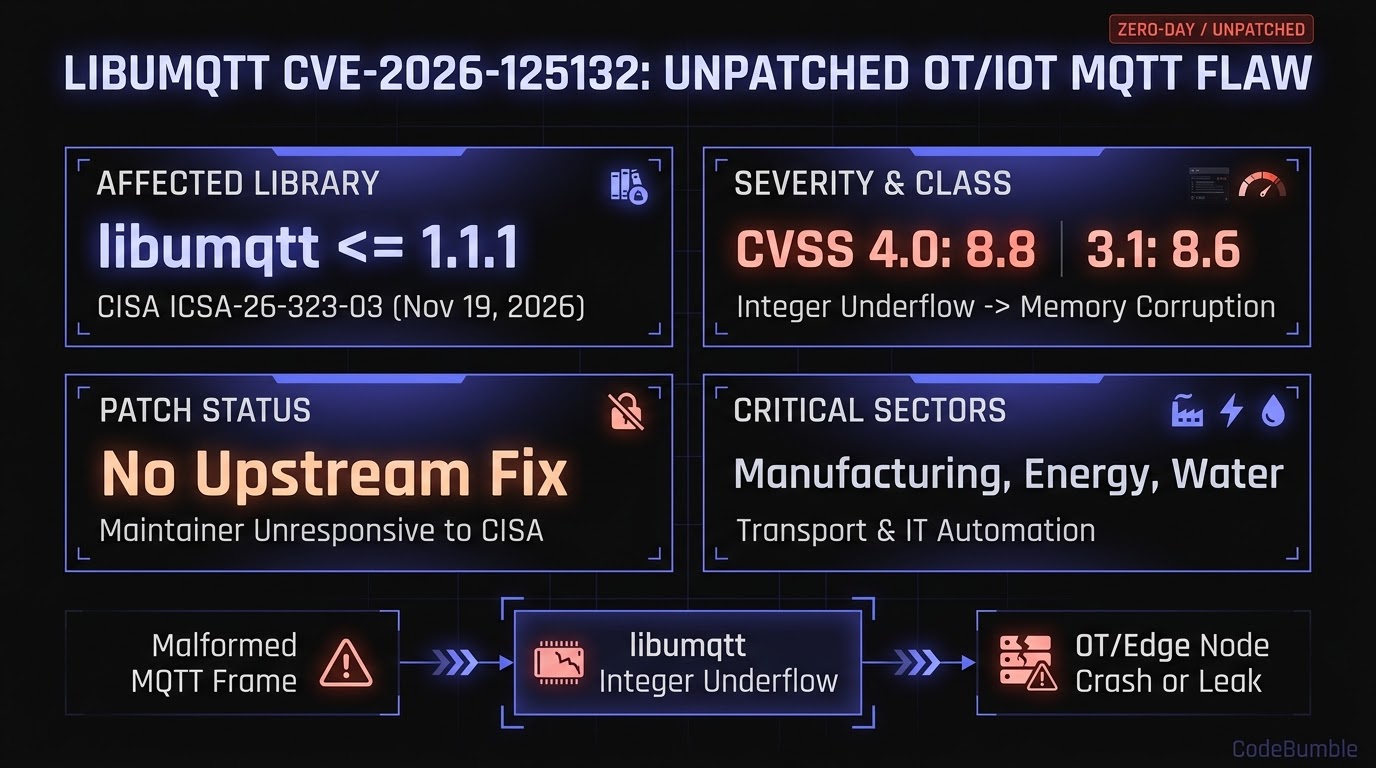
On November 19, 2026, the U.S. Cybersecurity and Infrastructure Security Agency (CISA) published Industrial Control Systems Advisory ICSA-26-323-03, disclosing CVE-2026-125132 in libumqtt versions 1.1.1 and earlier (CISA). Tracked as an integer underflow (wrap or wraparound) vulnerability, the flaw carries a CVSS v3.1 base score of 8.6 (High) and a CVSS v4.0 base score of 8.8 (High). Successful exploitation allows a remote, unauthenticated attacker to trigger a denial-of-service condition, memory corruption, or information disclosure.
Two operational factors make CVE-2026-125132 unusually urgent for industrial automation and embedded IoT engineering teams:
- No upstream patch is available: CISA states that the repository owners of
libumqtt(https://github.com/zhaojh329/libumqtt) did not respond to CISA's coordination request (CISA). Because no fixed release exists, operators cannot remediate this issue with a routine package bump. - Wide critical-infrastructure footprint: CISA identifies five affected sectors deployed worldwide—Critical Manufacturing, Energy, Information Technology, Transportation Systems, and Water and Wastewater.
Confidence assessment: High confidence on affected version range (<= 1.1.1), CVSS v3.1/v4.0 metrics, sector scope, and non-responsive maintainer status (sourced directly from CISA ICSA-26-323-03 and corroborated by JVN JVNVU#92814490). Moderate-to-low confidence on exact downstream firmware-vendor exposure, as libumqtt is frequently vendored or statically linked into embedded Linux/OpenWrt-style gateways without appearing in standard OS package manifests, and the CVE.org record remains in Reserved state pending CNA enrichment (CVE.org).
Technical Mechanics and Architecture
libumqtt is a lightweight C MQTT client library built for embedded Linux, gateways, and resource-constrained automation controllers. Unlike full-featured enterprise brokers or heavy runtime SDKs, lightweight C MQTT libraries parse variable-length wire headers, remaining-length encodings, and payload length fields directly from network buffers.
How Integer Underflow Corrupts MQTT Frame Parsing
In MQTT binary framing, packets consist of a fixed header, a variable-length "Remaining Length" field, a variable header (such as topic length or packet identifier), and an optional payload. When a C parser computes the remaining payload length by subtracting header or topic byte counts from a signed or unsigned length variable without first verifying that total_len >= consumed_len, an integer underflow (wraparound) occurs:
- If stored in an unsigned integer (
size_toruint32_t), subtracting a larger consumed count from a smaller remaining length wraps around to a huge positive value (nearSIZE_MAXorUINT32_MAX). - Passing that wrapped length into
memcpy(), buffer-read loops, or pointer arithmetic causes out-of-bounds reads (information disclosure), out-of-bounds writes (memory corruption), or immediate segmentation faults (denial of service).
+-----------------------+      Crafted MQTT Packet       +---------------------------+
| Untrusted Peer /      | -----------------------------> | Embedded Gateway / PLC    |
| Compromised Broker    |   Malformed length / header    | running libumqtt <= 1.1.1 |
+-----------------------+                                +-------------+-------------+
                                                                       |
                                         Length subtraction wraps      |
                                         (remaining_len < header_len)  |
                                                                       v
                                                         +---------------------------+
                                                         | Integer Underflow         |
                                                         | Huge unsigned copy length |
                                                         +-------------+-------------+
                                                                       |
                                   +-----------------------------------+-----------------------------------+
                                   |                                   |                                   |
                                   v                                   v                                   v
                         +-------------------+               +-------------------+               +-------------------+
                         | Denial of Service |               | Memory Corruption |               | Info Disclosure   |
                         | Daemon crash /    |               | Heap/stack        |               | Out-of-bounds     |
                         | telemetry loss    |               | overwrite         |               | memory read       |
                         +-------------------+               +-------------------+               +-------------------+
Because libumqtt is an MQTT client library, the attack surface is reached whenever an affected device connects to an untrusted, internet-exposed, or compromised MQTT broker—or when an attacker on the same network segment intercepts and injects malformed MQTT frames over unencrypted TCP (1883/tcp).
Defensive Mitigation Patterns (Safe Code and Broker Controls)
Because no upstream libumqtt patch is available as of November 20, 2026, defenders maintaining custom firmware or C/C++ gateways should audit local forks for length-subtraction checks, and network engineers should enforce strict TLS and broker ACLs.
1. Safe Defensive Bounds Check Pattern in C Parsers
If you maintain an internal fork of libumqtt or a similar C protocol parser, ensure every length subtraction explicitly validates operands before arithmetic:
#include <stddef.h>
#include <stdint.h>

/* Safe defensive pattern: validate before subtracting header/topic lengths */
int safe_extract_mqtt_payload(const uint8_t *buf, size_t remaining_len,
                              size_t header_bytes, const uint8_t **out_payload,
                              size_t *out_payload_len) {
    if (buf == NULL || out_payload == NULL || out_payload_len == NULL) {
        return -1;
    }
    /* Prevent integer underflow / unsigned wraparound */
    if (remaining_len < header_bytes) {
        return -1;
    }
    *out_payload = buf + header_bytes;
    *out_payload_len = remaining_len - header_bytes;
    return 0;
}
2. Defensive Broker and Firewall Segmentation (Mosquitto Example)
Since CVE-2026-125132 requires a malicious or spoofed MQTT frame reaching the client, enforcing mutual TLS (mTLS) and disabling plaintext port 1883 prevents on-path attackers from injecting malformed frames:
# /etc/mosquitto/conf.d/ot-hardening.conf
# Enforce TLS 1.2+ with client certificate verification for OT/IoT clients
listener 8883 10.20.30.10
cafile /etc/mosquitto/certs/ot-ca.crt
certfile /etc/mosquitto/certs/broker.crt
keyfile /etc/mosquitto/certs/broker.key
require_certificate true
use_identity_as_username true
allow_anonymous false
Evidence: Severity Metrics, Sector Exposure, and Operational Impact
CVSS v3.1 and v4.0 Breakdown
Both CVSS v3.1 and v4.0 vectors published in CISA ICSA-26-323-03 confirm network reachability (AV:N), low attack complexity (AC:L), no privileges required (PR:N), and no user interaction (UI:N):
| Metric Version | Base Score | Severity | Vector String |
|---|---|---|---|
| CVSS v3.1 | 8.6 |
HIGH | CVSS:3.1/AV:N/AC:L/PR:N/UI:N/S:U/C:L/I:L/A:H |
| CVSS v4.0 | 8.8 |
HIGH | CVSS:4.0/AV:N/AC:L/AT:N/PR:N/UI:N/VC:L/VI:L/VA:H/SC:N/SI:N/SA:N |
The primary impact (A:H / VA:H) is high availability loss—meaning an attacker can reliably crash the MQTT client daemon on edge gateways, telemetry concentrators, or industrial controllers, severing supervisory visibility or automated control loops. Confidentiality and integrity impacts (C:L/I:L) reflect potential memory disclosure or corruption.
Affected Sectors and Exploitation Status
- Affected versions:
libumqtt <= 1.1.1(CISA, AI Legal Lab). - Critical infrastructure sectors: Critical Manufacturing, Energy, Information Technology, Transportation Systems, and Water and Wastewater worldwide.
- Exploitation status: CISA notes that no known public exploitation specifically targeting CVE-2026-125132 has been reported as of November 19, 2026 (CISA).
- Performance and overhead benchmarks: No vendor or third-party performance benchmarks comparing
libumqttagainst alternative embedded MQTT libraries (such as Eclipse Paho Embedded C orcoreMQTT) or measuring mTLS overhead on constrained PLCs are available in the fetched advisories. Teams considering a library migration should benchmark flash/RAM footprint and TLS handshake latency on target hardware in staging.
Hardening Playbook
Because libumqtt currently has no upstream fix, organizations must treat this as an unpatched dependency and apply compensating controls across asset inventory, network architecture, and runtime monitoring.
Inventory binaries, firmware, and SBOMs for
libumqttCheck Linux gateways, OpenWrt/embedded images, and CI build artifacts for shared or statically linkedlibumqttsymbols:# Check dynamically linked packages and shared libraries find /usr /lib /opt -name "*umqtt*" 2>/dev/null # Inspect stripped/static firmware binaries for umqtt symbols or version strings grep -rn "umqtt" /etc /usr/bin /usr/sbin 2>/dev/nullCross-reference vendor SBOMs for
github.com/zhaojh329/libumqtt(<= 1.1.1).Eliminate internet exposure and isolate OT/ICS segments Per CISA ICSA-26-323-03, ensure no control-system device or MQTT client/broker interface is directly reachable from the public internet. Place OT networks behind stateful firewalls isolated from corporate IT networks.
Restrict MQTT egress and enforce mutual TLS
- Block plaintext
1883/tcpon OT VLANs where hardware supports TLS (8883/tcp). - Restrict outbound
1883/tcpand8883/tcpfrom edge gateways strictly to allowlisted internal broker IP addresses so a gateway cannot be redirected (via DNS spoofing or ARP poisoning) to a rogue broker serving malformed frames.
- Block plaintext
Monitor for unexpected client daemon restarts and malformed MQTT traffic Configure syslog/SIEM alerts for repeated restarts of telemetry or MQTT client daemons on edge gateways, and inspect firewall logs for anomalous
1883/tcpor8883/tcpconnections from unauthorized internal hosts.Evaluate long-term library replacement and rollback If your engineering team owns the firmware build and the upstream
zhaojh329/libumqttrepository remains unresponsive, plan a migration to an actively maintained C MQTT client with formal bounds-checking and responsive security contacts. Rollback note: When enforcingrequire_certificate trueon internal brokers, deploy client certificates in a staged canary VLAN first; misconfigured clock skew or expired CA chains on embedded RTOS nodes will drop all telemetry until certificates are corrected orrequire_certificateis temporarily reverted.
Frequently Asked Questions (FAQ)
1. Is there an official patch for libumqtt CVE-2026-125132?
No. As of CISA's November 19, 2026 advisory (ICSA-26-323-03), all versions through 1.1.1 are affected, and the repository maintainers did not respond to CISA's coordination request. No fixed release has been published.
2. Is CVE-2026-125132 being actively exploited in the wild?
No known public exploitation targeting CVE-2026-125132 has been reported to CISA as of November 19, 2026 (CISA).
3. Why is a CVSS 8.8 client-library bug dangerous for industrial automation?
Edge gateways, RTUs, and industrial sensors rely on lightweight MQTT clients like libumqtt to stream telemetry and receive control updates. An unauthenticated integer underflow that crashes the daemon (VA:H) or corrupts memory can blind supervisory SCADA/OT monitoring or disrupt automated workflows.
4. How can I tell if my OT devices use libumqtt?
Check vendor SBOMs and release notes for libumqtt (zhaojh329/libumqtt), search embedded Linux filesystems for libumqtt.so or umqtt strings, and contact OEMs whose gateways use C-based MQTT clients.
5. What is the fastest mitigation if I cannot replace the library?
Isolate affected devices from the internet, isolate OT segments from corporate IT networks, restrict outbound MQTT traffic (1883/tcp, 8883/tcp) strictly to trusted internal broker IPs, and enforce TLS/mTLS to prevent on-path frame injection.
Sources
- CISA — ICS Advisory ICSA-26-323-03: libumqtt (November 19, 2026)
- CVE.org — CVE Record: CVE-2026-125132 (Reserved Record)
- JVN (Japan Vulnerability Notes) — JVNVU#92814490: CISA ICS Advisory Summary (November 20, 2026)
- AI Legal Lab — Vulnerability News: libumqtt CVE-2026-125132 (November 19, 2026)
- OpenText Cybersecurity — CISA Releases Three Industrial Control Systems Advisories November 19, 2026 (November 20, 2026)