

SEO
Google November 2026 Core Update: Why Rank Trackers and Search Console Disagree
Google's November 2026 core update is rolling out through late November amid poisoned rank-tracker SERPs and a confirmed Nov 9–11 Search Console AI logging error. Learn how to separate real ranking shifts from noisy telemetry and run a clean post-rollout audit.
9 min read
Google November 2026 Core Update: Why Rank Trackers and Search Console Disagree
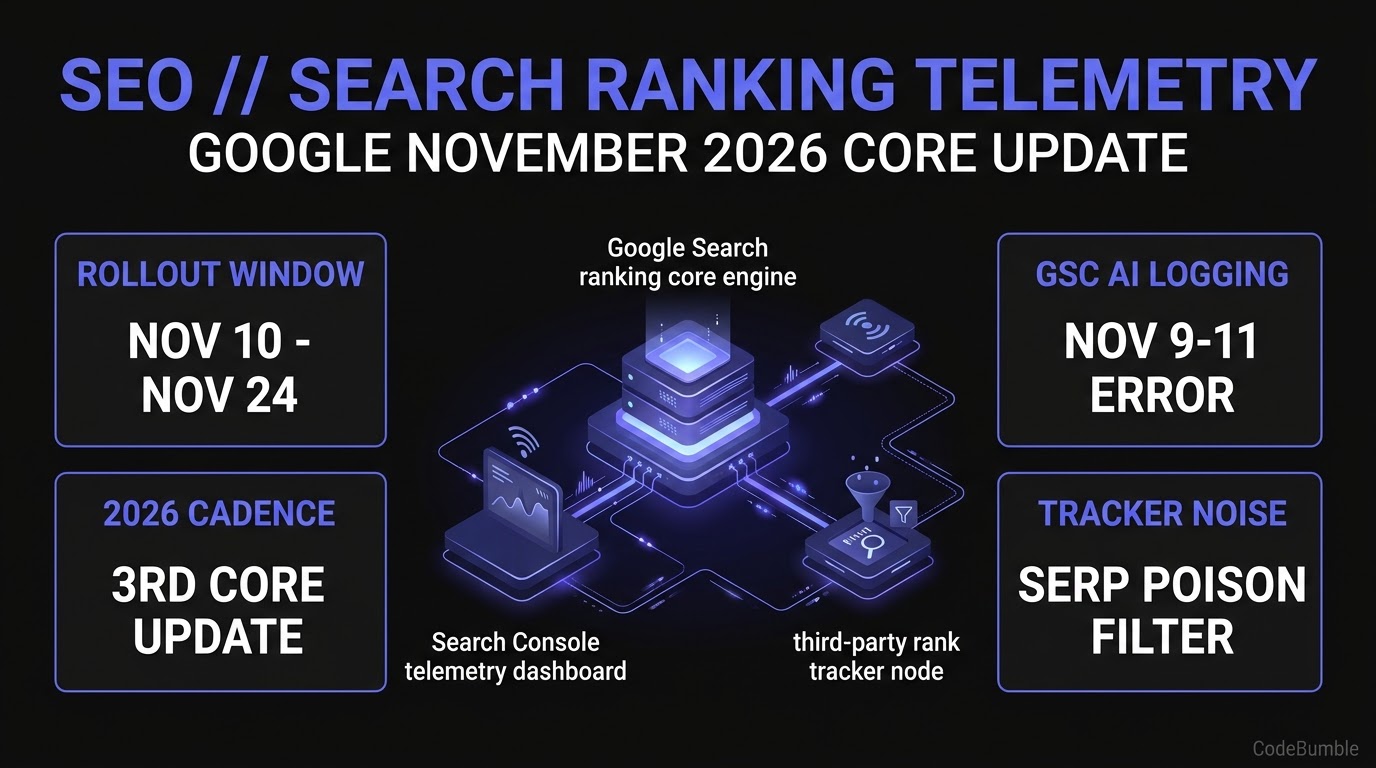
Executive Summary
Google's November 2026 core update is actively rolling out across all languages and regions, having begun on November 10, 2026 at 10:06 PST (1:07 PM ET). As Google's third broad core update of 2026—and its eighth ranking update listed on the Search Status Dashboard this year—the rollout is projected to take up to two weeks, potentially concluding around November 24, 2026, three days before Black Friday.
Unlike routine core updates, the November 2026 rollout is unfolding amid three overlapping measurement distortions that are causing third-party rank trackers, Google Search Console (GSC), and server analytics to diverge sharply:
- Poisoned automated SERP responses: Third-party rank tracking platforms (including Semrush) are actively filtering out "poisoned" search results returned by Google to automated scraping requests, muting aggregate volatility charts.
- Search Console generative AI logging error: Google confirmed a logging error in Search Console's generative AI report that artificially lowered reported impressions from November 9 to 11, 2026—directly overlapping the first two days of the core update rollout.
- Performance reporting lag and prior agent clicks: Search Engine Roundtable and SEO analyst Glenn Gabe documented Search Console performance reporting lag alongside earlier November "phantom agent clicks," with clear core-update ranking surges and drops landing primarily around November 13, 2026.
Confidence Level: High. Rollout timestamps, official guidance, and historical 2026 update dates are verified directly via the Google Search Status Dashboard and Google Search Central Core Updates Documentation; third-party tracker poisoning and GSC AI logging errors are corroborated by Semrush (Nov 17, 2026) and Search Engine Roundtable (Nov 16–17, 2026).
Technical Mechanics & Telemetry Architecture
Per Google Search Central's core update documentation, broad core updates do not target specific sites or enforce manual spam penalties. Instead, Google periodically recalibrates how its core ranking systems evaluate overall helpfulness, relevance, and user satisfaction across the open web—impacting standard Web Search, Google Images, Video mode, News, Google Discover, and AI experiences that integrate core ranking signals.
However, diagnosing those ranking shifts in November 2026 requires understanding why your monitoring stack may report conflicting signals:
+-----------------------------------------------------------------------+
|                GOOGLE SEARCH RANKING SYSTEMS (NOV 10+)                |
|  * Broad Core Update (All languages & regions; ~2 weeks -> Nov 24)    |
|  * Feeds Web Search, Discover, Featured Snippets, & AI Experiences    |
+-------------------+-----------------------------------+---------------+
                    |                                   |
        (Direct User / Browser)             (Automated Rank Trackers)
                    |                                   |
                    v                                   v
+---------------------------------------+   +---------------------------+
|      GOOGLE SEARCH CONSOLE (GSC)      |   |  3RD-PARTY RANK TRACKERS  |
|  * Source of truth for site queries   |   |  * Google returns         |
|  * Caveat 1: Nov 9-11 GenAI logging   |   |    "poisoned" SERPs to    |
|    error lowered AI impressions       |   |    automated requests     |
|  * Caveat 2: Reporting lag & early    |   |  * Trackers filter noise, |
|    Nov phantom agent click spikes     |   |    muting volatility data |
+-------------------+-------------------+   +-------------+-------------+
                    |                                     |
                    +------------------+------------------+
                                       |
                                       v
+-----------------------------------------------------------------------+
|             ENGINEERING & SEO DIAGNOSTIC BASELINE                     |
|  1. Wait 7 days post-rollout completion (per Google docs)             |
|  2. Cross-check GSC URL-level clicks vs. edge/origin server logs      |
|  3. Separate Web Search, Discover, Images, News & seasonal demand     |
+-----------------------------------------------------------------------+
Why Automated Rank Trackers Show Muted Volatility
During the initial days of the November 2026 rollout, Search Engine Roundtable noted that aggregate volatility sensors appeared unusually calm relative to publisher complaints. Both Semrush and Search Engine Roundtable attributed this discrepancy to Google serving "poisoned" or degraded SERP responses to automated rank-tracking bots, forcing trackers to aggressively filter anomalous results. When a third-party tracker shows a sudden swing on an unrelated keyword, teams must validate it against first-party Search Console data before touching production templates or canonicals.
Safe First-Party Verification: GSC API & Server Log Correlation
Instead of reacting to noisy third-party SERP scrapes mid-rollout, engineering and SEO teams should pull clean, segmented Search Console data via the Search Analytics API (which recently added branded queries, multimodal, and country/device filters) and correlate organic landing-page trends against origin HTTP status codes and Googlebot crawl logs.
Below is a safe, read-only Python snippet illustrating how to separate Web Search vs. Discover performance windows in Search Console without mixing holiday seasonality or Nov 9–11 logging anomalies:
# Read-only Google Search Console Search Analytics API query template
# Compares clean pre-update baseline (Nov 1-7) vs. post-rollout window (after completion + 7 days)
from googleapiclient.discovery import build

def fetch_gsc_segment(credentials, site_url: str, start_date: str, end_date: str, search_type: str = "web"):
    """
    search_type: 'web', 'discover', 'image', 'video', or 'news'
    Always analyze search types separately per Google Search Central guidance.
    """
    service = build("searchconsole", "v1", credentials=credentials)
    request_body = {
        "startDate": start_date,
        "endDate": end_date,
        "dimensions": ["page", "device"],
        "type": search_type,
        "rowLimit": 1000,
    }
    response = service.searchanalytics().query(siteUrl=site_url, body=request_body).execute()
    return response.get("rows", [])
Equally important on the server side: Google Search Central reiterated on November 17, 2026 that returning an HTTP 200 status code when a site or page is down (a "soft 404" or outage mask) damages crawling and indexing quality. Audit edge logs to confirm outage or maintenance pages return 503 Service Unavailable with a Retry-After header rather than 200 OK.
Evidence & 2026 Rollout Context
2026 Google Search Update Cadence
Data from the Google Search Status Dashboard and Semrush's November 17, 2026 analysis places the November 2026 core update in historical context:
| Update | Start Date | Completion / Duration | Notes |
|---|---|---|---|
| February 2026 Discover Core Update | February 5, 2026 | Completed | Discover-specific core update |
| March 2026 Core Update | March 27, 2026 | April 8, 2026 (~12 days) | 1st broad core update of 2026 |
| May 2026 Core Update | May 21, 2026 | June 2, 2026 (~12 days) | 2nd broad core update of 2026 |
| September 2026 Spam Update | September 24, 2026 | October 8, 2026 (~14 days) | Preceded Nov core update by ~1 month |
| November 2026 Core Update | November 10, 2026 | Active (est. up to 2 weeks -> ~Nov 24) | 3rd broad core update; 8th ranking update of 2026 |
Timing Risk: Holiday Seasonality vs. Rollout Length
While Google's March and May 2026 core updates each completed in roughly 12 days, Semrush notes that prior Q4 core updates ran significantly longer: the November 2024 core update took nearly 24 days, and the November 2023 core update took almost 26 days. Even on a 14-day schedule, the November 2026 core update lands directly ahead of Black Friday (November 27, 2026) and Cyber Monday, making year-over-year and category-level benchmarking essential so teams do not mistake seasonal retail demand swings for algorithmic penalties.
Early Volatility Patterns Observed (Nov 9–17, 2026)
Reports compiled by Search Engine Roundtable highlight several recurring patterns—while noting that early rollout fluctuations frequently reverse before completion:
- Delayed initial wave: Although announced November 10, publisher chatter and rank-tracker spikes accelerated on Friday, November 13 and Saturday, November 14, 2026.
- Scaled AI content & YMYL sensitivity: Analyst Glenn Gabe shared initial examples of domains scaling heavily via AI-generated content experiencing sharp drops starting November 13, alongside heightened volatility in health/YMYL informational queries.
- Local service-area pages: Multiple SMB practitioners reported ranking pressure on thin "service area" location pages lacking a physical presence in the target city.
- AI Overviews CTR compression: Publishers noted that even stable
#1organic rankings are experiencing lower click-through rates where AI Overviews sit above traditional organic results.
Hardening & Diagnostic Playbook
To avoid making destructive SEO or architectural changes based on incomplete mid-rollout telemetry, follow this five-step diagnostic playbook grounded in Google Search Central's core update guidance.
1. Freeze Reactive Template & Content Changes Until Rollout Completion
Do not rewrite templates, prune URLs, or alter internal linking while the Google Search Status Dashboard still lists the November 2026 core update as Active. Google explicitly warns against "quick fix" deletions or removing page elements mid-rollout.
2. Establish a Clean Pre/Post Measurement Window
Wait at least 7 full days after Google marks the November 2026 core update complete before running your primary Search Console comparison. Compare a full week post-completion against a clean pre-update week (such as November 1–7, 2026), explicitly excluding November 9–11 from generative AI impression comparisons due to Google's confirmed logging bug.
3. Segment by Search Surface and Position Magnitude
Analyze Web Search, Google Discover, Images, Video, and News separately in Search Console. Triage drops by magnitude per Google's documentation:
- Small position shifts (e.g., position 2 -> 4): Avoid touching pages that remain in top positions.
- Large sustained drops (e.g., position 4 -> 29): Audit the specific URLs against competitor pages now occupying those positions, evaluating first-hand expertise, original evidence, and commercial vs. informational intent alignment.
4. Audit HTTP Status Codes and Crawlability in Server Logs
Verify that your origin and CDN never serve HTTP 200 on soft-404s, empty category filters, or temporary maintenance pages. Run a quick edge-log audit to confirm Googlebot receives clean 200, 301, 404, or 503 responses:
# Audit Googlebot response code distribution in Nginx access logs
awk '$0 ~ /Googlebot/ {print $9}' /var/log/nginx/access.log | sort | uniq -c | sort -rn
5. Rollback & Recovery Expectations
If you determine that a prior site move, thin programmatic city/tag pages, or unreviewed AI-scaled sections contributed to a sustained post-rollout drop, consolidate or improve them for human readers rather than chasing short-term keyword tweaks. Per Google's documentation, recovery from a broad core update can take several months—either through continuous smaller unannounced core refreshes or the next major core update.
Frequently Asked Questions
When did the Google November 2026 core update start, and when will it finish? Per the Google Search Status Dashboard, the rollout began on November 10, 2026 at 10:06 PST and is expected to take up to two weeks (around November 24, 2026), though past Q4 core updates have occasionally run longer.
Why do third-party rank trackers look calmer than Search Console? Semrush and Search Engine Roundtable report that Google is returning "poisoned" SERP results to some automated requests, forcing rank trackers to filter anomalous data. Treat Google Search Console—after allowing for reporting lag—as your primary source of truth.
Why did my Search Console generative AI impressions drop on November 9–11? Google confirmed a logging error in Search Console's generative AI report that lowered reported impressions from November 9 to 11, 2026. That dip is a reporting artifact, not a core update penalty.
Does the November 2026 core update affect Google Discover and AI Overviews? Yes. Google's documentation confirms core updates affect Discover and other Search features, and Google integrates core ranking signals into its AI experiences, though Google has not published AI-specific guidance for this release.
Should I delete pages that dropped during the November 2026 core update? Google advises treating content deletion as a last resort—only for sections created primarily for search engines rather than people that cannot be salvaged—and never making major deletions before the rollout finishes and stabilizes.
Sources
- Google Search Status Dashboard — November 2026 core update Incident (Started November 10, 2026; Dashboard checked November 17–18, 2026)
- Google Search Central — Google Search's Core Updates and Your Website and Latest Documentation Updates (Updated November 2026)
- Semrush — Google November 2026 core update: What marketers should know (Published November 17, 2026)
- Search Engine Roundtable — Google November 2026 Core Update Ranking Volatility (Published November 16, 2026; updated November 17, 2026)