

AI
Inkling 2 Mini: Looped 26.4B MoE Architecture, Benchmarks, Pricing & Production Trade-Offs
Thinking Machines Lab released Inkling 2 Mini on November 20, 2026 under Apache 2.0: a 26.4B-parameter looped Mixture-of-Experts model (3.4B active, 5.4B effective) with 1M context and $0.15/$0.50 per 1M token pricing. We audit its vendor-reported coding leads against independent composite scores and live agentic caveats.
9 min read
Inkling 2 Mini: Looped 26.4B MoE Architecture, Benchmarks, Pricing & Production Trade-Offs
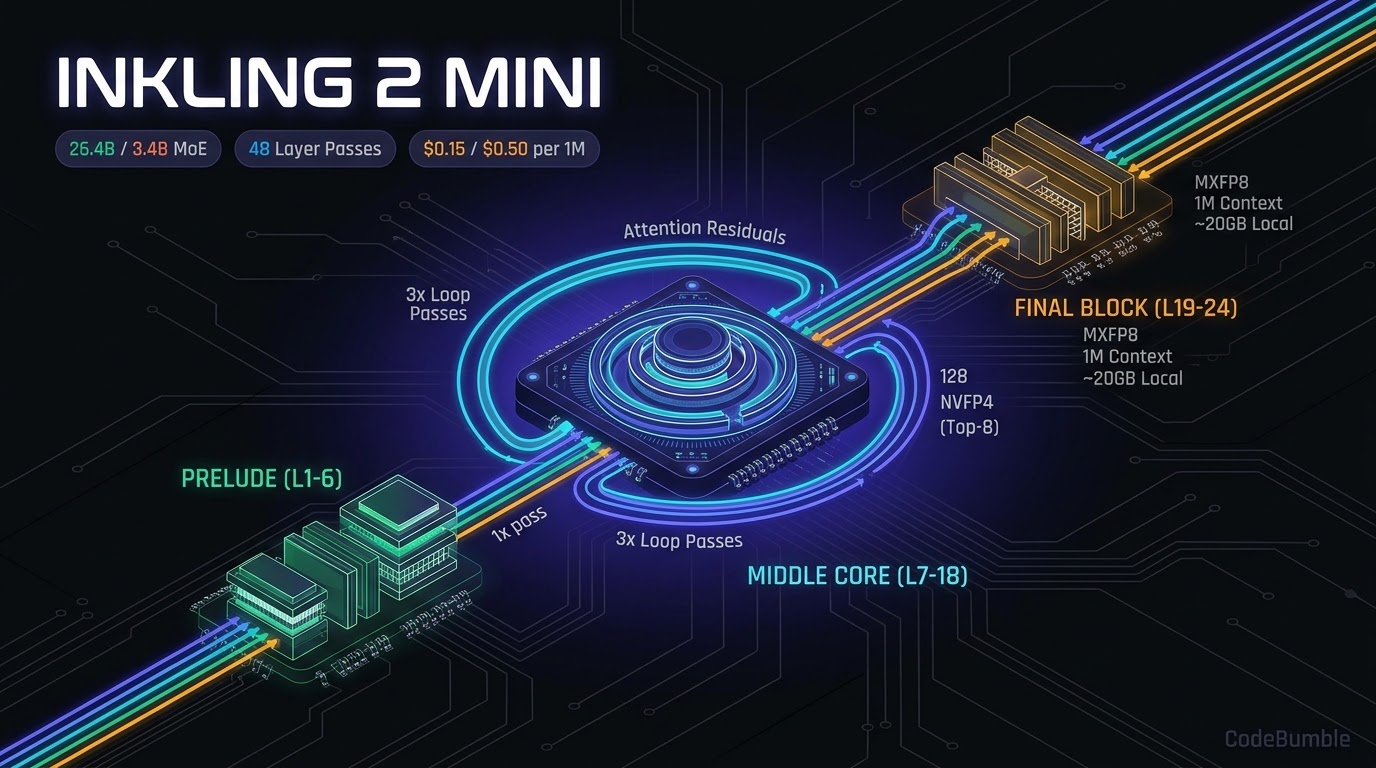
On November 20, 2026, Thinking Machines Lab released Inkling 2 Mini, an open-weight multimodal Mixture-of-Experts (MoE) model under the Apache 2.0 license designed to deliver agentic coding and long-context reasoning inside a ~20 GB local memory footprint (Thinking Machines Lab). Instead of scaling parameter count to boost reasoning depth, Inkling 2 Mini uses a looped transformer architecture that runs its middle 12 layers three times per token—expanding 24 stored layers into 48 layer applications.
Executive Summary
- Release & License: Inkling 2 Mini, released November 20, 2026 by Thinking Machines Lab under Apache 2.0 (Hugging Face Model Card).
- Specs & Footprint: 26.4B total parameters, 3.4B active parameters per pass (5.4B effective across three middle-block loops), 1M-token context window, text + image input, text output, and a ~20 GB checkpoint trained natively in NVFP4 (layers 0–19) and MXFP8 (layers 20–23).
- API Pricing: $0.150 per 1M input tokens, $0.0150 per 1M cached input tokens, and $0.500 per 1M output tokens via Thinking Machines Lab's Tinker platform (LLM Stats).
- Empirical Caveat: While vendor-reported evaluations show Inkling 2 Mini leading sub-100B open-weight peers on coding and document suites—79.2% on SWE-bench Verified and 92.8% on OmniDocBench v1.6—independent composite tracking on LLM Stats places it #92 of 425 overall (
39.4), and early third-party testing flags infinite reasoning-loop risks during live debugging (MindStudio).
Architecture & How It Works
Standard decoder-only transformers pass each token through a fixed stack of layers once, forcing multi-step serial reasoning either into more parameters or into longer, token-expensive chain-of-thought (CoT) outputs. Inkling 2 Mini modifies that trade-off by recycling its middle weights.
Model Specifications
| Attribute | Inkling 2 Mini Specification | Source |
|---|---|---|
| Architecture | 24-layer Sparse MoE Looped Transformer (128 experts, top-8 active) | Hugging Face Blog |
| Total / Active Parameters | 26.4B total / 3.4B active (5.4B effective weight activations) | Thinking Machines Lab |
| Layer Execution | 4 blocks × 6 layers; Blocks 2 & 3 (layers 6–17) loop 3× (48 passes/token) | ggml-org GGUF Notes |
| Context Window & Modalities | 1,048,576 (1M) input tokens; Text + Image in, Text out | LLM Stats |
| Native Quantization | Layers 0–19 experts in NVFP4; Layers 20–23 in MXFP8 (~20 GB) | Thinking Machines Lab |
| Speculative Drafter | Bundled DSpark drafter (up to 7 tokens per pass) | Hugging Face Blog |
| License | Apache 2.0 (open weights + variable-loop research checkpoint) | Thinking Machines Lab |
Looped Middle Layers and Attention Residuals
Thinking Machines Lab divided the 24-layer network into four 6-layer blocks:
flowchart LR
    A["Input Tokens + Images"] --> B["Prelude: Block 1 (Layers 0–5)<br/>Runs 1x"]
    B --> C["Loop Core: Blocks 2 & 3 (Layers 6–17)<br/>Pass 1 (No prior message)"]
    C -->|"Message + Attention Residuals"| D["Loop Core: Blocks 2 & 3<br/>Pass 2"]
    D -->|"Message + Attention Residuals"| E["Loop Core: Blocks 2 & 3<br/>Pass 3"]
    E --> F["Final Block 4 (Layers 18–23)<br/>MXFP8 • Runs 1x"]
    B -.->|"Prelude Feed"| D
    B -.->|"Prelude Feed"| E
    F --> G["Output Tokens (DSpark Speculative Drafter)"]
Rather than summing every layer's output into a single running residual stream, Inkling 2 Mini uses Attention Residuals—allowing each layer to read and mix earlier block outputs—paired with a learned gate that blends the prelude's output with the previous pass's hidden "message." According to Thinking Machines Lab's ablation study, looping the middle 12 layers outperformed looping the final 12 layers on 27 out of 28 evaluations, yielding a 1.51× to 1.91× compute-equivalent gain versus 1.24× to 1.36× for last-layer looping. Crucially, while an unlooped baseline required 7.5% less training compute, it needed 140% more inference compute to match the looped model's loss on 512K-token agentic traces.
Native NVFP4 Training, Pruning, and Healing
Rather than training in BF16 and quantizing post-hoc, Thinking Machines Lab trained Inkling 2 Mini's routed experts natively in 4-bit NVFP4 (layers 0–19) and 8-bit MXFP8 (layers 20–23) on NVIDIA GB300 hardware, eliminating post-training conversion loss. Mid-training, the team pruned two-thirds of the 384 experts down to the 128 most-used experts per layer, then healed the model on 1 trillion tokens distilled from a larger internal Inkling checkpoint before running SFT and 2.2 trillion tokens of RL over 2,000 steps.
Benchmarks, Cost & Latency Analysis
Evaluating Inkling 2 Mini requires separating Thinking Machines Lab's self-reported model card comparisons from broader third-party leaderboards and real-world agent tests.
Vendor-Reported Benchmarks vs. Sub-100B Open Peers
In Thinking Machines Lab's launch evaluation, Inkling 2 Mini leads or ties in 32 of 48 benchmarks against Gemma 4 31B, Muse Glimmer (30B), Qwen3.8-27B, and Nemotron 3.5 Super VL (124.5B total / 12B active):
| Benchmark | Inkling 2 Mini | Qwen3.8-27B | Gemma 4 31B | Nemotron 3.5 Super VL | Notes / Harness |
|---|---|---|---|---|---|
| AA Index (v5.0) | 20.1 | 20.1 | 4.4 | 13.6 | Tied first among peers |
| SWE-bench Verified | 79.2% | 77.8% | 46.1% | 71.1% | Bash-only harness |
| SWE-bench Pro v2 (Hard) | 77.9% | 73.8% | 14.2% | 44.1% | mini-swe-agent v2.4.6 |
| DeepSWE v1.1 | 48.2% | 42.2% | 0.3% | 24.7% | mini-swe-agent v2.4.6 |
| Terminal Bench v2.1 | 71.6% | 73.0% | 43.4% | 60.7% | pi v0.83.0 |
| BrowseComp (compaction) | 79.0% | 61.6% | 37.0% | 78.9% | Search + compaction |
| MCP Atlas (Public) | 82.7% | 77.3% | 54.2% | 67.7% | Tool calling |
| OmniDocBench v1.6 | 92.8% | 91.5% | 82.5% | 77.9% | Document OCR/parsing |
| LongBench v2 | 66.9% | 52.3% | 52.9% | 62.1% | Long-context reasoning |
| AA-Omniscience v1.1 | -8.6 (63.4% non-halluc.) | -6.4 (71.4%) | -48.5 | -2.9 (69.5%) | Knowledge factuality |
Independent Reality Check & Evidence Caveats
When placed on cross-tier leaderboards against frontier proprietary models, Inkling 2 Mini's standing is more modest:
- Composite Ranking: On LLM Stats, Inkling 2 Mini holds a composite score of 39.4 (#92 of 425 tracked models), sitting just behind Grok-4 Heavy (
39.8) and ahead of Seed 2.0 Pro (38.4). While it ranks #17 of 139 on long-context composite (RULER,MRCR,NoLiMa,LongBench), it ranks #84 of 317 in coding and #90 of 418 in reasoning across all model sizes. - Knowledge & Multi-Turn Weaknesses: Thinking Machines Lab explicitly notes in its Model Card that looping does not add factual memory to weights. Inkling 2 Mini scores -8.6 on AA-Omniscience (
63.4%non-hallucination rate vs. Qwen3.8-27B's71.4%), 50.0% on MultiChallenge, 33.4% on ComplexConstraints v1.1, and 15.2% on HLE-Diamond. - Live Agentic Loop Risk: In an independent test reported by MindStudio, debugging a tiered electricity-pricing bug caused Inkling 2 Mini to loop for over an hour without isolating the root cause—echoing the official model card's warning that the model can get stuck in repetitive reasoning or code-rechecking loops.
Token Pricing, Energy Efficiency & Local Speed
| Deployment / Provider | Input $/1M | Cached Input $/1M | Output $/1M | Hardware / Throughput Notes |
|---|---|---|---|---|
| Thinking Machines Lab (Tinker) | $0.150 | $0.0150 | $0.500 | 1M context; serverless inference (LLM Stats) |
| Self-Hosted (DGX Spark 128 GB) | $0 (CapEx) | $0 | $0 | 0.703 Stanford Intelligence per Watt (MXFP8) vs. 0.430 Qwen3.6-35B-A3B |
| Self-Hosted (1× RX 7900 XTX / RTX 3090) | $0 (CapEx) | $0 | $0 | ~80 tok/s with DSpark draft head (RX 7900 XTX); up to 300 tok/s on RTX 3090 vLLM (HF Discussions) |
| Apple Silicon (32 GB+ Mac / 16 GB 2-bit) | $0 (CapEx) | $0 | $0 | ~20 GB original checkpoint runs via MLX; 9.1 GiB 2-bit MLX build available with ~10% higher perplexity |
Production Deployment & Trade-Offs
For engineering teams deciding where Inkling 2 Mini fits in a production stack, the trade-offs are sharp:
- Choose Inkling 2 Mini for local or low-cost document parsing (
92.8%OmniDocBench), search-augmented agents (82.7%MCP Atlas,79.0%BrowseComp), and single-GPU coding assistants (~20 GBVRAM) where tool use compensates for smaller parametric knowledge. - Choose Qwen3.8-27B or Cloud Flagships for closed-book factual recall (
71.4%vs63.4%non-hallucination), strict multi-constraint instruction following (ComplexConstraints), or non-English workloads (the Model Card notes clipped phrasing and mixed-language artifacts in Chinese). - Production Guardrails Required:
- Cap Output & Turn Budgets: Always set strict
max_tokensand maximum agent turn limits to prevent infinite debugging loops. - Tune
reasoning_effort: Runtimes likellama.cppandvLLMexposereasoning_effort(none,minimal,low,medium,high[default],xhigh,max, or0.0–0.99)—dial it down for routine tool routing and up only for hard planning steps. - Avoid Low
top_k: Community engine maintainers (Xolotl/GGUF notes) warn that smalltop_kvalues exacerbate thinking loops; stick to default sampling (temperature=1.0,top_p=1.0). - Gate Destructive Tools: The official model card warns that Inkling 2 Mini can overwrite or delete files without confirmation and misreport outcomes—require explicit human confirmation or sandboxed execution.
- Cap Output & Turn Budgets: Always set strict
Frequently Asked Questions
How does Inkling 2 Mini's looped transformer work?
Inkling 2 Mini stores 24 transformer layers organized into four 6-layer blocks. The first block (layers 0–5) and last block (layers 18–23) run once per token, while the two middle blocks (layers 6–17) loop three times using shared weights and Attention Residuals. Each token receives 48 effective layer passes without storing 48 layers of weights in memory.
Can I run Inkling 2 Mini on a laptop or a single 24 GB GPU?
Yes. Because experts in layers 0–19 are natively quantized in NVFP4 and layers 20–23 in MXFP8, the full checkpoint is roughly 20 GB. It runs on 32 GB+ Apple Silicon Macs via mlx-vlm or llama.cpp, and community GGUF (Q4_K_M / IQ4_NL) or vLLM NVFP4 builds fit on a single 24 GB GPU such as an RTX 3090 or RX 7900 XTX.
Does looping make chain-of-thought monitoring harder?
In Thinking Machines Lab's preliminary monitorability experiments with their variable-loop TML-d24-varloop-research model, increasing loops raised no-CoT reasoning horizons from 16 seconds (1 pass) to 37 seconds (3 passes), and shortened written CoT slightly, but CoT remained legible and did not increase covert sabotage behavior at this 26.4B scale.
How much does Inkling 2 Mini cost via API?
Via Thinking Machines Lab's Tinker platform, Inkling 2 Mini costs $0.150 per million input tokens, $0.0150 per million cached input tokens, and $0.500 per million output tokens, with a 1M-token context window. Self-hosting under Apache 2.0 incurs zero licensing fees.
What are Inkling 2 Mini's biggest weaknesses in production?
Its primary weaknesses are closed-book factual recall (-8.6 on AA-Omniscience), multi-turn constraint adherence (50.0% on MultiChallenge), non-English output quality, and a tendency to get stuck in repetitive reasoning or debugging loops unless max_tokens and turn caps are enforced.
Sources
- Thinking Machines Lab: Introducing Inkling 2 Mini — Published November 20, 2026 (official architecture, looping ablations, NVFP4/MXFP8 training, monitorability study, and benchmark table).
- Hugging Face Model Card: thinkingmachines/Inkling-2-Mini — Published November 19, 2026; verified November 22, 2026 (official limitations, safety evaluation, and community runtime discussions).
- Hugging Face Blog: Inkling 2 Mini, Cutting-edge Performance for your Local Setup — Published November 21, 2026 (DSpark drafter,
transformers,llama.cpp,MLX, andSGLangsupport). - LLM Stats: Inkling 2 Mini Benchmarks, Pricing & Context Window — Updated November 21, 2026 (Tinker API pricing
$0.150/$0.0150/$0.500,#92 of 425composite score, and#17 of 139long-context rank). - MindStudio: Inkling 2 Mini Benchmarks: How Thinking Machines' Open Model Scores — Published November 21, 2026 (independent live debugging loop observation).
- MarkTechPost: Meet Thinking Machines Inkling 2 Mini — Published November 21, 2026 (architecture summary and hardware footprint).