

Device
Apple iPad mini (2026) A20 Pro: 2nm GAA Silicon Architecture, Storage-Tied Binning & Benchmarks
Apple's 2026 iPad mini pairs an 8.5-inch OLED display and IP67 chassis with TSMC 2nm A20 Pro silicon—but splits CPU and Neural Engine hardware by storage tier. Here is the architectural breakdown, Geekbench 7 telemetry, and thermal and display trade-offs.
9 min read
Apple iPad mini (2026) A20 Pro: 2nm GAA Silicon Architecture, Storage-Tied Binning & Benchmarks
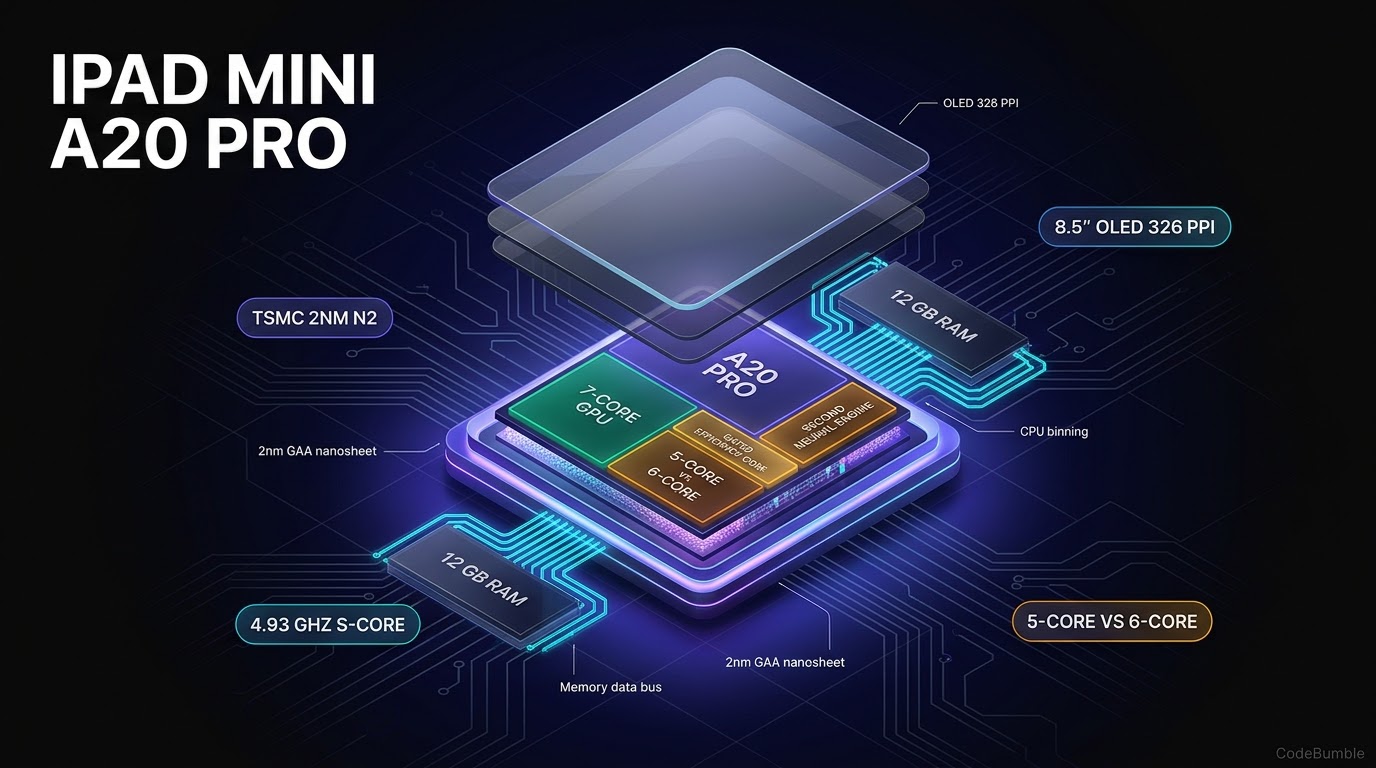
Executive Summary
Apple's 2026 iPad mini (A20 Pro)—announced in October 2026 and starting at $699 (Wi-Fi) and $849 (Wi-Fi + Cellular) per MacRumors—brings TSMC's 2nm N2 Gate-All-Around (GAA) nanosheet silicon, 12 GB of RAM, Wi-Fi 7, IP67 water resistance, and an 8.5-inch Super Retina XDR OLED display into a 255-gram chassis. However, Apple Support's official technical specifications confirm an unusual hardware segmentation: the 128 GB and 256 GB models ship with a binned 5-core CPU and single 16-core Neural Engine, while only the 512 GB configuration unlocks the full 6-core CPU and Dual 16-core Neural Engine.
For embedded engineers, mobile developers, and technical buyers evaluating compact compute-per-watt, the iPad mini (A20 Pro) delivers workstation-class single-thread burst speed (3,879 in Geekbench 7 per Notebookcheck)—outscoring even larger iPad Pro generations on single-core tasks—while remaining constrained by passive cooling, a 60 Hz OLED refresh rate, and 10 Gb/s USB 3 I/O.
Silicon & Hardware Architecture
Built on TSMC's 2nm N2 process with Gate-All-Around (GAA) nanosheet transistors—confirmed across Apple's A20 Pro announcement and Notebookcheck's SoC database (updated November 24, 2026)—the A20 Pro represents a major architectural jump over the 3nm A17 Pro in the 2024 iPad mini.
flowchart LR
    SoC[Apple A20 Pro - TSMC 2nm N2 GAA] --> SCore[2x Super Cores @ up to 4.93 GHz]
    SoC --> ECore[Efficiency Cluster @ up to 2.6 GHz]
    ECore -->|128GB / 256GB| E3[3x Active E-Cores + 16-Core NPU]
    ECore -->|512GB| E4[4x Active E-Cores + Dual 16-Core NPU]
    SoC --> GPU[7-Core GPU @ up to 1620 MHz + Ray Tracing + Neural Accelerators]
    SoC --> Cache[24 MiB L2 + 36 MiB System-Level Cache]
    SoC --> RAM[12 GB Unified Memory]
    SoC --> IO[Apple N1 Wi-Fi 7 / BT 6 / Thread + Apple C2 5G Modem]
Why TSMC 2nm N2 GAA Nanosheets Matter
Unlike FinFET transistors used in earlier 3nm Apple Silicon nodes (such as A17 Pro and A18 Pro), TSMC's N2 process transitions to Gate-All-Around (GAA) nanosheet channels, where the gate wraps completely around horizontally stacked silicon channels. For compact, fanless devices like the 5.4 mm iPad mini, GAA architecture improves electrostatic control and reduces sub-threshold leakage—allowing Apple to push the two Super Cores (S-Cores) to 4.93 GHz while keeping idle and light-load power draw low enough to preserve the 10-hour battery target inside an 18.9 Wh cell.
| SoC Generation | Process Node | CPU Core Count | Peak Clock | Cache |
|---|---|---|---|---|
| Apple A20 Pro (512 GB iPad mini) | TSMC 2nm (N2 GAA) | 6 (2 S-Core + 4 E-Core) | Up to 4.93 GHz | 36 MiB SLC |
| Apple A20 Pro 5-Core (128/256 GB) | TSMC 2nm (N2 GAA) | 5 (2 S-Core + 3 E-Core) | Up to 4.93 GHz | 36 MiB SLC |
| Apple A19 Pro | 3nm | 6 cores | 2.6 – 4.26 GHz | 32 MiB L3 |
| Apple A18 Pro | 3nm | 6 cores | 2.42 – 4.04 GHz | 24 MiB SLC |
Core Layout, Cache Hierarchy, and Storage-Tied Binning
According to Notebookcheck's A20 Pro analysis and Apple Support, the 2026 iPad mini splits A20 Pro silicon into two distinct SKUs tied directly to NAND storage capacity:
| Specification | 128 GB / 256 GB iPad mini (A20 Pro) | 512 GB iPad mini (A20 Pro) |
|---|---|---|
| Process Node | TSMC 2nm (N2 GAA Nanosheet) | TSMC 2nm (N2 GAA Nanosheet) |
| CPU Configuration | 5-Core: 2x Super Cores (up to 4.93 GHz) + 3x Efficiency Cores (up to 2.6 GHz) | 6-Core: 2x Super Cores (up to 4.93 GHz) + 4x Efficiency Cores (up to 2.6 GHz) |
| Neural Engine (NPU) | 16-core Neural Engine | Dual 16-core Neural Engine |
| GPU | 7-core GPU (up to 1620 MHz), Neural Accelerators, HW Ray Tracing | 7-core GPU (up to 1620 MHz), Neural Accelerators, HW Ray Tracing |
| Cache Hierarchy | 1.4 MiB L1, 24 MiB L2, 36 MiB SLC | 1.4 MiB L1, 24 MiB L2, 36 MiB SLC |
| Unified Memory | 12 GB (confirmed via Xcode 27.2) | 12 GB (confirmed via Xcode 27.2) |
| Nano-Texture Glass | Optional on 256 GB only | Optional |
Display, Chassis, and Connectivity
- 8.5-inch Super Retina XDR OLED: Measures 2316×1512 at 326 ppi, delivering 600 nits max SDR brightness, 1,200 nits peak HDR brightness, 1 nit minimum brightness, and a 2,000,000:1 contrast ratio (Apple Support). However, as MacRumors notes, the panel remains locked at 60 Hz without ProMotion.
- Custom Silicon Connectivity: All models integrate the Apple N1 wireless chip (Wi-Fi 7 / 802.11be 2×2 MIMO, Bluetooth 6, and Thread), while cellular models add the Apple C2 5G modem (sub-6 GHz 4×4 MIMO, eSIM-only).
- Enclosure & Acoustics: At 5.4 mm thin and 255 g (Wi-Fi) / 263 g (Cellular), the chassis gains an IP67 rating (1 meter up to 30 minutes) and uses Acoustic Display stereo audio rather than traditional dual speaker grilles.
Real-World Performance, Thermals & Efficiency
Geekbench 7 Telemetry vs. Predecessor & iPhone 18 Pro Max
Early Geekbench 7 database results (iPad19,2, cellular 5-core A20 Pro unit) highlight both the raw speed of the 2nm Super Cores and the measurable cost of losing one efficiency core:
- Single-Core Score: 3,879 — 47% faster than the previous A17 Pro iPad mini, and roughly 4% behind the full 6-core iPhone 18 Pro Max. Notably, this places the 8.5-inch tablet ahead of larger iPad Pro models in single-threaded responsiveness.
- Multi-Core Score: 9,870 — 39% faster than the previous iPad mini, though roughly 14% behind the full 6-core iPhone 18 Pro Max due to the disabled fourth efficiency core.
Thermal Envelope, Power Delivery & Battery Trade-Offs
Unlike the iPhone Duo—which Apple pairs with a custom-designed vapor chamber—the iPad mini (A20 Pro) relies on passive aluminum dissipation across a 195.3 × 132.6 mm footprint and houses an 18.9 Wh lithium-polymer battery (rated for up to 10 hours of Wi-Fi web/video or 9 hours on cellular, with 50% fast-charging in ~30 minutes using a ≥35W USB-C adapter; a 20W adapter is bundled in the box).
- Burst vs. Sustained Workloads: Clocking two Super Cores at 4.93 GHz inside a 5.4 mm sealed IP67 enclosure favors bursty UI, compilation, and on-device LLM token prefill tasks. Under prolonged GPU ray tracing or continuous local inference, passive thermal throttling will naturally cap sustained clocks below peak numbers—meaning developers should benchmark sustained 10-minute loops rather than relying on single Geekbench runs.
- On-Device AI Memory & NPU Ceiling: Jumping to 12 GB of RAM removes the 8 GB ceiling that constrained local quantized models on earlier compact iPads. However, teams targeting heavy on-device Apple Intelligence / Core ML pipelines should note that only the 512 GB tier carries the Dual 16-core Neural Engine; the 128 GB and 256 GB tiers are limited to a single 16-core NPU.
Ecosystem, Repairability & Practical Verdict
Developer & Power-User Considerations
- Camera, Media Engine & Codec Support: Beyond compute, the A20 Pro media pipeline and Apple Support spec sheet include hardware playback support for AV1, ProRes, HEVC, and H.264, with HDR support spanning Dolby Vision, HDR10+, HDR10, and HLG. Imaging relies on a 12MP Wide rear camera (ƒ/1.8, 4K up to 60 fps, 1080p slo-mo up to 240 fps) paired with a landscape 12MP Center Stage front camera (ƒ/2.0), aligning video-call framing with horizontal tablet use.
- Wireless & Cellular Architecture: By pairing the custom Apple N1 wireless chip (Wi-Fi 7 2×2 MIMO, Bluetooth 6, Thread) with the Apple C2 5G modem (sub-6 GHz 4×4 MIMO, Gigabit LTE, eSIM-only with no physical SIM tray), Apple brings its vertically integrated radio stack to the iPad mini—reducing board footprint while enabling Thread smart-home border-router compatibility.
- I/O & External Display Limits: The USB-C port supports USB 3 up to 10 Gb/s and native DisplayPort output up to one 4K 60Hz external display (Apple Support). It lacks Thunderbolt / USB4 bandwidth for external NVMe RAID arrays or high-refresh external monitors.
- Environmental & Material Footprint: Apple reports 35% total recycled content, including 100% recycled aluminum in the enclosure, 100% recycled cobalt and 95% recycled lithium in the battery, and 100% recycled gold plating and tin solder on Apple-designed PCBs.
- Repairability Trade-Offs: Adding IP67 ingress protection and Acoustic Display stereo drivers improves durability against dust and spills, but sealed adhesives and integrated display transducers typically increase component replacement complexity compared to non-IP-rated tablets (independent teardown scores are not yet published in the fetched sources).
Who Should Upgrade (or Skip)
- Upgrade to 128 GB / 256 GB ($699+) if you want the lightest OLED field tablet (255 g, IP67, Wi-Fi 7, 12 GB RAM) for reading, Apple Pencil Pro sketching, or portable diagnostics, and can live with a 60 Hz panel and 5-core CPU.
- Step up to 512 GB only if you specifically need local storage headroom plus the unbinned 6-core CPU and Dual 16-core Neural Engine for heavier Core ML or multitasking workloads.
- Skip if you require 120 Hz ProMotion, Thunderbolt speeds, or active/vapor-chamber cooling for sustained 3D rendering—the M-series iPad Pro remains the better fit.
Frequently Asked Questions (FAQ)
What is the difference between the 128GB/256GB and 512GB iPad mini (2026)?
Per Apple Support, the 128 GB and 256 GB models use a binned 5-core CPU (2 super + 3 efficiency cores) and a single 16-core Neural Engine, whereas the 512 GB model includes a 6-core CPU (2 super + 4 efficiency cores) and a Dual 16-core Neural Engine. All tiers share the 7-core GPU and 12 GB of RAM.
How fast is the 2026 iPad mini A20 Pro in benchmarks?
In early Geekbench 7 listings, the 5-core A20 Pro iPad mini scored 3,879 in single-core (+47% over the prior generation) and 9,870 in multi-core (+39%).
Does the 2026 OLED iPad mini support 120Hz ProMotion?
No. Despite upgrading to an 8.5-inch Super Retina XDR OLED panel (326 ppi, 1,200 nits peak HDR), the 2026 iPad mini remains capped at a 60 Hz refresh rate (MacRumors).
How much RAM does the iPad mini (A20 Pro) have?
While Apple's public spec sheet omits RAM capacity, Xcode 27.2 developer tools and Geekbench 7 listings confirm 12 GB of unified memory across the lineup (Notebookcheck).
Is the 2026 iPad mini water-resistant?
Yes. It is the first iPad mini rated IP67 under IEC standard 60529, protecting against dust and immersion up to 1 meter for up to 30 minutes under controlled conditions (Apple Support).
Sources
- Apple Support — iPad mini (A20 Pro) - Tech Specs (Primary specification, 2026)
- Apple Newsroom — Apple debuts iPhone 18 Pro and iPhone 18 Pro Max (Primary A20 Pro 2nm architecture announcement, September 9, 2026)
- Notebookcheck — Apple A20 Pro 5-Core Processor - Benchmarks and Specs (Secondary technical database, updated November 24, 2026)
- Notebookcheck — Apple iPad mini (2026) in Geekbench: Single-core performance ahead of the iPad Pro (Secondary benchmark report, October 30, 2026)
- MacRumors — 512GB OLED iPad Mini Gets Extra CPU Core and Dual Neural Engine (Secondary reporting, October 26, 2026)