

Technology
Ladybird Browser Reaches Public Alpha (2026.47.8): Independent Engine Benchmarks, WPT Parity & Security Caveats
The non-profit Ladybird Browser Initiative launched its first public alpha on November 23–24, 2026 (2026.47.8) for macOS and Linux, bringing an independent from-scratch engine to desktop testers. Here is how its Speedometer 3.1, WPT parity, and security caveats compare to Chromium.
8 min read
Ladybird Browser Reaches Public Alpha (2026.47.8): Independent Engine Benchmarks, WPT Parity & Security Caveats
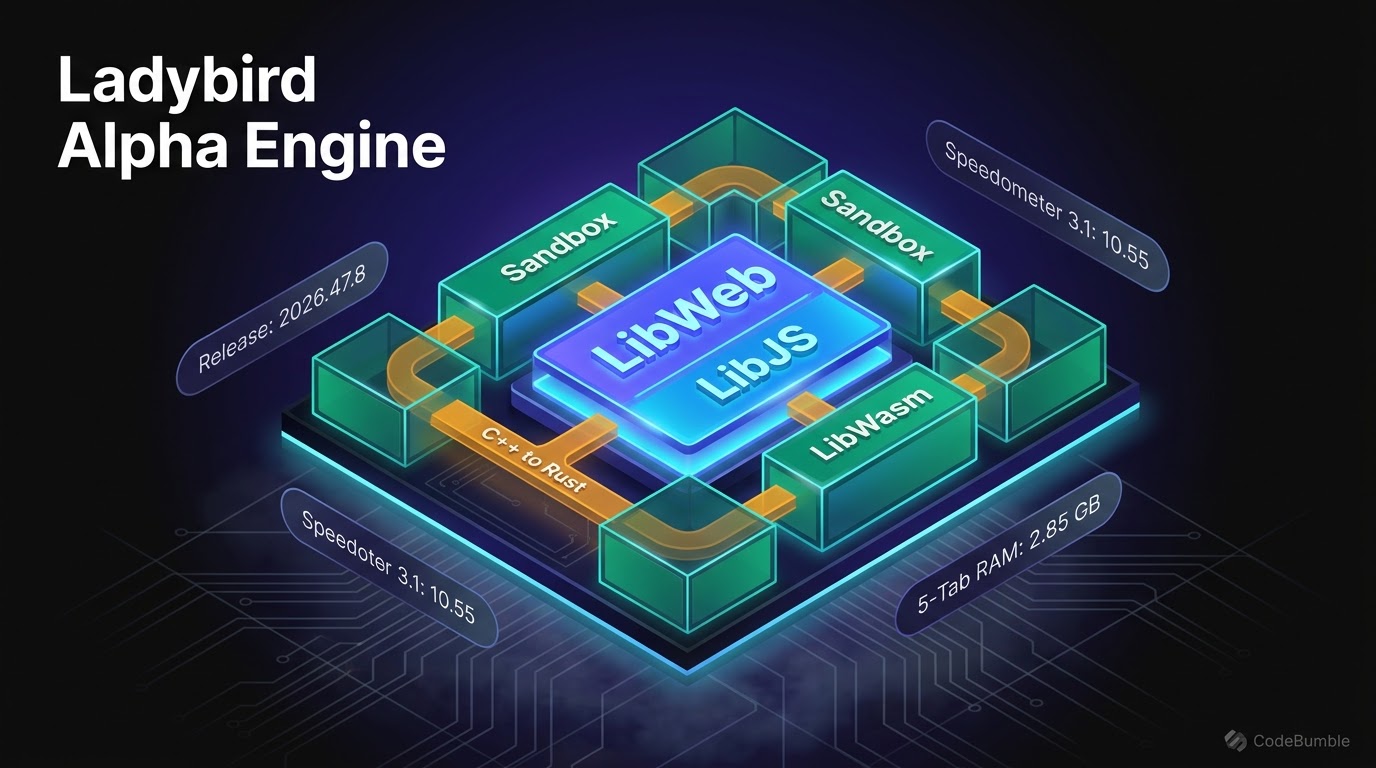
Executive Summary
On November 23, 2026, the Ladybird Browser Initiative—a 501(c)(3) non-profit organization—released the first public alpha of Ladybird (2026.47.7), followed on November 24, 2026 by rolling update 2026.47.8 for macOS and Linux (Ladybird; Ladybird GitHub Releases). Unlike browsers that re-skin Chromium's Blink engine, Ladybird implements HTML, CSS, DOM, layout, JavaScript (LibJS), and WebAssembly (LibWasm) from scratch—marking the first downloadable, non-forked desktop browser engine in over a decade.
- Standards & Compatibility: According to Ladybird's October 2026 progress data, the engine passed Safari Technology Preview on Web Platform Tests (WPT) subtests on October 26 and sits roughly 4,600 subtests behind Firefox (
2,189,315vs. Chrome's2,244,397) (DevOpen). - Real-World Speed & Memory Gap: Independent Linux testing on November 24, 2026 measured Ladybird
2026.47.7at 10.55 in Speedometer 3.1—about 40% of Chromium 158's26.5on the same machine—while consuming 2.85 GB PSS across 25 processes for five open tabs (~2.2× Chromium's1.28 GB) (DevOpen). - Primary Takeaway: Web developers can now test sites against a genuinely independent fourth engine via built-in WebDriver BiDi and Firefox DevTools protocol support. However, Ladybird explicitly states it makes "no promises about security today" and offers no native Windows installer yet, making it strictly a secondary testing browser rather than a daily driver (Ladybird GitHub Releases; WindowsForum).
What Changed: Independent Engine Architecture & Rolling Alpha
Most alternative desktop browsers—including Edge, Brave, Opera, and Vivaldi—share Google's Blink rendering engine, leaving the open web reliant on three major engines: Blink (Chromium), WebKit (Safari), and Gecko (Firefox) (DevOpen). Originally spun out of SerenityOS, Ladybird is built from the ground up with its own web-platform implementation while using third-party libraries for low-level media, graphics, and cryptography primitives (Ladybird).
Before November 23, 2026, trying Ladybird required cloning the repository and compiling the full C++/Rust codebase locally. The public alpha introduces prebuilt, auto-updating rolling packages alongside a rapid hotfix cadence:
2026.47.7(Nov 22–23, 2026): Initial public alpha for macOS (Apple SiliconmacOS 14.4+disk image) and Linux (x86-64andARM64via Flatpak, Ubuntu24.04/26.04+APT, Fedora44/45RPM, and standalone tarballs) (Ladybird GitHub Releases).2026.47.8(Nov 24, 2026): First rolling update, restoring macOS audio output (#15555), fixing Linux DNS resolution after NetworkManager rewrites/etc/resolv.conf(#14605), preventing Gmail's search box collapse (#15775), fixing oversized 2D<canvas>compositor crashes (#15429), and resolving Wayland Qt 6.10/6.11 and non-NVIDIA Linux GPU crashes (#15765,#15458) (Ladybird GitHub Releases).
Multi-Process Sandboxing & C++-to-Rust Migration
Ladybird separates untrusted web content into isolated OS processes (Ladybird GitHub Releases):
- Per-Site Sandboxed Renderer (
WebContent): Documents from different origins run in separate, sandboxed renderer processes. - Out-of-Process Image & Network Isolation: Image decoding and network connections execute out-of-process, isolated per top-level site.
- Incremental Rust Adoption: Although Ladybird began in C++, the project adopted Rust as its successor language in February 2026 for memory safety, migrating
LibJS's runtime and parts of style/layout incrementally (Ladybird; DevOpen).
flowchart TD
    UI["Browser UI Process<br/>(Tabs, Session Restore, Crash Reporter)"] --> NP["Site-Isolated Network Process<br/>(Per Top-Level Site)"]
    UI --> WC1["Sandboxed WebContent Renderer A<br/>(LibWeb + LibJS JIT + LibWasm)"]
    UI --> WC2["Sandboxed WebContent Renderer B<br/>(LibWeb + LibJS JIT + LibWasm)"]
    WC1 --> IMG["Out-of-Process Image & Media Decoders<br/>(ANGLE / Metal / Vulkan)"]
    WC2 --> IMG
    UI -->|DevTools & Automation| DT["WebDriver BiDi & Firefox DevTools Protocol"]
2026 Engineering Milestones Before Alpha
The November 2026 alpha builds on a rapid sequence of monthly engineering milestones documented on Ladybird's news archive:
- June–July 2026: Added GPU process isolation, download management, browsing history, DevTools storage inspection, private browsing, browser profiles, WebAudio, and began porting style and layout subsystems to Rust.
- August–September 2026: Landed a faster style engine, YouTube/Twitch video playback, hardware video decoding, and underwent security hardening with Trail of Bits while reducing idle-page resource consumption.
- October 2026: Shipped a redesigned UI shell (light, dark, and violet-dark private-window themes, pinned/searchable tabs, built-in content-blocking filter toggles), a new JavaScript JIT, a replacement WebAssembly engine, and initial screen-reader support (VoiceOver on macOS and Orca on Linux) (Ladybird; DevOpen; WindowsForum).
Funding & Governance Model
The Ladybird Browser Initiative operates as a 501(c)(3) non-profit funded exclusively by unrestricted donations and annual corporate sponsorships—Platinum ($100,000, including FUTO, Shopify, Cloudflare), Gold ($50,000, Human Rights Foundation, Proton VPN), Silver ($10,000), Bronze ($5,000), and Copper ($1,000) (Ladybird). Sponsors receive no board seats or roadmap influence, and the browser ships with no default-search revenue deals, crypto tokens, or user monetization.
Evidence and Data: Benchmarks, WPT Parity & Real-World Tests
Speedometer 3.1 & Memory Footprint (Independent Tests)
On November 24, 2026, DevOpen benchmarked Ladybird 2026.47.7 on two platforms using clean profiles (DevOpen):
| Metric / Test Environment | Ladybird 2026.47.7 |
Chromium 158 Baseline |
Measured Ratio / Notes |
|---|---|---|---|
| Linux Speedometer 3.1 (i7-13650HX, 30 GB RAM, Wayland) | 10.55 (10.5 / 10.6) |
26.5 (26.4 / 26.6) |
~40% of Chromium throughput |
| Linux 5-Tab Memory (Wikipedia, GitHub, Maps, Reddit, MDN) | 2.85 GB PSS (25 processes) |
1.28 GB PSS |
~2.2× memory (~2.1 GB in WebContent) |
| macOS Speedometer 3.1 (Apple M1, 16 GB RAM, macOS 27.0.1) | 13.2 (±0.43 / ±0.60) |
Not tested (no matching chromedriver) |
~53 s per run; ~2.8 GB footprint (26 processes) |
| Acid3 Compliance Test (Linux & macOS) | 96 / 100 |
— | WebGL & WebGL 2 via ANGLE; no WebGPU |
Ladybird's own October 2026 telemetry reflects rapid month-over-month optimization after landing a JavaScript JIT (x86-64 and AArch64) and a new WebAssembly engine: Speedometer 2 climbed from 84 to 156, Speedometer 3 rose from 5.9 to 8.6, and the JSLinux x86 emulator booted Alpine Linux in 1.8 s vs. Chrome's 1.5 s (DevOpen).
Site Compatibility & Standards Caveats
Across DevOpen's November 24 hands-on testing on macOS and Linux:
- Working Interactive Web Apps: YouTube (
1080pon macOS,720pon Linux with PipeWire audio),vscode.dev(syntax highlighting and auto-indent), Google Maps, Excalidraw,three.jsWebGL demos (60 FPSon M1), GitHub, Reddit, Wikipedia, MDN, and DuckDuckGo all rendered and functioned interactively (DevOpen). - Known Gaps & Alpha Bugs: Widevine, FairPlay, and ClearKey DRM are absent (so Netflix-style encrypted streams will not play), WebGPU is not yet exposed, and clicking elements inside a normal window via WebDriver triggered an assertion crash (
TypeCasts.h:65) in 3/3 Linux tries and 1/3 macOS tries—though headless WebDriver worked. - WPT Subtest Caveat: While passing Safari Technology Preview on WPT subtests (
~4,600behind Firefox's2,189,315) is a major engineering milestone, raw WPT counts compare against Safari's preview channel rather than stable Safari and do not weight real-world site traffic frequency (DevOpen).
Practical Guidance & Next Steps
Installing Safely & Testing Your Websites
Because the Ladybird team explicitly warns that some sites will break, crashes occur, and "there are no security promises yet", treat the alpha strictly as an isolated secondary browser—never use it for banking, primary work logins, or sensitive credentials (Ladybird GitHub Releases; DevOpen).
- Install via Auto-Updating Channels: On Apple Silicon Macs (
macOS 14.4+), use the official.dmgfromladybird.org. On Linux, prefer Flatpak or the Ubuntu/Fedora repositories so rolling updates (2026.47.8+) arrive automatically—standalone Linux tarballs do not auto-update (WindowsForum). - Windows Users (WSL2 Only): There is no native Windows
.exeor.msixalpha installer yet. Windows developers must build and run Ladybird inside WSL2 (Ubuntu/Fedora), though CI already testsLibJSon Windows (Ladybird; WindowsForum). - Run Automated Site Checks via WebDriver or Source: Developers can inspect pages using the Firefox DevTools protocol or run headless WebDriver checks, or build locally from GitHub:
# Build and launch Ladybird from source for local web compatibility testing
git clone https://github.com/LadybirdBrowser/ladybird.git
cd ladybird
./Meta/ladybird.py run
When a page layout or script fails in Ladybird, use the in-browser broken-site reporter (and review any crash dump before sending) so the team can isolate spec ambiguities against Blink/Gecko/WebKit behavior (Ladybird).
Platform Packaging & Automation Workarounds
For web developers evaluating cross-engine rendering, DevOpen's November 24 testing and WindowsForum's platform breakdown highlight three practical setup details:
- Package Choice Dictates Updates: On Linux, Flatpak and the official Ubuntu
24.04/26.04+APT and Fedora44/45RPM repositories track the rolling alpha channel automatically. The standalone Linux.tararchive does not self-update and requires manual replacement when hotfixes like2026.47.8ship. On macOS, the signed.dmgtargets Apple Silicon Macs runningmacOS 14.4or later. - Headless WebDriver vs. Normal Window Clicks: While Ladybird exposes WebDriver BiDi and the Firefox DevTools protocol, DevOpen observed an assertion crash (
TypeCasts.h:65) when sending automated mouse clicks inside a normal visible window (3/3 failures on Linux, 1/3 on macOS). Running automated test suites in headless mode avoided the crash cleanly. - Frozen User-Agent & Missing Media/GPU APIs: Ladybird's macOS build currently reports a frozen
Chrome 153onIntel Mac OS X 10_15_7user-agent string, passes96/100on Acid3, and supports WebGL/WebGL 2 via ANGLE, but lacks WebGPU and Widevine/FairPlay/ClearKey DRM—so interactive 3D canvases work while DRM-encrypted streaming services remain unsupported in alpha.
Frequently Asked Questions
Is Ladybird based on Chromium, Firefox, or WebKit?
No. Ladybird implements its own rendering (LibWeb), JavaScript (LibJS), and WebAssembly (LibWasm) engines from scratch rather than forking Blink, Gecko, or WebKit—though it uses established third-party libraries for image, audio, video, graphics, and cryptography primitives (Ladybird; Ladybird GitHub Releases).
Can I download Ladybird on Windows right now?
Not as a native installer. The November 2026 public alpha (2026.47.7 / 2026.47.8) supports macOS (Apple Silicon, 14.4+) and Linux (x86-64 and ARM64). Windows users can build from source via WSL2 while native Windows and mobile support remain planned for later stages (Ladybird; WindowsForum).
How fast is Ladybird compared to Chrome in Speedometer 3.1?
In independent Linux testing on November 24, 2026, Ladybird 2026.47.7 averaged 10.55 on Speedometer 3.1 compared to 26.5 for Chromium 158 on the same machine (~40% of Chromium's score) and used 2.85 GB of RAM across five tabs versus Chromium's 1.28 GB (DevOpen).
Is Ladybird safe to use as my daily browser?
No. The Ladybird release notes explicitly state "there are no security promises yet" and warn that sites may break or crash. Use it as a secondary browser for testing web compatibility and reporting bugs rather than for logins, banking, or sensitive sessions (Ladybird GitHub Releases; DevOpen).
How is Ladybird funded and governed?
Ladybird is developed by the Ladybird Browser Initiative, a 501(c)(3) non-profit funded solely by unrestricted donations and corporate sponsorships (including Platinum sponsors FUTO, Shopify, and Cloudflare at $100,000/year), with no default-search deals, crypto tokens, or sponsor control over the roadmap (Ladybird).
Sources
- Ladybird Browser Initiative — Official Website & Alpha Announcement (Published November 23, 2026): https://ladybird.org/
- GitHub — LadybirdBrowser/ladybird Releases (
2026.47.7and2026.47.8) (Released November 22–24, 2026): https://github.com/LadybirdBrowser/ladybird/releases - DevOpen — Ladybird Browser Alpha (2026): Engine, Speed, Mac & Linux Tests (Selim Talha Aksoy, published November 24, 2026): https://devopen.io/ladybird-browser/
- WindowsForum — Ladybird Browser Alpha Launches for macOS and Linux: Windows Support and Security Caveats (Updated November 24, 2026): https://windowsforum.com/news/ladybird-browser-alpha-launches-for-macos-and-linux-windows-support-and-security-caveats.453833/