

AI
LingSante-3.1-flash: Ant Group's 560B Open-Weight MoE Medical Model, Benchmarks & Serving Trade-Offs
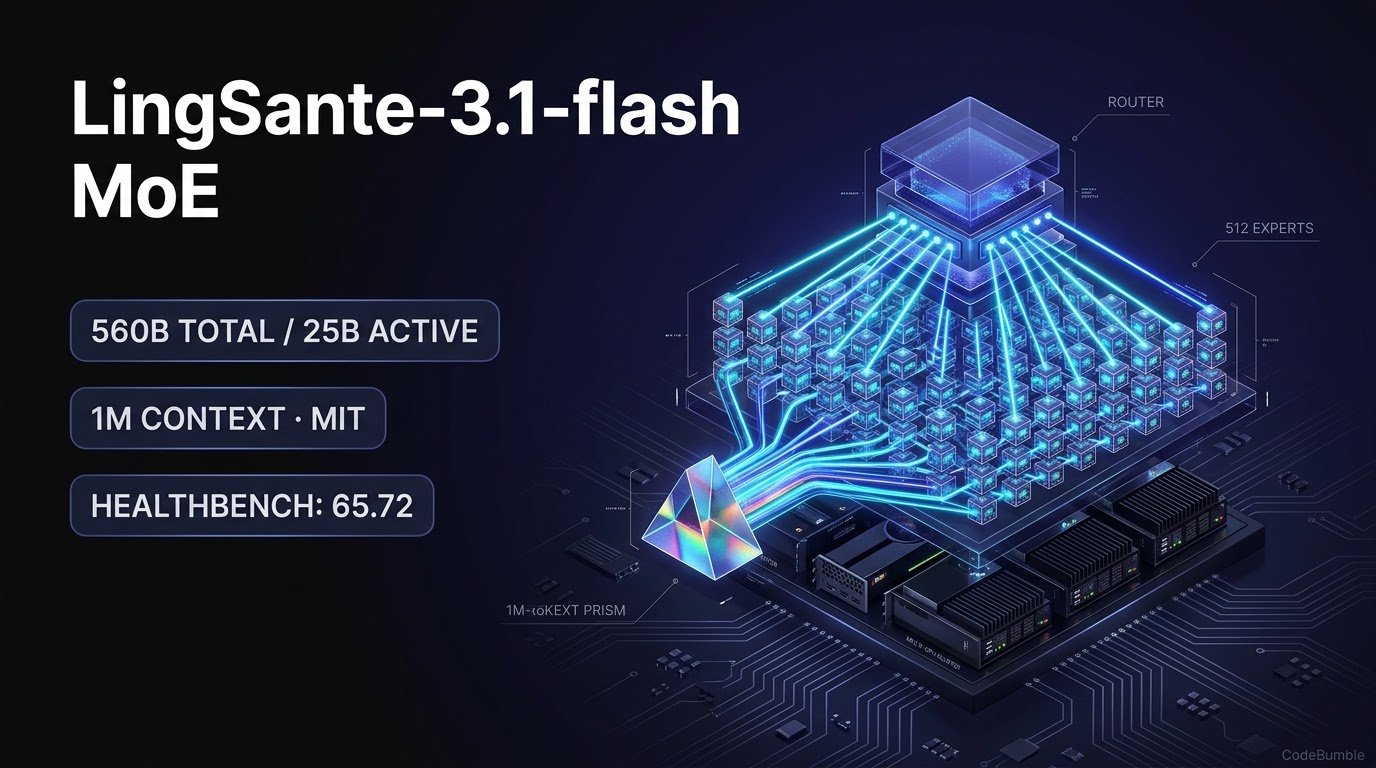
On November 22, 2026, Ant Group's inclusionAI team open-sourced LingSante-3.1-flash (560B total / 25B active, 1M context, MIT) and LingSante-3.1-air-VL (124B / 5.5B active). Here is a grounded look at its hybrid KDA+MLA architecture, where Ant's benchmarks lead or trail frontier models, and 8× H200 / 4× GB300 deployment requirements.
7 min read
LingSante-3.1-flash: Ant Group's 560B Open-Weight MoE Medical Model, Benchmarks & Serving Trade-Offs
Executive Summary
- Fresh open-weight release (November 22, 2026): Ant Group's Ant Ling (
inclusionAI) team releasedLingSante-3.1-flashon Hugging Face under an MIT license—a 560B total / 25B active parameter hybrid-linear Mixture-of-Experts (MoE) model with a 1-million-token context window—alongsideLingSante-3.1-air-VL(124B total / 5.5B active, 256K context) for multimodal medical imaging and GUI workflows, plus anMXFP4quantized variant published November 23, 2026. - Mixed self-reported benchmark profile: In Ant's own evaluation charts documented by CellCog,
LingSante-3.1-flashleads GPT-6 Astra, Claude Opus 5.5, and Gemini 4 Argon on HealthBench Professional (65.72), HLE text-only with tools (72.22), BrowseComp (94.10), and EHR-Complex (74.40), while trailing on MedXpertQA-Text (57.27), MedEthicAlign (80.85), MCP-Atlas (83.98), DiagnosisArena-MCQ (83.9), and PhysicianBench (57). - Cluster-scale hardware floor: Running full-precision/FP8
LingSante-3.1-flashvia day-0 SGLang or vLLM recipes targets 8 × H200 (TP8 + EP8) or 4 × GB300 (TP4 + EP4) clusters; no official hosted API pricing or independent third-party leaderboard scores have been published yet. - Strict clinical boundaries: Both model cards explicitly state that the models are research releases—not medical devices—and must not be used independently for diagnosis, prescriptions, or clinical triage.
Architecture & How It Works
Hybrid-Linear MoE Design (63 KDA + 9 Gated MLA)
Rather than using a uniform dense-attention transformer—which becomes memory-bandwidth bound at 1-million-token context lengths—LingSante-3.1-flash inherits the bailing_hybrid architecture of Ling-3.1-flash. It interleaves 63 KDA (linear-complexity) layers with 9 Gated Multi-Head Latent Attention (MLA) layers in a 7:1 ratio, plus 4 dense layers.
| Specification | LingSante-3.1-flash |
LingSante-3.1-air-VL |
|---|---|---|
| Release Date (UTC) | November 22, 2026 (15:22 UTC) | November 22, 2026 (17:26 UTC) |
| Base Model | Ling-3.1-flash |
Ling-3.0-flash-VL |
| Architecture | Hybrid-linear MoE (bailing_hybrid) |
Multimodal MoE (bailing_moe_v3_vl) |
| Total Parameters | 560B (572B params on HF card) | 124B (125B params on HF card) |
| Active Parameters / Token | 25B | 5.5B |
| Context Window | 1M tokens | 256K tokens (with YaRN scaling) |
| Layer Mix | 63 KDA + 9 Gated MLA (7:1), 4 dense | Vision-language MoE |
| Expert Routing | 512 routed + 1 shared (8 routed active) | Fine-grained MoE |
| Hidden / Vocab Size | Hidden 4096, 64 heads, Vocab 157,184 | Multimodal image + text |
| License | MIT | MIT |
Training Pipeline & Multimodal Companion
According to the Hugging Face model card, LingSante-3.1-flash was trained across five stages: native medical-mixed pretraining, mid-training, supervised fine-tuning (SFT), task-specific reinforcement learning (covering medical reasoning, search, tool use, and professional behavior alignment), and multi-teacher on-policy distillation to merge specialized capabilities while retaining general coding and reasoning skills.
Two hours later on November 22, 2026, Ant released LingSante-3.1-air-VL for visual-clinical workflows—covering chest X-ray multi-finding interpretation (identifying 8–9 positive findings such as cardiomegaly, pleural effusion, consolidation, pneumonia, and pneumothorax), 120+ skin condition assessments with multi-turn follow-up questions, meal/nutrient estimation, and medical GUI agent execution.
flowchart LR
    Input["Clinical Query / EHR / Tools (Up to 1M Tokens)"] --> Router["Top-8 MoE Router (512 Routed + 1 Shared Expert)"]
    Router --> Hybrid["63 KDA Linear Layers + 9 Gated MLA Layers (7:1)"]
    Hybrid --> Thinking{"Reasoning Mode (enable_thinking: true)"}
    Thinking -->|Tool / Search Needed| Tools["Verified Search / EHR / Imaging Tools"]
    Tools --> Hybrid
    Thinking -->|Final Synthesis| Output["Evidence-Grounded Response (Requires Human Review)"]
Day-0 Serving Setup (SGLang & vLLM)
Both SGLang and vLLM support LingSante-3.1-flash out of the box with Multi-Token Prediction (NEXTN / mtp) speculative decoding and ling3 tool/reasoning parsers. Below is the recommended SGLang Docker launch command from the official model card:
# Recommended day-0 SGLang server on 8x H200 (TP8 + EP8)
# On 4x GB300, replace with: --tp 4 --ep 4
docker run --gpus all --network host --ipc=host --rm \
  lmsysorg/sglang:dev-ling-3.1-flash \
  python3 -m sglang.launch_server \
  --model-path inclusionAI/LingSante-3.1-flash \
  --tp 8 --ep 8 \
  --speculative-algorithm NEXTN \
  --host 0.0.0.0 --port 30000
For Hopper GPUs, Ant documents optional environment flags (SGLANG_ENABLE_FP8_BLOCK_GEMV=1 and SGLANG_ENABLE_FUSED_KDA_OUTPUT_QUANT=1) for roughly 10% faster batch-1 decode. Recommended sampling parameters are temperature=1.0, top_p=0.95, top_k=20, with chat_template_kwargs: {"enable_thinking": true}.
Benchmarks, Cost & Latency Analysis
Vendor-Reported Benchmarks vs. US Frontier Models
No independent third-party leaderboard evaluations (such as Artificial Analysis or independent HealthBench runs) existed at launch on November 22, 2026. Every score below comes directly from Ant Group's release chart as transcribed and audited by CellCog:
| Benchmark | LingSante-3.1-flash (Ant Chart) |
Best US Frontier Model (Ant Chart) | Margin / Outcome |
|---|---|---|---|
| HealthBench Professional | 65.72 | 64.18 (GPT-6 Astra) | Leads (+1.54) |
| HLE (text only, with tools) | 72.22 | 63.59 (GPT-6 Astra) | Leads (+8.63) |
| BrowseComp (with context) | 94.10 | 91.50 (GPT-6 Astra) | Leads (+2.60) |
| EHR-Complex | 74.40 | 74.20 (GPT-6 Astra) | Leads (+0.20) |
| DiagnosisArena-MCQ | 83.9 | 84.7 (GPT-6 Astra) | Trails (-0.8) |
| PhysicianBench | 57 | 58 (Gemini 4 Argon) | Trails (-1) |
| MedXpertQA-Text | 57.27 | 71.35 (Gemini 4 Argon) | Trails (-14.08) |
| MedEthicAlign | 80.85 | 88.08 (Claude Opus 5.5) | Trails (-7.23) |
| MCP-Atlas | 83.98 | 88.30 (Gemini 4 Argon) | Trails (-4.32) |
On HealthBench Professional, Ant's chart places LingSante-3.1-flash (65.72) ahead of GPT-6 Astra (64.18), Claude Opus 5.5 (61.19), Gemini 4 Argon (55.91), Kimi-K3.1-Pro (55.87), and DeepSeek-V4.1-Flash (52.04).
Critical Evaluation Caveats & Hardware Economics
- Self-reported & internal evaluations: As CellCog notes, all scores are vendor-reported, and several benchmarks on Ant's full chart (such as AFUMED, MedEthicAlign, and InclusionMed) are labeled internal. Furthermore, while Ant's social announcement highlighted PhysicianBench (57), Gemini 4 Argon scored 58 on the same chart.
- No published API pricing yet: At launch, the Hugging Face model card lists no Inference Providers and no per-token API pricing. Because
LingSante-3.1-flashhas 560B total parameters (BF16/F8_E4M3 safetensors), all 560B weights must reside in GPU VRAM even though only 25B parameters activate per token—requiring an 8 × H200 or 4 × GB300 node in standard FP8/BF16, or the newly uploadedLingSante-3.1-flash-MXFP44-bit weights for tighter memory envelopes. - Smaller footprint for vision tasks:
LingSante-3.1-air-VL(124B total / 5.5B active) drops the hardware requirement to 4 × 141GB GPUs (TP4) or 8 × 80GB H100/H800 (TP8), making it far more practical for single-node hospital or research deployments.
Production Deployment & Trade-Offs
When to Choose LingSante-3.1-flash vs. Alternatives
- Self-hosted healthcare research & EHR synthesis: Because the weights carry a permissive MIT license, organizations bound by strict PHI/HIPAA or regional data-residency rules can run
LingSante-3.1-flash(orLingSante-3.1-air-VLfor imaging) entirely inside air-gapped VPCs without sending patient records to external LLM APIs. - Tool-assisted long-horizon workflows: If your workload pairs multi-turn literature search, EHR document extraction, and structured evidence verification—where
LingSante-3.1-flashposted its strongest self-reported numbers on HLE with tools and BrowseComp—its 1M-token window and 25B active-parameter decode speed offer an appealing open-weight baseline. - When to stay on frontier APIs or smaller models: If your primary bottleneck is zero-shot medical QA (
MedXpertQA-Text, where it trailed Gemini 4 Argon by 14.08 points) or strict MCP tool-calling reliability (MCP-Atlas, trailing by 4.32 points), or if you lack multi-H200/GB300 GPU capacity, frontier APIs or smaller specialized worker models remain cheaper and easier to operate.
Mandatory Operational & Safety Guardrails
Both Hugging Face model cards highlight three non-negotiable production constraints:
- Human-in-the-loop review: Neither model is cleared as a medical device; never wire outputs directly to patient-facing triage, diagnosis, or prescription systems.
- Long-context verification: A 1M-token context window does not guarantee 100% recall across dense clinical records; implement citation grounding and contradiction checks.
- Least-privilege tool sandboxing: When enabling search or GUI agents, enforce strict action validation and human approval for consequential state changes, as external search results can inject malicious instructions.
Frequently Asked Questions
What license do LingSante-3.1-flash and LingSante-3.1-air-VL use?
Both models are released on Hugging Face under the permissive MIT license, allowing commercial and research self-hosting without restrictive custom terms.
What GPU hardware is required to serve LingSante-3.1-flash?
The official SGLang recipe targets 8 × H200 (--tp 8 --ep 8) or 4 × GB300 (--tp 4 --ep 4) for full-scale serving. An MXFP4 quantized checkpoint was also published on November 23, 2026, to reduce memory footprint.
Are LingSante-3.1-flash's benchmark wins independently verified?
Not yet. As of November 22–23, 2026, all published benchmark comparisons come from Ant Group's own evaluation charts, and several suites (such as AFUMED and InclusionMed) are marked internal.
How does LingSante-3.1-flash differ from LingSante-3.1-air-VL?
LingSante-3.1-flash is a text-only 560B/25B-active MoE with a 1M-token context window for deep medical reasoning and long-horizon workflows, whereas LingSante-3.1-air-VL is a 124B/5.5B-active multimodal MoE (256K context) built for medical imaging reports, dermatology/dietary photos, and GUI agents.
Can LingSante-3.1-flash be used for autonomous clinical diagnosis?
No. The official model card explicitly warns that the model is for research and evaluation only and must not independently diagnose, prescribe, determine treatment, or make clinical triage decisions.
Sources
- Hugging Face —
inclusionAI/LingSante-3.1-flashModel Card (Published November 22, 2026): https://huggingface.co/inclusionAI/LingSante-3.1-flash - Hugging Face —
inclusionAI/LingSante-3.1-air-VLModel Card (Published November 22, 2026): https://huggingface.co/inclusionAI/LingSante-3.1-air-VL - Hugging Face —
inclusionAI/LingSante-3.1-flash-MXFP4Repository (Published November 23, 2026): https://huggingface.co/inclusionAI/LingSante-3.1-flash-MXFP4/tree/main - CellCog — Ant Group Opens LingSante-3.1, a 560B Medical Model (Published November 22, 2026): https://cellcog.ai/blog/lingsante-3-1-flash/