

Packages
LiteLLM v1.110.2 and v1.108.13 LTS: Fixing Key Leaks, Duplicate Stream Billing, and GPT-6.2 Caching
LiteLLM shipped coordinated patches on November 19–20, 2026 across v1.110.2 stable, v1.108.13 LTS, and v1.111.0-rc.3. The updates close a /key/info credential leak, stop Responses API streams from billing duplicate calls, resolve worker memory growth, and restore GPT-6.2 prompt caching.
8 min read
LiteLLM v1.110.2 and v1.108.13 LTS: Fixing Key Leaks, Duplicate Stream Billing, and GPT-6.2 Caching
Executive Summary
- Featured Package & Ecosystem:
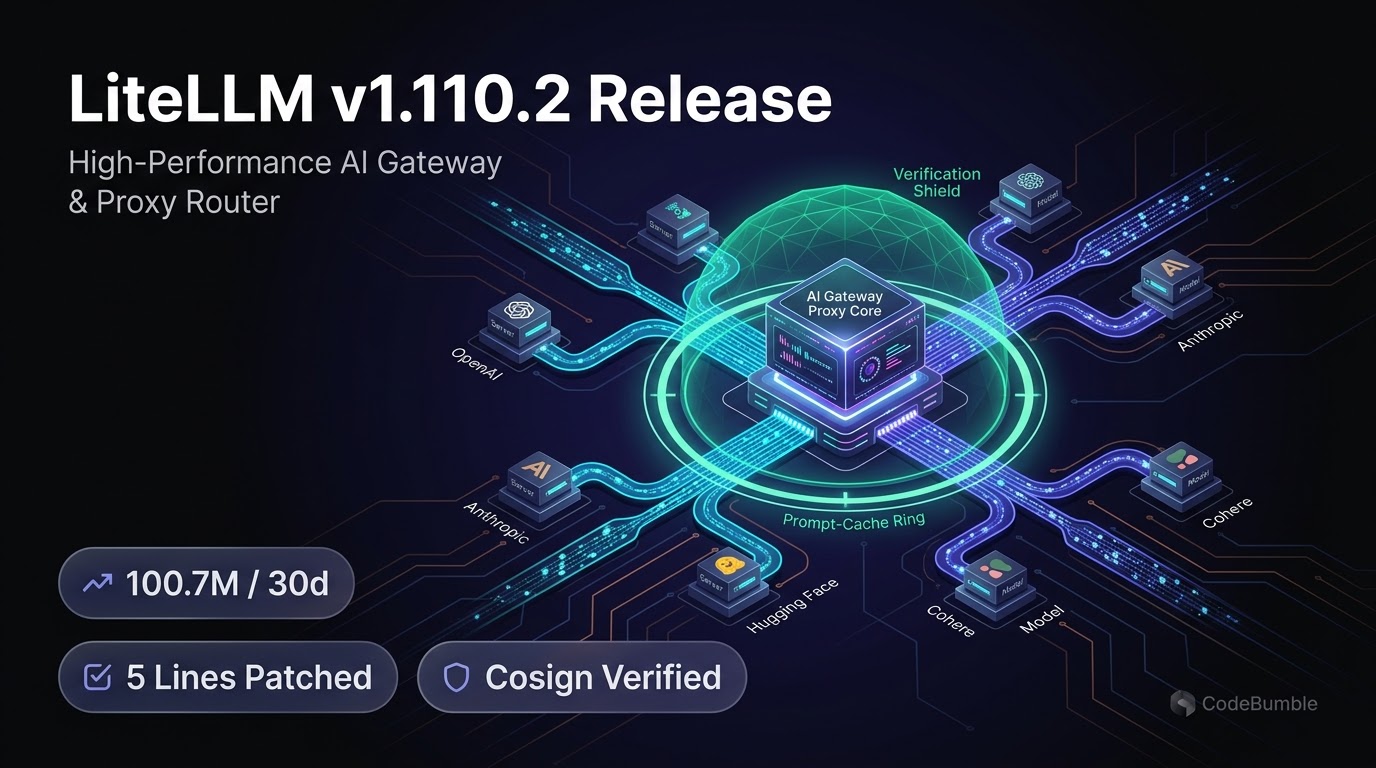
litellm(Python / PyPI and Docker AI Gateway), licensed under the MIT License, with 100,732,250 downloads in the trailing 30 days and 3,544,098,888 total downloads on PyPI (Pepy.tech, verified November 21, 2026). - Latest Verified Releases (November 19–20, 2026): Stable
v1.110.2(commitc3cafa3, zero database migrations), pre-releasev1.111.0-rc.3,v1.109.3,v1.108.13(LTS), andv1.106.12on GitHub Releases. - Critical Fixes Landed: Closes an authorization flaw on
/key/info(#52838,#52925), stops OpenAI Responses API streams from retrying after output reaches the client (#52461,#52616), fixes request-retention memory leaks (#51888,#52600), and restores GPT-6.2 prompt caching (#52906). - Supply-Chain & Runtime Evolution: Following two 2026 supply-chain compromises (
1.82.7/1.82.8in March and1.107.0on October 21), LiteLLM now signs container images and Helm charts with keylesscosignvia Sigstore (LiteLLM Security Incident Report) while migrating core routing and budget enforcement to Rust (v1.112.0-dev.1).
Adoption Telemetry and Release Lineup
LiteLLM serves as the unified LLM proxy and SDK layer for multi-provider AI applications, translating OpenAI, Anthropic, Google Gemini, AWS Bedrock, Azure, and Cohere payloads behind a single API. According to Pepy.tech (checked November 21, 2026), litellm has accumulated 3,544,098,888 cumulative PyPI downloads and 100,732,250 downloads over the past 30 days. Independent security telemetry from Datadog Security Labs places its steady-state distribution at roughly 23 million weekly downloads, making its release cadence directly consequential for CI/CD pipelines and AI agent frameworks.
Starting in November 2026, LiteLLM shifted its release schedule from Saturday to Tuesday mornings and launched a one-month Long-Term Support (LTS) pilot on the 1.108 line (LiteLLM Release Cadence Blog). On November 19–20, 2026, the maintainers shipped coordinated updates across five active release branches to address silent prompt-cache regressions, authorization leaks, and memory retention bugs:
| Release Line | Patched Version | Release Date | Key Fixes Included | Container Tag (ghcr.io/berriai/litellm) |
|---|---|---|---|---|
| 1.111 RC | v1.111.0-rc.3 |
Nov 19, 2026 | All 1.110.2 fixes + failed body GC leak (#52600), TLS SSO redirect (#52213), Postgres pool boot (#52378) |
v1.111.0-rc.3 |
| 1.110 Stable | v1.110.2 |
Nov 19–20, 2026 | Responses stream retries (#52461, #52616), GPT-6.2 cache (#52906), /key/info leak (#52838), GC leak (#51888) |
v1.110.2 (c3cafa3) |
| 1.109 Stable | v1.109.3 |
Nov 19, 2026 | GPT-6.2 prompt cache (#52906), /key/info leak (#52838), JWT mapping delay (#52350), Wolfi base image (#53008) |
v1.109.3 |
| 1.108 LTS | v1.108.13 |
Nov 19, 2026 | Claude Code billing header cache fix (#52922), GPT-6.2 cache (#52906), /key/info leak (#52838), Cloud SQL boot (#52797) |
lts / v1.108.13 |
| 1.106 Stable | v1.106.12 |
Nov 19, 2026 | GPT-6.2 prompt cache (#52906), /key/info leak (#52838), updated dnspython/tornado/opentelemetry + Wolfi base |
v1.106.12 |
flowchart LR
    A[AI Client / Claude Code] -->|/v1/chat/completions or /v1/messages| B[LiteLLM Proxy v1.110.2]
    B -->|Auth & Key Scope Check #52838| C{Valid Key Owner?}
    C -->|No| D[Reject / Isolate Userless Keys]
    C -->|Yes| E[Rewrite System Prompt as Developer Input #52599]
    E -->|Single Non-Retrying Stream #52461| F[OpenAI GPT-6.2 / Anthropic]
    F -->|Cache Hit + Exact Token Billing| B
Security Patches, Memory Fixes, and Prompt Caching Internals
1. Closing the /key/info Authorization Leak and Auth Delays
Across all five patched lines (v1.106.12, v1.108.13, v1.109.3, v1.110.2, and v1.111.0-rc.3), PRs #52838 and #52925 fix an authorization boundary flaw on the /key/info management endpoint. Previously, a virtual API key that had no associated user (user_id unset) could query /key/info by key hash or alias and read metadata belonging to other userless keys. For multi-tenant proxy deployments issuing service-level or team-level keys without a user binding, upgrading to a patched release closes that cross-key enumeration path.
In addition, PR #52350 fixes a five-minute propagation delay for JWT key mappings without a jwt_issuer when litellm_jwtauth.issuers is configured (a regression present since v1.103.0), and v1.111.0-rc.3 resolves an Admin UI bug (#52213) where SSO logins redirected to http:// when the proxy sat behind TLS termination.
2. GPT-6.2 Prompt Caching and Claude Code Billing Header Fixes
On November 19, 2026, LiteLLM published a post-mortem titled GPT-6.2 Stopped Caching System Prompts Sent Through LiteLLM. Two days earlier, on November 17, OpenAI changed the Responses API so that the top-level instructions field on GPT-6.2 is billed at the full uncached input rate on every call, whereas reusable prompts placed in a developer message at the start of input continue to receive prompt-cache discounts. Because no HTTP errors occurred, monitoring alerts stayed silent while callers on /v1/chat/completions (using openai/responses/, chatgpt/, or Bedrock Mantle) and /v1/messages paid uncached rates for their system prompts.
PR #52599 (backported as #52906) updates LiteLLM to forward system prompts as a developer message at the start of input for GPT-6.2 deployments, requiring zero configuration changes after upgrading. Separately, in v1.108.13 (LTS) and v1.111.0-rc.3, PR #52922 fixes an issue where Claude Code's rotating billing header invalidated prompt caches and inflated input token counts when routed to non-Anthropic models.
3. Stopping Duplicate Billing on Responses API Streams and Worker Memory Leaks
Two high-impact reliability bugs in v1.110.2 directly affected production cost and stability:
- Duplicate Stream Retries (
#52461,#52616): When a Responses API stream failed after partial output or reasoning tokens had already reached the client, LiteLLM retried the request or restarted on a fallback model group—emitting duplicate SSE events to the caller and billing extra upstream API calls.v1.110.2halts post-output stream retries. - Worker Memory Growth (
#51888,#52600): A regression introduced inv1.110.0-rc.1retained every finished request object in memory until a full Python garbage-collection pass (#51888). Inv1.111.0-rc.3, PR#52600also fixes failed calls holding large request bodies in memory, which previously caused proxy workers to balloon to several GiB under load. - Claude Sampling & Cost Tracking (
#52341,#52313):v1.110.2stops sendingtemperature=1on Claude models that removed sampling parameters across Anthropic, Vertex AI, and Azure AI (preventingHTTP 400errors), and ensures forwarded Anthropic credentials on/v1/messageshonor custom deployment pricing.
4. Supply-Chain Hardening: Keyless Cosign and Curated Checkpoints
As Anaconda's November 19, 2026 security analysis notes, LiteLLM experienced two supply-chain compromises in 2026: 1.82.7/1.82.8 on March 24 (which CloudSEK later estimated exposed over 2,500 organizations and 434,000 CI/CD pipelines) and 1.107.0 on October 21 (where an unrevoked administrative key allowed attackers to poison prebuilt PyPI wheels and Docker tags for roughly two hours).
In response, starting with v1.111.0-dev.3 on November 15, 2026, LiteLLM signs all release container images and Helm charts with keyless cosign backed by Sigstore short-lived certificates and the public Rekor transparency log (LiteLLM Oct 21 Incident Report). Operators can verify every container pull before deploying:
# Verify the LiteLLM v1.110.2 container image signature via Sigstore cosign
cosign verify \
  --certificate-identity https://github.com/BerriAI/project-releaser/.github/workflows/release.yml@refs/heads/main \
  --certificate-oidc-issuer https://token.actions.githubusercontent.com \
  ghcr.io/berriai/litellm:v1.110.2

# Pin exact PyPI version in requirements.txt or pyproject.toml (avoid unpinned upgrades)
pip install --require-hashes -r requirements.txt
# Or run the verified container directly:
docker run -p 4000:4000 \
  -e LITELLM_MASTER_KEY="sk-your-generated-key" \
  -e DATABASE_URL="postgresql://user:pass@host:5432/litellm" \
  docker.litellm.ai/berriai/litellm:1.110.2
Ecosystem Comparison and Safe Upgrade Checklist
Teams deciding how to route multi-provider LLM traffic in Python have several architectural options depending on whether they need a centralized network proxy or an in-process SDK:
| Package | Latest Verified Version | Architecture Role | License | Key Trade-Offs (Nov 2026) |
|---|---|---|---|---|
litellm |
v1.110.2 / v1.108.13 LTS |
Centralized AI Gateway Proxy & Python SDK | MIT | 100+ providers, budget/RBAC controls, migrating hot paths to Rust (v1.112.0-dev.1); requires strict version pinning and cosign checks |
pydantic-ai |
v2.70.0 (Nov 17, 2026) |
Type-safe Python Agent SDK & Harness | MIT | Strong static typing, Temporal/DBOS durable execution, patched ReDoS (GHSA-m4cr-m4qc-9hh3) in 0.70.0; in-process only without standalone proxy UI |
langchain-litellm |
0.11.2 |
Integration bridge (LangChain ↔ LiteLLM) | MIT | Connects LangChain runnables to LiteLLM; inherits LiteLLM dependency surface unless pinned to >=1.110.2 |
Safe Production Upgrade Checklist
- Choose the Right Branch: If you prioritize stability over new features, pin
v1.108.13(ghcr.io/berriai/litellm:lts). If you are on1.110.x, upgrade immediately tov1.110.2—there are no new database migrations between1.110.1and1.110.2(v1.110.2 Release Notes). Note also thatv1.110.2fixes a startup regression (#52080inv1.111.0-rc.3) and1.108.13fixes Unix-socket Postgres boot failures on Cloud SQL (#52797). - Enforce Image & Wheel Pinning: Never deploy
:latestor unpinnedpip install litellmin CI/CD pipelines. Always verifyghcr.io/berriai/litellmtags withcosign verify, usepip install --require-hashes, or pull from a curated, build-delayed artifact channel (such as Anaconda's source-built repository, which enforces a build delay and SHA-256 source verification) as recommended by Anaconda. - Prepare for the Rust Core Transition: Looking ahead,
v1.112.0-dev.1on GitHub Releases already introduces Rust-backed budget hold/settle engines admitted at auth (#51535), Rust route-rule and authentication path planning (#51531,#51605), and Rust-only Bedrock message invocation (#51330), alongside Wolfi base image updates on1.109.3and1.106.12(#53008,#53033). Benchmark staging latency, memory usage, and custom Python callbacks before adopting1.112.xwhen it graduates to stable.
Frequently Asked Questions
Does upgrading to LiteLLM v1.110.2 require a database migration?
No. According to the v1.110.2 release notes, there are no new database migrations in v1.110.2 over v1.110.1, making it a low-friction drop-in patch.
Which LiteLLM version fixes the GPT-6.2 prompt caching regression?
The fix (PR #52599 / #52906) is available in v1.111.0-rc.3, v1.110.2 (stable), v1.109.3 (stable), v1.108.13 (LTS), and v1.106.12 (stable). No configuration changes are needed after upgrading.
Why did LiteLLM add keyless Cosign verification?
Following the October 21, 2026 release-pipeline compromise (v1.107.0), LiteLLM eliminated stored signing keys and adopted keyless cosign with Sigstore short-lived certificates and Rekor transparency logging starting in v1.111.0-dev.3 on November 15, 2026.
Who is affected by the /key/info security fix in v1.110.2?
Deployments using virtual API keys that have no associated user (user_id unset) are affected; prior to the fix (#52838, #52925), a userless key could read other userless keys via /key/info by hash or alias.
Should production teams run v1.111.0-rc.3 or v1.110.2?
Run v1.110.2 (or v1.108.13 LTS) in production. Only adopt v1.111.0-rc.3 in staging unless you are specifically hit by the failed-request body GC leak (#52600) or the TLS-terminated SSO http:// redirect bug (#52213).
Sources
- LiteLLM v1.110.2 and v1.111.0rc3 fix Responses stream restarts — LiteLLM Docs — November 20, 2026
- GPT-6.2 Stopped Caching System Prompts Sent Through LiteLLM — LiteLLM Blog — November 19, 2026
- Releases · BerriAI/litellm — GitHub — November 19, 2026
- Two LiteLLM Attacks and the Checkpoint Your Pipelines Need — Anaconda Blog — November 19, 2026
- litellm PyPI Download Stats — Pepy.tech — Verified November 21, 2026
- Contained: Oct 21, 2026 LiteLLM release v1.107.0 Compromised — LiteLLM Blog — October 21, 2026 (Updated November 15, 2026)