

Packages
mcp-memory-service v13.0.0: 5ms Agent Memory, LongMemEval Benchmarks & Security Audit
Released on PyPI on November 20, 2026, mcp-memory-service v13.0.0 brings 5ms local semantic recall, a causal knowledge graph, and autonomous consolidation to LangGraph, CrewAI, AutoGen, and Claude. We audit its LongMemEval benchmarks, dependency footprint, and 2026 security posture.
8 min read
mcp-memory-service v13.0.0: 5ms Agent Memory, LongMemEval Benchmarks & Security Audit
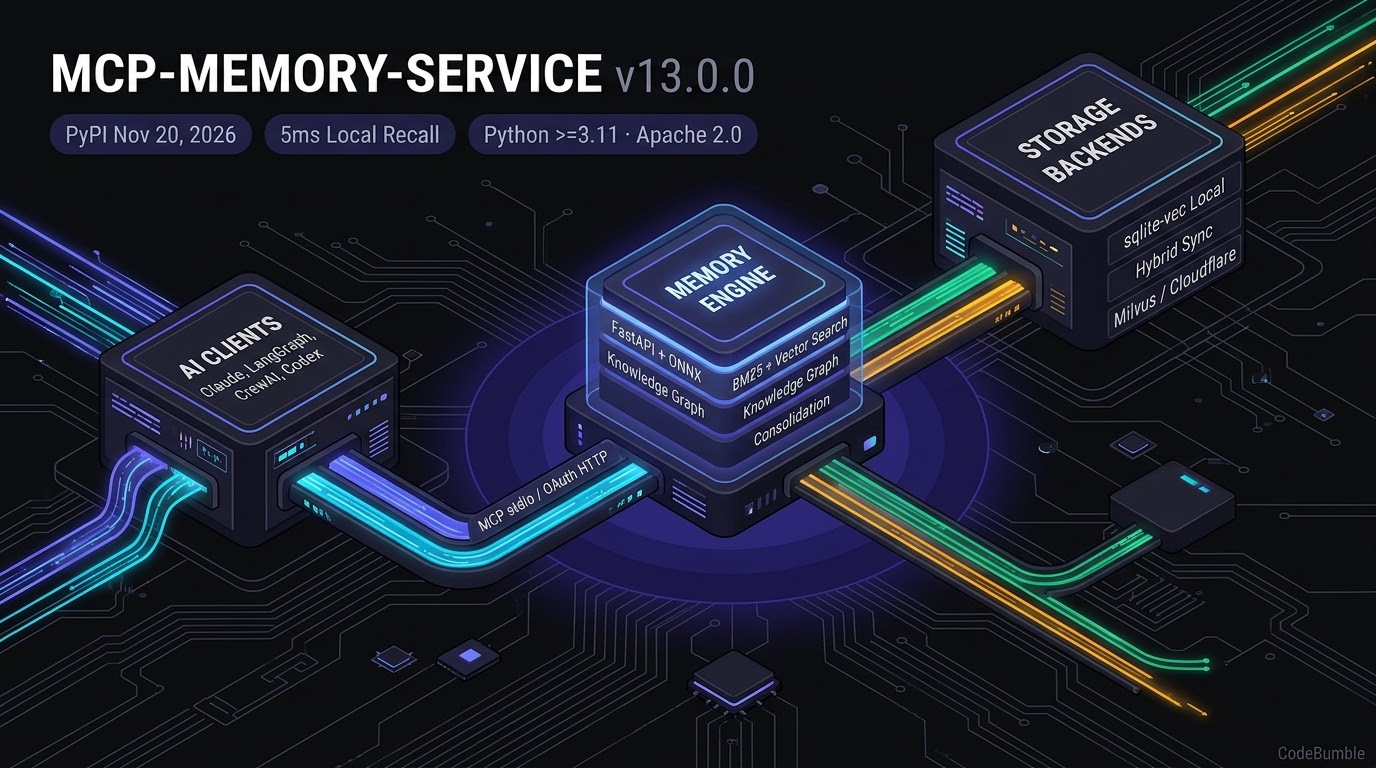
Stateless agent runs force developers to re-inject architecture decisions, bug histories, and repository conventions into every new prompt—burning context tokens and inflating latency. On November 20, 2026, maintainer Heinrich Krupp (doobidoo) released mcp-memory-service v13.0.0 on PyPI, advancing an Apache-2.0 persistent memory backend for Python >=3.11 that unifies an MCP server, a FastAPI REST API, local ONNX embeddings, a causal knowledge graph, and autonomous memory consolidation in a single self-hosted service.
Executive Summary
- Package & Version:
mcp-memory-servicev13.0.0(Python / PyPI), released November 20, 2026 under the Apache-2.0 license (PyPI). - Runtime & Extras: Requires Python >=3.11 (tested on 3.11 and 3.12; uploaded via
twine/7.0.0on CPython 3.14.4). Optional PyPI extras includesqlite,sqlite-ml,ml,nli,clustering,milvus,dev, andfull. - AI & Agent Relevance: Delivers 5 ms local retrieval via
sqlite-vec+ BM25 hybrid search,X-Agent-IDscoped multi-agent memory, causal knowledge-graph edges (causes,fixes,contradicts), and native integrations for LangGraph, CrewAI, AutoGen, Claude Code, Codex, and OpenCode. - Primary Upgrade Takeaway: Stay on the latest release—
mcp-memory-servicefollows a forward-only security patch policy without backports (Greenlit Books), and running it over localstdiowithMCP_HTTP_ENABLED=false(the default) avoids network-exposed attack surfaces.
Adoption Telemetry & Version Changelog
mcp-memory-service has grown from a lightweight sqlite-vec MCP server into one of the most actively iterated memory backends in the Python agent ecosystem:
| Metric / Artifact | Verified Value (v13.0.0) |
Source |
|---|---|---|
| Latest PyPI Release | 13.0.0 (November 20, 2026) |
PyPI Release History |
| GitHub Community Scale | 9,300+ stars; 400+ releases |
Awesome Claude Code / GitHub |
| Wheel / Sdist Size | 1.7 MB wheel (py3-none-any); 44.6 MB sdist |
PyPI Release Files |
| PyPI Provenance | None (not uploaded via Trusted Publishing) | PyPI Security Metadata |
| Minimum Python Floor | Python >=3.11 (raised from >=3.10 in earlier 11.5.2 builds) |
PyPI Metadata |
Release Cadence & Breaking Milestones
Between 10.x and 13.0.0, the project maintained a rapid release cadence—shipping multiple minor releases per week across 11.x (June–October 2026), 12.x (October–November 16, 2026), and culminating in 13.0.0 on November 20, 2026. Key breaking and architectural transitions documented in the Installation & Migration Wiki include:
- Deprecated MCP Tool Aliases Removed (
v11+): Legacy MCP tool aliases were dropped inv11.0.0. Teams upgrading from10.xor earlier must update client prompts and agent harnesses to use canonical tool names (memory_store,memory_search,memory_harvest,memory_bootstrap_profile). - Consolidation Schedules Opt-In (
v10.47.x+): Autonomous background consolidation is disabled by default and requires explicitMCP_SCHEDULE_*environment variables. - Store-Scoped Partitions & Hybrid Sync Fixes (
v12.x–v13.0.0): Multi-store isolation (default,docs,all) andHybridbackend pull-sync fixes (skip_semantic_dedup=Trueon secondary pulls and store-scopedsqlite_vecupdates in Issue #1875) hardened multi-device synchronization ahead of13.0.0. - Supply-Chain Note: PyPI metadata shows
mcp-memory-service 13.0.0was uploaded without PEP 740 Trusted Publishing attestations (No provenance), so security-conscious teams should verify the SHA-256 checksums published on PyPI (dca5cb5e8c13caceb6b0c689bf3626b228eec5b1c4d9502898b3a603b53db712for the1.7 MBwheel).
Architecture, Storage Backends & Fast-Startup CLI
All deployment topologies share the same storage engines and environment-variable configuration, differing only in transport exposure (Production Guide):
- SQLite-vec (Default Local): Single-file local vector store paired with local ONNX embeddings and BM25 lexical search (
mode="ranked"weighs recency, access frequency, and quality). - Hybrid (5 ms Reads + Background Sync): Serves local reads in 5 ms from
sqlite-vecwhile syncing asynchronously to a secondary Cloudflare D1/Vectorize backend or a second self-hosted HTTPmcp-memory-serviceinstance (MCP_HYBRID_SECONDARY_BACKEND=http). Separately enabled delta-sync is off by default. - Milvus: Supports embedded Milvus Lite files, self-hosted Docker Milvus, or managed Zilliz Cloud (with official docs recommending Docker Milvus or Zilliz Cloud over Milvus Lite for long-lived services).
- Lean CLI Lifecycle: Commands such as
memory launch,memory launch --port 8192,memory info,memory logs --lines 50, andmemory stopare optimized for fast startup and defer loading heavy ML dependencies until semantic operations are invoked.
Security Patches, Breaking Changes & Internals
Because a persistent memory store acts as long-term context injection for coding and operations agents, its authorization and transport boundaries are critical.
Patched Advisories & 2026 Security Posture
GHSA-2r68-g678-7qr3/CVE-2026-49291(CVSS 8.1 High, CWE-862): Published in May/June 2026 for versions<= 10.65.1and patched in10.65.3(GitHub Advisory). The HTTP/mcpJSON-RPC endpoint previously checked onlyrequire_read_accessat the route level, allowing an OAuth token withscope: readto invokestore_memoryanddelete_memoryviatools/call—bypassing the403 insufficient_scopeguard enforced onPOST /api/memories. The fix enforces per-tool authorization insidetools/call.- September 2026 Advisories & Health Route Fix: As documented in Greenlit Books' September 25, 2026 code audit,
v11.13.0closed three critical advisories, followed by commit4a22534(September 24, 2026) stoppingGET /mcp/healthfrom leaking storage statistics. - Default Safe Boundaries:
- Local-First by Default:
MCP_MEMORY_STORAGE_BACKENDdefaults tosqlite_vec,MCP_HTTP_ENABLEDdefaults tofalse(running overstdio), and HTTP binds to127.0.0.1unless explicitly overridden with--host 0.0.0.0. - Network Transport File Guard: Two
stdiotools accept caller-controlled filesystem paths; those tools are hidden and rejected over network transports. - Opt-In Egress Caveat: Default ONNX embeddings and quality scoring run locally with zero telemetry. Enabling
MCP_SEARCH_SUMMARIZE_ENABLED=true, Groq/Gemini scoring, ormemory_harvesttranscript extraction sends excerpts to your configured external LLM provider (api.groq.comor your OpenAI-compatible endpoint).
- Local-First by Default:
Clean Setup & Usage Example (v13.0.0)
Install with the [sqlite] extra so the local ONNX embedding model is bundled (without [sqlite], semantic search falls back to hash embeddings):
uv tool install "mcp-memory-service[sqlite]"
claude mcp add memory -- memory server
memory launch --port 8000
When calling the FastAPI REST API from LangGraph, CrewAI, or AutoGen pipelines (http://127.0.0.1:8000/api/docs), pass X-Agent-ID: <agent_name> on POST /api/memories to automatically tag memories with agent:<agent_name> for scoped retrieval via POST /api/search/by-tag, or pass conversation_id to bypass deduplication for incremental conversation logs. Beyond Python SDK pipelines, the repository ships native hook installers for Codex (python3 codex/install_hooks.py to inject context and checkpoint outcomes before compaction), Claude Code session capture hooks, an OpenCode /memory slash command, and OAuth 2.0 Remote MCP support for browser-based claude.ai and ChatGPT Developer Mode clients behind Cloudflare Tunnel, nginx, Caddy, or Docker.
Retrieval Benchmarks: LongMemEval Turn vs. Session Mode
In the official BENCHMARKS.md suite, mcp-memory-service evaluates retrieval across both fine-grained turn-level storage (the default) and whole-session storage (memory_store_session), noting that session mode boosts R@5 by +5.6% (86.0% vs 80.4% baseline) at the cost of lower MRR because fewer redundant hits appear from the same session:
| Question Type | Mode | Recall@5 (R@5) | MRR / NDCG@10 |
|---|---|---|---|
single-session-assistant |
Turn Mode (Baseline) | 100.0% | 99.1% MRR / 99.3% NDCG@10 |
single-session-user |
Turn Mode (Baseline) | 91.4% | 83.8% MRR / 86.0% NDCG@10 |
single-session-preference |
Turn Mode (Baseline) | 86.7% | 79.2% MRR / 83.4% NDCG@10 |
knowledge-update |
Turn Mode (Baseline) | 84.6% | 95.5% MRR / 86.2% NDCG@10 |
multi-session |
Session Mode | 85.9% | 89.7% MRR |
temporal-reasoning |
Session Mode | 82.6% | 80.9% MRR |
Maintainer Heinrich Krupp also explicitly caveats viral 96.6% competitor claims from MemPalace (citing Issue #27, where whole-session ChromaDB storage bypassed Palace's advertised architecture).
Ecosystem Comparison & Upgrade Checklist
| Package / Solution | License & Cost | Default Storage & Embeddings | Transport & Auth | Retrieval / Graph Features |
|---|---|---|---|---|
mcp-memory-service 13.0.0 |
Apache-2.0 ($0 self-hosted) | sqlite-vec + local ONNX (or Hybrid / Milvus / Cloudflare) |
MCP (stdio, Streamable HTTP + OAuth 2.0) + FastAPI REST |
Hybrid BM25 + vector (5 ms), causal knowledge graph, autonomous consolidation |
Official @modelcontextprotocol/server-memory |
MIT ($0 self-hosted) | Local JSONL knowledge graph | MCP stdio |
Simple entity-relation graph; no vector search or REST API |
| Mem0 (OSS / Hosted) | Apache-2.0 / Commercial SaaS | Configurable vector/graph DBs (often cloud LLM calls) | Python/TS SDK + Hosted API | LLM-extracted fact memory; higher API token overhead |
| MemPalace | Open Source | ChromaDB (session-level units) | MCP | Session-granularity LongMemEval (96.6% raw ChromaDB mode disputed in Issue #27) |
Safe Upgrade & Pinning Checklist
- Pin Exact Wheel Versions & Verify Hashes: Pin
mcp-memory-service==13.0.0inpyproject.tomloruv.lockand verify PyPI SHA-256 hashes, since Trusted Publishing provenance is absent. - Audit
10.x->13.0.0Tool Names: If upgrading fromv10.xor earlier, replace any deprecated MCP tool aliases removed inv11. - Keep
stdioDefault for Single-Machine Agents: LeaveMCP_HTTP_ENABLED=falseunless you specifically need multi-agent REST or Remote MCP; if exposing HTTP, bind to127.0.0.1or terminate TLS behind a reverse proxy with OAuth 2.0 enabled. - Monitor Release Advisories: Because fixes are not backported to older branches, subscribe to GitHub release notifications for
doobidoo/mcp-memory-service.
Frequently Asked Questions
What is new in mcp-memory-service 13.0.0?
Released on November 20, 2026 on PyPI, mcp-memory-service 13.0.0 advances the Apache-2.0 Python >=3.11 memory backend with multi-store partition isolation, Hybrid sync deduplication fixes, an 8-tab FastAPI web dashboard, causal knowledge-graph edges, and 5 ms local vector+BM25 retrieval.
Is mcp-memory-service safe to run with Claude Desktop or Cursor?
Yes, when run in its default stdio mode with sqlite-vec and local ONNX embeddings, where nothing leaves your machine. Keep the package updated to the latest release (since security fixes are forward-only) and manually review any stdio file-reading tool calls.
Why does pip install mcp-memory-service[sqlite] matter?
The [sqlite] extra installs the local ONNX embedding runtime. Without it, mcp-memory-service falls back to basic hash embeddings, which degrades semantic search quality.
Does mcp-memory-service require an OpenAI or Anthropic API key?
No. Core storage, ONNX embeddings, BM25 + vector search, and local quality scoring run offline with zero API keys. External LLM keys are only needed if you opt into MCP_SEARCH_SUMMARIZE_ENABLED=true, cloud-LLM quality scoring, or memory_harvest transcript extraction.
How does mcp-memory-service prevent read-only OAuth clients from deleting memories?
Following CVE-2026-49291 (GHSA-2r68-g678-7qr3, patched in 10.65.3), the /mcp JSON-RPC dispatcher enforces per-tool OAuth scopes at tools/call time, rejecting store_memory and delete_memory calls from tokens that only hold read scope.
Sources
- PyPI:
mcp-memory-service13.0.0 — Released November 20, 2026; verified November 22, 2026 (package metadata,Python >=3.11, Apache-2.0, wheel/sdist SHA-256 checksums, and provenance status). - GitHub Repository:
doobidoo/mcp-memory-service&BENCHMARKS.md— Verified November 22, 2026 (LongMemEval turn-mode and session-mode benchmarks,v13.0.0release tag, and wiki migration notes). - GitHub Security Advisory:
GHSA-2r68-g678-7qr3(CVE-2026-49291) — Published June 26, 2026; verified November 22, 2026 (CVSS 8.1 High OAuth scope bypass patched in10.65.3). - Greenlit Books: Is MCP Memory Service safe to give your AI a long-term memory? — Published September 25, 2026; verified November 22, 2026 (independent code audit of defaults, forward-only patch policy, and opt-in egress behavior).