

Packages
LiteLLM v1.111.0 and LTS 1.108.17: Rust /v1/messages Path, MCP DCR Opt-In, and Standalone UI Security Updates
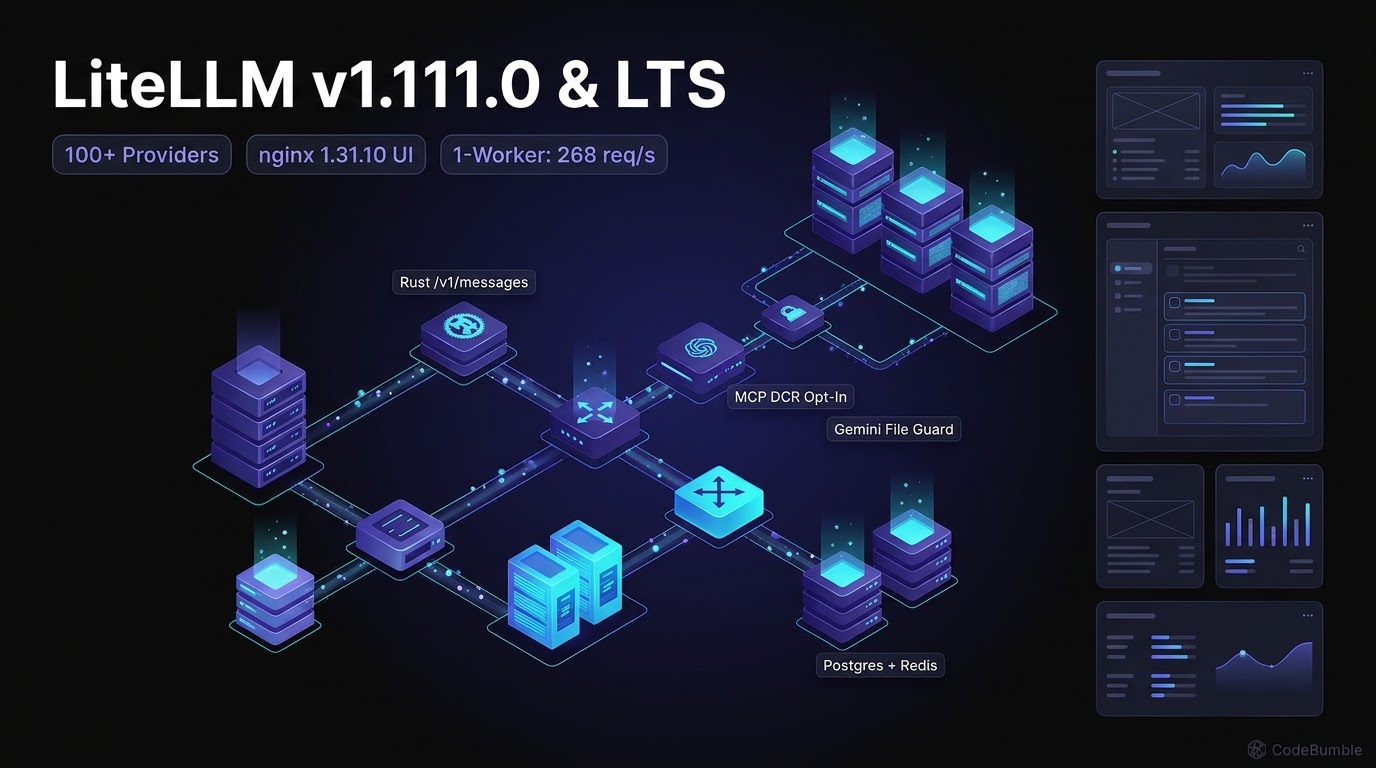
LiteLLM shipped v1.111.0 alongside maintenance patches v1.110.4, v1.109.5, and v1.108.17 LTS on November 23–24, 2026. The updates introduce a native Rust /v1/messages execution path, opt-in MCP dynamic client registration, Gemini pass-through file ownership checks, and nginx 1.31.10 / zlib 1.4 upgrades for the standalone UI image, alongside breaking billing and RAG changes.
10 min read
LiteLLM v1.111.0 and LTS 1.108.17: Rust /v1/messages Path, MCP DCR Opt-In, and Standalone UI Security Updates
Executive Summary
Between November 23 and November 25, 2026, BerriAI published a coordinated set of releases across its active LiteLLM branches: feature release v1.111.0, pre-release v1.112.0-rc.1, and maintenance patches v1.110.4, v1.109.5, and v1.108.17 (LTS) following the prior day's v1.110.3, v1.109.4, and v1.108.16 (LTS) security and regression fixes on GitHub Releases. For teams running the open-source AI gateway in production, the November 23–25 cycle combines incremental Rust migration, breaking protocol defaults for Model Context Protocol (MCP) OAuth, and container-level security updates.
This technical breakdown covers the exact package metadata, release matrix, breaking changes, security patches, independent gateway performance context, and supply-chain verification steps for upgrading safely.
Package Overview and Runtime Footprint
litellm is distributed on PyPI under the MIT license (with commercial features separated into litellm-enterprise, such as 0.1.88 uploaded November 21, 2026, on PyPI). As of the 1.111.0 upload on November 25, 2026, the package metadata specifies the following runtime and distribution footprint:
| Attribute | Verified Value | Source |
|---|---|---|
| Latest Stable Release | 1.111.0 (Nov 24–25, 2026) |
PyPI |
| Active Maintenance Branches | 1.110.4, 1.109.5, 1.108.17 (LTS) |
GitHub Releases |
| Next Release Candidate | 1.112.0rc1 (Nov 24, 2026) |
PyPI |
| Python Requirement | Python >=3.10, <3.16 |
PyPI |
| License | MIT (core); Commercial (Enterprise) | PyPI |
| Wheel ABI / Platforms | cp310-abi3 (Linux glibc/musl, macOS x86_64/ARM64, Win x86_64) |
PyPI |
Total 1.111.0 Release Size |
362.0 MB across 8 files (27.7 MB sdist + 7 wheels) |
PyPI |
| PyPI Provenance | Full PEP 740 attestations via BerriAI/project-releaser |
PyPI |
| Production Backing Stores | PostgreSQL (keys/spend) + Redis (multi-instance scaling) | Respan Comparison |
The cp310-abi3 wheel tags reflect LiteLLM's ongoing integration of compiled Rust extensions alongside Python, enabling a single stable-ABI wheel per OS and architecture rather than per-minor-Python-version builds. An independent litellm-core distribution is also documented on PyPI for Python SDK users who want import litellm without CLI entry points, optional extras, or the bundled dashboard.
Release Matrix: v1.111.0, v1.112.0-rc.1, and LTS 1.108.17
Rather than forcing every production deployment onto the newest minor branch, BerriAI backported critical fixes across three maintenance lines (1.110.x, 1.109.x, and 1.108.x LTS) while advancing Rust execution and enterprise control-plane scaffolding in 1.111.0 and 1.112.0-rc.1:
v1.111.0(Nov 24, 2026): Introducesclaude-fable-5-2support across Anthropic, AWS Bedrock, Azure AI, Vertex AI, and GitHub Copilot; OpenSearch index pass-through with per-key read/write grants (#50573); alitellm-s3Rust crate and Rust model-cost map fetch (#50547,#50501); a native/v1/messagesRust execution path (#50335,#50420–#50426); fail-closed team budget enforcement (#50603); and two breaking fixes affecting audio transcription billing (#50727) and RAG ingest file IDs on GitHub Releases.v1.112.0-rc.1(Nov 24, 2026): Previews the--control-planeenterprise skeleton, Open Cybersecurity Schema Framework (OCSF) audit events, external audit sinks for S3 Object Lock, Splunk HEC, and Microsoft Sentinel, plus Rust YAML and environment configuration loading on GitHub Releases.v1.110.4,v1.109.5, andv1.108.17 (LTS)(Nov 24, 2026): Address container security in the standalone UI Docker image by upgrading outdatednginxandzlibpackages tonginx 1.31.10andzlib 1.4(#54149,#54150,#54207), and optimize end-user restriction refreshes to query only restricted customer rows rather than scanning the entire end-user table (#51772) on GitHub Releases.- Additional
1.108.17 (LTS)Backports: Bundles 40 pull requests, including fixes for OpenAI streamed tool calls arriving with empty arguments (#52069,#53306), a 30-second worker stall when processing Bedrock Claude$defsschemas (#54118), OpenAI Agents API/openailogging$0spend (#53881), Gemini page/sheet range file options (#52611), and/key/updaterejectingmax_budget: nullclears with HTTP403(#53978) on GitHub Releases.
LiteLLM's model catalog also continues to expand rapidly: according to the LiteLLM New Models log updated November 24, 2026, 904 models were added to LiteLLM's open-source model price file in November 2026 alone.
Security Fixes and Breaking Changes (Nov 23–24, 2026)
Operators planning an upgrade from 1.108.x or 1.109.x should audit four security and behavioral changes before rolling out new container images or PyPI pins.
1. Gemini Pass-Through File Ownership Enforcement (v1.110.3, v1.109.4, v1.108.16 LTS)
Prior to the November 23 patches, /gemini pass-through file get, download, and delete routes skipped the file ownership validation enforced by /v1/files (#53171, #53210) on GitHub Releases. In multi-tenant deployments where multiple virtual keys share a single proxy instance, this gap allowed callers hitting the Gemini pass-through file endpoints to bypass tenant ownership checks. All three active maintenance branches now enforce ownership verification on those routes.
2. MCP Dynamic Client Registration (DCR) Changed to Opt-In
A breaking default change in v1.110.3, v1.109.4, and v1.108.16 (LTS) alters how the MCP Gateway handles OAuth Dynamic Client Registration (#53059) on GitHub Releases. Previously, gateway-owned DCR client registration could trigger 403 oauth_principal_mismatch errors when multiple callers shared a service key. Gateway-owned DCR client registration is now opt-in: operators who specifically require automatic gateway-owned registration for clientless DCR bridges must explicitly set LITELLM_MCP_DCR_GATEWAY_CLIENT=true in their environment. Otherwise, as documented on PyPI, upstream MCP servers that refuse dynamic registration require pre-registered credentials.client_id and credentials.client_secret values.
3. Fail-Closed Team Budget Enforcement and Key Update Guards
In v1.111.0, team budget checks now fail closed (#50603): if a user belongs to a team configuration without a corresponding team membership row in PostgreSQL, the proxy returns HTTP 403 and explicitly names /team/member_add in the error payload rather than allowing unbudgeted traffic through on GitHub Releases. Meanwhile, 1.108.17 (LTS) closes a budget-bypass edge case (#53978) where /key/update could clear max_budget by passing null, returning HTTP 403 instead.
4. Audio Transcription Billing, RAG File IDs, and Azure Key Fallback
Three additional breaking or action-required behaviors apply depending on your workload:
- Audio transcription billing (
v1.111.0,fix(cost)!,#50727): Transcriptions are now billed strictly by provider-reported seconds, changing cost calculations for deployments that previously relied on fallback duration estimates on GitHub Releases. - RAG ingest and vector stores (
v1.111.0,fix(proxy)!): RAG ingest endpoints now return managed file IDs, and vector store file routes use team credentials rather than falling back to global defaults on GitHub Releases. - Azure
/openai/v1key resolution (v1.108.16+): Deployments targetingazure /openai/v1must explicitly configureapi_keyorAZURE_API_KEY, as they no longer fall back toOPENAI_API_KEY(#51144,#53408) on GitHub Releases. - Audit endpoint stability (
v1.108.16+): Resolves a regression introduced inv1.108.0whereGET /auditreturned HTTP500after key or team updates (#50929,#53305) on GitHub Releases.
Rust Migration and Gateway Performance Context
LiteLLM's v1.111.0 release advances its incremental Rust migration by adding a native Rust /v1/messages execution path (#50335, #50420–#50426), litellm-s3, and Rust model-cost map fetching (#50547, #50501) on GitHub Releases. However, the gateway remains predominantly Python-based in production today.
In a November 25, 2026 comparative analysis of five self-hosted open-source AI gateways (Respan, LiteLLM, Bifrost, agentgateway, and Portkey Gateway), Respan notes that LiteLLM's Rust gateway mode is still in beta—meaning most request paths still execute in Python and require PostgreSQL for key/spend persistence plus Redis once scaling beyond a single instance or pod.
In Respan's published single-worker comparison table (with partial confidence: Respan ran the benchmark itself, did not publish the full harness configuration, and excluded agentgateway from the throughput table), the four tested gateways measured as follows:
| Gateway | Runtime | p50 Added Latency | Throughput | Memory | 1k-Stream Success | p99 w/ 5% Slow Calls | Source |
|---|---|---|---|---|---|---|---|
| LiteLLM (1 worker) | Python (+ partial Rust) | 4.34 ms |
268 req/s |
418 MB |
79% |
2,024 ms |
Respan |
| Respan | Rust | 0.07 ms |
56,734 req/s |
31 MB |
100% |
105 ms |
Respan |
| Bifrost | Go | 0.16 ms |
18,182 req/s |
488 MB |
92–100% |
2,002 ms |
Respan |
| Portkey Gateway | Node.js | 0.17 ms |
4,187 req/s |
350 MB |
Not listed | 2,003 ms |
Respan |
Note that PyPI lists 8ms P95 latency at 1k RPS in LiteLLM's own project summary, whereas Respan's single-worker test highlights Python's single-process ceiling (268 req/s and 79% completion at 1,000 concurrent streams). In practice, teams scaling LiteLLM beyond low-hundreds-RPS workloads deploy multiple stateless proxy pods behind a load balancer backed by PostgreSQL and Redis, and will want to watch whether the new Rust /v1/messages path in v1.111.0 materially reduces per-worker overhead for Anthropic-format traffic.
Supply-Chain Security: Why Digests and Attestations Matter
Any operational review of litellm in late 2026 must account for two verified supply-chain compromises earlier in the year:
- March 24, 2026 (
1.82.7and1.82.8): Compromised CI/CD credentials linked to TeamPCP pushed malicious wheels to PyPI for roughly 40 minutes, accumulating over119,000downloads according to the PyPI Incident Report and LiteLLM's March 2026 Security Update. BerriAI subsequently introduced an isolatedCI/CD v2release pipeline inv1.83.0. - October 21, 2026 (
1.107.0): Attackers overrode branch protections using compromised developer credentials and published maliciouslitellm==1.107.0wheels on PyPI (11:39–13:23 UTC) as well as compromisedv1.107.0,latest,main-latest, andmain-stableDocker tags (11:46–14:20 UTC), as detailed in LiteLLM's October 21 Incident Postmortem and Datadog Security Labs.
Following the October incident, BerriAI rotated its signing keys and moved to keyless Cosign OIDC signing starting with v1.111.0-dev.3 (LiteLLM Incident Postmortem). All 8 artifacts in litellm 1.111.0 (as well as 1.110.4, 1.109.5, and 1.108.17) also carry full PyPI Publish Attestations signed by GitHub Actions (BerriAI/project-releaser) on PyPI.
Recommended Verification Checklist Before Upgrading
- Never pull floating tags: Avoid
:latest,:main-latest, or unpinnedpip install litellm. Pin an exact patch version (litellm==1.108.17for LTS stability orlitellm==1.111.0if testing the Rust/v1/messagespath) and an immutable SHA-256 container digest. - Verify Cosign OIDC signatures: Validate
ghcr.io/berriai/litellm:<tag>using keyless Cosign verification against the GitHub Actions OIDC issuer before admitting images into production clusters. - Audit PyPI provenance: Confirm PEP 740 attestations or SHA-256 wheel hashes from PyPI in lockfiles (
uv.lockorpip-compile --generate-hashes). - Check environment variables before rollout: Set
AZURE_API_KEYexplicitly forazure /openai/v1routes, setLITELLM_MCP_DCR_GATEWAY_CLIENT=trueonly if you rely on clientless MCP DCR bridges, and confirm every active team user has a PostgreSQL team membership row.
Frequently Asked Questions
Should production teams upgrade to v1.111.0 or v1.108.17 (LTS)?
Teams prioritizing stability and existing Python routing behavior should pin 1.108.17 (LTS), which receives security and regression backports—including the nginx 1.31.10 / zlib 1.4 UI fix, Gemini file ownership checks, and Bedrock Claude $defs stall fix—without introducing 1.111.0's breaking audio billing and RAG ingest changes (GitHub Releases). Choose v1.111.0 in staging if you need claude-fable-5-2, OpenSearch per-key pass-through, or want to test the native Rust /v1/messages path.
Why did MCP OAuth flows start returning 403 or stop auto-registering clients after 1.108.16?
PR #53059 changed gateway-owned Dynamic Client Registration (DCR) to opt-in to prevent 403 oauth_principal_mismatch errors on shared service keys (GitHub Releases). If your deployment relies on automatic gateway-owned DCR for clientless bridges, set LITELLM_MCP_DCR_GATEWAY_CLIENT=true or configure static credentials.client_id and credentials.client_secret on the MCP server (PyPI).
Does the standalone UI security update affect Python SDK users?
No. The nginx 1.31.10 and zlib 1.4 upgrades (#54149, #54150, #54207) apply specifically to the standalone UI Docker image (GitHub Releases). Python SDK users who only need import litellm can also evaluate litellm-core to omit the CLI and dashboard entirely (PyPI).
How reliable are the 268 req/s LiteLLM benchmark numbers?
Treat them with partial confidence. The 4.34 ms p50 latency, 268 req/s throughput, and 79% 1k-stream success rate come from a November 25, 2026 single-worker comparison published by Respan, a competing gateway vendor whose full test harness is unpublished. By contrast, PyPI cites 8ms P95 latency at 1k RPS for LiteLLM. Horizontal scaling with multiple proxy pods, PostgreSQL, and Redis materially changes real-world throughput.
Are v1.111.0 and 1.108.17 safe from the 2026 PyPI supply-chain incidents?
Both 1.111.0 and 1.108.17 were built after BerriAI's October 2026 key rotation and migration to keyless Cosign OIDC signing, and all 8 release artifacts on PyPI include verified GitHub Actions (BerriAI/project-releaser) provenance attestations. Teams should still pin exact versions and verify Cosign/SHA-256 hashes in CI.
Sources
- GitHub Releases — BerriAI/litellm (
v1.111.0,v1.112.0-rc.1,v1.110.4,v1.109.5,v1.108.17 LTS,v1.110.3,v1.109.4,v1.108.16 LTS, published Nov 23–24, 2026): https://github.com/BerriAI/litellm/releases - PyPI — litellm 1.111.0 (Release metadata, Python
>=3.10, <3.16,cp310-abi3wheels, PEP 740 provenance, updated Nov 25, 2026): https://pypi.org/project/litellm/ - Respan — Best Open-Source AI Gateways (Dylan Cable, published Nov 25, 2026): https://www.respan.ai/articles/best-open-source-ai-gateways
- LiteLLM New Models Log — November 2026 (Updated Nov 24, 2026): https://models.litellm.ai/new-models/2026-11
- LiteLLM Security Postmortem — Oct 21, 2026 (
v1.107.0Incident & Keyless Cosign Migration) (Updated Nov 15, 2026): https://docs.litellm.ai/blog/security-incident-oct-21-2026 - Datadog Security Labs — LiteLLM Supply Chain Compromise (Oct 21, 2026): https://securitylabs.datadoghq.com/articles/litellm-compromised-pypi-docker/
- PyPI Incident Report — LiteLLM/Telnyx Supply-Chain Attacks (Apr 2, 2026): https://blog.pypi.org/posts/2026-04-02-incident-report-litellm-telnyx-supply-chain-attack/
- LiteLLM Security Update — March 2026 (
1.82.7/1.82.8) (Mar 24, 2026): https://docs.litellm.ai/blog/security-update-march-2026