

Packages
Pydantic AI v2.74.0: 6 Security Patches (SSRF, OTel), ComputerUse Sandboxes, and Upgrade Guide
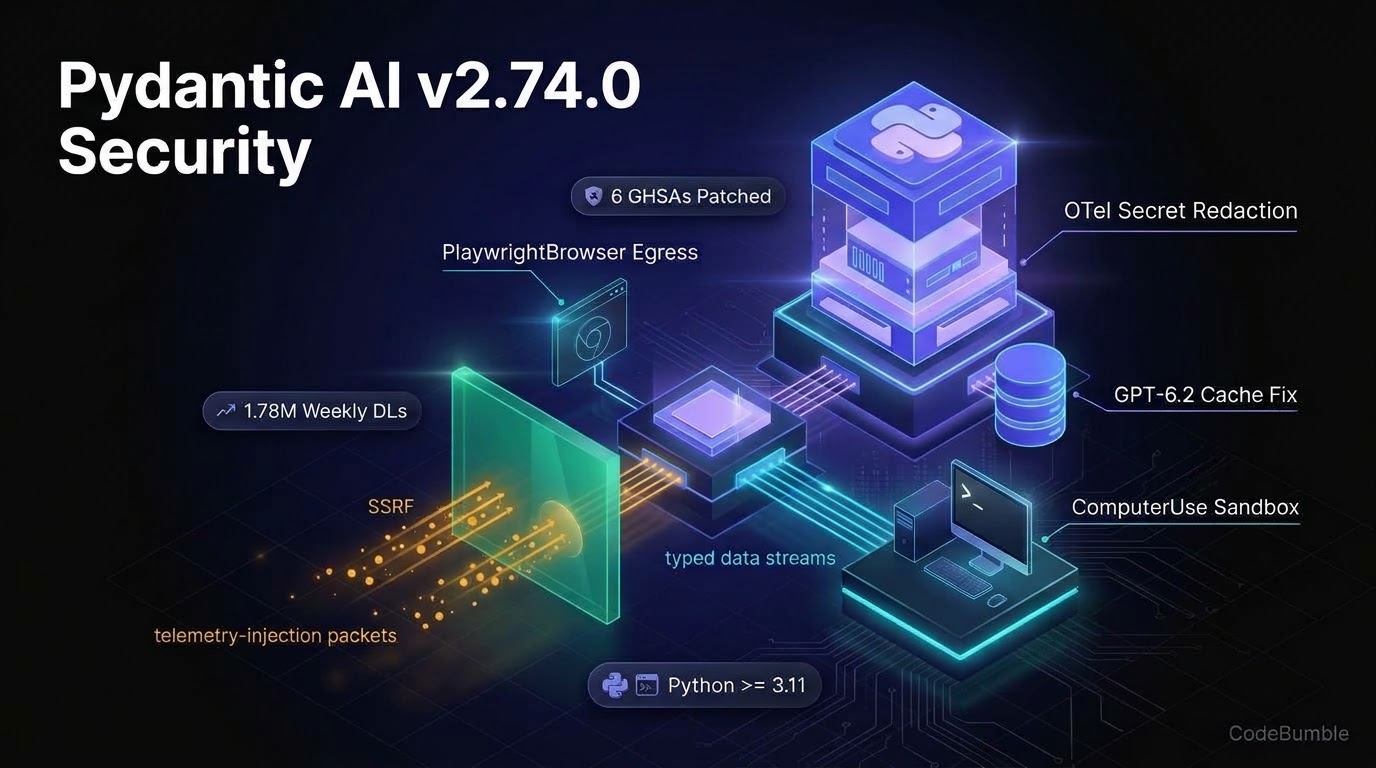
Pydantic AI v2.74.0, pydantic-ai-harness v0.74.0, and pydantic-evals v2.74.0/v1.107.11 shipped on November 24, 2026, resolving six security advisories across PlaywrightBrowser SSRF/egress policies, ElevenLabs OpenTelemetry secret logging, and inbound OTel baggage injection. The release also introduces a unified ComputerUse capability across 11 sandbox backends and changes GPT-6.2 prompt caching behavior. Here is what broke, what was patched, and how to upgrade safely.
8 min read
Pydantic AI v2.74.0: 6 Security Patches (SSRF, OTel), ComputerUse Sandboxes, and Upgrade Guide
Executive Summary
On November 24, 2026, the Pydantic team released pydantic-ai v2.74.0 alongside pydantic-ai-slim v2.74.0, pydantic-ai-harness v0.74.0, and pydantic-evals v2.74.0 / v1.107.11 on GitHub Releases. Operating in the Python/PyPI ecosystem (requiring Python >= 3.11, MIT-licensed), this coordinated release resolves six medium-severity GitHub Security Advisories (GHSAs)—including five CVEs (CVE-2026-136638, CVE-2026-136639, CVE-2026-136640, CVE-2026-136642, and CVE-2026-136643)—spanning PlaywrightBrowser SSRF/egress bypasses, ElevenLabs OpenTelemetry secret logging, and inbound OTel baggage injection in online evaluations.
Beyond security hardening, v2.74.0 introduces a first-class pydantic_ai.computer_use / ComputerTool contract in core, pairs it with a ComputerUse() capability across 11 sandbox backends in pydantic-ai-harness, adds a raw CDPBrowser capability, and ships breaking compatibility changes for GPT-6.2 prompt caching, Gemini usage accounting, and Chromium egress APIs. With pydantic-ai averaging 1.78 million weekly PyPI downloads (verified November 24, 2026), teams running browser-capable or OpenTelemetry-instrumented agents should upgrade immediately and audit historical trace spans.
Adoption Telemetry & Version Changelog
pydantic-ai has grown from 135 stars at launch to one of the highest-volume Python agent SDKs in production:
- Weekly PyPI Downloads: 1.78 million downloads per week as of November 24, 2026 (Tally).
- GitHub Stars: 21,291 stars as of November 19, 2026 (Tally).
- Runtime & Packaging: Requires Python >= 3.11 (supporting Python 3.11 through 3.15 classifiers on PyPI), distributed under the MIT license with full PyPI Trusted Publishing provenance (
pydantic_ai-2.73.0-py3-none-any.whlweighs 10.6 kB as a metapackage overpydantic-ai-slim, with2.74.0tagged on GitHub on Nov 24, 2026).
Key Release Milestones (v2.66.0 – v2.74.0)
Pydantic AI ships on a rapid cadence, intentionally separating its stable core SDK (2.x) from its faster-moving capability library (pydantic-ai-harness, 0.x):
- v2.66.0 (Nov 4, 2026): Patched 10 GHSAs—including ReDoS in
secret_data()/redact_secrets(GHSA-mfx5-pc32-32m8), Tencent Cloud metadata SSRF at169.254.0.23(GHSA-5fj9-5pjw-vpwc), and OpenTelemetry embedding credential leaks (GHSA-jp94-mmr3-2pvv)—while addingOpenSandboxandRenderSandbox. - v2.68.0 – v2.69.0 (Nov 11–16, 2026): Added
Gemini 4 HydrogenandGoogleDecisionsModelsupport,WindowsWorkspacePowerShell support,KubernetesSandbox, andPeersmulti-agent messaging in the harness. - v2.70.0 – v2.71.0 (Nov 17–18, 2026): Patched two high-severity ReDoS advisories (
GHSA-m4cr-m4qc-9hh3inToolOutputLimits(strip_ansi=True)andGHSA-5m5q-5qj4-gx9hin JWT redaction), addedStreamGuardrail,PromptInjectionDefender,ToolBridge,Gemini 4 Neon, and GPT-6.2 Astra / Sol support. - v2.73.0 (Nov 23, 2026): Raised the minimum
openaidependency floor from3.31.0to3.50.0across allopenaiextras, bumpedboxdto>=0.3.3,<0.4, addedSubAgentsdeferred tool resumption, and enforcedFileSystem(max_image_side=1024)downscaling forCoder. - v2.74.0 (Nov 24, 2026): Patched 6 GHSAs across browser egress and OpenTelemetry; shipped
ComputerTool,ComputerUse()across 11 sandboxes,CDPBrowser, and GPT-6.2 static-instruction caching.
Security Patches, Breaking Changes & Internals
Six Security Advisories Patched in v2.74.0 / v0.74.0
Every advisory below was disclosed in the v2.74.0 GitHub release notes on November 24, 2026:
| Advisory / CVE | Severity | Affected Package & Component | Vulnerability Summary | Fixed Version |
|---|---|---|---|---|
GHSA-wm3r-gc4c-q7qg (CVE-2026-136639) |
Medium | pydantic-ai-harness (PlaywrightBrowser) |
block_private_addresses=True (default) failed to block IPv6 site-local addresses (fec0::/10), letting attacker-influenced URLs read internal hosts. |
pydantic-ai-harness 0.74.0 |
GHSA-p2q8-3252-77c3 (CVE-2026-136640) |
Medium | pydantic-ai-harness (PlaywrightBrowser) |
Private-address block allowed IPv6 addresses embedding cloud metadata IPs under a network's NAT64 prefix and ISATAP forms. | pydantic-ai-harness 0.74.0 |
GHSA-g87v-g79r-whvj (CVE-2026-136638) |
Medium | pydantic-ai-harness (PlaywrightBrowser) |
URLs with a backslash in the query string parsed as having no host, allowing page scripts to bypass allowed_domains, blocked_domains, and private-IP blocks. |
pydantic-ai-harness 0.74.0 |
| GHSA-mj96-6529-3cpf (No CVE listed) | Medium | pydantic-ai-harness (PlaywrightBrowser) |
Egress policy did not cover WebRTC, WebTransport, WebSocketStream, or FedCM traffic, allowing exfiltration or private-IP reads. |
pydantic-ai-harness 0.74.0 |
GHSA-gm2p-369w-rcgv (CVE-2026-136642) |
Medium | pydantic-ai, pydantic-ai-slim (ElevenLabsAgentsRealtimeModel) |
With OTel enabled, realtime trace spans logged elevenlabs_agents_custom_llm_extra_body and secret__ dynamic variables in full (even with include_content=False on 2.58.0–2.62.0). |
pydantic-ai / pydantic-ai-slim 2.74.0 |
GHSA-7xcv-6766-v6v5 (CVE-2026-136643) |
Medium | pydantic-evals (Online evaluation) |
Inbound OpenTelemetry baggage could overwrite unset gen_ai.evaluation.result attributes (error.type, gen_ai.evaluation.score.value). |
pydantic-evals 2.74.0 & 1.107.11 |
flowchart LR
    A[Untrusted Page / Inbound HTTP] --> B{PlaywrightBrowser Egress Guard<br/>Harness v0.74.0}
    B -->|Blocks fec0::/10, NAT64, ISATAP,<br/>Backslash Queries & WebRTC/WebTransport| C[Safe Chromium Sandbox]
    A -->|OTel Baggage Header| D{pydantic-evals v2.74.0 / 1.107.11}
    D -->|Ignores Inbound Baggage Overrides| E[Clean gen_ai.evaluation.result]
    F[ElevenLabs Realtime Session] -->|Redacts secret__ & extra_body| G[Sanitized OTel Span]
Deep Dive on Browser Egress & OpenTelemetry Hardening
The four PlaywrightBrowser fixes in pydantic-ai-harness v0.74.0 close classic SSRF and egress-bypass gaps that arise when agents browse untrusted pages:
- IPv6 & NAT64 Alignment:
PlaywrightBrowsernow refuses every IP address that Pydantic AI's coresafe_downloadURL guard refuses, closingfec0::/10site-local ranges, ISATAP-encoded private addresses, and IPv6 addresses embedding cloud metadata endpoints (169.254.169.254) behind a network's NAT64/SIIT prefix. - Query Backslash Parsing: Previously, a backslash inside a URL query string caused the parser to treat the request as hostless, slipping past
allowed_domainsandblocked_domainschecks. - Non-HTTP Transport Surface: Under an enforced egress policy (on by default),
PlaywrightBrowsernow stripsRTCPeerConnection,WebTransport,WebSocketStream, andFedCMfrom pages and frames, and launches Chromium withFedCMandWebSocketStreamdisabled. Note the documented boundary: workerWebTransport,WebSocketStreaminside workers overcdp_url, isolated sandboxed iframes, and documents loaded before attachment remain open per the advisory. - Telemetry & Evaluation Integrity: In
pydantic-ai2.74.0,ElevenLabsAgentsRealtimeModelno longer emitselevenlabs_agents_custom_llm_extra_bodyorsecret__dynamic variables into OpenTelemetry spans. Meanwhile,pydantic-evals2.74.0 and1.107.11block inbound OTelbaggageheaders from injectingerror.typeorgen_ai.evaluation.score.valueontogen_ai.evaluation.resultevents.
Breaking Compatibility Notes & New Capabilities
- Chromium APIs Disabled Under Default Egress Policy (
#14363): UnderPlaywrightBrowser's enforced egress policy,RTCPeerConnection,WebTransport,WebSocketStream, andFedCMare removed from pages. If your browser agent legitimately needs one of these protocols, you must track upstream configuration flags rather than relying on the default policy. - GPT-6.2 Prompt Caching Behavior (
#14095): Because OpenAI's GPT-6.2 models never cache top-level instructions,v2.74.0sends static instructions as leading input messages. Breaking side effect: Continuing a GPT-6.2 response viaopenai_previous_response_id='resp_...'without passingmessage_historynow inherits that response's static instructions. Passmessage_historyexplicitly or opt out viaOpenAIModelProfile(openai_responses_stable_instructions_as_input=False). - Gemini Streaming Usage Totals (
#14285): Streaminggemini*models throughOpenAIChatModel/OpenAIProviderno longer sums intermediate running usage totals; it reports only the endpoint's final usage totals. Your recorded token cost figures will drop andUsageLimitswill trigger accurately. - Native
ComputerTool&ComputerUse()Across 11 Sandboxes (#11006,#11037): Corepydantic_ai.computer_useaddsComputerTooltoNATIVE_TOOLS_REQUIRING_CONFIG(with native provider wiring for OpenAI GPT-5.4+, Anthropic Claude, and Google Gemini), while Harness addsComputerUse()andDisplayprotocols withdesktop=Truesupport across DockerContainer, DaytonaSandbox, E2BSandbox, SpritesSandbox, BoxLiteSandbox, BoxdSandbox, SmolSandbox, RenderSandbox, ModalSandbox, KubernetesSandbox, and OpenSandbox, alongside a new rawCDPBrowsercapability (#14229).
Updated Usage Example (v2.74.0)
from pydantic_ai import Agent
from pydantic_ai.models.openai import OpenAIModelProfile, OpenAIResponsesModel
from pydantic_ai_harness import ComputerUse, DockerContainer, PlaywrightBrowser

# 1. Opt out of leading-message static instructions only if chaining without message_history
model = OpenAIResponsesModel(
    "gpt-6.2-sol",
    profile=OpenAIModelProfile(openai_responses_stable_instructions_as_input=True),
)

# 2. Hardened browser + desktop sandbox in pydantic-ai-harness v0.74.0
agent = Agent(
    model,
    capabilities=[
        PlaywrightBrowser(block_private_addresses=True),  # Blocks fec0::/10, NAT64, WebRTC/FedCM
        DockerContainer(desktop=True),
        ComputerUse(),
    ],
)
Ecosystem Comparison & Upgrade Checklist
When deciding between Python agent frameworks in late 2026, compare architecture, version stability, and dependency footprints (TwitterAPI.io, Pydantic Docs):
| Framework | Latest Verified Release | License | GitHub Stars (Nov 2026) | Typing & Schema Model | Durable Execution & MCP |
|---|---|---|---|---|---|
| Pydantic AI | v2.74.0 (harness 0.74.0) |
MIT | ~21,291 | Native Python + Pydantic v2 end-to-end | 9 engines (Temporal, DBOS, Prefect, Lambda, etc.) + native MCP |
| LangChain / LangGraph | 1.x series |
MIT | ~44,800 (LangGraph) | TypedDict / Pydantic state schemas | LangGraph checkpointing + MCP adapters |
| OpenAI Agents SDK | Active 0.x/1.x |
MIT | Smaller, OpenAI-focused | Pydantic outputs + handoffs | Temporal preview / lightweight loop; OpenAI-first |
Core vs. Harness Package Split (Why Versions Diverge)
Pydantic AI V2 (stabilized June 23, 2026) deliberately separates its dependency tree into focused packages so teams do not pull heavy browser or sandbox libraries unless needed:
pydantic-ai/pydantic-ai-slim(2.x): Core typedAgent,RunContext, provider adapters (OpenAI, Anthropic, Google, Bedrock, Azure, Groq, Mistral, Ollama),MCPcapability, andTemporal/DBOS/Prefectdurability integrations.pydantic-ai-harness(0.x): Higher-level capabilities (Coder,PlaywrightBrowser,ComputerUse,CDPBrowser,StreamGuardrail,PromptInjectionDefender,StepPersistence, and 11 sandbox backends) that iterate faster between minor releases.- Companion Packages:
pydantic-evals(stochastic evaluation + online OTel scoring),pydantic-graph(typed graph control flow),genai-prices(live model pricing), andpydantic-monty(sandboxed Python execution forCodeMode).
Safe Upgrade & Pinning Checklist
- Pin Core and Harness Together: Because
pydantic-ai-harnessuses0.xversioning alongsidepydantic-ai2.x, update both in lockstep:uv add "pydantic-ai>=2.74.0" "pydantic-ai-harness>=0.74.0" "pydantic-evals>=2.74.0". If you are still on the1.xevals line, pinpydantic-evals>=1.107.11. Verify your lockfile also satisfies theopenai>=3.50.0floor introduced inv2.73.0. - Audit Historical OpenTelemetry Traces: If you instrumented
ElevenLabsAgentsRealtimeModelbefore2.74.0, inspect exported spans in Logfire or your OTLP backend for leakedsecret__dynamic variables orelevenlabs_agents_custom_llm_extra_bodyvalues, and rotate exposed credentials. - Strip Inbound
baggageHeaders at the Edge: Even after upgradingpydantic-evals, configure your API gateway or OTel propagator to reject untrusted clientbaggageheaders on public endpoints. - Test GPT-6.2 & Browser Agents Before Deploying: Verify any
openai_previous_response_idloops passmessage_history(or setopenai_responses_stable_instructions_as_input=False), and confirm noPlaywrightBrowserworkflow depends onWebRTCorWebTransport.
Frequently Asked Questions
What CVEs are fixed in Pydantic AI v2.74.0?
Pydantic AI v2.74.0, pydantic-ai-harness 0.74.0, and pydantic-evals 2.74.0 / 1.107.11 patch five CVEs—CVE-2026-136638, CVE-2026-136639, CVE-2026-136640, CVE-2026-136642, and CVE-2026-136643—plus GHSA-mj96-6529-3cpf covering WebRTC/WebTransport/FedCM egress bypasses.
Am I affected if I do not use PlaywrightBrowser or ElevenLabs?
If you only use standard text/structured-output agents without PlaywrightBrowser, ElevenLabsAgentsRealtimeModel, or online pydantic-evals with inbound OTel baggage propagation, you are not directly exposed to the six new GHSAs—though upgrading still delivers the GPT-6.2 caching and Gemini streaming usage fixes.
Does PlaywrightBrowser break existing browser automation in v0.74.0?
Potentially yes, if your target web app requires RTCPeerConnection (WebRTC), WebTransport, WebSocketStream, or FedCM under the default enforced egress policy. Standard DOM navigation, forms, and HTTP(S) fetches continue working normally.
Why did Pydantic AI change GPT-6.2 instruction handling in v2.74.0?
OpenAI's GPT-6.2 models do not cache top-level system instructions. Moving static instructions into leading input messages unlocks prompt caching, though callers using openai_previous_response_id without message_history must be aware that prior static instructions are inherited.
What Python version and license does pydantic-ai v2.74.0 require?
pydantic-ai requires Python >= 3.11 (supporting up to Python 3.15) and is distributed under the permissive MIT license.
Sources
- Pydantic AI GitHub Releases (
v2.74.0,v2.73.0,v1.107.11) — pydantic/pydantic-ai (November 24, 2026): https://github.com/pydantic/pydantic-ai/releases - PyPI (
pydantic-ai) — Python Package Index Metadata & Provenance (Verified November 24, 2026): https://pypi.org/project/pydantic-ai/ - PyPI (
pydantic-evals) — Python Package Index Release Files (November 24, 2026): https://pypi.org/project/pydantic-evals/ - Tally Catalog — Pydantic AI Weekly PyPI Downloads (1.78M) & GitHub Stars (21,291) (November 19–24, 2026): https://tallycatalog.com/c/pydantic-ai/pypi-downloads-weekly
- TwitterAPI.io — Pydantic AI vs LangGraph (2026): How to Pick (November 24, 2026): https://twitterapi.io/blog/pydantic-ai-vs-langgraph