

Packages
openadapt-flow 4.0.0 & openadapt 1.24.0: Default HPKE Encryption at Rest, Fail-Closed Verdict Kernel, and Upgrade Guide
OpenAdaptAI released openadapt-flow 4.0.0, openadapt 1.24.0, openadapt-agent 2.2.4, openadapt-types 0.24.2, and OpenAdapt Desktop 0.33.1 on November 24, 2026. The major 4.0.0 bump enables sealed-set v3 HPKE encryption at rest by default for recordings, bundles, and run directories, introduces a unified fail-closed verdict kernel and zero-log 2FA handling, and tightens dependency floors. Here is what changed, what breaks on older launchers, and how to upgrade safely.
8 min read
openadapt-flow 4.0.0 & openadapt 1.24.0: Default HPKE Encryption at Rest, Fail-Closed Verdict Kernel, and Upgrade Guide
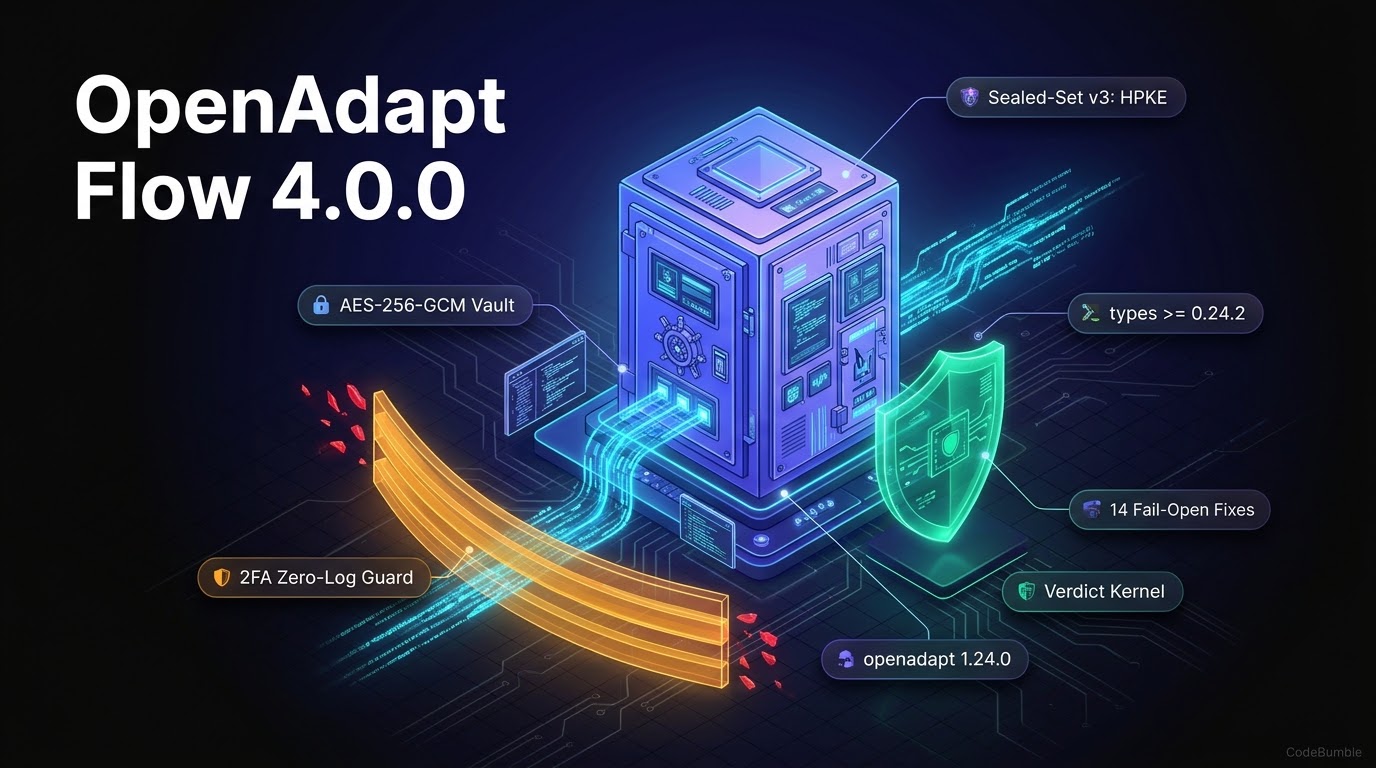
Executive Summary
On November 24, 2026, OpenAdaptAI published a coordinated monorepo release on GitHub Releases and PyPI: openadapt-flow 4.0.0, openadapt 1.24.0, openadapt-agent 2.2.4, openadapt-verify 0.2.1, openadapt-types 0.24.2, and OpenAdapt Desktop 0.33.1. Targeting Python 3.11 and 3.12 GUI/browser automation and EHR/payer-portal agent workflows (MIT license for core packages, with separately licensed media/vision components downloaded on first use in Desktop), openadapt-flow 4.0.0 introduces two major breaking changes alongside deep verification and security hardening.
First, encryption at rest is now enabled by default (#2423): recordings, compiled bundles, and run directories (including report, step screenshots, crops, frames, evidence, and REPORT.md) are written as sealed-set v3 encrypted containers using cryptography>=50 HPKE (P-256, HKDF-SHA256, AES-256-GCM) and Tink AES-256-GCM-HKDF 1 MiB streams. Second, openadapt-flow 4.0.0 tightens its dependency floor to openadapt-types>=0.24.2,<0.25.0 because earlier 0.24.0 installs lacked newly imported modules (evidence_scope, run_ledger, receipt, exception_card) and caused import-time crashes. Teams upgrading from openadapt 1.23.0 / Flow 3.4.0 must update launcher, agent, and types packages together—and configure recovery keys or --no-encrypt flags before running unattended CI pipelines.
Adoption Telemetry & Version Changelog
OpenAdapt operates as a modular Python monorepo (OpenAdaptAI/OpenAdapt) spanning CLI launchers, a deterministic compiler/governed runtime (openadapt-flow), an AI agent layer (openadapt-agent with Official MCP Registry auto-syndication and A2A protocol support), and native Tauri/React desktop installers:
- Coordinated November 24, 2026 Package Matrix (Verified on GitHub Releases):
openadapt-flow:4.0.0(major breaking release; pairs withopenadapt 1.24.0via>=4.0.0,<5.0.0).openadapt(launcher):1.24.0(replaces1.23.0, which remains pinned toopenadapt-flow<4/3.4.0because1.23.0reads run files via plain paths).openadapt-agent:2.2.4(widensopenadapt-flow[vision]andtutorialextras to>=2.2.0,<5so1.24.0resolves withFlow 4.0.0on PyPI; follows2.2.3on Nov 22 addingserve --a2aAgent2Agent support).openadapt-verify:0.2.1(widensopenadapt-flowandopenai/claude/mcpextras from<4to<5,#2535).openadapt-types:0.24.2(0.24.1was tagged onmainbut never published;0.24.2is the first published release withreceipt,run_ledger,exception_card,evidence_scope, andcheck_level).OpenAdapt Desktop:0.33.1(freezesopenadapt-flow[browser,console]==2.4.1andplaywright==1.61.0inside its sidecar, shipping macOS DMG, Windows MSI/NSIS, and Linux DEB/AppImage).
- Runtime & Dependency Footprint: Core Python packages target Python 3.11 or 3.12 (OpenAdapt Desktop GitHub);
openadapt-flow 4.0.0addscryptography>=50(for HPKE) as a core dependency, whilepip install openadaptbundleskeyringfor OS keychain storage (a bareopenadapt-flowinstall without thekeychainextra falls back to a0600key file with a warning).
Security Patches, Breaking Changes & Internals
Sealed-Set v3 Encryption at Rest (#2423)
Prior to 4.0.0, OpenAdapt stored desktop and browser recordings, step screenshots, and run reports as plaintext directories. In openadapt-flow 4.0.0, every recording, compiled bundle, and run directory is encrypted at rest by default with zero configuration:
- Cryptographic Envelope: Each set generates a per-set data key wrapped via HPKE (
P-256,HKDF-SHA256,AES-256-GCM) to a per-set bucket key, encrypting files as TinkAES-256-GCM-HKDF1 MiB streams. - Key Wrapping & Lifecycle: The bucket key is wrapped to the device runtime key (while the set is written; compiled bundles retain it), a device viewer key, optional organization keys (
P-256orRSA-OAEP-3072via MDM, Group Policy, or/etc/openadapt/policy.json), and a recovery key (openadapt-flow at-rest recovery create). Note that Secure Enclave, TPM, Touch ID, and Windows Hello providers are currently interface stubs with test doubles—not yet backed by hardware keys. - Organization Fail-Closed Policy: In organization mode, an archive directory is accepted only if it contains a
.openadapt-key-archivemarker; recording aborts if organization recipients or the archive are missing.openadapt-flow at-rest shredauthenticates headers first and reports complete only once every tracked bucket-key copy and store file is deleted. - Plaintext Receipts & Opt-Out: Receipts (
seal.json,receipt.*,public-seal.json) remain plaintext, with digests computed over the plaintextreport.json(and note: the receipt page embeds the report, logging it as a plaintext copy beside an encrypted run). Version 1 and 2 sets and legacy plaintext folders remain readable, and passingOPENADAPT_ENCRYPT_AT_REST=0or--no-encryptonrecord,compile,run, orreplaydisables encryption for that command with a warning and ledger entry.
flowchart LR
    A[Recording / Compiled Bundle / Run Dir] --> B[Tink AES-256-GCM-HKDF<br/>1 MiB Encrypted Streams]
    B --> C[Per-Set Bucket Key<br/>HPKE P-256 + HKDF-SHA256]
    C --> D[Device Key via keyring / 0600 File]
    C --> E[Org Key + .openadapt-key-archive]
    C --> F[Recovery Key<br/>at-rest restore DIR --yes]
    G[openadapt_flow.verdict Kernel] -->|15 Fail-Open Mutations Tested| H[Held / Refuted / Not Checked]
Fail-Closed Verdict Kernel, Verification Ladder & Zero-Log 2FA
Alongside encryption at rest, openadapt-flow 4.0.0 overhauls how agents verify side effects and handle multi-factor authentication:
- Unified Verdict Kernel (
openadapt_flow.verdict): Every check that converts evidence intoheld,refuted, ornot_checkednow runs through one kernel. It locks plan obligations up front and refuses to pass empty sets, truncated/short reads, raising probes, cross-run mismatched results, or disagreeing results. A dedicated fail-open test harness (tests/failopen) runs 15 generic mutations against@verdict_sitefunctions—catching 14 historical fail-open bugs and one live connector site—whilescripts/check_verdict_folds.pyfails CI if hand-writtenexceptfall-throughs or partial-read"nothing else changed"checks increase. - One Verification Ladder (
openadapt_types.check_level):verify-run, runtime reports, and thetxengine now map every check toVERIFIED(levels 3–4 only, paired withseparate_session,system_api,activity_log,db_frame, orowned_connection),SHOWN,CONFIRMED,ATTESTED, orRECORDED, carrying an additiveopenadapt.evidence-scope/v1block. - Zero-Log Second-Factor (
second_factor) Steps: When a sign-in flow hits anautocomplete="one-time-code"input (SMS, email, authenticator, or push approval),Flow 4.0.0pauses for human input viaOPENADAPT_SECOND_FACTOR_URL,OPENADAPT_SECOND_FACTOR_COMMAND, or a non-echoing interactive terminal (msvcrt.getwchon Windows). Before typing, it verifies the focused element is still empty and masked as dots; the code is filled once, never retried, and never written to model page listings, screenshots, logs, receipts, or recordings. - Network Capture Hashing:
record --capture-network,dump_har, andsave_harno longer write raw HTTP bodies by default; they store only declared--paramand--identifiervalues plus per-capture keyed hashes of HTML, text, binary bodies, and undeclared query parameters.
Effect Locations & GUI Step Semantics (openadapt_flow.gui.steps)
Two additional runtime additions in openadapt-flow 4.0.0 tighten how desktop and browser agents verify outcomes without hardcoding brittle application strings:
- Effect Locations (
openadapt.effect-location/v1): Stored insideopenadapt_flow/effect_location/as pack data, an effect location defines where a careful human reviewer would look again to confirm an intended write—capturing the demonstration path, start condition (same_screen,fresh_navigation,new_session, orother_channel), locator (label, row key, or region), expected value, and codec (including a template codec for multi-value summary rows and asplit_datecodec).evaluate_allgrades every planned value asheld,refuted, ornot_checked; any unreachable or unreadable location defaults tonot_checked, never a pass. Notably, the engine carries no built-in application vocabulary—month names, currency signs, and yes/no tokens live in the pack itself. - Commit vs. Navigation Steps (
openadapt_flow.gui.steps): Links, tabs, and menu items now qualify as first-class steps, and each demonstrated click is classified by what the backend observed: acommitwhen a write occurred, versus anavigationwhen the screen changed without a write.openadapt_flow.guiexposes a neutral screen view (role, name, state, containers) across browser pages, OS accessibility trees, andform_txsnapshots.
CLI & Recovery Commands (v4.0.0)
# Upgrade launcher, flow, agent, and types together
uv add "openadapt>=1.24.0" "openadapt-flow>=4.0.0,<5.0.0" "openadapt-agent>=2.2.4" "openadapt-types>=0.24.2,<0.25.0"

# Create a recovery key and inspect at-rest encryption status
openadapt-flow at-rest recovery create
openadapt-flow at-rest status

# Restore an encrypted backup using the recovery key
openadapt-flow at-rest restore ./run_dir --yes

# Temporarily disable encryption at rest for a single local debug run
openadapt-flow run --no-encrypt ./bundle
Ecosystem Comparison & Upgrade Checklist
How does openadapt-flow 4.0.0 compare to other Python browser/GUI agent packages and the standalone OpenAdapt Desktop installer?
| Package / Distribution | Latest Verified Version | Encryption & Secrets Posture | Verification & Eval Model | Dependency / Runtime Notes |
|---|---|---|---|---|
openadapt-flow + openadapt |
4.0.0 / 1.24.0 (Nov 24, 2026) |
Default HPKE sealed-set v3; zero-log 2FA; hashed HAR bodies | Fail-closed verdict kernel + check_level + EffectBench (SWER) |
Python 3.11–3.12; cryptography>=50; openadapt-types>=0.24.2,<0.25.0 |
OpenAdapt Desktop |
0.33.1 (Nov 24, 2026) |
Sidecar freezes openadapt-flow[browser,console]==2.4.1; CycloneDX SBOM + GitHub OIDC attestation |
Attended decision console + mobile pairing (openadapt://connect) |
macOS (adhoc DMG), Windows (unsigned MSI/NSIS), Linux (DEB/AppImage) |
pydantic-ai-harness |
0.74.0 (Nov 24, 2026) |
PlaywrightBrowser IPv6/NAT64 SSRF blocks + WebRTC/FedCM egress guard |
pydantic-evals OTel trajectory & online evals |
Python >=3.11; general LLM/browser agent SDK |
Safe Upgrade & Pinning Checklist
- Do Not Mix
openadapt 1.23.0withopenadapt-flow 4.0.0: Becauseopenadapt 1.23.0reads run directories via plain filesystem paths, keep1.23.0pinned toopenadapt-flow<4(3.4.0), or upgradeopenadaptto1.24.0alongsideopenadapt-agent>=2.2.4andopenadapt-verify>=0.2.1. - Enforce
openadapt-types>=0.24.2,<0.25.0: If your lockfile pinsopenadapt-types==0.24.0,Flow 4.0.0will fail on import (evidence_scope,run_ledger,receipt,exception_card). Upgradeopenadapt-typesto0.24.2first. - Provision
keyringand Recovery Keys in CI/Headless Containers: Bareopenadapt-flowinstalls without thekeychainextra store device keys in a0600file; in ephemeral containers, either generate and mount recovery keys (openadapt-flow at-rest recovery create) or setOPENADAPT_ENCRYPT_AT_REST=0for non-sensitive synthetic runs. - Verify Native Desktop Checksums: When distributing
OpenAdapt Desktop 0.33.1, verifySHA256SUMSwithgh attestation verifyandverify-openadapt-native-release.py --channel openadapt-desktop-channel.jsonrather than trusting release-note text.
Frequently Asked Questions
What breaks when upgrading from openadapt-flow 3.4.0 to 4.0.0?
Recordings, compiled bundles, and run directories are now encrypted at rest by default as sealed-set v3 containers, which breaks openadapt 1.23.0 (which expects plain paths). You must upgrade to openadapt 1.24.0, openadapt-agent 2.2.4, openadapt-verify 0.2.1, and openadapt-types>=0.24.2,<0.25.0.
Can I still read older v1/v2 or plaintext OpenAdapt runs in 4.0.0?
Yes. openadapt-flow 4.0.0 still reads version 1 and 2 sets as well as legacy plaintext folders, and you can opt out of encryption for individual commands using --no-encrypt or OPENADAPT_ENCRYPT_AT_REST=0.
Does openadapt-flow 4.0.0 use hardware TPM or Secure Enclave keys yet?
Not yet. The release notes explicitly state that Secure Enclave, TPM, Touch ID, and Windows Hello providers are currently interface stubs with test doubles; the device key is a software P-256 key stored via keyring (or a 0600 file if keyring is absent).
How does openadapt-flow 4.0.0 handle 2FA prompts without leaking OTP codes?
When a focused autocomplete="one-time-code" field is detected, Flow 4.0.0 pauses for human entry via OPENADAPT_SECOND_FACTOR_URL, OPENADAPT_SECOND_FACTOR_COMMAND, or a non-echoing terminal, fills the code once, and omits it from screenshots, page listings, logs, receipts, and recordings.
Why is OpenAdapt Desktop 0.33.1 still bundling openadapt-flow==2.4.1?
OpenAdapt Desktop native releases are unadmitted release candidates whose sidecar freezes openadapt-flow[browser,console]==2.4.1 and playwright==1.61.0 for local authoring and pairing, separate from the 4.0.0 PyPI engine release.
Sources
- OpenAdaptAI GitHub Releases (
openadapt-flow 4.0.0,openadapt-agent 2.2.4,openadapt-types 0.24.2,OpenAdapt Desktop 0.33.1) — OpenAdaptAI/OpenAdapt (November 24, 2026): https://github.com/OpenAdaptAI/OpenAdapt/releases - PyPI (
openadapt-flow) — EffectBench & Package Metadata (Updated November 24, 2026): https://pypi.org/project/openadapt-flow/1.33.0/ - OpenAdaptAI GitHub (
openadapt-desktop) — Python 3.11/3.12 Runtime & Monorepo Docs (November 2026): https://github.com/OpenAdaptAI/openadapt-desktop - OpenAdapt Official Download Page — Desktop Installers & PyPI Instructions (November 2026): https://openadapt.ai/download