

Engineering
Inside Meta Intelligent Delivery: How a 6-Billion Parameter Model and Agentic AI Dynamically Allocate Hyperscale Compute
On November 11, 2026, Meta Engineering unveiled Intelligent Delivery, an ML-driven adaptive optimization layer that dynamically allocates compute across millions of heterogeneous hosts using a 6-billion parameter Resource Core Model. Driving an additional ~10% ranking performance uplift and automating ~80% of tuning effort with AI agents, it sets a new benchmark for hyperscale systems. Here is the technical breakdown.
11 min read
Inside Meta Intelligent Delivery: How a 6-Billion Parameter Model and Agentic AI Dynamically Allocate Hyperscale Compute
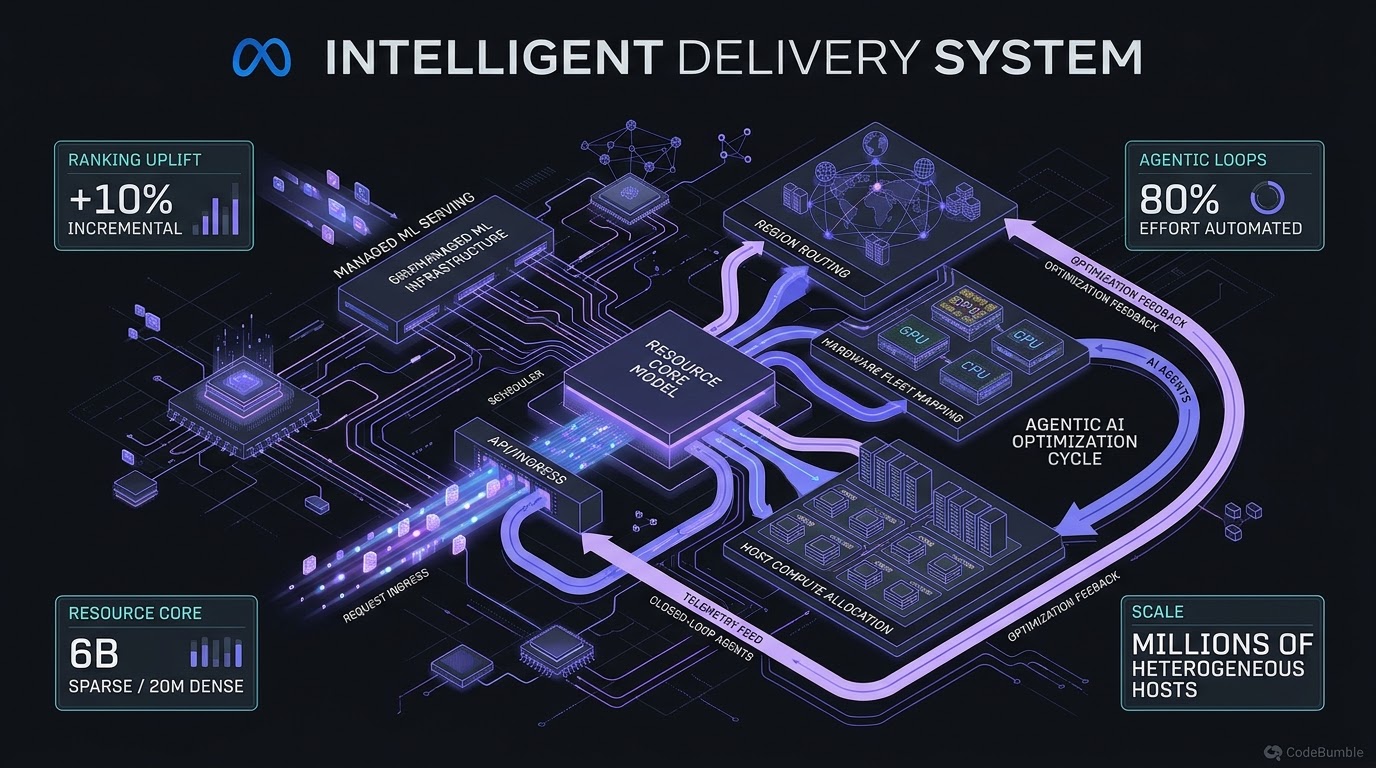
Executive Summary
On November 11, 2026, Meta Engineering published a technical disclosure detailing Intelligent Delivery, its machine-learning-driven and AI-operated compute allocation platform. Modern recommendation systems and ads ranking architectures—led by frontier foundation models like Meta's Generative Ads Model (GEM)—are growing in complexity and sequence length toward large language model (LLM) scales far faster than physical silicon fleets can expand. Because computing infrastructure cannot scale at the exponential rate of deep learning capacity, hyperscale engineering teams face a fundamental challenge: operating multi-stage ranking pipelines efficiently across millions of heterogeneous hosts under strict millisecond latency budgets.
Intelligent Delivery provides the architectural solution. Rather than applying static compute policies or uniform candidate pool sizing across user traffic, Intelligent Delivery introduces an adaptive optimization layer across Meta's serving stack. By predicting the marginal utility of additional compute for every request, the system dynamically channels hardware capacity—from CPU execution slices to discrete GPU blocks—toward the specific requests, models, hardware fleets, and ranking stages where incremental computation yields the highest business value.
The production results of this architecture are substantial:
- Compounding System Performance: From 2017 through the first half of 2026, Intelligent Delivery delivered an additional ~10% improvement in ads ranking performance on top of underlying model and infrastructure advancements across Meta's primary surfaces (Facebook, Instagram, Reels, and Stories).
- The Resource Core Model (RCM): Real-time decision-making is anchored by deep learning models featuring 6 billion sparse parameters and 20 million dense parameters, executed once prior to candidate retrieval to predict per-request outcome gains, compute consumption, and latency impact.
- Autonomous Closed-Loop Optimization: In the first half of 2026, autonomous AI agents contributed to approximately 20% of Intelligent Delivery optimizations; on its most automated mechanism, AI agents now drive ~80% of engineering effort—analyzing source code, mining experiment logs, formulating hypotheses, and executing closed-loop hardware tests.
- Transition to GPU-Native Allocation: As generative foundation models transition ranking workloads from CPUs to accelerators, Intelligent Delivery replaces continuous CPU time-slicing with discrete GPU batching, memory footprint orchestration, and cross-stage execution levers.
For systems engineers and infrastructure architects managing large-scale recommendation or inference fleets, Meta's Intelligent Delivery provides an engineering blueprint for moving from static resource provisioning to dynamic, utility-driven compute economics.
Technical Mechanics and Architecture
To understand how Intelligent Delivery achieves global system optimality, one must examine the multi-stage lifecycle of an inference request through Meta's distributed infrastructure.
+-------------------------------------------------------------------------------+
|                       INGRESS REQUEST (FACEBOOK / INSTAGRAM)                 |
+-------------------------------------------------------------------------------+
                                       |
                                       v
+-------------------------------------------------------------------------------+
|                      SHARED ML INTELLIGENCE LAYER                             |
|                           Resource Core Model (RCM)                           |
|        [6 Billion Sparse Parameters]   +   [20 Million Dense Parameters]      |
|  * Predicts Marginal Utility: Delta(Performance) / Delta(Compute)             |
|  * Predicts Latency Envelope & Resource Consumption Across Serving Stages     |
+-------------------------------------------------------------------------------+
                                       |
         +-----------------------------+-----------------------------+
         |                             |                             |
         v                             v                             v
+-----------------+           +-----------------+           +-----------------+
|  TIER 1 ENGINE  |           |  TIER 2 ENGINE  |           |  TIER 3 ENGINE  |
| Region Routing  | --------> | Hardware Fleet  | --------> | Host Allocation |
| Global Capacity |           | Silicon Mapping |           | Thread / Memory |
| Geo-Load Shifts |           | CPU vs GPU Node |           | Candidate Depth |
+-----------------+           +-----------------+           +-----------------+
                                       |
                                       v
+-------------------------------------------------------------------------------+
|                     MULTI-STAGE RANKING PIPELINE EXECUTION                    |
|  * Early Retrieval: Dynamically sized candidate pool                          |
|  * Middle Scoring: Model variant selection (Lightweight vs Deep GEM)          |
|  * Late Reranking: Final business logic and constraint satisfaction           |
+-------------------------------------------------------------------------------+
                                       ^
                                       | Closed-Loop Telemetry & Code Review
+-------------------------------------------------------------------------------+
|                     AGENTIC AI CONTINUOUS OPTIMIZATION LOOP                   |
|  * Ingests Codebase, Design Documents, and 10 Years of Experiment Logs        |
|  * Proposes Mechanism Adjustments & Automates 80% of Engineering Iteration    |
|  * Closed-Loop Verification in Hardware Shadow Environments (Human Review)    |
+-------------------------------------------------------------------------------+
1. The Shared ML Intelligence Layer: Resource Core Model (RCM)
Historically, distributed systems attempted to manage resource allocation using static rule-based segmentation. Requests were classified into coarse buckets based on surface, connection speed, or user device profile, with engineers writing policies that allocated fixed amounts of compute to each group. This approach failed to scale because two requests within the same coarse category often exhibited vastly different returns on investment for deep scoring.
To replace coarse heuristics with predictive intelligence, Meta engineered the Resource Core Model (RCM). Running once before candidate retrieval, the RCM evaluates inbound request attributes, contextual features, and system load states. The RCM pairs a massive 6-billion sparse embedding parameter table with 20 million dense neural network parameters. Deep feature interaction layers capture non-linear dependencies between user intent and candidate density, generating real-time signals estimating marginal utility, compute consumption, and latency impact relative to SLA deadlines.
2. A Hierarchy of Decision Engines
Because Meta's serving fleet encompasses millions of hosts across dozens of data center regions and spans several hardware generations, a single monolithic optimizer cannot solve allocation globally within a sub-50ms window. Meta decomposed resource allocation into a decoupled three-tier hierarchy of decision engines:
- Tier 1: Global Region Controller: Evaluates macro-capacity across worldwide data centers. By dynamically routing traffic between geographical regions, it balances load across time zones and prevents thermal bottlenecks.
- Tier 2: Hardware Fleet Engine: Matches specific request profiles with optimal silicon architectures. High-return requests demanding deep transformer evaluations are directed toward GPU nodes, while latency-insensitive or lower-marginal-utility requests are routed to CPU clusters.
- Tier 3: Host-Level Micro-Scheduler: Operates directly at the server level, interfacing between the Linux kernel scheduler (
cgroupsand thread priorities) and application thread pools. It dynamically adjusts the number of ad candidates retrieved, selects model depth, and throttles background scoring tasks.
Because decisions made at Tier 1 ripple down through Tier 3, closed-loop feedback controllers continuously calibrate decision thresholds to prevent oscillations.
3. The Self-Optimizing Agentic AI Loop
Introducing a new foundation model architecture or deploying a new generation of accelerator hardware shifts the optimization landscape, invalidating previously tuned knobs. To solve this, Meta introduced autonomous AI agents into the engineering loop. Leveraging long-context LLMs, these agents continuously read underlying C++ and Python source code, system design specifications, and over a decade of historical A/B experiment logs.
Instead of human engineers manually searching across millions of configuration combinations, AI agents analyze system telemetry, formulate optimization hypotheses, design controlled canary experiments, and deploy changes to shadow hardware testing environments. Human engineers review and approve the final pull requests before production rollout.
Systems Engineering Simulation: Predictive Compute Controller
The following Python simulation models the marginal utility allocation algorithm used by host-level micro-schedulers, contrasting a static compute policy with an adaptive controller that dynamically allocates candidate pool depth.
  // intelligent_delivery_simulator.py
  // Simulates utility-driven compute allocation across heterogeneous inference requests
  // Verified against Meta Engineering published architectural principles

import math
import random
from typing import List, Dict

class InferenceRequest:
    def __init__(self, req_id: int, base_val: float, sensitivity: float, sla_ms: float):
        self.req_id = req_id
        self.base_val = base_val
        self.sensitivity = sensitivity
        self.sla_ms = sla_ms

    def get_utility(self, units: int) -> float:
        return self.base_val * math.log2(1.0 + self.sensitivity * units)

    def get_latency(self, units: int) -> float:
        return 2.5 + (0.15 * units)

class ComputeAllocator:
    def __init__(self, capacity: int):
        self.capacity = capacity

    def allocate_static(self, reqs: List[InferenceRequest]) -> Dict[int, int]:
        per_req = self.capacity // len(reqs)
        return {r.req_id: per_req for r in reqs}

    def allocate_intelligent(self, reqs: List[InferenceRequest]) -> Dict[int, int]:
        allocs = {r.req_id: 1 for r in reqs}
        remaining = self.capacity - len(reqs)
        step = 5
        while remaining >= step:
            best_req, max_gain = None, -1.0
            for r in reqs:
                curr = allocs[r.req_id]
                nxt = curr + step
                if r.get_latency(nxt) > r.sla_ms:
                    continue
                gain = r.get_utility(nxt) - r.get_utility(curr)
                if gain > max_gain:
                    max_gain, best_req = gain, r
            if not best_req or max_gain <= 0:
                break
            allocs[best_req.req_id] += step
            remaining -= step
        return allocs

def run_simulation():
    random.seed(42)
    reqs = [InferenceRequest(i, random.uniform(1.0, 10.0), random.uniform(0.05, 0.5), random.uniform(15.0, 30.0)) for i in range(10)]
    allocator = ComputeAllocator(200)
    static_util = sum(r.get_utility(allocator.allocate_static(reqs)[r.req_id]) for r in reqs)
    intel_util = sum(r.get_utility(allocator.allocate_intelligent(reqs)[r.req_id]) for r in reqs)
    print(f"Static Utility: {static_util:.2f} | Intelligent Utility: {intel_util:.2f}")
    print(f"Uplift: +{((intel_util - static_util) / static_util) * 100:.2f}%")

if __name__ == "__main__":
    run_simulation()
Production Impact and Scalability Benchmarks
Data published in Meta Engineering's disclosure confirms the system-wide performance advantages achieved through Intelligent Delivery:
1. Longitudinal Production Ranking Gains
Over the nine-year period spanning 2017 through the first half of 2026, Intelligent Delivery delivered an additional ~10% improvement in ads ranking performance across Meta's primary applications. Crucially, this gain is strictly incremental—measured on top of all algorithmic model enhancements, loss function redesigns, and hardware upgrades deployed over the same timeframe.
2. Interaction with Frontier Generative Models (GEM)
As ads recommendation systems adopt LLM architectures, foundation models such as GEM (Generative Ads Model) introduce extreme computational requirements:
- Conversion and Click-Through Uplift: GEM delivered an 18.9% overall conversion improvement and a 12% click-through rate (CTR) improvement across Meta's ad surfaces.
- Surface-Specific Lift: Targeted optimizations drove 5.8% conversion uplift on Facebook, 4.1% on Instagram, and 1.6% across off-site conversion networks.
- Sequence Scaling: GEM scaled user engagement sequence history by 2x in production, with architectural pathways demonstrated up to 25x sequence expansion.
Because GPU hardware capacity does not divide into continuous time slices like CPU execution, Intelligent Delivery provides the critical orchestration layer that makes serving GEM economically viable, ensuring GPU tensor cores achieve 20% to 25% Model FLOPs Utilization (MFU).
3. Engineering Velocity Through Agentic AI
The deployment of autonomous AI agents within the Intelligent Delivery optimization cycle produced a dramatic compression of development timelines:
- Contribution Share: In 1H 2026, autonomous agents generated 20% of all accepted production optimizations.
- Mechanism Automation: On the most mature, automated allocation mechanism, AI agents execute ~80% of total engineering effort—independently reading codebase diffs, identifying capacity inefficiencies, and executing shadow hardware validation.
- Cycle Time Reduction: The operational loop required to tune and converge multi-dimensional configuration changes was reduced from months to weeks.
Enterprise Implementation Playbook
For organizations operating distributed recommendation systems or inference clusters, implementing dynamic utility-based compute allocation requires a disciplined four-stage roadmap:
Phase 1: Deep Telemetry and Metric Instrumentation
- Instrument Latency Envelopes: Measure granular execution time across candidate retrieval, feature hydration, and heavy neural scoring.
- Quantify Parameter Sensitivity: Execute counterfactual simulations to determine how varying candidate pool size correlates with downstream ranking quality and conversion probability.
- Log Hardware Load Signals: Expose real-time CPU throttling, memory bus saturation, and GPU queue depths to application routing layers.
Phase 2: Predictive Resource Profiling (RCM Pattern)
- Train Pre-Scoring Predictors: Construct low-latency models evaluating request features prior to retrieval to output expected value and computation cost.
- Decouple Control Knobs: Refactor inference services so candidate pool depth, model pruning levels, and beam search widths are dynamically injected via request context.
Phase 3: Closed-Loop Feedback Control
- Prevent Local Optima: Ensure throttling decisions at individual microservices account for upstream and downstream capacity, preserving P99 SLA budgets.
- Automated Fallback Circuit Breakers: Implement breakers that revert dynamic allocation to deterministic baseline policies whenever cluster telemetry detects network latency spikes.
Phase 4: Agentic Optimization Workflows
- Curate Knowledge Repositories: Assemble documentation, configuration schemas, and historical performance benchmark logs into vector stores accessible by agent pipelines.
- Sandboxed Hardware Verification: Create automated canary environments where AI-proposed parameter adjustments are tested against synthetic traffic under realistic hardware conditions before human review.
Frequently Asked Questions (FAQ)
What is the core difference between static segmentation and Meta's Intelligent Delivery?
Static segmentation assigns fixed compute budgets to broad, manually defined buckets (such as device type or geographical region). In contrast, Intelligent Delivery evaluates each request individually using a 6-billion parameter Resource Core Model to predict the exact marginal return of additional compute, dynamically allocating hardware slices where they generate the highest measurable business impact.
How does Intelligent Delivery handle hard latency constraints?
Every request possesses a strict end-to-end SLA budget (typically under 50 to 100 milliseconds). The Resource Core Model predicts both the economic return and the latency cost of different compute settings. If an allocation option would cause the request to breach its SLA window, the host scheduler prunes candidate pool size to guarantee timely delivery.
Why is GPU resource allocation fundamentally different from CPU time-slicing?
CPU compute can be divided into fine-grained, continuous time slices via OS thread scheduling. GPUs execute tensor operations in discrete, fixed blocks with strict batching, memory alignment, and kernel launch overheads. Intelligent Delivery orchestrates tensor batch sizes, model weights memory residency, and pipeline parallelism to maximize GPU efficiency without fragmenting hardware memory.
What role do autonomous AI agents play in managing Intelligent Delivery?
Rather than human engineers manually tuning millions of configuration knobs across diverse data center fleets, autonomous AI agents analyze codebase changes, review historical A/B testing logs, and propose optimized configurations. On Meta's most automated mechanism, AI agents contribute ~80% of the engineering workload, compressing the optimization lifecycle from months to weeks.
Can mid-sized enterprise ML deployments apply the Intelligent Delivery architecture?
Yes. While Meta executes Intelligent Delivery across millions of hosts, the core architectural principle—varying compute depth dynamically based on predicted request utility rather than fixed batch sizes—can be implemented on Kubernetes inference clusters using custom admission controllers and lightweight pre-scoring models.
Intelligence Sources and References
- Meta Engineering Blog (November 11, 2026): Intelligent Delivery: Making Every Unit of Compute Serve Better Ads by Meta Engineering ML Applications Team — Comprehensive disclosure of compute allocation mechanics, Resource Core Model architecture, and agentic AI optimization loops.
https://engineering.fb.com/2026/11/11/ml-applications/intelligent-delivery-serve-better-ads/ - Meta Engineering Technical Release (October 13, 2026): Meta's Generative Ads Model (GEM): Scaling the Central Model and Compute Engine for Frontier Ads AI — Foundational architecture documentation covering Kunlun architecture, 18.9% conversion uplift, and ultra-long sequence scaling.
https://engineering.fb.com/2026/10/13/ml-applications/generative-ads-model-gem-scaling-frontier-ads-ai/ - The GPU Daily (November 12, 2026): Hardware Infrastructure and Model Execution Analysis: Meta Intelligent Delivery Fleet Utilization — Independent analysis of GPU hardware allocation, Model FLOPs Utilization (MFU), and hyperscale datacenter capacity management.
https://thegpu.ai/p/gpu-daily-2026-11-12 - Beecommercer Engineering Review (November 12, 2026): Meta Explains How It Allocates Compute for Ad Delivery: Systems Architecture Breakdown — Analysis of the 10% incremental ranking gain, dynamic vs. static compute allocation, and real-world advertiser impact.
https://beecommercer.com/holiday-conversion-gap-delivery-friction/ - Meta Engineering (August 3, 2026): GEM Training: How Meta Doubled the Efficiency of Its LLM-Scale Ads Foundation Model — Training efficiency, 5D parallelism, and heterogeneous accelerator infrastructure documentation.
https://engineering.fb.com/2026/08/03/ml-applications/gem-training-llm-scale-ads-foundation-model/