

Engineering
Inside Meta TLX: How Triton Low-Level Extensions Bridge Python Productivity and Hardware-Native GPU Execution at Scale
On November 10, 2026, Meta Engineering unveiled Triton Low-Level Extensions (TLX), an open-source compiler framework bridging the gap between high-level Python productivity and low-level GPU hardware control. Introducing Multiple-Instructions Multiple-Warps (MIMW) orchestration, warp specialization, and Tensor Memory (TMEM) management across NVIDIA Blackwell and AMD Instinct silicon, TLX delivers up to a 66% latency reduction and outperforms FlashAttention-4 by 50% on backward passes. Here is the technical breakdown.
11 min read
Inside Meta TLX: How Triton Low-Level Extensions Bridge Python Productivity and Hardware-Native GPU Execution at Scale
Executive Summary
On November 10, 2026, Meta Engineering published an in-depth systems architecture disclosure detailing Triton Low-Level Extensions (TLX), an open-source compiler extension to OpenAI Triton designed to resolve a fundamental tension in modern high-performance computing: the growing chasm between low-level hardware control and high-level developer productivity. As modern graphics processing unit (GPU) architectures—exemplified by NVIDIA's Hopper (H100) and Blackwell (B200) families alongside AMD's Instinct (MI300) series—evolve toward deeply asynchronous, execution-oriented designs, traditional programming models have struggled to keep pace.
Contemporary GPU silicon no longer operates purely as simple Single Instruction, Multiple Threads (SIMT) vector engines. Instead, peak hardware utilization (Model FLOPs Utilization, or MFU) demands coordinating complex, heterogeneous hardware primitives:
- Warp Specialization and Asynchronous Transfers: Allocating dedicated execution groups where producer warps continuously issue asynchronous memory transfers via the Tensor Memory Accelerator (TMA) while consumer warps drive Tensor Core arithmetic via Warp Group Matrix Multiply and Accumulate (WGMMA).
- On-Chip Tensor Memory (TMEM): Leveraging Blackwell's dedicated physical SRAM buffers and cluster-level synchronization barriers.
- The Programming Dilemma: Implementing these asynchronous orchestration patterns in standard CUDA requires thousands of lines of fragile, architecture-specific C++ boilerplate (often exceeding 10,000 lines of CuTeDSL). Conversely, standard Triton hides execution scheduling behind high-level blocked tensor abstractions, preventing engineers from manually managing hardware resources.
Meta engineered TLX to bridge this divide by introducing the Multiple-Instructions Multiple-Warps (MIMW) execution model into Triton's Python ecosystem. TLX gives systems engineers explicit control over cooperating warp groups, asynchronous memory staging, and cluster-level synchronization while preserving Triton's productive Python authoring loop.
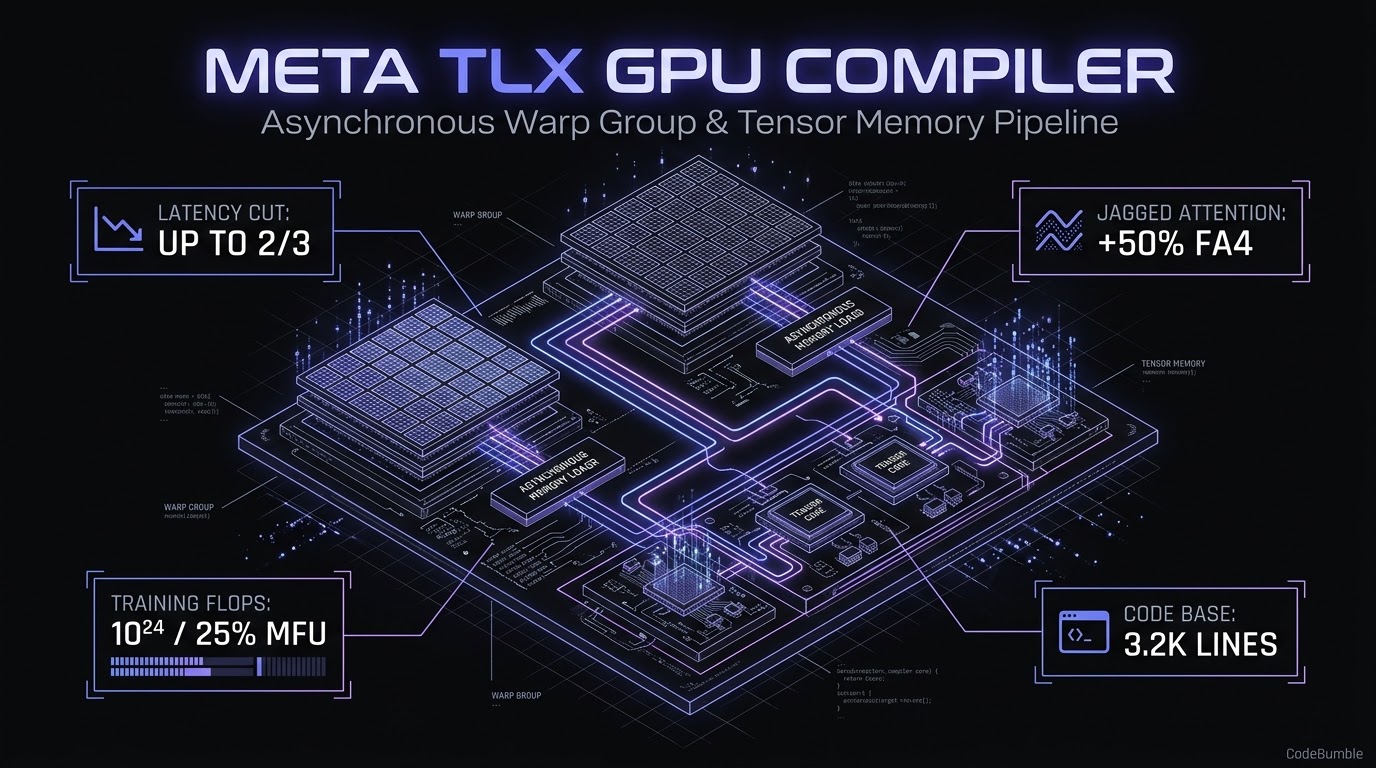
In production at Meta, TLX powers large-scale recommender system (RecSys) foundation model training, high-throughput ads ranking inference, and frontier language model pretraining. Production telemetry reveals up to a two-thirds (66%) reduction in compute-intensive ranking latency, an O(10^24) FLOPs training run across thousands of Blackwell GPUs achieving 20% to 25% MFU, and a concise 3.2K-line FlashAttention kernel that outperforms state-of-the-art FlashAttention-4 by 50% on backward passes.
Technical Mechanics and Architecture
To understand why TLX represents an architectural leap, one must contrast how standard GPU programming paradigms manage the trade-off between control and productivity.
+-------------------------------------------------------------------------------+
|                       GPU PROGRAMMING PARADIGM SPECTRUM                       |
+-------------------------------------------------------------------------------+
  [Fine-Grained Control / Low Productivity]          [High Productivity / Inflexible]
  NVIDIA CUDA / CuTeDSL / AMD HIP                    Standard OpenAI Triton (SIMB)
  * Thread-level SIMT management                     * Single Instruction, Multiple Blocks
  * Manual register allocation & barriers            * Automatic loop scheduling
  * ~10,000 lines of complex C++                     * Obscured hardware synchronization
                        \                                   /
                         \                                 /
                          v                               v
+-------------------------------------------------------------------------------+
|                   TRITON LOW-LEVEL EXTENSIONS: THE MIMW MODEL                 |
|             (Multiple-Instructions Multiple-Warps within Python)               |
+-------------------------------------------------------------------------------+
  * Cooperating Warp Groups as first-class language constructs
  * Explicit Producer-Consumer specialization (TMA Memory Load vs WGMMA Compute)
  * Fine-grained control over Shared Memory / TMEM barriers and handoffs
  * Concise Python syntax (~3.2K lines) with automatic autotuning
+-------------------------------------------------------------------------------+
|                    TLX WARP-SPECIALIZED EXECUTION PIPELINE                    |
+-------------------------------------------------------------------------------+
  Inbound Tensor Tiling: Batch (B), Sequence (S), Head Dim (D)
      |
      +---> [WARP GROUP 0: PRODUCER (I/O AGENT)]
      |     * Dispatches Asynchronous Copy / TMA from Global HBM to TMEM / Shared Mem
      |     * Manages circular double-buffering without stalling arithmetic pipelines
      |     * Signals arrival via hardware transaction barriers (mbarrier)
      |
      +---> [WARP GROUPS 1-3: CONSUMERS (COMPUTE AGENTS)]
            * Waits on transaction barrier (zero CPU/SIMT polling overhead)
            * Executes WGMMA / Tensor Core matrix multiplies directly from TMEM
            * Accumulates intermediate results into dynamic register files
            * Emits persistent tile outputs across thread-block clusters
1. The Multiple-Instructions Multiple-Warps (MIMW) Paradigm
Historically, GPU programming operated under the SIMT model, where every thread within a warp executed the same instruction at the same cycle. As hardware evolved, NVIDIA and AMD introduced specialized asynchronous hardware units that run out-of-band relative to the primary integer and floating-point ALUs.
On NVIDIA Hopper and Blackwell architectures, tensor operations are executed at the warp-group level (128 threads acting cooperatively). Crucially, overall kernel efficiency is no longer determined solely by arithmetic throughput; it is dominated by how effectively execution groups cooperate.
Standard Triton operates under Single Instruction, Multiple Blocks (SIMB), where developers write programs from the perspective of an entire thread block. While SIMB simplifies memory coalescing and loop tiling, it treats all warps within a block identically. It cannot express asymmetric execution—where Warp 0 acts as a memory loader while Warps 1–3 act as compute engines.
TLX introduces MIMW as an intermediate paradigm. In TLX, developers define cooperating warp groups (and wave groups on AMD Instinct GPUs) as first-class programming entities. An engineer can assign distinct execution roles to different warp groups within the same CTA (Cooperative Thread Array), coordinate shared-memory handoffs via explicit barriers, and orchestrate hardware-native asynchronous pipelines—all directly within Python.
2. In-Kernel Broadcast Elimination (IKBO) in RecSys Inference
In hyperscale recommendation systems (such as Meta's Adaptive Ranking Models and Generative Ads Model - GEM), inference latency is heavily constrained by jagged feature shapes. User features (such as user demographics and past engagement history) are identical across hundreds of candidate ads being scored in the same request.
In conventional GPU architectures, user feature embeddings are repeatedly broadcast and replicated across memory buffers for each candidate ad, wasting memory bus bandwidth and polluting on-chip caches.
Meta leveraged TLX to develop In-Kernel Broadcast Elimination (IKBO):
- By amortizing Key and Value tensor reads across all candidate ads sharing the same user context within on-chip shared memory, the attention kernel transitions from an I/O-bound workload to a compute-bound workload.
- TLX layers FlashAttention-3-style warp specialization with persistent thread blocks, eliminating cross-CTA launch stalls that traditionally dominate short-sequence RecSys queries.
- In production, IKBO achieved up to a two-thirds (66%) reduction in net compute latency for co-designed recommendation models.
3. Distributed Grouped GEMM for Mixture-of-Experts (MoE)
In large-scale language model pretraining, Mixture-of-Experts architectures route tokens dynamically to different expert sub-networks. This routing requires grouped matrix multiplications (Grouped GEMM) across heterogeneous matrix dimensions.
Existing implementations in standard CUDA or vendor libraries leave significant performance on the table because they decouple local matrix multiplication from inter-node communication. Using TLX, Meta engineers built distributed grouped GEMM kernels that tightly interleave tensor computation with inter-node network data movement, overlapping collective communication with Tensor Core execution across multi-node clusters.
Technical Implementation: Warp-Specialized Pipeline in TLX
To illustrate how TLX expresses asynchronous warp specialization within Triton's Python DSL, the following code snippet demonstrates the structural pattern of a producer-consumer matrix multiplication pipeline:
  // tlx_warp_specialized_gemm.py
  // Illustrates the MIMW (Multiple-Instructions Multiple-Warps) pattern in TLX
  // Target: NVIDIA Hopper (H100) / Blackwell (B200) architectures

import triton
import triton.language as tl
import triton.language.extra.tlx as tlx

@triton.jit
def warp_specialized_gemm_kernel(
    A_ptr, B_ptr, C_ptr,
    M, N, K,
    stride_am, stride_ak,
    stride_bk, stride_bn,
    stride_cm, stride_cn,
    BLOCK_M: tl.constexpr,
    BLOCK_N: tl.constexpr,
    BLOCK_K: tl.constexpr,
    NUM_STAGES: tl.constexpr,
):
    pid = tl.program_id(axis=0)
    num_pid_m = tl.cdiv(M, BLOCK_M)
    pid_m = pid % num_pid_m
    pid_n = pid // num_pid_m

    // Identify current warp group role (TLX Primitive)
    warp_group_id = tlx.get_warp_group_id()

    // Shared memory transaction barrier allocation
    barriers = tlx.alloc_barriers(num_barriers=NUM_STAGES)
    smem_a = tlx.alloc_smem(shape=(NUM_STAGES, BLOCK_M, BLOCK_K), dtype=tl.float16)
    smem_b = tlx.alloc_smem(shape=(NUM_STAGES, BLOCK_K, BLOCK_N), dtype=tl.float16)

    if warp_group_id == 0:
        // =====================================================================
        // PRODUCER WARP GROUP: Dedicated Asynchronous TMA Data Loading
        // =====================================================================
        for stage in range(NUM_STAGES):
            k_offset = stage * BLOCK_K
            // Issue hardware TMA asynchronous load into shared memory
            tlx.async_load_2d(
                dest=smem_a[stage],
                src=A_ptr + pid_m * BLOCK_M * stride_am + k_offset * stride_ak,
                barrier=barriers[stage]
            )
            tlx.async_load_2d(
                dest=smem_b[stage],
                src=B_ptr + k_offset * stride_bk + pid_n * BLOCK_N * stride_bn,
                barrier=barriers[stage]
            )
    else:
        // =====================================================================
        // CONSUMER WARP GROUPS: Tensor Core Matrix Multiplication (WGMMA)
        // =====================================================================
        accumulator = tl.zeros((BLOCK_M, BLOCK_N), dtype=tl.float32)

        for stage in range(NUM_STAGES):
            // Hardware wait on TMA transaction completion
            tlx.wait_barrier(barriers[stage])

            // Execute asynchronous Tensor Core GEMM directly from shared memory
            accumulator = tlx.wgmma(smem_a[stage], smem_b[stage], accumulator)

            // Release barrier buffer for the producer to reuse
            tlx.arrive_barrier(barriers[stage])

        // Epilogue: Store accumulated result to global memory
        offs_m = pid_m * BLOCK_M + tl.arange(0, BLOCK_M)
        offs_n = pid_n * BLOCK_N + tl.arange(0, BLOCK_N)
        c_ptrs = C_ptr + offs_m[:, None] * stride_cm + offs_n[None, :] * stride_cn
        tl.store(c_ptrs, accumulator.to(tl.float16))
In this architecture, the producer warp group never touches arithmetic registers, and the consumer warp groups never execute high-latency global memory load instructions. The hardware transaction barriers coordinate execution with zero instruction-level polling overhead.
Production Evidence and Performance Telemetry
Meta Engineering's publication provides concrete production telemetry validating TLX across diverse workload topologies:
1. Recommender Foundation Model (GEM) Training at Scale
Training Meta's Generative Ads Model (GEM) represents one of the most computationally complex workloads in production AI:
- Heterogeneous Limitations: Unlike standard dense transformer training, GEM incorporates smaller input shapes, more than 10 normalization operations per layer, and diverse sparse modules.
- Scale Reached: Through TLX kernel co-design, GEM training scaled across several thousand NVIDIA Blackwell GPUs, executing an aggregate computational budget exceeding O(10^24) total training FLOPs.
- Model FLOPs Utilization: Sustained end-to-end MFU of 20% to 25%, a level of efficiency previously unattainable without months of manual CUDA engineering.
2. Jagged FlashAttention Benchmark on NVIDIA Blackwell (B200)
Attention operations in recommendation ranking evaluate jagged, variable-length user histories. In head-to-head benchmarking against state-of-the-art FlashAttention-4 (FA4, May 2026 release) on NVIDIA B200 hardware using bfloat16:
- Code Efficiency: The TLX attention kernel required ~3,200 lines of Python code, compared to ~10,000 lines of specialized CuTeDSL and CUDA in FA4 (a 68% reduction in code volume).
- Forward Pass Throughput: TLX outperformed FA4 by ~13% on jagged sequence shapes.
- Backward Pass Throughput: TLX outperformed FA4 by ~50% on the backward execution pass due to optimized register allocation and persistence across thread blocks.
3. Developer Velocity and Kernel Population Growth
Over a ten-month observation period across Meta's infrastructure:
- The total population of production Triton/TLX kernels grew ~3.8x, while traditional CUDA kernels grew only ~2.0x.
- Optimization cycle times collapsed: machine learning modeling engineers routinely identified bottlenecks, authored specialized warp-group kernels, and deployed optimizations within hours rather than weeks.
Systems Engineering and Implementation Playbook
For organizations seeking to optimize large-scale PyTorch inference and training pipelines using hardware-native extensions, the following operational playbook outlines the deployment workflow.
Phase 1: Environment and Extension Toolchain Setup
- Verify PyTorch-Triton Extension Subsystem: Ensure production container environments deploy PyTorch with Triton 3.7+ plugin support, which enables dynamic loading of TLX passes without modifying the core compiler distribution.
- Inspect Hardware Capabilities: Verify that target clusters feature hardware TMA support (NVIDIA Compute Capability 9.0+ for Hopper H100, 10.0+ for Blackwell B200) or asynchronous compute engines on AMD CDNA3 (MI300).
Phase 2: Kernel Bottleneck Profiling and Co-Design
- Profile Memory-Compute Overlap: Utilize NVIDIA Nsight Compute (
ncu) or AMD Omnitrace to inspect warp stalls. If kernels exhibit significant stalls onLG ThrottleorMemory Throttle, refactor the loop to separate memory loading into a dedicated producer warp. - Implement Double-Buffering Barriers: When writing TLX kernels, allocate at least two shared-memory buffer stages (
NUM_STAGES >= 2) paired with hardware transaction barriers to hide DRAM latency completely.
Phase 3: Autotuning and Model-Aware Fusion
- Leverage Triton Autotuner: Define discrete search spaces for
BLOCK_M,BLOCK_N,BLOCK_K, andNUM_STAGES. Let Triton's built-in autotuning framework evaluate candidate launch configurations across target GPU architectures. - Fuse Epilogue Operations: Combine elementwise activations, dropout, and residual additions directly into the kernel epilogue, avoiding intermediate memory round-trips to high-bandwidth global memory.
Frequently Asked Questions (FAQ)
What is the core difference between OpenAI Triton and Meta TLX?
OpenAI Triton provides a high-level tensor programming model based on Single Instruction, Multiple Blocks (SIMB), where all warps in a thread block execute identical code. Meta TLX (Triton Low-Level Extensions) extends Triton with Multiple-Instructions Multiple-Warps (MIMW), allowing engineers to explicitly assign specialized roles (such as producer versus consumer) to individual warp groups within Python.
Does TLX support AMD Instinct GPUs as well as NVIDIA GPUs?
Yes. TLX is engineered as a cross-vendor hardware-native extension. While it leverages NVIDIA-specific features like TMA, WGMMA, and TMEM on Hopper and Blackwell architectures, it maps onto wave-group primitives and asynchronous memory engines on AMD Instinct (CDNA/MI300) hardware.
How does TLX achieve 3x code reduction compared to CUDA CuTeDSL?
Traditional CUDA and CuTeDSL require developers to manually manage thread indexing, raw pointer arithmetic, shared-memory layout padding to avoid bank conflicts, and low-level PTX inline assembly for hardware barriers. TLX retains Triton's high-level multidimensional array abstractions while exposing only the necessary synchronization and execution-group control primitives.
Why is In-Kernel Broadcast Elimination (IKBO) critical for recommendation models?
In recommendation ranking, thousands of candidate items share the exact same user engagement features. Without IKBO, user features are redundantly copied across memory buffers for each candidate. IKBO keeps user features in on-chip SRAM across candidate evaluations, cutting memory bus traffic and reducing ranking latency by up to 66%.
Is TLX intended to completely replace CUDA at Meta?
No. Meta Engineering emphasizes an evolutionary approach. CUDA and CUTLASS remain foundational for low-level library development. However, TLX enables machine learning engineers to write state-of-the-art, hardware-optimized kernels directly in Python, dramatically accelerating iteration speed without sacrificing peak execution efficiency.
Intelligence Sources and References
- Meta Engineering Blog (November 10, 2026): How We Built TLX: A Hardware-Native GPU Compiler for Production ML at Scale by Hongtao Yu, Peng Chen, Daohang Shi, Nick Riasanovsky, Lei Wang, and Partha Kanuparthy — Comprehensive systems disclosure detailing MIMW, warp specialization, and production benchmarks.
https://engineering.fb.com/2026/11/10/open-source/tlx-a-hardware-native-gpu-compiler-for-production-ml/ - PyTorch Architecture Blog (October 1, 2026): Optimizing Jagged Flash Attention with TLX: The Road Toward SOTA FA4 on Blackwell — Detailed performance analysis comparing TLX against FlashAttention-4 on NVIDIA B200 GPUs.
https://pytorch.org/blog/optimizing-jagged-flash-attention-with-tlx-the-road-toward-sota-fa4-on-blackwell/ - PyTorch Architecture Newsletter (August 18, 2026): PyTorch-Triton Plugin Extensions System and Dynamic Hardware Pass Management — Technical overview of Triton plugin architecture and cross-vendor accelerator integration.
https://pytorch.org/newsletter/august-2026/ - Meta Engineering ML Applications (October 28, 2026): Meta Andromeda: Powering the Next Generation of Ads Retrieval via GPU Co-Design — Production deployment of custom GPU kernels and hardware-aware serving systems.
https://engineering.fb.com/2026/10/28/ml-applications/meta-andromeda-next-gen-ads-retrieval-gpu-co-design/ - OpenReview / TritonGym Technical Report: A Benchmark for Agentic LLM Workflows in Triton GPU Kernel Synthesis — Analysis of domain-specific language abstractions and hardware-efficient GPU kernel generation.
https://openreview.net/attachment?id=Htq2loTQTL&name=originally_submitted_PDF