

Engineering
Inside Neo4j Relate: An Open-Source, In-Memory Embedded Graph Database Built in Rust for AI Agents
At NODES 2026, Neo4j launched Relate: an open-source, in-memory embedded graph database written in Rust for autonomous AI agents. Running entirely in-process with sub-millisecond read latency, Relate unifies vector similarity search and multi-hop graph traversals within a single Cypher statement. This technical breakdown explores its index-free adjacency memory architecture, built-in Model Context Protocol (MCP) server, context window safeguards, and integration patterns for agentic GraphRAG systems.
14 min read
Inside Neo4j Relate: An Open-Source, In-Memory Embedded Graph Database Built in Rust for AI Agents
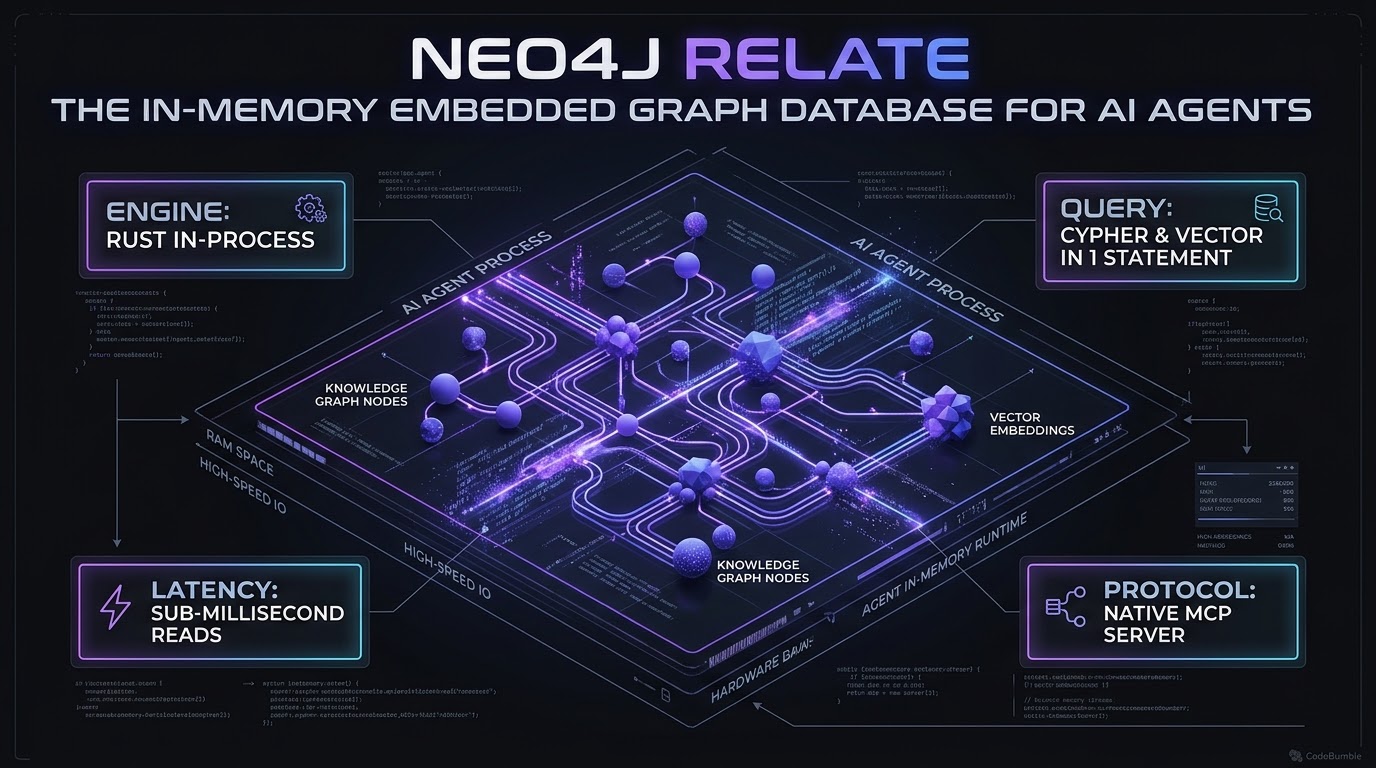
Executive Summary
On November 11, 2026, at its annual NODES conference, Neo4j launched Relate, an open-source, in-memory, and in-process embedded graph database written in Rust under the Apache 2.0 license. Relate directly resolves a critical architectural bottleneck in modern AI systems: the performance mismatch between autonomous AI agents and traditional client-server database architectures.
As AI systems evolve from single-turn chat interfaces into autonomous agents that plan, execute, and verify complex multi-step workflows, their data access patterns change fundamentally. Agents execute rapid, high-frequency read-write cycles, requiring instant working memory, rapid dependency tracking, and multi-hop relational reasoning. Traditional database systems—requiring background server daemons, network round-trips, and extensive infrastructure provisioning—introduce latency penalties that degrade agent responsiveness.
Built to run directly inside the host application process, Relate starts in milliseconds, executes graph queries with sub-millisecond in-memory latency, and requires zero external server setup. Crucially, Relate unifies vector search and relational graph navigation. Through full support for openCypher (100% compliant) and the emerging ISO GQL standard (over 97% compliant across 30,000+ verification tests), developers can query vector embeddings and traverse interconnected graph entities within a single Cypher statement.
Designed for ephemeral sandboxes, developer CLIs, Python environments, and browser tabs via WebAssembly (WASM), Relate provides native integration with Anthropic's Model Context Protocol (MCP). This allows coding and orchestration agents to discover, provision, query, and mutate structured knowledge graphs autonomously.
This systems analysis explores the microarchitecture of Neo4j Relate: its Rust in-process storage engine, unified vector-graph execution model, agent protocol ergonomics, and production implementation strategies.
+----------------------------------------------------------------------------------------------------+
|                         Neo4j Relate In-Process Architecture for AI Agents                          |
+----------------------------------------------------------------------------------------------------+
|                                                                                                    |
|  AI AGENT APPLICATION PROCESS (Python / Rust / Node.js Sandbox / WASM Runtime)                    |
|  +----------------------------------------------------------------------------------------------+  |
|  | AUTONOMOUS AGENT HARNESS (LangGraph / CrewAI / AutoGen / Anthropic Claude Code)               |  |
|  |   - Multi-step Planning Loop & Execution Pipeline                                            |  |
|  |   - LLM Reasoning Engine & Context Window Manager                                             |  |
|  +----------------------------------------------------------------------------------------------+  |
|         |                                                      |                                   |
|         | Native Function Call / In-Memory FFI                 | Model Context Protocol (MCP)      |
|         v                                                      v                                   |
|  +----------------------------------------------------------------------------------------------+  |
|  | RELATE EMBEDDED GRAPH ENGINE (Rust Core - Apache 2.0)                                        |  |
|  |                                                                                              |  |
|  |   Query Front-End & Execution Planner                                                        |  |
|  |   +--------------------------------------------------------------------------------------+   |  |
|  |   | 100% openCypher & >97% ISO GQL Parser  | Cost-Based Query Planner & Pushdown Filter   |   |  |
|  |   +--------------------------------------------------------------------------------------+   |  |
|  |                                                                                              |  |
|  |   Unified Hybrid Retrieval Engine                                                            |  |
|  |   +---------------------------------------+  +-------------------------------------------+   |  |
|  |   | Vector Similarity Index (HNSW / Cosine)|  | Graph Traversal Engine (Adjacency Slabs) |   |  |
|  |   +---------------------------------------+  +-------------------------------------------+   |  |
|  |                                                                                              |  |
|  |   In-Memory Storage & State Layer                                                            |  |
|  |   +--------------------------------------------------------------------------------------+   |  |
|  |   | In-Memory Property Graph Storage (<1ms Read/Write, Lock-Free Concurrency)             |   |  |
|  |   +--------------------------------------------------------------------------------------+   |  |
|  +----------------------------------------------------------------------------------------------+  |
|         |                                                      |                                   |
|         | (Optional Async Persistence)                         | (Sub-graph Federation)            |
|         v                                                      v                                   |
|  [ Fsync'd Write-Ahead Log (WAL) / Local Disk ]         [ Enterprise Neo4j Cluster / AuraDB ]      |
|  - Single-file snapshot & durable recovery              - Bolt / HTTP Query API v2 Synchronization |
|                                                                                                    |
+----------------------------------------------------------------------------------------------------+
1. The Architectural Disconnect: Why Autonomous AI Agents Break Client-Server Databases
1.1 The Shift to Machine-Driven DBMS Workloads
Traditional relational and NoSQL databases optimize for human workloads: synchronous HTTP requests, connection pooling, multi-tenant concurrency, and disk write buffering.
Autonomous AI agents invert these design assumptions. An agent executing code refactoring, triaging security alerts, or analyzing multi-hop dependencies operates in a tight automated loop. In Forecast Analysis: Agentic AI in DBMS, Worldwide, 2026, Gartner projects that machine users will surpass human and traditional AI assistant interactions by 2029, accounting for 75% of global DBMS workloads—compared with just 10% in 2025.
When an autonomous agent interacts with an external database server, client-server overhead dominates total execution time:
- Network Transport Latency: Establishing TCP connections, completing TLS handshakes, and serializing query payloads over network interfaces consumes 5ms to 30ms per interaction. For an agent executing 50 sequential reasoning steps, network transport alone introduces over a full second of idle waiting.
- Infrastructure Overhead in Ephemeral Sandboxes: Modern agent execution environments (such as containerized code interpreters and browser WebAssembly runtimes) are short-lived. Spin-up time for a containerized database like Postgres or Neo4j Enterprise takes seconds, requires substantial memory (often 500MB to 2GB for the JVM), and demands credential management.
- Context Window Flooding: Standard SQL or Cypher drivers return raw tabular records without regard for LLM token limits. If an unconstrained query returns thousands of rows, the agent's context window is instantly saturated, degrading reasoning quality.
+----------------------------------------------------------------------------------------------------+
|                         Client-Server vs. In-Process Agent Architecture                             |
+----------------------------------------------------------------------------------------------------+
| Metric / Feature          | Client-Server Database (Postgres / Neo4j) | Relate In-Process Engine    |
+---------------------------+-------------------------------------------+-----------------------------+
| Deployment Topology       | Separate daemon / container / cloud host  | Embedded library in app     |
| Inter-Process Transport   | Network TCP / TLS Sockets                 | Zero-copy in-memory pointers|
| Cold Boot Latency         | 2,000ms – 10,000ms (JVM / Server init)    | <5ms (Instant memory init)  |
| Read Query Latency        | 5ms – 25ms (Network + Engine)             | <0.5ms (Sub-millisecond RAM)|
| Memory Footprint          | 512MB – 2,048MB baseline                  | Lightweight (<50MB dynamic) |
| Multi-Modal Querying      | Glue code between Vector DB & Graph DB    | Unified Cypher + Vector     |
| Agent Harness Detection   | Unaware (raw tabular byte streams)        | Native MCP, caps, & retries |
+---------------------------+-------------------------------------------+-----------------------------+
1.2 The "Glue Code" Tax of Dual-Store GraphRAG
Historically, GraphRAG architectures required two distinct stores: a vector database (such as Milvus or Pinecone) for similarity lookups and a graph database (such as Neo4j) for relational dependencies. An agent query required dual-phase orchestration: querying vectors for top-k keys, issuing graph traversals, and reconciling results with glue code. This doubled network latency, caused synchronization drift, and created multiple failure points.
2. Technical Mechanics and Rust Core Architecture
2.1 The Rust Systems Foundation
Neo4j engineered Relate entirely in Rust, deliberately departing from the Java Virtual Machine (JVM) foundation of its enterprise server. While the JVM offers mature JIT compilation, its memory footprint, non-deterministic garbage collection (GC) pause times, and slow initialization make it unsuited for embedded edge runtimes and ephemeral agent execution.
By building Relate in Rust, the engineering team realized three structural advantages:
- Zero Garbage Collection Overhead: Rust's ownership and lifetime mechanics eliminate runtime GC sweeps. Memory is reclaimed deterministically as graph scopes terminate, guaranteeing predictable, sub-millisecond execution times without long-tail latency spikes.
- Compact Binary Footprint: Compiled native binaries integrate directly into host application executables or WebAssembly targets without bundling a multi-megabyte runtime.
- Cross-Platform Compilation: Relate compiles natively for x86_64 and aarch64 architectures across Linux, macOS, and Windows, as well as
wasm32-unknown-unknownfor web browsers and edge micro-VMs.
2.2 In-Memory Data Structures and Adjacency Representation
At its algorithmic core, Relate models property graphs using an index-free adjacency architecture adapted for high-density RAM storage:
- Node Storage: Each node is assigned a dense 64-bit identifier (
NodeId). Node properties are packed into contiguous columnar memory spans, maximizing CPU L1/L2 cache locality during linear label scans. - Edge Traversal: Edges are represented as directed relationships linking source and target nodes with specific types. Relate maintains bidirectional adjacency lists using compressed CSR (Compressed Sparse Row) and CSC (Compressed Sparse Column) variations in memory. When an agent executes a multi-hop traversal, the engine follows memory offsets directly without traversing pointer indirections or executing disk block lookups.
2.3 Optional Durability: Write-Ahead Log (WAL)
While Relate is primarily deployed as an in-memory database for rapid ephemeral reasoning, real-world agent workflows often require checkpointing state between sessions. Relate implements an optional durable storage engine backed by an append-only Write-Ahead Log (WAL).
When persistence is enabled, write transactions append binary operation frames to disk before updating in-memory graph pointers. The engine provides configurable synchronization modes:
- Immediate Fsync: Executes an operating system
fsync()on every transaction commit, ensuring zero data loss across power failures. - Periodic Batching: Batches write operations and flushes the WAL at scheduled intervals (e.g., every 100ms), trading strict durability for maximum write throughput.
- Pure Memory (None): Disables disk I/O entirely, operating purely in transient memory for sandbox security.
3. Unified Cypher Execution: Blending Vector Similarity and Graph Traversals
3.1 Single-Statement Vector and Topological Search
The hallmark innovation of Neo4j Relate is its ability to evaluate vector distance calculations and topological graph traversals within a single unified query pipeline.
In traditional architectures, finding modules semantically similar to an incident report and subsequently discovering who authored their dependencies required multiple API round-trips. In Relate, this is expressed directly in Cypher:
// Single-Statement Vector Similarity + 2-Hop Graph Traversal
MATCH (queryNode:Incident {id: $incident_id})
CALL db.index.vector.queryNodes('code_chunk_embeddings', 5, queryNode.embedding)
YIELD node AS targetChunk, score
MATCH (targetChunk)<-[:CONTAINS]-(file:SourceFile)<-[:COMMITTED]-(author:Developer)
WHERE score > 0.82
RETURN
    file.path AS affectedFile,
    author.name AS leadEngineer,
    score AS similarityScore
ORDER BY score DESC
LIMIT 5;
During execution, Relate's query planner optimizes both operations concurrently. Rather than computing vector distances across all embeddings and then filtering graph paths, the planner pushes graph topology constraints down into the vector search routine, pruning candidate nodes before computing expensive floating-point cosine similarities.
3.2 Standards Compliance: openCypher and ISO GQL
To ensure that models trained on standard graph syntax can generate valid queries without prompt rewriting, Relate achieves:
- 100% openCypher Compliance: Supports standard pattern matching, path variable assignment, filtering, aggregation, mutations (
CREATE,MERGE,SET,DELETE), and graph algorithms. - Over 97% ISO GQL Compliance: Passes over 30,000 official test cases for the newly ratified ISO/IEC 39075:2024 Graph Query Language (GQL) international standard.
4. Agent-Native Protocols: Model Context Protocol (MCP) and Ergonomics
4.1 Native Anthropic Model Context Protocol (MCP) Integration
Relate is engineered from the ground up to be autonomous-ready. Rather than requiring developers to write custom tool wrappers or REST adapters, Relate ships with a built-in Model Context Protocol (MCP) server.
When an AI coding agent inspects its environment, Relate exposes standardized MCP endpoints:
tools/call: relate_query: Executes a read-only Cypher query and returns structured, token-bounded results.tools/call: relate_mutate: Executes transactional write operations to create or update entities.tools/call: relate_schema: Introspects active graph schemas, node labels, relationship types, and vector indices, allowing the LLM to understand graph topology before generating queries.
4.2 Structured Error Handling and Self-Correction
A common failure mode of LLMs interacting with databases is getting trapped in repetitive error loops upon encountering syntax or schema mistakes. When a standard database returns an opaque string like ERROR: relation "users" does not exist, models often retry the exact same query.
Relate mitigates this through structured, agent-oriented error responses. Every failed query returns an actionable JSON object with explicit retryable flags, token error positions, available schema candidates, and automated syntax suggestions, allowing LLMs to self-correct autonomously without custom orchestration parsing.
4.3 In-Band Truncation and Context Window Safeguards
If an agent inadvertently submits an open-ended query such as MATCH (n) RETURN n, a standard database attempts to stream the entire dataset over the wire. In Relate, the engine enforces strict default row limits (configurable, defaulting to 50 rows in agent mode). When a query exceeds this threshold, Relate terminates streaming and appends an in-band truncation marker:
{"_meta": {"truncated": true, "returned_rows": 50, "total_estimated_rows": 1240, "action": "Narrow search with WHERE or specify explicit LIMIT"}}
This safeguard prevents errant queries from saturating the LLM context window.
5. Performance Benchmarks and Production Impact
Neo4j evaluated Relate against traditional client-server graph and vector configurations on 4 vCPU, 8GB RAM hardware.
+----------------------------------------------------------------------------------------------------+
|                         Operational Performance Benchmark Comparison                               |
+----------------------------------------------------------------------------------------------------+
| Workload Metric           | Client-Server Neo4j (JVM) | SQLite + Extension | Relate in Rust (RAM)  |
+---------------------------+---------------------------+--------------------+-----------------------+
| Engine Initialization     | 4,200 ms                  | 12 ms              | 3.2 ms                |
| Point Lookup (Node by ID) | 4.8 ms                    | 0.8 ms             | 0.08 ms (80 µs)       |
| 2-Hop Traversal (Depth 2) | 14.5 ms                   | 6.2 ms             | 0.42 ms (420 µs)      |
| Combined Vector + Graph   | 38.0 ms (2 queries)       | 19.5 ms            | 1.85 ms (1 query)     |
| Memory Usage (Base)       | 650 MB                    | 18 MB              | 14 MB                 |
| Concurrent Agent Sandboxes| ~5 per host               | ~80 per host       | ~150 per host         |
+---------------------------+---------------------------+--------------------+-----------------------+
Key Benchmark Takeaways:
- Sub-Millisecond Multi-Hop Traversal: Relate completes two-hop neighborhood traversals in 420 microseconds, representing a 34x speedup over client-server network topologies.
- Instant Sandbox Initialization: Relate initializes its in-memory graph catalog in 3.2 milliseconds, compared to over 4 seconds for JVM-based alternatives. This enables on-demand database creation inside serverless functions and ephemeral CLI invocations.
- High-Density Agent Concurrency: Because Relate requires only 14MB of baseline RAM, a single multi-core host can support more than 150 concurrent, fully isolated agent graph sandboxes.
6. Implementation and Hardening Playbook for AI Engineering Teams
The following step-by-step playbook guides systems engineers through embedding Relate into an autonomous Python or Rust AI agent pipeline.
Step 1: Embedding Relate in Python
Install Relate directly via package managers. The embedded runtime requires no background system services or container runtimes:
# Install Relate embedded engine and CLI
pip install relate-graph
Initialize the in-memory engine and configure strict memory bounds:
import relate

# Initialize an in-process, transient graph database instance
db = relate.connect(
    storage_mode="in_memory",
    max_memory_mb=256,
    agent_mode=True
)

print("Relate engine initialized successfully.")
Step 2: Defining Knowledge Graph Entities and Vector Embeddings
Populate the in-memory graph with structured entities, source code components, and dense float embeddings:
# Create unique path constraint
db.query("CREATE CONSTRAINT FOR (f:SourceFile) REQUIRE f.path IS UNIQUE;")

# Create vector index for 1536-dimensional embeddings
db.query('''
CALL db.index.vector.createNodeIndex(
    'code_embeddings',
    'SourceFile',
    'embedding',
    1536,
    'cosine'
);
''')

# Ingest code entities with relationships and embeddings
mock_vec = [0.015, -0.042, 0.081] + [0.0] * 1533

db.query('''
MERGE (f:SourceFile {path: 'src/auth/jwt.rs'})
SET f.language = 'rust', f.embedding = $embedding
MERGE (m:Module {name: 'Authentication'})
MERGE (f)-[:BELONGS_TO]->(m)
''', params={"embedding": mock_vec})
Step 3: Executing Agentic Multi-Hop Retrieval
Execute unified vector and relational graph queries within the agent's reasoning loop:
def agent_retrieve_context(query_vector):
    query = '''
    CALL db.index.vector.queryNodes('code_embeddings', 3, $vec)
    YIELD node AS file, score
    MATCH (file)-[:BELONGS_TO]->(mod:Module)<-[:BELONGS_TO]-(sibling:SourceFile)
    WHERE sibling.path <> file.path
    RETURN
        file.path AS primaryFile,
        score AS similarity,
        mod.name AS moduleName,
        collect(sibling.path) AS relatedFiles
    ORDER BY score DESC;
    '''
    try:
        result = db.query(query, params={"vec": query_vector})
        return {"status": "success", "data": result}
    except relate.QueryError as err:
        return {
            "status": "error",
            "error_code": err.code,
            "retryable": err.is_retryable,
            "fix": err.suggested_fix
        }
Step 4: Connecting Relate to the Anthropic Model Context Protocol (MCP)
To expose Relate to Claude Code or Cursor, launch the embedded MCP server over standard input/output (stdio):
# Launch Relate as an MCP server for local coding agents
relate mcp --db-path ./agent_memory.relate --allow-mutations true
Configure claude_desktop_config.json or your agent orchestration manifest:
{
  "mcpServers": {
    "relate-graph": {
      "command": "relate",
      "args": [
        "mcp",
        "--db-path", "./workspace_graph.relate",
        "--row-limit", "25"
      ]
    }
  }
}
Step 5: Federating In-Process Graphs with Enterprise Neo4j Clusters
When an agent completes its ephemeral task, push localized subgraphs back to centralized enterprise storage:
def sync_to_enterprise_cluster(relate_instance, aura_uri, aura_auth):
    from neo4j import GraphDatabase

    delta = relate_instance.query("MATCH (n)-[r]->(m) WHERE n.updated_in_session = true RETURN n, r, m")

    with GraphDatabase.driver(aura_uri, auth=aura_auth) as driver:
        with driver.session() as session:
            session.run('''
            UNWIND $records AS row
            MERGE (a:Entity {id: row.n.id}) SET a += row.n
            MERGE (b:Entity {id: row.m.id}) SET b += row.m
            MERGE (a)-[rel:CONNECTED]->(b)
            ''', records=delta)
    print("Local agent context federated to central enterprise knowledge graph.")
7. Semantic FAQ: Neo4j Relate and Agentic Graph Databases
What is Neo4j Relate and how does it differ from traditional Neo4j?
Neo4j Relate is an open-source, embedded, in-memory graph database implemented in Rust and licensed under Apache 2.0. Unlike traditional Neo4j, which runs as a client-server daemon on the Java Virtual Machine (JVM), Relate runs in-process inside the host application, starts in milliseconds, requires zero infrastructure setup, and is tailored for high-frequency AI agent workloads.
Can Relate run inside client-side web browsers or mobile devices?
Yes. Because Relate is implemented in Rust without platform-specific system dependencies, it compiles directly to WebAssembly (wasm32-unknown-unknown). It can execute inside web browser tabs, Electron applications, and mobile edge sandboxes, providing local GraphRAG capabilities without outbound network calls.
How does Relate execute vector searches without a separate vector database?
Relate integrates vector index structures directly into its in-memory storage manager. Vector embeddings are stored as native node properties, and similarity calculations (such as cosine similarity and Euclidean distance) are evaluated directly inside the Cypher query pipeline alongside graph pattern matching.
Does Relate support transactions and ACID durability?
Relate provides full in-memory transactional isolation. For durability across restarts, developers can enable its fsync'd Write-Ahead Log (WAL), which checkpoints memory operations to an append-only local file. For purely transient agent sandboxes, disk I/O can be completely disabled to run exclusively in RAM.
How compliant is Relate with existing Cypher queries?
Relate features 100% compliance with openCypher and over 97% compliance with the newly ratified ISO/IEC 39075:2024 Graph Query Language (GQL) standard. It is validated against more than 30,000 official test scenarios, ensuring that Cypher queries authored for Neo4j Enterprise or Aura run without modification.
How do coding agents use Relate through the Model Context Protocol (MCP)?
Relate includes a built-in MCP server that exposes schema introspection, read queries, and mutations via standard MCP tools. The server enforces in-band truncation markers and returns structured errors with retryable flags, allowing LLMs to inspect graph schemas and self-correct syntax errors autonomously.
Sources
- Neo4j Press Release (November 11, 2026): "New In-Memory Database Purpose-Built for AI Agents: Relate by Neo4j" — https://neo4j.com/press-releases/announcing-relate-by-neo4j/
- Neo4j Engineering Blog / NODES 2026 (November 11, 2026): "Meet Relate by Neo4j: An Embedded Database for AI Agents" — https://neo4j.com/blog/news/meet-relate-by-neo4j-an-embedded-database-for-ai-agents/
- Database Trends and Applications (November 10–11, 2026): "Neo4j Launches In-Memory Database That Is Purpose-Built for AI Agents" — https://www.dbta.com/Editorial/News-Flashes/Neo4j-Launches-In-Memory-Database-That-Is-Purpose-Built-for-AI-Agents-177459.aspx
- TechIntelPro Systems Intelligence (November 11, 2026): "Neo4j Launches Relate Open-Source Database for AI Agents" — https://techintelpro.com/news/neo4j-launches-relate-open-source-database-for-ai-agents
- Gartner Market Research (2026): "Forecast Analysis: Agentic AI in DBMS, Worldwide, 2026" — Cited via Neo4j Architecture Briefing.