

Automation
OpenTofu vs. Terraform: Production Trade-Offs for IaC Automation (2026)
An engineering comparison of OpenTofu 1.13.9 and Terraform 1.17.2 in late 2026 covering client-side state encryption, MPL-2.0 vs. BUSL-1.1 licensing, HCP Terraform resource pricing, and CI/CD pipeline migration.
10 min read
OpenTofu vs. Terraform: Production Trade-Offs for IaC Automation (2026)
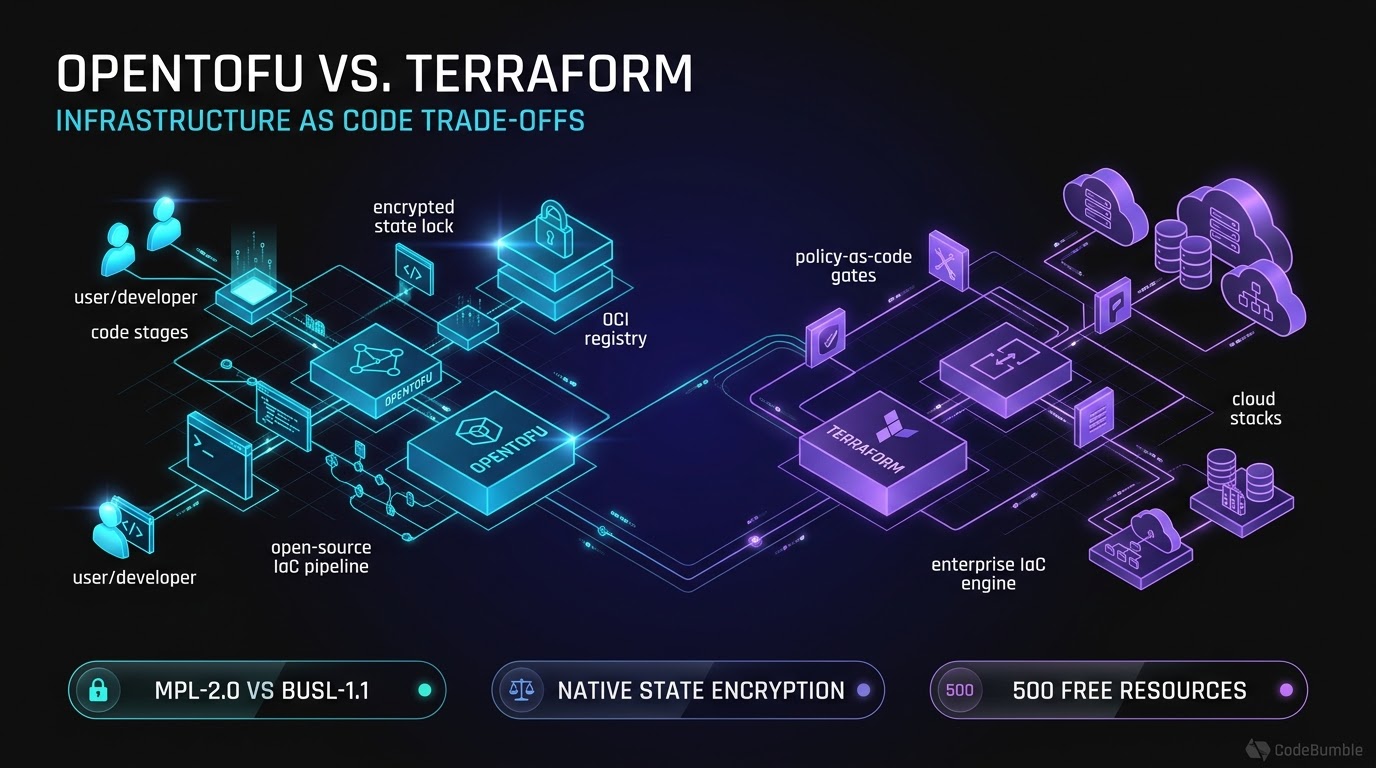
Evergreen Technical Guide — Verified against OpenTofu v1.13.9 and Terraform v1.17.2 as of November 28, 2026.
Three years after HashiCorp relicensed Terraform under the Business Source License (BUSL) v1.1 on August 10, 2023, the day-to-day question for platform and DevOps teams is no longer whether the OpenTofu fork will survive. Backed by the Linux Foundation with more than 30,000 GitHub stars and a steady release cadence, OpenTofu has reached its v1.13.x series, while Terraform—now part of IBM following the $6.4 billion acquisition that closed on February 27, 2025—is shipping v1.17.x.
For teams automating cloud infrastructure in CI/CD pipelines, both binaries still parse HashiCorp Configuration Language (HCL) and share the same core state file format. Yet meaningful architectural, security, and commercial differences have emerged across state encryption, planning flags, policy enforcement, and managed control-plane pricing.
Executive Summary
- License and governance divide: OpenTofu uses the OSI-approved Mozilla Public License (MPL) 2.0 under Linux Foundation stewardship, whereas Terraform uses BUSL-1.1 (converting to MPL-2.0 four years after each release), which restricts competing commercial products while permitting internal production use.
- Divergent engine capabilities: OpenTofu (
v1.7–v1.13.9) leads on client-side state and plan encryption, early variable/local evaluation in backend blocks, provider-levelfor_each,-excludeplanning, and OCI registry mirrors; Terraform (v1.14–v1.17.2) leads on-minimal-refresh, generally available Terraform Policy (-policies),listresources withterraform query,actionsblocks, and HCP Terraform Stacks. - Cost inflection at 500 resources: Both CLI binaries are free, so cost lives in the control plane—HCP Terraform caps its free tier at 500 managed resources (with one concurrent run) before charging $0.10 to $0.99 per resource per month, whereas runners like Spacelift and env0 price by worker concurrency or runs across either binary.
- Low-friction migration with clear boundaries: Switching standard HCL estates from Terraform to OpenTofu typically requires only installing the
tofubinary and runningtofu initagainst existing remote state, unless your pipelines depend on HCP Stacks, Sentinel,terraform query, oractionsblocks.
Core Mechanism and Feature Divergence
At the execution-graph level, OpenTofu (forked from Terraform 1.5.x and shipped as 1.6.0 GA on January 10, 2024) and modern Terraform still build a directed acyclic graph (DAG) of resources, data sources, and providers from HCL, reconcile desired state against remote state in S3, GCS, or Azure Blob Storage, and execute CRUD calls through the same provider plugin protocol. Most public providers and community modules work identically on both tools.
Where the two engines diverge is in how they handle state confidentiality, dynamic configuration, and fleet-scale planning.
flowchart LR
    A[HCL Config & Modules] --> B{Select IaC Engine}
    B -->|OpenTofu v1.13.9 MPL-2.0| C[Early Eval + State Encryption]
    C --> D[OCI Registry Mirrors / S3 Lock]
    D --> E[Third-Party Runner: Spacelift / env0 / GitHub Actions]
    B -->|Terraform v1.17.2 BUSL-1.1| F[-minimal-refresh + Terraform Policy]
    F --> G[Stacks / List Query / Actions]
    G --> H[HCP Terraform or Self-Hosted CI Runner]
What OpenTofu Added Since the Fork
According to the Encore 2026 IaC comparison and OpenTofu GitHub releases, OpenTofu prioritized long-standing community pain points that previously required external wrappers:
- Client-side state and plan encryption (
1.7+): OpenTofu encrypts state files and saved plan artifacts client-side before they ever touch S3, GCS, or local disk, using configurable key providers (such as PBKDF2, AWS KMS, GCP KMS, or OpenBao) declared directly in HCL. Inv1.13.8(late October 2026), maintainers also patched an edge-case panic when invalid encryption configurations are supplied (#4783). - Early variable and local evaluation (
1.8+): Teams can parameterizebackendblocks and module sources using variables and locals without resorting to Terragrunt orsedpre-processing scripts in CI. - Provider-level
for_eachand-exclude(1.9+): Multi-region and multi-account architectures can iterate over provider aliases cleanly withfor_each, and operators can exclude specific targets during incident recovery viatofu plan -exclude=...without editing HCL. - OCI registry distribution and
enabledmeta-argument (1.10–1.11): Modules and provider mirrors can be pulled directly from OCI container registries (1.10), alongside S3 native state locking without DynamoDB (1.10) and theenabledboolean meta-argument (1.11) as a cleaner alternative tocount = var.create ? 1 : 0. - Recent
v1.13.xhardening and experiments (Sep–Nov 2026):v1.13.0(September 30, 2026) added official Windows on ARM64 binaries, planning functions to reduce unknown values, an experimental built-in linter, and an experimental Symbol Libraries artifact for sharing values, functions, and type aliases. Subsequent patches inv1.13.2(October 21, 2026) andv1.13.9(mid-November 2026) fixed HTTP/2 CPU exhaustion duringtofu init(#4681), filtered compromised intermediate CA certificates (#4750), and resolved a local backend state persistence bug on first-apply crashes (#4811).
What Terraform Added Through v1.17.2
On the upstream side, Terraform's GitHub releases show HashiCorp and IBM focusing on enterprise governance, large-estate performance, and HCP Terraform integration:
- Terraform Policy GA (
v1.17.0, October 21, 2026): The-policiesflag forplan,apply, andquerygraduated to general availability without requiring experimental flags (#38970), evaluating both planned changes and discovered resources. -minimal-refreshand provider requirement expressions (v1.17.0): Teams with massive state files can pass-minimal-refresh(#35290) to refresh only resources with proposed changes, while module authors can use variables and locals inside provider requirement blocks (#39153).- Resource discovery and day-2 actions (
v1.14+): Terraform introducedlistblocks withterraform queryfor discovering unmanaged cloud resources andactionsblocks for imperative day-2 operations—features absent from OpenTofu.v1.17.2(November 11, 2026) further reduced memory allocations when generating configuration from large HCP Terraform queries (#39470). - Certificate and cycle hardening (
v1.16.7–v1.17.2): Terraformv1.16.7andv1.17.0moved to Go1.26.10, revoking trust in compromised eMudhra intermediate CAs (CVE-2026-111943,#39417), whilev1.17.1(October 28, 2026) fixed module policy evaluation during destroy plans (#39455).
Feature, Reliability, and Cost Comparison
The table below consolidates verified feature availability, licensing, and control-plane pricing across both engines as of November 2026, drawing on Encore's changelog audit, Qovery's 2026 IaC pricing analysis, and the official release feeds.
| Dimension | OpenTofu (v1.13.9) |
Terraform (v1.17.2) |
|---|---|---|
| License & Governance | MPL-2.0 (Linux Foundation) | BUSL-1.1 (IBM / HashiCorp; converts to MPL after 4 years) |
| Client-Side State & Plan Encryption | Built-in (1.7+) |
Not built-in (relies on backend SSE/KMS) |
| Early Eval in Backend Config | Supported (1.8+) |
Not supported |
Provider-Level for_each & -exclude |
Supported (1.9+) |
Not supported |
| S3 Native Locking (No DynamoDB) | Supported (1.10+) |
GA (1.11+) |
| Ephemeral Resources & Write-Only Attrs | Supported (1.11+) |
Supported (1.10–1.11+) |
| OCI Registry Provider/Module Mirrors | Supported (1.10+) |
Not supported |
Built-in Policy Flag (-policies) |
Experimental linting (1.13.0); uses OPA/Conftest |
GA in CLI (1.17.0) + Sentinel in HCP |
| Large-State Refresh Optimization | Standard refresh / -exclude |
-minimal-refresh (1.17.0) |
| Multi-Stack / Day-2 Primitives | None native (use Terragrunt/runners) | Stacks (HCP Terraform), list/query, actions (1.14+) |
| Managed Control-Plane Pricing | Free CLI; runners like env0 (250 runs free) or Spacelift (2 users/workers free) | HCP Terraform: Free up to 500 resources (1 concurrent run); then $0.10 / $0.47 / $0.99 per resource/mo |
Reliability, Failure Modes, and Cost Mechanics
Both tools share the fundamental architectural constraint of HCL-based IaC: state is point-in-time rather than continuously reconciled (unlike Kubernetes-native Crossplane). If a cloud console change drifts from state, neither tofu nor terraform notices until the next scheduled or PR-triggered plan.
Where operational failure modes differ is in state security and scaling cost:
- State secrets exposure: Standard Terraform state files store sensitive outputs and resource attributes in plaintext JSON inside the state file, relying on bucket-level server-side encryption (SSE-S3 or SSE-KMS). Any CI job or engineer with read access to the state bucket can read secrets unless you strictly adopt ephemeral resources (
1.10+) and write-only attributes (1.11+). OpenTofu's client-side state encryption (1.7+) adds defense-in-depth by ensuring the state file itself is ciphertext at rest and in transit to the backend, though teams must carefully manage KMS/passphrase availability in CI so a lost key never locks out recovery. - The 500-resource billing cliff: On March 31, 2026, HashiCorp retired HCP Terraform's older seat-based free tier in favor of resource-based metering. As documented in Qovery's 2026 pricing breakdown, HCP Terraform is free up to 500 managed resources with a single concurrent run. Beyond 500 resources—a threshold an average microservice + VPC + IAM + Kubernetes stack crosses quickly—costs scale linearly at $0.10 (Essentials), $0.47 (Standard), or $0.99 (Premium) per managed resource per month. At 2,000 managed resources on Standard, that is $940/month before adding extra concurrency. Self-hosted CI runners (GitHub Actions, GitLab CI) or binary-agnostic orchestrators like Spacelift and env0 avoid per-resource taxation regardless of whether you run
tofuorterraform. - Vendor and compliance posture: For internal engineering teams deploying their own workloads, BUSL-1.1 does not restrict internal production use; it restricts offering a competing hosted Terraform-as-a-service product. However, organizations building internal developer platforms exposed to external customers, or legal teams with strict OSI-approved license mandates, treat MPL-2.0 on OpenTofu as a hard requirement.
Practical Implementation and Migration Trade-Offs
For teams running Terraform today or starting a greenfield IaC repository, the safest engineering principle in 2026 is preserving optionality. Unless you explicitly commit to an exclusive feature, writing portable HCL keeps switching costs measured in hours rather than quarters.
Safe Migration Checklist (Terraform to OpenTofu)
If your estate uses standard HCL and remote S3/GCS/Azure state without HCP-exclusive features:
- Pin and verify provider parity: Audit
.terraform.lock.hcland confirm all required providers resolve cleanly fromregistry.opentofu.org(most MPL-licensed providers publish identically to both registries). - Test in a read-only CI stage first: Install
tofu(for examplev1.13.9) alongsideterraformin a non-mutating branch pipeline. Back up your remote state file, then run:
A clean exit codetofu init -upgrade=false tofu plan -detailed-exitcode0confirms zero unintended diffs against your existing state. - Adopt OpenTofu-only features intentionally: Keep
.tffile extensions and avoid.tofuoverrides,for_eachon providers, orenabledmeta-arguments until you are certain you will not need to roll back toterraform. - Enable state encryption at initialization: If migrating a greenfield stack to OpenTofu, configure the
encryptionblock in yourterraform {}settings on day one—retrofitting encryption onto an existing unencrypted state requires a carefulunencryptedfallback migration block. - Replace Sentinel if leaving HCP: Teams migrating off HCP Terraform typically pair OpenTofu with Open Policy Agent (OPA) / Conftest in CI or via Spacelift/env0 policy gates.
Decision Framework
- Choose OpenTofu (
v1.13.9) when your organization requires an OSI-approved MPL-2.0 license, wants native client-side state encryption, relies on dynamic backend configs or providerfor_each, or runs on self-hosted CI, Spacelift, or env0 to avoid per-resource SaaS fees above 500 resources. - Stay on Terraform (
v1.17.2) when procurement requires an IBM/HashiCorp enterprise support SLA, when your workflows already depend on HCP Terraform Stacks, Sentinel policies,terraform query, oractionsblocks, or when regulated vendor certifications explicitly mandate upstream Terraform. - Consider higher-level abstractions only if module maintenance—not the IaC binary—is your bottleneck. Even when pairing with Kubernetes-native reconciliation (Crossplane) or application-layer Infrastructure from Code (such as Encore), most platform teams still keep a thin OpenTofu or Terraform foundation stack for cloud accounts, IAM boundaries, DNS, and KMS keys.
Frequently Asked Questions
Can I switch from Terraform to OpenTofu without rewriting my HCL or migrating state?
Yes, for the vast majority of configurations. OpenTofu forked from Terraform 1.5.x and maintains the same HCL syntax and state file schema. If you do not rely on Terraform 1.14+ exclusive syntax (list/query, actions) or HCP Terraform Stacks, running tofu init and tofu plan against a backed-up remote state works as a drop-in swap.
Does Terraform's BUSL-1.1 license prohibit my company from using Terraform in production?
No. HashiCorp's BUSL-1.1 permits commercial and non-commercial internal use for deploying and managing your own infrastructure. The restriction targets third-party "competitive offerings" that embed or wrap Terraform to sell a competing hosted product.
What happens if I enable OpenTofu state encryption and later need to move back to Terraform?
Because upstream Terraform (v1.17.2) does not support OpenTofu's native client-side state encryption, Terraform cannot read an encrypted state file directly. Before switching back, you must configure a migration fallback in OpenTofu to write an unencrypted state snapshot, then transition the backend.
Why did HCP Terraform's pricing change in 2026 matter for small teams?
After HashiCorp retired its seat-based free tier on March 31, 2026, HCP Terraform's free tier became capped at 500 managed resources and one concurrent run. Once an infrastructure estate crosses 500 resources, paid plans bill per managed resource ($0.10 to $0.99/resource/month), which pushes growing teams toward OpenTofu with self-hosted CI or concurrency-priced runners like Spacelift and env0.
Which version of OpenTofu and Terraform should teams target in CI right now?
As of November 28, 2026, teams should pin v1.13.9 (or v1.12.12 on the prior line) for OpenTofu and v1.17.2 for Terraform. Both lines include recent security patches for compromised intermediate CA certificates and critical state/planning bug fixes.
Sources
- OpenTofu GitHub Releases (v1.13.0–v1.13.9, v1.12.7–v1.12.12) — Accessed November 28, 2026 (releases through mid-November 2026)
- HashiCorp Terraform GitHub Releases (v1.16.4–v1.17.2) — Accessed November 28, 2026 (v1.17.2 released November 11, 2026)
- OpenTofu vs Terraform in 2026: License, Features, and Migration — Encore — Updated November 5, 2026
- OpenTofu vs Terraform in 2026: What to Pick and 7 Options — Qovery — Published October 20, 2026; updated November 8, 2026